ICU Sedation, Delirium & Sleep
The 2025 SCCM Focused Update to the PADIS (Pain, Anxiety, Agitation/Sedation, Delirium, Immobility, Sleep) Guidelines updates the landmark 2018 guidelines with new evidence on sedation selection, melatonin, enhanced mobilization, and anxiety management. Bottom line: dexmedetomidine over propofol when targeting light sedation, melatonin for sleep, and enhanced mobilization/rehabilitation are now formally recommended.
🔍 Overview
What Is PADIS?
Pain • Anxiety/Agitation • Delirium • Immobility • Sleep Disruption, the five domains of ICU suffering that drive morbidity, mortality, and post-ICU syndrome.
2025 SCCM Focused Update vs 2018 PADIS, At a Glance
CHANGED Dexmedetomidine suggested over propofol when light sedation (RASS 0 to −2) or delirium reduction are priorities. 2018: no preference between the two non-benzodiazepine agents; both considered equivalent. Why it matters: a resident asked about sedation choice should now lead with dex when these goals apply, not "either is fine."
NEW 2025 Melatonin suggested for ICU patients (3–5 mg PO at bedtime). May improve sleep quality and reduce delirium incidence. 2018: no recommendation; melatonin was off-label and informal. Now guideline-supported.
EXPANDED Enhanced mobilization/rehabilitation over usual care, including in-bed cycling, early initiation, twice-daily sessions, protocol-driven approaches, or extended duration. 2018: early mobilization recommended in general terms; 2025 specifies what "enhanced" means and asks for an intensification beyond baseline ICU PT.
NEW 2025 Anxiety added as a sixth domain. No specific intervention strongly recommended yet; emphasis on assessment and acknowledgment as a distinct ICU stressor. 2018 PADIS = Pain, Agitation/Sedation, Delirium, Immobility, Sleep only. The acronym is sometimes now written PADIS-A.
CLARIFIED Antipsychotics for delirium: unable to make a recommendation for or against (insufficient evidence for benefit on duration, LOS, or mortality). 2018: weak conditional against routine use for prevention; 2025 reframes the treatment evidence gap explicitly. Clinical bottom line is unchanged: do not use antipsychotics to "treat" delirium, only for safety-threatening agitation.
UNCHANGED Avoid benzodiazepines for routine ICU sedation (worsen delirium); analgesia-first approach (treat pain before escalating sedation); ABCDEF bundle; RASS, CAM-ICU/ICDSC, CPOT/BPS as screening tools; non-pharmacologic prevention as first-line for delirium.
UNCHANGED All 2025 recommendations remain conditional with low-certainty evidence; individualize to each patient.
NEW 2025 Melatonin suggested for ICU patients (3–5 mg PO at bedtime). May improve sleep quality and reduce delirium incidence. 2018: no recommendation; melatonin was off-label and informal. Now guideline-supported.
EXPANDED Enhanced mobilization/rehabilitation over usual care, including in-bed cycling, early initiation, twice-daily sessions, protocol-driven approaches, or extended duration. 2018: early mobilization recommended in general terms; 2025 specifies what "enhanced" means and asks for an intensification beyond baseline ICU PT.
NEW 2025 Anxiety added as a sixth domain. No specific intervention strongly recommended yet; emphasis on assessment and acknowledgment as a distinct ICU stressor. 2018 PADIS = Pain, Agitation/Sedation, Delirium, Immobility, Sleep only. The acronym is sometimes now written PADIS-A.
CLARIFIED Antipsychotics for delirium: unable to make a recommendation for or against (insufficient evidence for benefit on duration, LOS, or mortality). 2018: weak conditional against routine use for prevention; 2025 reframes the treatment evidence gap explicitly. Clinical bottom line is unchanged: do not use antipsychotics to "treat" delirium, only for safety-threatening agitation.
UNCHANGED Avoid benzodiazepines for routine ICU sedation (worsen delirium); analgesia-first approach (treat pain before escalating sedation); ABCDEF bundle; RASS, CAM-ICU/ICDSC, CPOT/BPS as screening tools; non-pharmacologic prevention as first-line for delirium.
UNCHANGED All 2025 recommendations remain conditional with low-certainty evidence; individualize to each patient.
The ABCDEF Bundle
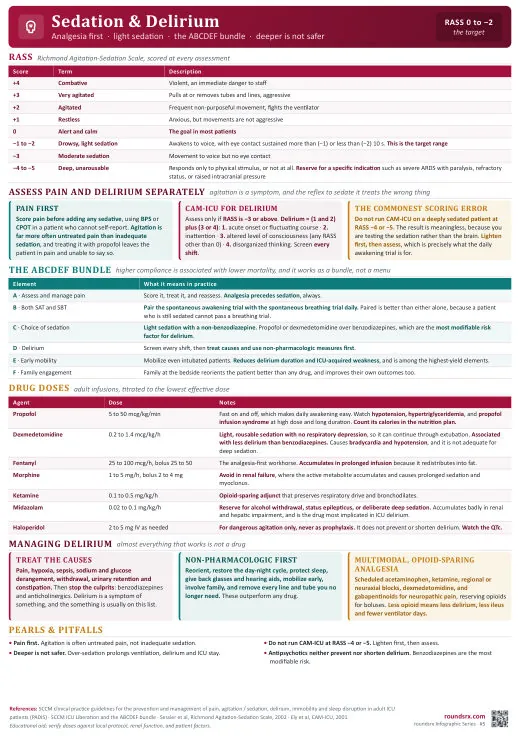
The ICU Liberation ABCDEF Bundle operationalizes PADIS at the bedside. Each element should be assessed daily:
| Letter | Element | Action |
|---|---|---|
| A | Assess/prevent/manage pain | CPOT or BPS q4h. Analgesia-first approach. |
| B | Both SAT + SBT | Daily sedation awakening trial + spontaneous breathing trial. |
| C | Choice of sedation | Dexmedetomidine or propofol. Avoid benzos. Target RASS 0 to −2. |
| D | Delirium assess/prevent/manage | CAM-ICU or ICDSC q8-12h. Non-pharmacologic prevention first. |
| E | Early mobilization | PT/OT within 48h of ICU admission when safe. |
| F | Family engagement | Open visitation, shared decision-making, emotional support. |
Key Scales
| Domain | Tool | Target |
|---|---|---|
| Pain | CPOT (Critical-Care Pain Observation Tool) or BPS | CPOT < 3, BPS < 5 |
| Sedation | RASS (Richmond Agitation-Sedation Scale) | RASS 0 to −2 (light sedation) |
| Delirium | CAM-ICU or ICDSC | CAM-ICU negative |
| Anxiety | No validated ICU-specific tool yet (2025 gap) | Assess clinically; consider nonpharmacologic interventions |
💤 Sedation
2025 Sedation Recommendations
Key Change: PADIS, 2025, Dexmedetomidine is now suggested over propofol for sedation in mechanically ventilated adults where light sedation (RASS 0 to −2) and/or delirium reduction are highest priorities.
| Recommendation | 2025 Status | vs 2018 | Clinical Notes |
|---|---|---|---|
| Dexmedetomidine over propofol when light sedation or delirium reduction are priorities | Suggested Conditional, low certainty | CHANGED 2018: no preference between dex and propofol | Dexmedetomidine may reduce delirium incidence and improve time at target RASS. Higher risk of bradycardia and hypotension. NOT appropriate for deep sedation (RASS −4/−5) or patients needing NMBAs, dex cannot achieve that depth. |
| Propofol remains appropriate for rapid on/off sedation or deep sedation | Niche preserved Not displaced, just not preferred when light sedation is the goal | UNCHANGED Still first-line when deep sedation or fast neuro-check turnaround is needed | Faster wake-up for neuro checks and SAT/SBT. Monitor triglycerides q48h, hypertriglyceridemia is dose-related. Propofol infusion syndrome (PRIS) risk if > 80 mcg/kg/min for > 48h, watch for unexplained metabolic acidosis, rhabdo, bradycardia. |
| Avoid benzodiazepines for routine ICU sedation | Avoid (routine) Conditional | UNCHANGED 2018 already against routine use | Associated with increased delirium (OR ~2–3x), longer MV duration, longer ICU stay, worse cognitive outcomes. Reserve for alcohol withdrawal (CIWA-guided), seizures, or benzodiazepine-dependent patients. |
| Analgesia-first approach | Recommended Conditional | UNCHANGED 2018 core principle, carried forward | Treat pain before escalating sedation. Fentanyl infusion as first-line. Many patients labeled "agitated" are actually in untreated pain, sedation alone treats the wrong problem. |
When to Choose What
| Clinical Scenario | Preferred Agent | Rationale |
|---|---|---|
| Light sedation target (RASS 0 to −2) | Dexmedetomidine | Less delirium, preserves respiratory drive, cooperative sedation |
| Deep sedation needed (NMBAs, proning) | Propofol ± fentanyl | Titratable, rapid on/off. Dex inadequate for RASS −4/−5 |
| Neuro checks needed frequently | Propofol | Fastest wake-up time for neurological assessment |
| Hemodynamically unstable / bradycardia risk | Propofol or fentanyl | Dex causes bradycardia and hypotension; avoid in shock |
| Alcohol withdrawal / seizure risk | Benzodiazepine (CIWA-guided) | Only appropriate indication for benzo ICU sedation |
| Post-extubation agitation / anxiety | Dexmedetomidine low-dose | Preserves airway reflexes; anxiolytic without respiratory depression |
Daily Sedation Awakening Trial (SAT)
Protocol: Hold sedation each morning → assess RASS → if patient tolerates (RASS −1 to +1 without distress) → proceed to SBT. If agitation/distress → restart at 50% previous dose and titrate. ABC Trial, 2008: paired SAT + SBT reduced ventilator days by 3.1 days and 1-year mortality by 14%.
🧠 Delirium
Delirium: 2025 Update
2025 Key Finding: The PADIS task force was unable to recommend for or against antipsychotics for ICU delirium. Current evidence shows minimal or no effect on ICU/hospital length of stay. Focus on non-pharmacologic prevention first.
CAM-ICU Screening (Assess q8-12h)
| Feature | Assessment | Positive If |
|---|---|---|
| 1. Acute onset / fluctuating course | Change from baseline OR fluctuating mental status in past 24h? | Yes |
| 2. Inattention | Squeeze my hand when I say "A", S-A-V-E-A-H-A-A-R-T | < 8/10 correct (errors > 2) |
| 3. Altered consciousness | RASS score at time of assessment | RASS ≠ 0 (any score other than alert/calm) |
| 4. Disorganized thinking | "Will a stone float on water?" "Are there fish in the sea?" + command | < 4/5 correct |
CAM-ICU positive = Feature 1 + Feature 2 + (Feature 3 OR Feature 4). Sensitivity ~80%, specificity ~96%.
Prevention (Non-Pharmacologic), First-Line
- Reorientation, clock, calendar, whiteboard with date/names/plan
- Sleep hygiene, lights off at night, minimize nighttime vitals/labs, ear plugs, eye masks
- Early mobilization, PT/OT within 48h, dangle/chair/walk when safe
- Minimize deliriogenic meds, avoid benzos, anticholinergics, opioid excess
- Correct sensory deficits, glasses, hearing aids at bedside
- Family presence, familiar voices reduce agitation and disorientation
- Music therapy, familiar music may reduce anxiety and agitation
- Melatonin, now formally suggested PADIS, 2025
Pharmacologic Management
| Drug | Dose | Evidence | 2025 vs 2018 |
|---|---|---|---|
| Haloperidol (Haldol) | 0.5–2 mg IV/IM q4-6h PRN | HOPE-ICU, 2013 and MIND-USA, 2018: no benefit on delirium duration, coma-free days, or mortality. AID-ICU, 2022 reinforced no mortality benefit. | CLARIFIED 2025: no recommendation for or against. 2018: weak conditional against routine use for prevention. Clinical bottom line unchanged, only for safety-threatening agitation, not as a delirium "treatment." |
| Quetiapine (Seroquel) | 25–200 mg PO BID | Limited evidence, may reduce delirium duration in small trials. Preferred when haldol contraindicated (Parkinson's, Lewy body dementia). | CLARIFIED 2025: no recommendation for or against, same as 2018. Use only when antipsychotic is genuinely needed. |
| Dexmedetomidine | 0.2–1.5 mcg/kg/hr IV | MENDS, 2007: more delirium-free and coma-free days vs lorazepam. SEDCOM, 2009: less delirium (54% vs 76.6%) and shorter time to extubation vs midazolam. DahLIA, 2016: faster resolution of agitated delirium. | ELEVATED 2025: suggested over propofol when light sedation or delirium reduction prioritized. 2018: dex and propofol considered equivalent. |
| Melatonin | 3–5 mg PO at bedtime | Low-risk intervention. May improve sleep quality and reduce delirium incidence. Note: not FDA-regulated, brand-to-brand variability in bioavailability. | NEW 2025 2018: no recommendation, off-label use only. Now formally suggested. |
Avoid: Benzodiazepines for delirium treatment (worsen delirium). Physical restraints should be minimized, they increase agitation and prolong delirium. QTc monitoring required for all antipsychotics.
🏃 Mobility & Sleep
Enhanced Mobilization (2025 Recommendation)
New: PADIS, 2025, Enhanced mobilization/rehabilitation is suggested over usual care. Enhancements include cycling, early initiation, twice-daily sessions, protocol-driven approaches, or extended duration.
Mobilization Levels
| Level | Activity | When |
|---|---|---|
| 0 | Passive ROM in bed | Hemodynamically unstable, on NMBAs, high FiO₂ |
| 1 | Active-assisted ROM in bed, bed exercises | On vasopressors but stable, mechanical ventilation |
| 2 | Sitting on edge of bed (dangle) | RASS ≥ −2, FiO₂ ≤ 0.6, vasopressors weaning |
| 3 | Standing, transfer to chair | Cooperative, stable vitals, able to follow commands |
| 4 | Ambulation (with or without assist) | Off vasopressors, tolerating lower vent support or extubated |
Safety Screen Before Mobilization
- MAP < 60 or > 110, or new/escalating vasopressors
- Active cardiac ischemia or unstable arrhythmia
- SpO₂ < 88% on current settings
- Active seizures, raised ICP, or unstable spine
- Active hemorrhage or unsecured airway
- Patient refusal or extreme distress
Sleep Disruption
New: PADIS, 2025, Melatonin is now suggested for ICU patients. Low-risk intervention that may improve sleep quality and reduce delirium. Note: not FDA-regulated, so quality may vary between brands.
ICU Sleep Bundle
- Environmental: Dim lights 10 PM–6 AM, minimize alarms, cluster care to allow 4h uninterrupted sleep
- Pharmacologic: Melatonin 3–5 mg PO at 9 PM. Avoid benzos and zolpidem (worsen delirium)
- Ventilator: Optimize settings to minimize discomfort/dyssynchrony at night
- Sensory: Offer ear plugs and eye masks (shown to improve sleep quality in RCTs)
- Minimize nocturnal interruptions: Avoid routine 2 AM vitals/labs unless clinically indicated
💊 Medications
ICU Sedation & Analgesia Dosing
| Drug | Dose | Onset | Key Points |
|---|---|---|---|
| Fentanyl (Sublimaze) | 25–200 mcg/hr IV infusion | 1–2 min | First-line analgesia. Less hypotension than morphine. Accumulates in renal/hepatic failure. |
| Dexmedetomidine (Precedex) | 0.2–1.5 mcg/kg/hr IV | 5–10 min | PADIS 2025 preferred for light sedation. Bradycardia risk. No respiratory depression. Anxiolytic. |
| Propofol (Diprivan) | 5–50 mcg/kg/min IV | 30–60 sec | Fastest wake-up. Monitor TGs q48h. Propofol infusion syndrome (PRIS) risk if > 80 mcg/kg/min > 48h. Best for neuro checks. |
| Midazolam (Versed) | 0.02–0.1 mg/kg/hr IV | 2–3 min | Avoid for routine sedation (↑ delirium). Reserve for alcohol withdrawal/seizures. Accumulates. |
| Ketamine | 0.1–0.5 mg/kg/hr IV | 1–2 min | Opioid-sparing analgesic. Useful in refractory pain or bronchospasm. Emergence reactions. |
| Melatonin | 3–5 mg PO at bedtime | 30–60 min | PADIS 2025 new recommendation. Sleep promotion. May reduce delirium. Not FDA-regulated. |
| Haloperidol (Haldol) | 0.5–2 mg IV/IM q4-6h PRN | 10–20 min | No PADIS recommendation for delirium. QTc monitoring. Risk of EPS. Use only for acute safety threats. |
Hypersalivation / Sialorrhea
Common in the ICU from ketamine infusions, clozapine, bulbar dysfunction (stroke, ALS, post-extubation weakness), or simply an inability to clear pooled oropharyngeal secretions. Listed most common to least common.
| Drug | Dose | Key Points |
|---|---|---|
| Glycopyrrolate (Robinul) | 0.1–0.2 mg IV q4–6h PRN, or 1–2 mg PO/NG TID | First-line in ICU. Does not cross the blood-brain barrier, so no delirium risk (unlike IV atropine or scopolamine). Workhorse for ketamine infusions, clozapine drooling, and post-extubation secretions. |
| Atropine 1% ophthalmic drops | 1–2 drops sublingual q4–6h | Off-label but cheap and effective. Minimal systemic absorption. Useful when the patient cannot swallow pills. |
| Scopolamine patch (Transderm Scōp) | 1.5 mg transdermal q72h | Convenient sustained effect but 6–12 h to onset. Avoid in elderly or already delirious patients (CNS anticholinergic effects). |
| Hyoscyamine (Levsin) | 0.125 mg SL q4h PRN | Alternative when glycopyrrolate is unavailable. |
| Ipratropium | 500 mcg nebulized q6h, or SL | Reserve for refractory cases or when other routes are limited. |
| Botulinum toxin (parotid / submandibular injection) | Ultrasound-guided by ENT or neurology | Chronic or refractory sialorrhea only (bulbar ALS, Parkinson, cerebral palsy). Effect lasts ~3 months. |
Address the cause: Ketamine infusion: glycopyrrolate premedication is standard. Clozapine: dose reduction or scheduled glycopyrrolate (do not abruptly stop clozapine). Organophosphate toxicity: atropine plus pralidoxime (different problem). Bulbar / neuro: glycopyrrolate plus Yankauer suction, head of bed up, swallow evaluation.
Watch for anticholinergic load: urinary retention, ileus, tachycardia, delirium, dry eyes. Stack carefully if the patient is already on other anticholinergics.
Watch for anticholinergic load: urinary retention, ileus, tachycardia, delirium, dry eyes. Stack carefully if the patient is already on other anticholinergics.
📋 On Rounds
Pimp Questions
What sedation agent does PADIS 2025 suggest over propofol, and when?
Dexmedetomidine is suggested over propofol when light sedation (RASS 0 to −2) and/or delirium reduction are the highest priorities. It reduces delirium incidence but carries higher risk of bradycardia. NOT appropriate for deep sedation or hemodynamic instability.
Does PADIS 2025 recommend antipsychotics for ICU delirium?
No. The task force was unable to issue a recommendation for or against antipsychotics for delirium treatment. MIND-USA, 2018 and other trials show minimal or no effect on ICU/hospital LOS. Focus on non-pharmacologic prevention: reorientation, sleep hygiene, early mobilization, minimizing deliriogenic meds.
What is the ABCDEF bundle and why does it matter?
A = Assess/prevent/manage pain, B = Both SAT + SBT daily, C = Choice of sedation (dex or propofol, avoid benzos), D = Delirium assess/prevent/manage, E = Early mobilization, F = Family engagement. Operationalizes PADIS guidelines at the bedside. Bundle compliance associated with lower mortality, less delirium, and shorter ICU stays.
When is propofol preferred over dexmedetomidine?
When deep sedation is required (RASS −4/−5 for NMBAs or proning), when frequent neuro checks need rapid wake-up, or when the patient has hemodynamic instability or bradycardia risk. Dex cannot achieve deep sedation and may worsen hypotension/bradycardia.
What does PADIS 2025 say about melatonin in the ICU?
Melatonin is now conditionally suggested for ICU patients (3–5 mg PO at bedtime). It is a low-risk intervention that may improve sleep quality and reduce delirium incidence. Caveat: melatonin is not FDA-regulated, so quality and bioavailability may vary between brands. Optimal dosing is still being studied.
Why should you avoid benzodiazepines for routine ICU sedation?
Benzodiazepines are independently associated with increased delirium (OR ~2–3x), longer duration of mechanical ventilation, longer ICU stay, and worse cognitive outcomes. PADIS, 2018 recommended non-benzodiazepine sedation. The only appropriate ICU indications are alcohol withdrawal (CIWA-guided), active seizures, and benzodiazepine-dependent patients.
What enhanced mobilization strategies does PADIS 2025 suggest?
Enhanced mobilization includes: in-bed cycling, early initiation (within 48h), twice-daily sessions, protocol-driven approaches, or extended duration of mobility. Schweickert, 2009: early PT/OT improved functional independence and reduced delirium duration. Goal is to mitigate ICU-acquired weakness and its long-term impact on survival and quality of life.
Daily ICU Sedation Checklist
- RASS score, Current? At target (0 to −2)?
- Pain assessment, CPOT/BPS. Analgesia adequate before sedation adjustment?
- CAM-ICU, Delirium screen this shift?
- SAT eligibility, Can we hold sedation today?
- SBT eligibility, If SAT passed, ready for breathing trial?
- Mobilization, What level today? PT/OT ordered?
- Sleep, Melatonin ordered? Nighttime interruptions minimized?
- Deliriogenic meds, Can we stop benzos, anticholinergics, unnecessary opioids?
- Family, Visitation plan? Family meeting needed?
📋 Sample Presentation
"Mrs. Chen is on ICU day 3, intubated for ARDS. Sedation: dexmedetomidine at 0.8 mcg/kg/hr with fentanyl 75 mcg/hr. RASS is −1, at our target. CAM-ICU was negative this morning. We did a SAT, she tolerated the sedation hold and proceeded to an SBT, which she passed. Plan is to extubate today. PT had her dangling yesterday. Melatonin 3 mg at bedtime. No benzodiazepines. Family has been at bedside with open visitation."
Related Topics
Acute Decompensated Heart FailureAcute Exacerbation of COPD (AECOPD)Acute Ischemic StrokeAcute Mesenteric IschemiaAcute PancreatitisAirway & Ventilator Management