Acid-Base Disorders
| pH | Primary Process |
|---|---|
| < 7.35 | Acidemia (acidosis is the dominant process) |
| 7.35–7.45 | Normal (or mixed disorder with complete compensation) |
| > 7.45 | Alkalemia (alkalosis is the dominant process) |
| If pH < 7.35 (acidemia) | If pH > 7.45 (alkalemia) |
|---|---|
| PCO₂ > 40 → respiratory acidosis (hypoventilation) | PCO₂ < 40 → respiratory alkalosis (hyperventilation) |
| HCO₃ < 22 → metabolic acidosis | HCO₃ > 26 → metabolic alkalosis |
| Primary Disorder | Expected Compensation |
|---|---|
| Metabolic acidosis | Winter's formula: expected PCO₂ = 1.5 × [HCO₃] + 8 (± 2). If actual PCO₂ ≠ expected → additional respiratory disorder. |
| Metabolic alkalosis | Expected PCO₂ = 0.7 × [HCO₃] + 21 (± 2). Or: PCO₂ rises ~0.7 for each 1 mEq/L rise in HCO₃. |
| Acute respiratory acidosis | HCO₃ rises 1 per 10 mmHg ↑ PCO₂ |
| Chronic respiratory acidosis | HCO₃ rises 3.5–4 per 10 mmHg ↑ PCO₂ |
| Acute respiratory alkalosis | HCO₃ falls 2 per 10 mmHg ↓ PCO₂ |
| Chronic respiratory alkalosis | HCO₃ falls 4–5 per 10 mmHg ↓ PCO₂ |
| Cause | Mechanism |
|---|---|
| M ethanol | Alcohol dehydrogenase converts methanol to formic acid, which inhibits cytochrome oxidase and damages the retina (optic disc edema, blindness). Treat with fomepizole + dialysis. |
| U remia | Failing kidneys cannot excrete sulfates, phosphates, urate, and other organic anions. Develops at GFR < 20. |
| D KA (also alcoholic KA, starvation KA) | Insulin deficiency (or alcohol-induced NADH excess) drives lipolysis and hepatic ketogenesis. Accumulating β-hydroxybutyrate and acetoacetate are the unmeasured anions. |
| P ropylene glycol | Solvent in IV lorazepam, phenobarbital, and diazepam infusions. Metabolized by alcohol dehydrogenase to lactic acid. Classic iatrogenic ICU cause after high-dose benzo drips. |
| I soniazid / Iron | INH depletes pyridoxine (B6) and inhibits GABA synthesis → refractory seizures + lactic acidosis. Treat with high-dose pyridoxine 1:1 (g per g of INH ingested). Iron OD disrupts mitochondrial oxidative phosphorylation → lactate. |
| L actic acidosis #1 cause in hospital | Type A: tissue hypoperfusion or hypoxia (sepsis, shock, ischemia, severe anemia, CO poisoning). Type B: drugs (metformin, linezolid, propofol, NRTIs, β2 agonists), liver failure, malignancy (Warburg effect), thiamine deficiency, D-lactic from short bowel. See full breakdown in Differentials tab. |
| E thylene glycol | Antifreeze. Metabolized to glycolic acid (AG acidosis) and oxalic acid (calcium oxalate crystalluria → AKI). Treat with fomepizole + dialysis. Bedside clues: oxalate crystals in urine, fluorescence under Wood's lamp (some products). |
| S alicylates | Uncouples mitochondrial oxidative phosphorylation → AG acidosis. Also directly stimulates the medullary respiratory center → early respiratory alkalosis. The classic mixed disorder (AGMA + resp alkalosis) is the giveaway. Tinnitus is the bedside tell. |
| Cause | Mechanism |
|---|---|
| H yperalimentation (TPN) | Cationic amino acids (lysine, arginine, histidine) in TPN generate HCl as they are metabolized. Modern TPN includes acetate buffer to offset this; classic boards still tests it. |
| A ddison's / Acetazolamide | Addison's (adrenal insufficiency): low aldosterone → impaired distal H+ and K+ excretion (mimics Type 4 RTA, hyperK). Acetazolamide: blocks proximal carbonic anhydrase → bicarbonate wasted in urine. |
| R TA | Type 1 (distal): α-intercalated cells cannot secrete H+ → urine pH > 5.5, hypoK, kidney stones (Sjögren, SLE). Type 2 (proximal): impaired HCO3- reabsorption → Fanconi syndrome, hypoK. Type 4: hypoaldosteronism (DM, ACEi/ARB, TMP-SMX, heparin, spironolactone) → hyperK. Most common RTA. |
| D iarrhea #1 cause of NAGMA | Direct loss of bicarbonate-rich small bowel and colonic secretions. Urine AG is negative (kidneys appropriately excrete NH4+), distinguishing it from RTA. |
| U reteral diversion (ileal conduit, ureterosigmoidostomy) | Bowel mucosa exchanges urinary Cl- for HCO3-. The longer the urine sits in contact with bowel, the more HCO3- is lost. |
| P ost-hypocapnia / Pancreatic fistula | Post-hypocapnia: chronic respiratory alkalosis caused renal HCO3- wasting as compensation; when PaCO2 abruptly normalizes (e.g., post-intubation), bicarb is now inappropriately low. Pancreatic fistula or biliary drain: direct loss of HCO3-rich secretions. |
| S aline (NS resuscitation) | Large-volume 0.9% NS delivers a Cl- load that displaces HCO3- extracellularly = hyperchloremic dilutional acidosis. Switch to LR or PlasmaLyte for ongoing resuscitation. SMART 2018 |
| Cause | Mechanism and Why It Matters |
|---|---|
| Laboratory error Most common cause | A small error in any of three measured values moves the gap directly (a Cl reported 4 high lowers the gap by 4). Repeat the panel before chasing a diagnosis, especially when the gap is negative and nothing else fits. |
| Hypoalbuminemia Most common real cause | Albumin is the main unmeasured anion. The gap falls about 2.5 mEq/L for every 1 g/dL fall in albumin, and chloride rises to fill the space. Cirrhosis, nephrotic syndrome and critical illness routinely drop the baseline, so always correct: a "normal" gap of 12 with albumin 2.0 is really about 17 and hides a gap acidosis. |
| IgG paraprotein (multiple myeloma) and polyclonal gammopathy (cirrhosis, HIV, CKD) | IgG has an isoelectric point above physiologic pH, so it circulates positively charged and acts as an unmeasured cation balanced mainly by chloride. IgA can do the opposite and raise the gap; IgM has no consistent effect. The gap was low in only ~22% of IgG gammopathies, so it cannot screen for myeloma, but an unexplained low gap earns an SPEP with immunofixation. Very high protein can also under-read sodium (below). |
| Salicylate (pseudohyperchloremia) | Salicylate is read as chloride by many chloride ion-selective electrodes, and it is now the most common cause of pseudohyperchloremia. The error grows with the salicylate level and the age of the electrode, and can produce a very small or negative gap that conceals the high-gap acidosis of salicylate poisoning. A low gap never excludes salicylate toxicity: send a level whenever the story fits. |
| Bromide and iodide (pseudohyperchloremia) | Halides are read as chloride, most markedly by ion-selective electrodes (colorimetric methods are affected too). This produces the most profoundly negative gaps (one case of bromism reported a gap of −65). Suspect bromism when a negative gap arrives with confusion, ataxia or psychosis, and ask the lab to measure chloride by another method. |
| Pseudohyponatremia (severe hypertriglyceridemia, marked hyperproteinemia) and sodium above the assay limit | Indirect ion-selective electrodes dilute the sample, so a large lipid or protein fraction makes sodium read falsely low and the gap with it. Direct potentiometry (the blood gas analyzer) gives the true sodium. Sodium above the analyzer's upper limit (often ~170) is also under-reported. |
| Lithium (severe toxicity) | Lithium is an unmeasured cation balanced by chloride and bicarbonate, while only sodium enters the formula. It needs very high levels to matter (a gap of −2 at lithium 14.5 mmol/L in one case), so a therapeutic level does not move the gap, but a low gap in a lithium user is a reason to check the level urgently. |
| Marked hyperkalemia, hypercalcemia, hypermagnesemia | More unmeasured cations push chloride up. The effect is usually small, and the cation itself is visible on the panel, so this is rarely the diagnostic question. |
| Polymyxin B | A polycationic antibiotic that lowers the gap by roughly 1–2.5 mEq/L. Worth knowing so a small drop on therapy is not over-read. |
| Ratio | Interpretation | What To Do |
|---|---|---|
| < 0.4 | Essentially a pure non-AG (hyperchloremic) acidosis (the bicarb fell but almost none of it is accounted for by unmeasured anions, so the gap is not the story -think diarrhea, saline, RTA) | Replace the bicarbonate. This is the one band where alkali is genuinely therapeutic, because chloride is not metabolizable, so the lost bicarbonate will never regenerate itself the way lactate and ketones do. Switch large-volume 0.9% NS to a balanced crystalloid (LR, Plasma-Lyte) and replace ongoing GI losses. For RTA, oral alkali (sodium bicarbonate or citrate), with K repletion in types 1 and 2 (both waste potassium, and alkali therapy drives it lower still) and attention to hyperkalemia in type 4. |
| 0.4–1 | AG metabolic acidosis + concurrent non-AG metabolic acidosis (the bicarb dropped more than expected from the AG alone → additional acid or bicarb loss) | Treat the gap cause, which is the dangerous half, but expect the bicarbonate to stay low after it clears. The classic case is DKA resuscitated with large-volume saline: the ketones clear while the chloride load holds the bicarbonate down. Follow beta-hydroxybutyrate, not the bicarbonate, so the insulin drip is not run on against an acidosis that is now chloride rather than ketones. The same logic applies to a diarrheal illness layered on a lactic acidosis. |
| 1–2 | Pure AG metabolic acidosis (the drop in bicarb matches the rise in AG, because a pure gap acidosis consumes one bicarbonate for each unmeasured anion added) | Treat the cause and do not reach for bicarbonate. Lactate and ketones are metabolized back to bicarbonate once the process stops, so the acidosis self-corrects while alkali only buys overshoot alkalosis, ionized hypocalcemia and a sodium load. Insulin and fluids for DKA; perfusion and source control for lactic acidosis; fomepizole plus dialysis for toxic alcohols; thiamine before glucose in alcoholic ketoacidosis (glucose alone can precipitate Wernicke). Reserve bicarbonate for severe acidemia, where the signal is confined to AKI. BICAR-ICU, 2018 |
| > 2 | AG metabolic acidosis + concurrent metabolic alkalosis (vomiting, diuretics, bicarb administration), or a pre-existing chronic respiratory acidosis. Both mean the same thing mathematically: the baseline bicarb was already above 24, so measuring the fall from 24 understates it. | Name the second process before treating either, because the pH can sit near normal while both are severe, and correcting the acidosis alone unmasks the alkalosis. Vomiting or NG suction: 0.9% NS with KCl, since the deficit is chloride and potassium, not free water. Diuretics: hold or reduce. Exogenous bicarbonate: stop it. If instead this is a chronic CO₂ retainer, do not normalize the PaCO₂ quickly -renal compensation takes days to unwind, so you are left with a post-hypercapnic metabolic alkalosis and a suppressed respiratory drive. |
| Cause | Mechanism |
|---|---|
| C ontraction (volume depletion) SALINE-RESP | Loss of Cl⁻-rich extracellular fluid (vomiting, diuretics, sweating) makes the proximal tubule reabsorb Na⁺ paired with HCO3- instead of Cl⁻. Volume contraction also activates RAAS → aldosterone drives distal H⁺ secretion. Together: rising and maintained HCO3-. |
| L icorice (glycyrrhizic acid) SALINE-RESIST | Inhibits renal 11β-HSD2, which normally inactivates cortisol to cortisone in the collecting duct. Unopposed cortisol activates the mineralocorticoid receptor → apparent mineralocorticoid excess (Na retention, K⁺ and H⁺ wasting). Mimics primary hyperaldosteronism but with low renin AND low aldosterone. |
| E ndocrine (Conn's, Cushing's, Bartter, Gitelman) SALINE-RESIST | Conn's: autonomous aldosterone → distal Na/K and Na/H exchange. Cushing's: excess cortisol overwhelms 11β-HSD2. Bartter: defective NKCC2 in TAL = "endogenous loop diuretic" (hypoK, hypoCl, alkalosis, normal BP). Gitelman: defective NCC in DCT = "endogenous thiazide" (adds hypoMg). |
| V omiting / NG suction SALINE-RESP Common | Direct loss of HCl from gastric secretions raises serum HCO3- (every H⁺ lost = one HCO3- generated). Concurrent volume and Cl⁻ depletion add a contraction component, perpetuating the alkalosis until both are repleted. |
| E xcess alkali SALINE-RESP | Direct HCO3- load: IV sodium bicarbonate, milk-alkali syndrome (CaCO3 antacids + milk → hyperCa, AKI, alkalosis; full breakdown in Hypercalcemia topic), massive transfusion (citrate metabolized to bicarb by the liver), TPN with acetate buffer overload. |
| R efeeding SALINE-RESP | Carb load triggers insulin surge → cellular uptake of K⁺, phos, Mg, and intracellular H⁺ shift. The resulting hypokalemia and intracellular acidosis maintain extracellular alkalosis. Watch closely in malnourished patients restarting nutrition. Full breakdown → Refeeding Syndrome topic. |
| P ost-hypercapnia SALINE-RESP | Chronic respiratory acidosis (COPD) caused renal HCO3- retention as compensation. When PaCO2 abruptly normalizes (post-intubation overventilation, NIV, mechanical hyperventilation), HCO3- is left inappropriately high → unmasked metabolic alkalosis. Avoid by lowering ventilator support gradually. |
| D iuretics (loop, thiazide) RESIST (active) RESP (off) | Block Na/Cl reabsorption proximal to the collecting duct → increased distal Na⁺ delivery + secondary hyperaldosteronism → distal Na/K and Na/H exchange. Plus volume contraction, hypoK, and hypoCl. While dosed: urine Cl > 20 (resistant). After stopping: urine Cl falls, becomes responsive. K⁺-sparing diuretics (spironolactone, eplerenone, amiloride) do NOT cause alkalosis (and can correct it). |
| Urine Cl⁻ | Category | Causes | Treatment |
|---|---|---|---|
| < 20 mEq/L | Chloride-responsive (saline-responsive) | Vomiting/NG suction (#1), diuretics (after stopping), post-hypercapnia | NS (volume + chloride repletion). Correct the deficit. |
| > 20 mEq/L | Chloride-resistant | Hyperaldosteronism (Conn syndrome), Cushing's, Bartter/Gitelman, active diuretic use, severe hypokalemia | Treat underlying cause. K⁺ repletion. Spironolactone if hyperaldosteronism. |
- NS (volume + Cl⁻): Volume depletion (from vomiting, NG suction, diuretics) makes the proximal tubule avidly reabsorb Na⁺. With Cl⁻ also depleted, Na⁺ has to be reabsorbed paired with HCO₃⁻ instead of Cl⁻, which keeps serum HCO₃⁻ high. Volume contraction also activates aldosterone, which drives distal Na⁺/H⁺ exchange and generates more HCO₃⁻. Giving NS restores volume (turns off RAAS) and supplies Cl⁻ so the proximal tubule pairs Na⁺ with Cl⁻ again, letting the kidney finally dump excess HCO₃⁻ in the urine.
- K⁺ repletion: Hypokalemia maintains the alkalosis through three mechanisms. (1) Transcellular shift: K⁺ leaves cells in exchange for H⁺ moving in, producing intracellular acidosis but extracellular alkalosis. (2) Distal tubule: when K⁺ is low, the principal cell swaps Na⁺ for H⁺ instead of K⁺, dumping more H⁺ in the urine. (3) Proximal tubule: hypokalemia stimulates ammoniagenesis (NH₄⁺ excretion), and each NH₄⁺ excreted generates a new HCO₃⁻. Replacing K⁺ shuts all three down. You cannot fully correct metabolic alkalosis without correcting K⁺.
| Type | Defect | pH | K⁺ | Classic Association |
|---|---|---|---|---|
| Type 1 (Distal) | Can't secrete H⁺ in distal tubule | Urine pH > 5.5 (can't acidify) | ↓ (hypoK) | Sjögren, SLE, nephrocalcinosis, amphotericin B |
| Type 2 (Proximal) | Can't reabsorb HCO₃ in proximal tubule | Urine pH < 5.5 (once threshold exceeded) | ↓ (hypoK) | Fanconi syndrome, multiple myeloma, carbonic anhydrase inhibitors (acetazolamide) |
| Type 4 (Hypoaldo) | ↓ Aldosterone or tubular resistance | Urine pH < 5.5 | ↑ (hyperK) | Most common RTA. Diabetic nephropathy, ACEi/ARBs, spironolactone, TMP-SMX, heparin |
Cohen-Woods classification. Two types only: A (hypoperfusion) and B (everything else). B is subdivided into B1, B2, B3. Every named cause (MALA, propofol infusion, D-lactic acidosis) sits inside one of these buckets.
| Type | Mechanism | Causes |
|---|---|---|
| Type A Most common | Tissue hypoperfusion or hypoxia. Anaerobic glycolysis surges. | Shock (septic, cardiogenic, hypovolemic, obstructive), regional ischemia (mesenteric, limb, compartment syndrome), severe hypoxemia, severe anemia, CO poisoning, post-arrest, seizures, heavy exertion. |
| Type B1 Underlying disease | Disease impairs lactate clearance or shifts metabolism without overt hypoperfusion. | Liver failure (impaired clearance), malignancy (Warburg effect; classic in leukemia/lymphoma), sepsis (overlaps with A), thiamine deficiency, diabetes, pheochromocytoma, short bowel / SIBO → D-lactic acidosis. |
| Type B2 Drugs / toxins | Mitochondrial toxicity, β2 stimulation, or impaired clearance. | Metformin (MALA, especially with AKI), linezolid (> 2 wks), propofol infusion syndrome, NRTIs (didanosine, stavudine, zidovudine), β2 agonists (albuterol, epinephrine, terbutaline), salicylates, cyanide, methanol, ethylene glycol, acetaminophen (late), cocaine, alcohol. |
| Type B3 Inborn errors | Genetic mitochondrial or enzyme defects. | Mitochondrial disorders (MELAS), pyruvate dehydrogenase deficiency, G6PD-related defects. |
Osmolar gap = measured osm − (2×Na + glu/18 + BUN/2.8). Normal < 10. The trap: the gap shrinks as the parent alcohol is metabolized to its toxic acid, so a late presentation can show a wide AG with a deceptively normal osmolar gap. Order both early and trend.
| Toxin | Source | Toxic metabolite | Bedside clue | Treatment |
|---|---|---|---|---|
| Ethylene glycol | Antifreeze, brake fluid | Glycolic acid (AG ↑) then oxalic acid (calcium oxalate → AKI) | Calcium oxalate crystalluria, hypocalcemia (Ca binds oxalate), AKI, Wood's lamp fluorescence (some products contain fluorescein) | Fomepizole 15 mg/kg IV load → 10 mg/kg q12h. Hemodialysis if pH < 7.25, AKI, end-organ damage, or level > 50 mg/dL. |
| Methanol | Windshield washer, moonshine, industrial solvents | Formic acid (AG ↑, inhibits cytochrome oxidase) | Visual changes (snowstorm vision, optic disc edema, blindness), abdominal pain, putaminal hemorrhage on imaging | Fomepizole + emergent dialysis (lower threshold than EG: pH < 7.30 or any visual changes). Folinic acid 50 mg IV q4h enhances formate clearance. |
| Isopropanol | Rubbing alcohol, hand sanitizer | Acetone (NOT an acid) | Osmolar gap WITHOUT AGMA, ketones positive without acidosis, fruity breath, CNS depression. Mimics DKA but glucose normal. | Supportive only. Fomepizole NOT indicated (no toxic acid metabolite). Dialysis only if hemodynamic instability or coma. |
| Propylene glycol | IV solvent in lorazepam, phenobarbital, diazepam infusions | Lactic acid (Type B lactic acidosis) | ICU patient on prolonged benzo drip with rising lactate without hypoperfusion. AKI possible. | Stop the offending infusion. Fomepizole if severe. Dialysis for refractory cases. |
Hypoventilation fails to clear CO2. Acute (HCO3 rises 1 per 10 mmHg ↑ PaCO2) vs chronic (HCO3 rises 3.5–4 per 10) distinction matters: chronic is renally compensated, acute is dangerous and may need ventilation.
| Mechanism | Causes | Bedside flag |
|---|---|---|
| CNS depression | Opioids, benzodiazepines, alcohol, barbiturates, brainstem stroke, encephalitis, ICH, post-ictal | Pinpoint pupils + slow RR → naloxone trial. AMS + bradypnea. |
| Lung / airway | Severe COPD/asthma exacerbation (eventual fatigue), end-stage ILD, severe pneumonia, ARDS, pulmonary edema, upper airway obstruction | "Normalizing" PaCO2 in a previously tachypneic asthmatic = pre-arrest. Intubate before the next ABG. |
| Neuromuscular | GBS, myasthenic crisis, ALS, polymyositis, severe hypoK/hypoPhos/hypoMg, organophosphates, botulism, high cervical cord injury | NIF less negative than −20 cmH2O, FVC < 15 mL/kg, paradoxical breathing → intubate before ABG declares failure. |
| Chest wall / restriction | Severe kyphoscoliosis, morbid obesity (OHS), large pleural effusion, flail chest, abdominal compartment syndrome, tense ascites | Restrictive PFT pattern, low ERV. OHS often missed on the ward. |
| Iatrogenic | Permissive hypercapnia (asthma, ARDS protective ventilation), under-set vent rate or tidal volume, sedation oversedation, equipment failure | Check vent settings before treating the patient. Always. |
Hyperventilation. Almost always centrally driven. Most common acid-base disorder in hospitalized patients, and frequently part of a mixed picture (sepsis, salicylates, hepatic encephalopathy).
| Trigger | Mechanism / Notes |
|---|---|
| Hypoxemia | Carotid body drives ventilation. PE, pneumonia, pulmonary edema, high altitude, severe anemia. Always check SpO2 and consider CTPA in unexplained tachypnea. |
| Sepsis | Cytokine-mediated central drive. Often the earliest acid-base abnormality, before lactate or hypotension appear. |
| Pain / anxiety | Voluntary or involuntary hyperventilation. Pure psychogenic hyperventilation is a diagnosis of exclusion (rule out PE, sepsis, ASA first). |
| Salicylate toxicity | Direct medullary stimulation + uncoupling of oxidative phosphorylation. Classic mixed AGMA + respiratory alkalosis. Tinnitus is the giveaway. |
| Hepatic encephalopathy / cirrhosis | Ammonia and progesterone-like metabolites stimulate the medullary center. Almost universal in advanced cirrhosis. |
| Pregnancy | Progesterone is a respiratory stimulant. Normal pregnant PaCO2 is 28–32 with compensatory low HCO3 (~18–20). |
| CNS lesions | Brainstem stroke, tumor, infection, head injury → central neurogenic hyperventilation. |
| Iatrogenic | Over-ventilation on the vent (rate or tidal volume too high). Re-check settings before treating. |
- ABG/VBG -VBG acceptable for pH/HCO₃
- BMP -AG calculation
- Albumin -corrected AG = AG + 2.5×(4−albumin)
- Lactate -#1 AG acidosis in hospital
- Ketones/BHB
- Osmolality (serum + calculated) -osmol gap >10 = toxic alcohol
- Urine AG -positive=RTA, negative=GI loss
- APAP + salicylate -always in unexplained AG acidosis
- AG acidosis: DKA→insulin. Lactic→treat shock. Toxic alcohols→fomepizole+dialysis. Uremia→dialysis. Stewart Approach, Kellum 2009
- Non-AG acidosis: Diarrhea→IVF. RTA→bicarb. NS-induced→switch to LR.
- Resp acidosis: COPD→BiPAP. Opioid→naloxone. NMD→intubation.
- Met alkalosis: Cl-responsive→NS+KCl. Cl-resistant→treat cause.
| Drug | Dose | Route | Notes |
|---|---|---|---|
| NaHCO₃ | 50-150 mEq | IV | Only pH < 6.9. Monitor K⁺. BICAR-ICU, Jaber 2018 |
| Fomepizole | 15 mg/kg load | IV | Toxic alcohols |
| Acetazolamide | 250 mg q6-12h | IV/PO | Refractory met alkalosis |
| KCl | 20-40 mEq q2-4h | IV | Must correct K⁺ to fix met alkalosis |
Patient: 58M with septic shock from pneumonia. ABG: pH 7.22, pCO₂ 30, HCO₃ 12. Na 142, Cl 98, albumin 2.0. Lactate 8.4. Also receiving NS resuscitation for 24h.
Key findings: Step 1: acidemia. Step 2: low HCO₃ = metabolic acidosis. Step 3: Winter's: expected pCO₂ = 1.5(12)+8 = 26 ± 2. Actual 30 → pCO₂ HIGHER than expected → concurrent respiratory acidosis (tiring out?). Step 4: corrected AG = (142-98-12) + 2.5(4-2) = 32+5 = 37 → AG metabolic acidosis. Step 5: delta-delta = (37-12)/(24-12) = 25/12 = 2.1 → hidden metabolic alkalosis (from vomiting? contraction?).
Management:
- Triple disorder: AG metabolic acidosis (lactic from sepsis) + respiratory acidosis (respiratory failure) + metabolic alkalosis (contraction from volume depletion)
- Address the lactate: aggressive IVF (switch to LR, NS worsens non-AG acidosis), source control, antibiotics
- The rising pCO₂ suggests respiratory fatigue → may need intubation soon (normally sepsis causes hyperventilation/low pCO₂)
- Correct the albumin, always use corrected AG in ICU patients (hypoalbuminemia is nearly universal)
- Recheck ABG in 2h, if pCO₂ continues to rise, intubate before arrest
Teaching point: A "normal" pCO₂ in a septic patient is alarming, they should be hyperventilating. A pCO₂ that is higher than Winter's predicted suggests respiratory muscle fatigue and impending respiratory arrest. This is a pre-intubation sign.
Patient: 45F with chronic diarrhea from Crohn's disease. pH 7.30, pCO₂ 28, HCO₃ 14. Na 138, Cl 112, AG 12 (normal). Urine: Na 30, K 20, Cl 60.
Key findings: Normal AG + metabolic acidosis = NAGMA (non-anion gap metabolic acidosis). Hyperchloremic (Cl elevated). Use urine anion gap (UAG) to distinguish GI vs renal cause: UAG = Na+K-Cl = 30+20-60 = -10 (NEGATIVE).
Management:
- Negative UAG = kidneys ARE appropriately excreting acid (NH4⁺) → GI bicarbonate loss (diarrhea is the cause)
- If UAG were positive: kidneys CANNOT excrete acid → renal tubular acidosis (RTA)
- Treat the diarrhea: optimize Crohn's therapy (5-ASA, immunomodulators, biologics per GI)
- Oral sodium bicarbonate 650 mg TID for symptomatic acidosis (bridge while treating diarrhea)
- Replace potassium (diarrheal losses), hypokalemia is common with GI bicarbonate loss
Teaching point: The urine anion gap is the key to NAGMA workup. Negative UAG = GI loss (diarrhea, kidneys working fine). Positive UAG = renal problem (RTA, kidneys can't excrete acid). Remember: "Negative = Normal kidneys, Positive = Problem in kidney."
Patient: 72F with COPD on chronic steroids, admitted for COPD exacerbation with NG tube on suction × 3 days. ABG: pH 7.58, pCO₂ 32, HCO₃ 38. K⁺ 2.8, Cl 88.
Key findings: Severely alkalemic (pH 7.58, dangerous). Two alkalosis disorders: metabolic alkalosis (HCO₃ 38, from NG suction losing HCl + volume contraction) AND respiratory alkalosis (pCO₂ 32, should be 48-52 for this HCO₃ level as compensation, but is much lower → concurrent respiratory alkalosis from anxiety/pain).
Management:
- Replace volume: NS is chloride-rich (restores renal ability to excrete bicarb, "chloride-responsive" metabolic alkalosis)
- Replace potassium aggressively: K⁺ 2.8 is dangerous + hypokalemia maintains metabolic alkalosis (kidneys retain H⁺ to excrete K⁺)
- Review NG suction necessity, can it be discontinued or placed to gravity?
- Address respiratory alkalosis: treat pain/anxiety (may be driving hyperventilation), optimize bronchodilators
- Danger: pH > 7.55 causes seizures, arrhythmias, and shifts the oxygen dissociation curve left (impaired O₂ delivery)
Teaching point: Metabolic alkalosis is maintained by three things: volume depletion (kidneys reabsorb Na with HCO₃), hypokalemia (kidneys excrete H⁺ instead of K⁺), and chloride depletion. Fixing all three (NS + KCl) corrects "chloride-responsive" alkalosis. Urine Cl < 20 = chloride-responsive.
- ABG q2-4h during correction
- BMP q4-6h -K⁺ shifts with pH
- AG trend
- Lactate q2-4h if lactic acidosis
- UOP
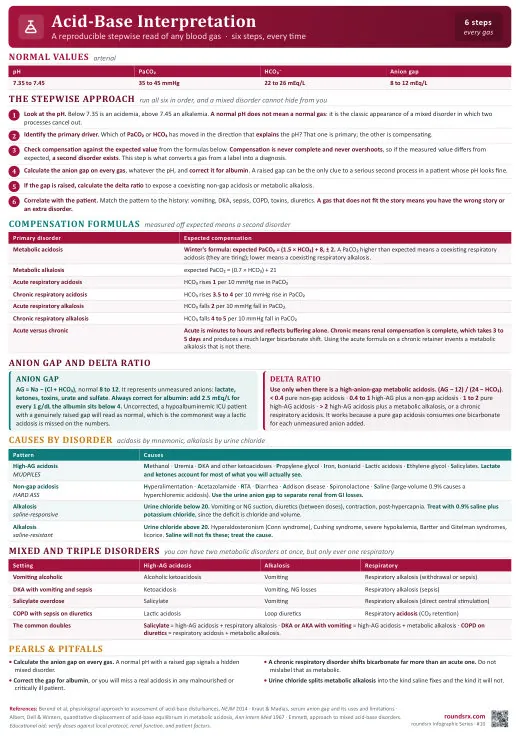
Text version
- Not correcting AG for albumin (misses hidden AG acidosis in ICU patients)
- Treating number without finding cause
- Bicarb for DKA (except pH < 6.9)
- Missing mixed acid-base disorder