Quick Reference
Antibiotic Guide
Empiric coverage by infection site, spectrum of activity, and renal dose adjustments. This is your go-to for every antibiotic decision on the wards.
🎯 Empiric Antibiotics by Condition
🫁 Pneumonia (CAP / HAP / VAP)
5 regimens
›
| Setting | First-Line | Alternatives / Severe | Duration |
|---|---|---|---|
| CAP -outpatient, healthy | Amoxicillin (Amoxil) 1g TID | Doxycycline 100 mg BID if penicillin allergy | 5 days |
| CAP -outpatient, comorbidities | Augmentin 875 BID + azithromycin | Respiratory FQ monotherapy (levofloxacin 750 mg daily) | 5 days |
| CAP -inpatient (non-ICU) | Ceftriaxone (Rocephin) 1–2g IV + azithro 500 IV | Add vancomycin if MRSA risk | 5 days (if stable ×48h) PTC (Dinh), 2021 |
| CAP -ICU (severe) | Ceftriaxone (Rocephin) 2g IV + azithro 500 IV | + vanc or linezolid if MRSA (linezolid preferred -better lung penetration). + pip-tazo/cefepime if Pseudomonas risk. | 7 days |
| HAP / VAP | Pip-tazo 4.5g q6h or cefepime 2g q8h | + vancomycin or linezolid for MRSA (linezolid if severe -better lung penetration). Pip-tazo if anaerobic concern (abscess/empyema). Cefepime preferred with vanc (↓ AKI ACORN, 2023). Need cefepime + anaerobes → add metronidazole. | 7 days ATS/IDSA, 2016 |
🔬 Urinary Tract Infections
3 regimens
›
| Setting | First-Line | Alternatives | Duration |
|---|---|---|---|
| Uncomplicated cystitis | Nitrofurantoin (Macrobid) 100 mg BID | TMP-SMX DS BID × 3d. Fosfomycin 3g × 1. Avoid FQ for cystitis. | 3–5 days |
| Pyelonephritis -outpatient | Ciprofloxacin (Cipro) 500 BID | Ceftriaxone 1g IM × 1 + oral step-down | 5–7 days |
| Pyelonephritis -inpatient | Ceftriaxone (Rocephin) 1g IV daily | Pip-tazo or meropenem if ESBL/MDR risk | FQ 5–7d, TMP-SMX 7–10d, beta-lactam 10–14d (total duration depends on PO step-down agent) |
ASB (asymptomatic bacteriuria) = do NOT treat -except in pregnancy and pre-urologic procedure. Nitrofurantoin: avoid if CrCl < 30.
🩹 Skin & Soft Tissue Infections
2 regimens
›
| Type | First-Line | Alternatives | Duration |
|---|---|---|---|
| Cellulitis (non-purulent) | Cefazolin (Ancef) 2g IV q8h (inpatient) or cephalexin (Keflex) 500 QID (outpatient) | Purulent/abscess → I&D + TMP-SMX or doxycycline for MRSA | 5–7 days |
| Necrotizing fasciitis SURGICAL EMERGENCY | Vanc + pip-tazo + clindamycin | Clindamycin inhibits toxin production (Group A strep). EMERGENT surgical debridement. | Until source controlled |
🫃 Intra-Abdominal Infections
2 regimens
›
| Setting | First-Line | Alternatives | Duration |
|---|---|---|---|
| Community intra-abdominal | Ceftriaxone (Rocephin) 2g + metronidazole (Flagyl) 500 q8h | Pip-tazo 4.5g q6h (single agent). Meropenem if ESBL. | 4 days (post source control) STOP-IT, 2015 |
| SBP* *= Spontaneous Bacterial Peritonitis | Ceftriaxone (Rocephin) 2g IV daily | Pip-tazo or meropenem if nosocomial/FQ* failure *FQ = Fluoroquinolone (ciprofloxacin, levofloxacin, moxifloxacin) | 5 days |
🧠 CNS Infections
1 regimen
›
| Setting | First-Line | Alternatives | Duration |
|---|---|---|---|
| Bacterial meningitis (adult) | Vanc + ceftriaxone 2g q12h | + ampicillin 2g q4h if age >50 or immunocompromised (Listeria). Dex before/with 1st abx dose European Dexamethasone Meningitis Trial, 2002. | 10–14 days (S. pneumo); 7 days (N. meningitidis) |
Antibiotics within 30–60 min. Do NOT delay for LP or CT. Get blood cultures → start abx → then LP.
❤️ Endocarditis
1 regimen
›
| Setting | Empiric | Culture-Directed | Duration |
|---|---|---|---|
| Native valve (empiric) | Vanc + ceftriaxone | MSSA → nafcillin/cefazolin. MRSA → vanc or daptomycin. Enterococcus → ampicillin + gentamicin or ampicillin + ceftriaxone. | 4–6 weeks |
3 sets of blood cultures from 3 sites before antibiotics. Daptomycin is an alternative to vanc for right-sided MRSA endocarditis -but NOT for left-sided (poor penetration through vegetations).
🚨 Sepsis & Febrile Neutropenia
2 regimens
›
| Setting | First-Line | Alternatives / Add-On | Duration |
|---|---|---|---|
| Sepsis (unknown source) | Vanc + cefepime or vanc + pip-tazo | Meropenem if ESBL risk or critically ill. Add antifungal if immunocompromised + no improvement day 4–7. | Source-dependent |
| Neutropenic fever (ANC < 500 + T ≥ 38.3) | Cefepime (Maxipime) 2g IV q8h | + vanc if hemodynamic instability, line infection, MRSA. + antifungal day 4–7 if persistent fever. | Until ANC recovery + afebrile ≥48h |
Antibiotics within 1 hour in sepsis and neutropenic fever. Every hour of delay increases mortality. Empiric broad → narrow based on cultures at 48–72h.
🦠 C. difficile
2 regimens
›
| Severity | First-Line | Alternatives | Duration |
|---|---|---|---|
| Non-severe | Fidaxomicin 200 mg BID PREFERRED | Vancomycin PO 125 mg QID | 10 days |
| Fulminant (ileus, megacolon, shock) | Vanc PO 500 QID + metronidazole IV 500 q8h | ± vanc enemas if ileus. Surgical consult for colectomy. | Until resolved |
Soap and water for hand hygiene (alcohol sanitizer does NOT kill C. diff spores). Fidaxomicin has lower recurrence rate than vanc IDSA/SHEA, 2021.
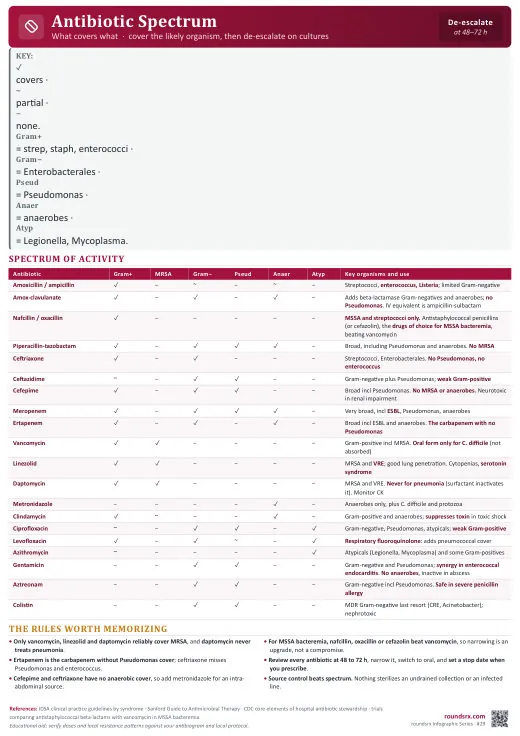
🦠 Spectrum of Activity
Gram-Positive Coverage
| Drug | MSSA | MRSA | Strep | Enterococcus | Notes |
|---|---|---|---|---|---|
| Cefazolin (Ancef) / Cephalexin (Keflex) | ✓ | ✗ | ✓ | ✗ | Best anti-staphylococcal cephalosporin. First-line MSSA. |
| Nafcillin / Oxacillin | ✓✓ | ✗ | ✓ | ✗ | Gold standard MSSA bacteremia / endocarditis. |
| Vancomycin (Vancocin) | ✓ | ✓ | ✓ | ✓ (not VRE) | Workhorse MRSA drug. Nephrotoxic. Target AUC/MIC 400–600 (trough-based monitoring is outdated per 2020 ASHP/IDSA). |
| Linezolid (Zyvox) | ✓ | ✓ | ✓ | ✓ (incl VRE) | Covers VRE. PO = IV bioavailability. Serotonin syndrome risk. Thrombocytopenia >2 weeks. |
| Daptomycin (Cubicin) | ✓ | ✓ | ✓ | ✓ (incl VRE) | Inactivated by surfactant -do NOT use for pneumonia. Check CK weekly (rhabdo). |
| TMP-SMX (Bactrim) | ✓ | ✓ (CA-MRSA) | Variable | ✗ | Good oral MRSA option for skin/soft tissue. Not reliable for strep. |
Gram-Negative Coverage
| Drug | Enterobacteriaceae | Pseudomonas | ESBL | Anaerobes | Notes |
|---|---|---|---|---|---|
| Ceftriaxone (Rocephin) | ✓✓ | ✗ | ✗ | ✗ | Workhorse for community GNR. No Pseudomonas. No anaerobes. |
| Cefepime (Maxipime) | ✓✓ | ✓ | ✗ | ✗ | Anti-pseudomonal cephalosporin. Neurotoxic in renal failure (seizures). |
| Pip-tazo (Zosyn) | ✓✓ | ✓ | Variable | ✓ | Broadest non-carbapenem. Covers Pseudomonas + anaerobes. Workhorse for abdominal/polymicrobial. |
| Meropenem (Merrem) | ✓✓ | ✓ | ✓ | ✓ | Broadest spectrum. Reserve for ESBL, MDR, failing empiric therapy. Does NOT cover MRSA. |
| Aztreonam | ✓ | ✓ | ✗ | ✗ | Safe in penicillin allergy (monobactam, no cross-reactivity). GNR only -no gram-positive, no anaerobes. |
| Fluoroquinolones | ✓ | ✓ (cipro) | ✗ | ✗ (moxi has some) | Rising resistance. FDA black box warnings. Save for specific indications (pyelo, prostatitis, Legionella). ⚠ They are not interchangeable -see respiratory vs non-respiratory → |
| Metronidazole (Flagyl) | ✗ | ✗ | ✗ | ✓✓ | Anaerobe specialist. Also covers C. diff (fulminant, IV), Giardia, amebiasis. Disulfiram reaction with alcohol. |
Daptomycin is inactivated by pulmonary surfactant -NEVER use for pneumonia. This is a classic boards and real-life mistake. Use vancomycin or linezolid for MRSA pneumonia.
Fluoroquinolones: "Respiratory" vs Not, and Why They Are Not Interchangeable
"Respiratory fluoroquinolone" means reliable S. pneumoniae activity, and that is the entire distinction. Levofloxacin and moxifloxacin qualify. ⚠ Ciprofloxacin does NOT -its pneumococcal activity is unreliable, so IDSA/ATS does not recommend it for community-acquired pneumonia. Reaching for cipro in CAP leaves the single commonest CAP pathogen uncovered, which is the most frequent fluoroquinolone error on the wards.
| Drug | S. pneumoniae "respiratory" | Pseudomonas | Anaerobes | Urinary levels | Clearance |
|---|---|---|---|---|---|
| Ciprofloxacin (Cipro) | ✗ NOT respiratory | ✓✓ most potent FQ | ✗ | ✓✓ | Renal adjust CrCl < 30 |
| Levofloxacin (Levaquin) | ✓ | ✓ at 750 mg | ✗ | ✓✓ ~87% unchanged | Renal adjust CrCl < 50 |
| Moxifloxacin (Avelox) | ✓✓ | ✗ | ✓ incl. B. fragilis | ✗ ~20% unchanged | Hepatic NO adjustment |
The Four Differences That Actually Decide the Choice
| Axis | What differs | Why it changes what you prescribe |
|---|---|---|
| Pseudomonas | Of the respiratory agents, only levofloxacin, and it needs the 750 mg dose. Moxifloxacin has none. Ciprofloxacin is the most potent antipseudomonal fluoroquinolone but is not a respiratory agent. | Drives the choice whenever Pseudomonas is plausible: bronchiectasis, structural lung disease, prior Pseudomonas isolate, recent broad-spectrum antibiotics. ⚠ Moxifloxacin in a bronchiectasis exacerbation is a coverage gap, not a stylistic preference. If you need pneumococcal AND pseudomonal cover from one oral drug, levofloxacin 750 mg is the only fluoroquinolone that does both. |
| Anaerobes | Only moxifloxacin has meaningful anaerobic activity. Its FDA label names B. fragilis, B. thetaiotaomicron, C. perfringens and Peptostreptococcus under complicated intra-abdominal infection. Levofloxacin and ciprofloxacin have none. | Why moxifloxacin can stand alone where anaerobic cover is needed (intra-abdominal source, aspiration with abscess or empyema), and why levofloxacin or ciprofloxacin must be paired with metronidazole for the same job. Adding metronidazole to moxifloxacin is redundant. |
| ⚠ Urinary concentration | Levofloxacin and ciprofloxacin concentrate in urine; moxifloxacin does not. Only about 20% of a moxifloxacin dose appears unchanged in urine, because it is cleared by conjugation rather than filtration. | ⚠ Moxifloxacin is NOT a UTI drug, and UTI is not on its label at all (approved for sinusitis, AECB, CAP, skin and complicated intra-abdominal infection only). Choosing it for pyelonephritis or a complicated UTI delivers subtherapeutic drug to the site of infection. Use levofloxacin or ciprofloxacin -levofloxacin 750 mg covers complicated UTI including Pseudomonas. |
| Clearance and dosing | Levofloxacin and ciprofloxacin are renally cleared and need adjustment (levofloxacin below CrCl 50, ciprofloxacin below 30). Moxifloxacin is hepatically conjugated (glucuronide and sulfate, no CYP450) and needs NO adjustment at any level of renal function, including hemodialysis and CAPD. | The reason moxifloxacin is convenient in AKI, advanced CKD and on dialysis -no dose math, no accumulation. But note the trade: the same property that makes it easy in renal failure is what makes it useless in the urinary tract. Also the reason an unadjusted levofloxacin dose in renal impairment accumulates and drives QT prolongation, tendinopathy and CNS toxicity. |
Why 750 mg, and Not 500
Fluoroquinolones kill in a concentration-dependent way, so the driver of outcome is the RATIO of drug exposure to the organism's MIC, not time above MIC. The classic target for gram-negative infection is AUC/MIC ≥ 125 Forrest, 1993, where cure rates roughly doubled above that threshold and time to eradication fell from over 32 days to under 2. Because the target ratio is fixed, an organism with a higher MIC needs a proportionally higher exposure -that is the entire reason the dose changes. Pseudomonas MICs to levofloxacin sit far above pneumococcal MICs, so the dose that comfortably clears the bar for S. pneumoniae does not come close for Pseudomonas.
| Levofloxacin | 500 mg daily | 750 mg daily |
|---|---|---|
| Peak (Cmax) | ~5.7 mcg/mL | ~8.6 mcg/mL |
| AUC over 24 h | ~47.5 mcg·h/mL | ~91 mcg·h/mL |
| Epithelial lining fluid the compartment that matters in pneumonia | ~9.9 mcg/mL | ~22.1 mcg/mL |
⚠ Be honest about what 750 mg does and does not buy you. Work the arithmetic at a Pseudomonas MIC of 1 mcg/mL: 500 mg gives AUC/MIC ≈ 48, nowhere near the target, while 750 mg gives ≈ 91, which is still short of 125. Only isolates at the lower end of the MIC range clear the bar even at 750 mg. So 750 mg is the minimum dose that makes levofloxacin a plausible antipseudomonal agent, not one that makes it a reliable one -confirm susceptibility, and do not lean on it as monotherapy for serious pseudomonal infection. Against S. pneumoniae, whose MICs are far lower and whose PK/PD target is lower still, 500 mg is already comfortably above target, which is why plain CAP does not need the bigger dose.
The same pharmacology explains two other things. Why it is dosed ONCE daily rather than split: a concentration-dependent drug wants a high peak, so splitting 750 mg into two doses would lower Cmax and defeat the mechanism, unlike a beta-lactam where frequent dosing is exactly right. And why underdosing breeds resistance: exposure that sits below target does not kill the less-susceptible subpopulation, it selects it, so a half-hearted fluoroquinolone dose is worse than none.
⚠ The two errors this table exists to prevent. (1) Ciprofloxacin for community-acquired pneumonia -it does not reliably cover S. pneumoniae, the commonest cause. (2) Moxifloxacin for a UTI -it does not reach therapeutic urinary concentrations and carries no UTI indication. Both look like reasonable fluoroquinolone choices on a drug list, and both leave the target organism untreated.
Class cautions apply to all of them. FDA boxed warnings for tendinitis and tendon rupture, peripheral neuropathy, CNS effects and myasthenia gravis exacerbation, plus aortic aneurysm and dissection risk. Moxifloxacin has the greatest QT effect of the class, so it is the wrong pick in a patient already on QT-prolonging drugs or with electrolyte derangement. All fluoroquinolones are chelated by di- and trivalent cations (calcium, magnesium, aluminum, iron, zinc, sucralfate, dairy), which can abolish oral absorption -separate the doses, or the patient is effectively untreated.
💊 Renal Dose Adjustments
This table covers antibiotics. For non-antibiotic renal dosing (anticoagulants, diabetes drugs, analgesics, cardiac meds) with renal-friendly alternatives, see the full Drug Dosing in Renal Impairment reference.
| Drug | Normal Dose | CrCl 10–30 | HD | Key Notes |
|---|---|---|---|---|
| Vancomycin (Vancocin) | 15–20 mg/kg q8–12h | 15–20 mg/kg q24–48h (by levels) | Re-dose by levels post-HD | Target AUC/MIC 400–600 (AUC-guided, not trough-only). Nephrotoxic in its own right; the added risk from pairing with pip-tazo was not confirmed by RCT ACORN, 2023. |
| Pip-tazo (Zosyn) | 4.5g IV q6h | 2.25g IV q6h | 2.25g q6h + dose after HD | Extended infusion (4h) improves outcomes in critically ill. |
| Cefepime (Maxipime) | 2g IV q8h | 1g IV q12–24h | 1g IV q24h + dose after HD | Neurotoxic in renal failure (encephalopathy, myoclonus, seizures). Monitor closely. |
| Meropenem (Merrem) | 1g IV q8h | 500 mg IV q12h | 500 mg IV q12h + dose after HD | Lower seizure threshold than imipenem. |
| Levofloxacin (Levaquin) | 750 mg IV/PO daily | 750 mg q48h | 500 mg q48h | Not removed by HD. Avoid in myasthenia. |
| TMP-SMX (Bactrim) | DS BID (UTI) or 15 mg/kg/day (PCP) | Half dose if CrCl 15–30. Avoid <15. | Dose after HD | Causes hyperkalemia (blocks ENaC). Falsely ↑ Cr (blocks tubular secretion). |
| Nitrofurantoin (Macrobid) | 100 mg BID | AVOID if CrCl < 30 | Ineffective (can't concentrate in urine) + pulmonary toxicity risk. | |
| Metronidazole (Flagyl) | 500 mg q8h | No adjustment needed | Dose after HD | Hepatically metabolized. No renal adjustment. |
| Linezolid (Zyvox) | 600 mg q12h | No adjustment needed | No adjustment | Not renally cleared. 100% PO bioavailability = IV. |
| Daptomycin (Cubicin) | 6–10 mg/kg IV daily | 6–10 mg/kg IV q48h | Dose after HD | Check CK weekly. Not for pneumonia. |
🧠 Stewardship Pearls
- Always get cultures before antibiotics -but never delay antibiotics for cultures in sepsis or meningitis
- De-escalate within 48–72h based on culture/sensitivity. Broad empiric → narrow targeted is the rule.
- Shorter is better: CAP 5 days, UTI 3–5 days, intra-abdominal 4 days post-source-control, HAP/VAP 7 days. Longer courses don't improve outcomes and increase resistance + C. diff.
- IV to PO switch: switch to oral when afebrile ×48h, tolerating PO, improving clinically. Most antibiotics have excellent oral bioavailability (FQ, linezolid, metronidazole, TMP-SMX, fluconazole).
- Vanc + pip-tazo was NOT shown to increase AKI in the only randomized trial, despite a long-standing observational signal ACORN, 2023. Prefer vanc + cefepime when both cover the suspected pathogens.
- "Bug-drug mismatch" -common errors: ceftriaxone doesn't cover Pseudomonas; cefazolin doesn't cover MRSA; daptomycin doesn't work in the lung; nitrofurantoin doesn't work above the bladder.
- Allergies: ~90% of "penicillin allergies" are not true IgE-mediated. Cephalosporin cross-reactivity is < 2%. Get allergy history details (rash vs anaphylaxis). Consider allergy testing.
Linezolid vs Vancomycin -When to Choose Which
Both cover MRSA. But they are NOT interchangeable. Choosing wrong = treatment failure, unnecessary toxicity, or worse outcomes. Know when each one wins.
| Feature | Vancomycin | Linezolid (Zyvox) |
|---|---|---|
| MOA | Cell wall synthesis inhibitor -binds D-Ala-D-Ala terminus of peptidoglycan precursors, preventing cross-linking. Bactericidal (slowly). | Protein synthesis inhibitor -binds 23S rRNA of the 50S ribosome, blocking formation of the 70S initiation complex → prevents translation. Bacteriostatic. Also a weak reversible MAOi (inhibits monoamine oxidase → serotonin syndrome risk). |
| Route | IV only for systemic infections (PO only for C. diff -not absorbed) | IV and PO -100% oral bioavailability (PO = IV) |
| MRSA | ✓ Gold standard | ✓ Equivalent |
| VRE* *= Vancomycin-Resistant Enterococcus | ✗ No | ✓ Yes -one of very few VRE options |
| Lung penetration | Poor (~25%) | Excellent (~100%) |
| CSF penetration | Moderate (needs inflamed meninges) | Good |
| Renal dosing | YES -must adjust. AUC/MIC-guided dosing (target 400-600). | No renal adjustment. No drug levels needed. |
| Key toxicity | Nephrotoxicity, Red Man Syndrome (infuse over ≥1h), ototoxicity, DRESS (rare) | Thrombocytopenia (#1 -dose-dependent, usually > 14 days), serotonin syndrome (MAOi activity), lactic acidosis (mitochondrial toxicity), peripheral neuropathy (may be irreversible), optic neuritis (vision loss -check visual acuity if > 28 days), myelosuppression (anemia, leukopenia) |
| Duration limit | No hard limit | ≤ 14 days preferred. > 14d: ↑ thrombocytopenia. > 28d: ↑↑ neuropathy, optic neuritis, lactic acidosis. If > 2 weeks needed → monitor closely or switch to vanc. |
| Monitoring | Trough AUC/MIC 400–600, BMP, CBC | CBC twice weekly (platelets). If > 14d: weekly lactate, visual acuity, neuro exam for neuropathy symptoms (numbness, tingling). No drug levels needed. |
| Drug interactions | Nephrotoxics (aminoglycosides, pip-tazo) | SSRIs, SNRIs, MAOIs, tramadol, meperidine → serotonin syndrome |
| Cost | Cheap | Expensive |
🏆 Choose Vancomycin
- MRSA bacteremia -bactericidal, proven outcomes
- Endocarditis -need bactericidal activity
- Osteomyelitis -long-duration therapy OK
- Empiric broad MRSA coverage -default first-line
- Cost-sensitive settings
🏆 Choose Linezolid
- MRSA pneumonia -far superior lung penetration ZEPHyR, 2012
- VRE infections -vanc is useless against VRE
- CKD / AKI -no renal adjustment, won't worsen kidneys
- No IV access -100% PO bioavailability
- Outpatient MRSA Tx -go home on PO instead of IV vanc
- Vancomycin failure or allergy
Never use daptomycin for pneumonia. Pulmonary surfactant inactivates it. For MRSA pneumonia your choices are vancomycin or linezolid -and linezolid is likely better due to lung penetration.
Linezolid + serotonergic drugs = serotonin syndrome. Always check the med list for SSRIs, SNRIs, MAOIs, tramadol, meperidine before starting linezolid. If the patient is on an SSRI and needs MRSA coverage → use vancomycin.
⚠️ Linezolid Toxicity Timeline:
• > 14 days: thrombocytopenia (check CBC twice weekly), myelosuppression, lactic acidosis (check weekly lactate)
• > 28 days: peripheral neuropathy (numbness/tingling -may be irreversible), optic neuritis (blurred vision, color vision loss -check visual acuity weekly)
• Any duration: serotonin syndrome if on SSRIs/SNRIs/MAOIs/tramadol (linezolid is a weak MAOi)
If you need > 2 weeks of MRSA therapy (endocarditis, osteo), vancomycin is safer for long courses.
• > 14 days: thrombocytopenia (check CBC twice weekly), myelosuppression, lactic acidosis (check weekly lactate)
• > 28 days: peripheral neuropathy (numbness/tingling -may be irreversible), optic neuritis (blurred vision, color vision loss -check visual acuity weekly)
• Any duration: serotonin syndrome if on SSRIs/SNRIs/MAOIs/tramadol (linezolid is a weak MAOi)
If you need > 2 weeks of MRSA therapy (endocarditis, osteo), vancomycin is safer for long courses.
Toxin suppression -linezolid & clindamycin. Both are protein synthesis inhibitors (50S ribosome) → they suppress bacterial toxin production even before the bacteria die. This is why clindamycin is always added in necrotizing fasciitis (suppresses Group A strep exotoxins), toxic shock syndrome (suppresses TSST-1 and strep pyrogenic exotoxins), and PVL-producing MRSA (Panton-Valentine leukocidin). Linezolid has the same mechanism and can substitute when clindamycin resistance is a concern. Vancomycin kills the bacteria but does NOT suppress toxin production -in toxin-mediated disease, bactericidal alone is not enough.
⏱ Duration by Infection
Respiratory
| Infection | Duration | Key Notes / Evidence |
|---|---|---|
| CAP (uncomplicated)* *= No ICU admission, no empyema/abscess, no bacteremia, immunocompetent, clinically improving | 5 days | If afebrile ≥48h + ≤1 sign instability (HR, RR, BP, SpO₂, mental status) |
| CAP (complicated)* *= Empyema, lung abscess, necrotizing pneumonia, cavitation, or inadequate clinical response by day 3–5 | 2–6 weeks | Depends on drainage adequacy and imaging resolution. Empyema needs chest tube + abx |
| HAP* / VAP* *HAP = Hospital-Acquired Pneumonia (≥48h after admission) *VAP = Ventilator-Associated Pneumonia (≥48h after intubation) | 7 days | ATS/IDSA 2016. Shorter courses reduce resistance |
| COPD exacerbation (with abx) | 5 days | Only if ≥2 Anthonisen criteria |
| Lung abscess | 4–6 weeks | Until imaging improvement |
Urinary
| Infection | Duration | Key Notes / Evidence |
|---|---|---|
| Simple cystitis (women) | 3–5 days | Nitrofurantoin (Macrobid) 5d, TMP-SMX (Bactrim) 3d, fosfomycin 1 dose |
| Complicated UTI* *= UTI extending beyond the bladder (pyelonephritis, urosepsis) OR occurring in a host with impaired urinary tract clearance (male, pregnant, anatomic abnormality, obstruction, catheter, immunocompromised, renal transplant) | 7–14 days | Depends on source control. Broader coverage needed (FQ or beta-lactam) |
| Pyelonephritis (uncomplicated) | 5–7 days | FQ 5d, TMP-SMX 7d, beta-lactam 10–14d |
| Catheter-associated UTI | 7 days | Remove or replace catheter. 10–14d if slow response |
| Prostatitis (acute) | 2–4 weeks | FQ or TMP-SMX preferred (prostate penetration) |
Bloodstream
| Infection | Duration | Key Notes / Evidence |
|---|---|---|
| Uncomplicated gram-negative bacteremia = Source identified & controlled, no endovascular infection, no prosthetic material, immunocompetent, defervesced within 72h, cultures cleared | 7 days | From first negative blood culture. ALL criteria must be met |
| Complicated gram-negative bacteremia = Undrainable source, endovascular, prosthetic material, immunocompromised, persistent bacteremia >72h, or metastatic infection | 14 days | Any ONE feature makes it complicated → 14 days |
| Staph aureus bacteremia (MSSA*/MRSA*) *MSSA = Methicillin-Sensitive Staph aureus *MRSA = Methicillin-Resistant Staph aureus | ≥4 weeks (minimum) | ALWAYS. TTE/TEE required. ID consult mandatory |
| Coag-negative staph (true infection) | 5–7 days + line removal | Often contaminant -need 2+ positive cultures |
| Enterococcal bacteremia | 7–14 days | Longer if endocarditis not excluded |
| Candidemia | 14 days from first negative culture | Ophthalmology consult. Remove all central lines. Echo |
S. aureus bacteremia is NEVER uncomplicated enough for short-course therapy. Minimum 4 weeks IV. Always echo. Always ID consult.
Skin / Soft Tissue
| Infection | Duration | Key Notes / Evidence |
|---|---|---|
| Simple cellulitis | 5 days | Extend to 7–10d if slow response |
| Purulent SSTI* / abscess *SSTI = Skin and Soft Tissue Infection | I&D* ± 5–7 days *I&D = Incision and Drainage | I&D is primary treatment |
| Necrotizing fasciitis | Until debridement complete | Surgical emergency |
| Diabetic foot (soft tissue) | 1–2 weeks | If no osteomyelitis |
| Diabetic foot (osteo) | 6 weeks | Based on bone culture |
Intra-abdominal
| Infection | Duration | Key Notes / Evidence |
|---|---|---|
| Intra-abdominal (adequate source control) | 4 days | STOP-IT, 2015. NOT 7–14 days |
| Cholangitis / cholecystitis | Source control + 4–5 days | Cholecystectomy within 72h |
| SBP* *= Spontaneous Bacterial Peritonitis | 5 days | Ceftriaxone. Albumin day 1 and 3 |
| C. difficile (initial) | 10 days | Fidaxomicin preferred |
| C. difficile (fulminant) | Until improving | PO vanc 500mg q6h + IV metronidazole |
Bone / Joint
| Infection | Duration | Key Notes / Evidence |
|---|---|---|
| Osteomyelitis (native bone) | 6 weeks | IV → PO step-down OK (OVIVA trial) |
| Prosthetic joint (DAIR*) *DAIR = Debridement, Antibiotics, Implant Retention | 6 wk IV + chronic suppression | Rifampin backbone if staph |
| Septic arthritis (native) | 3–4 weeks | GPC* 3wk, GNR* 4wk. I&D essential *GPC = Gram-Positive Cocci (staph, strep, enterococcus) *GNR = Gram-Negative Rods (E. coli, Klebsiella, Pseudomonas) |
CNS
| Infection | Duration | Key Notes / Evidence |
|---|---|---|
| Bacterial meningitis | 7–21 days | Meningo 7d, pneumo 10–14d, Listeria 21d, GNR 21d |
| Brain abscess | 6–8 weeks | Often need surgical drainage |
| Epidural abscess | 6–8 weeks | Surgical drainage + IV abx |
Endocarditis
| Infection | Duration | Key Notes / Evidence |
|---|---|---|
| Native valve (strep) | 4 weeks | 2wk if uncomplicated + gent synergy |
| Native valve (staph) | 6 weeks | Nafcillin for MSSA, vanc for MRSA |
| Prosthetic valve | ≥6 weeks | Rifampin + gentamicin backbone |
Other
| Infection | Duration | Key Notes / Evidence |
|---|---|---|
| TB (standard) | 6 months | 2 months RIPE* → 4 months RI *RIPE = Rifampin, Isoniazid, Pyrazinamide, Ethambutol |
| TB (meningitis / bone) | 9–12 months | Extended duration |
| Febrile neutropenia | Until afebrile + ANC* ≥500 × 2d *ANC = Absolute Neutrophil Count | Min 7 days if documented infection |