Electrolyte Replacement
Potassium, magnesium, phosphate and calcium repletion plus the sodium correction limits, all in one place. You'll order these 10 times a day: how much, how fast, PO vs IV, and when to recheck.
⚡ Replacement Protocols
| Electrolyte | Level | Replacement | Expected Rise | Recheck | Pearls |
|---|---|---|---|---|---|
| Potassium (Goal: 4.0–5.0) (ICU goal: 4.0–4.5) |
3.5–3.9 | KCl 40 mEq PO × 1 | ~0.2–0.4 mEq/L total classic rule is 0.1 per 10 mEq, but the real-world inpatient median is ~0.05 | Next AM BMP | Always replete Mg first -hypoMg causes renal K⁺ wasting via the ROMK channel. Mg²⁺ normally inhibits ROMK in the collecting duct. When Mg²⁺ is low → ROMK becomes uninhibited → K⁺ pours into the urine → refractory hypokalemia no matter how much K⁺ you give. Fix the Mg²⁺ first, or the K⁺ won't stay. Max IV rate: 10 mEq/hr peripheral, 20 mEq/hr central. PO preferred if tolerating. Recheck K⁺ 2–4h after IV repletion. |
| 3.0–3.4 | KCl 40 mEq PO × 2 doses (1h apart) or KCl 20 mEq IV × 2 | ~0.4–0.8 mEq/L | 2–4h post-IV | ||
| < 3.0 | KCl 40 mEq IV × 2–3 (with continuous telemetry). PO supplement simultaneously. | Variable -recheck frequently | Q2h until > 3.0 | ||
| Magnesium (Goal: ≥ 2.0) (ICU goal: ≥ 2.0) |
1.5–1.9 | MgOxide 400 mg PO BID or MgSO₄ 2g IV × 1 | ~0.1–0.2 per 1g IV | Next AM | Diarrhea is the dose-limiting PO side effect. IV preferred in critically ill. 1g IV MgSO₄ ≈ 8 mEq Mg. Renal excretion -use caution in CKD. For torsades → 2g IV push. Why Mg matters for K⁺ (ROMK channel): Mg²⁺ normally blocks the ROMK channel in the collecting duct, preventing K⁺ secretion. Low Mg²⁺ → ROMK uninhibited → kidney wastes K⁺ → refractory hypokalemia. Also: low Mg²⁺ causes PTH resistance → refractory hypocalcemia. Always check Mg²⁺ when K⁺ or Ca²⁺ won't correct. |
| < 1.5 | MgSO₄ 4g IV over 4h | ~0.3–0.5 | 2–4h post | ||
| Phosphorus (Goal: 2.5–4.5) |
1.5–2.4 | NeutraPhos 2 packets PO (32 mmol) or Na/K-Phos 15 mmol IV over 2h | ~0.5–1.0 mg/dL | Next AM | IV repletion in CKD → risk of hypocalcemia (CaPO₄ precipitation). Check Ca²⁺ concurrently. Oral preferred unless severe or NPO. K-Phos contains potassium -check K⁺ first. |
| < 1.5 | Na/K-Phos 30 mmol IV over 4–6h | ~1.0–1.5 mg/dL | 2–4h post | ||
| Calcium (Ionized goal: 1.1–1.3) |
Mild (iCa 0.9–1.1) | CaCO₃ 1250 mg PO TID (with meals) + vitamin D | Gradual | Next AM | Always check ionized Ca (not total -albumin confounds). Correct Mg first (hypoMg causes PTH resistance). IV CaCl₂ = 3× more elemental Ca than Ca gluconate but vesicant (central line only). Avoid IV Ca if hyperphosphatemic (CaPO₄ precipitation → calciphylaxis). |
| Severe (iCa < 0.9, symptomatic) | Ca gluconate 2g IV over 20 min (peripheral OK) or CaCl₂ 1g IV (central only) | Transient | Q2h + telemetry |
📐 The dosing arithmetic, and why "Expected Rise" is a range
Classic teaching is that every 10 mEq of KCl raises serum K⁺ by 0.1 mEq/L, so 40 mEq buys about 0.4. Treat that as a best case, not an average. It reflects acute IV dosing: in a medical ICU series of 495 infusion sets, 20 mEq of IV KCl raised K⁺ by a mean of 0.25 mEq/L measured right after the infusion Kruse & Carlson, 1990.
Across a hospital day it under-delivers badly. In 800 supplemented inpatients (median 40 mEq/day, 81% oral) the median rise was only 0.05 mEq/L per 10 mEq, improving to 0.07 in patients on no K⁺-affecting drugs and falling to 0.03 on a loop diuretic AJHP, 2024. In an ICU cohort, only 35% of replacement episodes hit the rule-predicted target. Expect roughly half the textbook rise in anyone still on a diuretic, and recheck the level rather than trusting the arithmetic.
Why one dose is rarely enough: only about 2% of body potassium is extracellular, so the serum value is the tip of the iceberg. Each 1 mEq/L below normal represents a 200–400 mEq total-body deficit. A K⁺ of 2.5 is a whole-body hole of 400 mEq or more, which is why the level drifts back down a few hours after you stop replacing.
Classic teaching is that every 10 mEq of KCl raises serum K⁺ by 0.1 mEq/L, so 40 mEq buys about 0.4. Treat that as a best case, not an average. It reflects acute IV dosing: in a medical ICU series of 495 infusion sets, 20 mEq of IV KCl raised K⁺ by a mean of 0.25 mEq/L measured right after the infusion Kruse & Carlson, 1990.
Across a hospital day it under-delivers badly. In 800 supplemented inpatients (median 40 mEq/day, 81% oral) the median rise was only 0.05 mEq/L per 10 mEq, improving to 0.07 in patients on no K⁺-affecting drugs and falling to 0.03 on a loop diuretic AJHP, 2024. In an ICU cohort, only 35% of replacement episodes hit the rule-predicted target. Expect roughly half the textbook rise in anyone still on a diuretic, and recheck the level rather than trusting the arithmetic.
Why one dose is rarely enough: only about 2% of body potassium is extracellular, so the serum value is the tip of the iceberg. Each 1 mEq/L below normal represents a 200–400 mEq total-body deficit. A K⁺ of 2.5 is a whole-body hole of 400 mEq or more, which is why the level drifts back down a few hours after you stop replacing.
🔗 The Mg²⁺ → K⁺ → Ca²⁺ Connection (ROMK Channel)
Low Mg²⁺ causes THREE problems:
1. Refractory hypokalemia -Mg²⁺ normally blocks the ROMK channel (Renal Outer Medullary K⁺ channel) in the collecting duct. Without Mg²⁺ → ROMK is wide open → kidney wastes K⁺ into urine → no amount of K⁺ repletion will stick until Mg²⁺ is corrected.
2. Refractory hypocalcemia -Mg²⁺ is required for PTH secretion and end-organ response. Low Mg²⁺ → PTH resistance → Ca²⁺ won't correct.
3. Cardiac arrhythmias -Mg²⁺ stabilizes cardiac membranes. Low Mg²⁺ → prolonged QT → Torsades de Pointes, refractory Afib/RVR, digoxin toxicity.
Clinical rule: When K⁺ or Ca²⁺ won't correct despite adequate repletion → check and replete Mg²⁺ first.
Low Mg²⁺ causes THREE problems:
1. Refractory hypokalemia -Mg²⁺ normally blocks the ROMK channel (Renal Outer Medullary K⁺ channel) in the collecting duct. Without Mg²⁺ → ROMK is wide open → kidney wastes K⁺ into urine → no amount of K⁺ repletion will stick until Mg²⁺ is corrected.
2. Refractory hypocalcemia -Mg²⁺ is required for PTH secretion and end-organ response. Low Mg²⁺ → PTH resistance → Ca²⁺ won't correct.
3. Cardiac arrhythmias -Mg²⁺ stabilizes cardiac membranes. Low Mg²⁺ → prolonged QT → Torsades de Pointes, refractory Afib/RVR, digoxin toxicity.
Clinical rule: When K⁺ or Ca²⁺ won't correct despite adequate repletion → check and replete Mg²⁺ first.
🛡️ Rates, Routes & Safety
IV rate and route limits
| Electrolyte | Peripheral | Central | Why the cap exists |
|---|---|---|---|
| Potassium | 10 mEq/hr concentration ≤ 40 mEq/L | 20 mEq/hr | Faster or more concentrated burns and causes phlebitis, which is the usual reason a peripheral infusion gets abandoned half finished. Rates up to 40 mEq/hr are reserved for arrest-level hypokalemia with ECG changes, central access, and continuous monitoring. Telemetry once K⁺ < 3.0. |
| Magnesium | 2 g over 1–2h; 4 g over 4h if Mg < 1.0 | A fast push causes flushing, warmth, and hypotension. Halve the dose in renal impairment, since Mg is renally cleared. 1 g MgSO₄ ≈ 8 mEq. A severely depleted patient may need 8–12 g over 24h. | |
| Phosphate | Max 7 mmol/hr | Faster infusion risks hypocalcemia from CaPO₄ precipitation and AKI. Check Ca²⁺ alongside, and reduce the dose in renal failure. | |
| Calcium | Ca gluconate is safe peripherally | CaCl₂ central line only | CaCl₂ delivers 3× the elemental calcium but is a vesicant that causes tissue necrosis if it extravasates. Reserve it for arrest or profound instability where the extra calcium per mL matters. |
⚠️ Mix IV KCl in saline, not dextrose. Dextrose triggers endogenous insulin, which drives K⁺ into cells and can drop the serum level further before it rises. The same logic explains why you never start insulin in DKA until K⁺ is ≥ 3.3–3.5.
🧪 Choosing the phosphate salt: use K-Phos when K⁺ is also low, since it repletes both, and Na-Phos when K⁺ is normal or high. K-Phos carries roughly 1.1 mEq of K⁺ per mmol of phosphate, so ordering it in a hyperkalemic patient is an easy and entirely avoidable error.
🚫 Avoid IV calcium in a hyperphosphatemic patient unless the hypocalcemia is symptomatic. CaPO₄ precipitates in tissue and drives calciphylaxis. In tumor lysis, correct the phosphate first and treat only symptomatic hypocalcemia.
When to recheck
| Situation | Recheck | Why |
|---|---|---|
| Oral repletion, stable patient | 2–4h, or next AM BMP | Drawing it earlier reads the dose, not the patient. |
| IV repletion | 1–2h after the infusion ends | A level drawn mid-infusion reads falsely high, especially if sampled from the infusing arm. |
| K⁺ < 3.0, or any arrhythmia | q1–2h until > 3.0 | Reassess between doses rather than chasing a target with one large bolus. The infusion rate that is safe at 2.2 is not safe at 3.8. |
| Refractory after two adequate doses | Send Mg²⁺, and Ca²⁺ if that is also low | Renal K⁺ wasting through an unblocked ROMK channel will defeat any amount of repletion until the magnesium is corrected. |
🔴 Sodium & Correction Limits
Sodium is a correction problem, not a repletion problem. What you are titrating is the rate of change, not a dose, and the harm comes from moving it too fast in either direction. The full diagnostic workups live in Hyponatremia and Hypernatremia; the limits below are what you need at the bedside.
≤ 8
mEq/L rise in 24h
(max safe correction rate)
(max safe correction rate)
≤ 10–12
mEq/L rise in 48h
(be stricter if chronic or high-risk)
(be stricter if chronic or high-risk)
ODS
Osmotic demyelination
if corrected too fast
if corrected too fast
| Problem | What to give | The limit, and why |
|---|---|---|
| Hyponatremia Na⁺ < 135 | NS if hypovolemic, fluid restriction if euvolemic (SIADH), diuresis if hypervolemic. 3% hypertonic saline 100 mL bolus for seizure or coma, repeat up to 3 times, recheck Na⁺ in 2h. | ≤ 8 mEq/L in 24h. The brain has already shed osmolytes to survive the low tonicity; raising the sodium faster than it can replace them demyelinates the pons, producing an irreversible locked-in syndrome 2 to 6 days later. Highest risk: chronic hyponatremia, alcohol use, malnutrition, hypokalemia, liver disease. |
| Overcorrection already up > 8 in 24h | D5W 3–6 mL/kg/hr plus DDAVP 2 mcg IV q8h to re-lower the sodium. | Act immediately. ODS is preventable at this stage and irreversible once established, so relowering to the safe trajectory is worth doing even if it feels like undoing your own work. |
| Hypernatremia Na⁺ > 145 | Enteral water is safest if the gut works, otherwise D5W. Restore perfusion with isotonic fluid first if shocked. | ≤ 10 mEq/L in 24h if chronic, since the adapted brain swells when water rushes back in, causing cerebral edema and seizures. Free water deficit = TBW × (Na⁺/140 − 1), TBW = 0.6 × wt in men and 0.5 × wt in women. Add insensible losses (~30–50 mL/hr) and ongoing urine output, or the sodium will plateau. |
⚠️ Potassium counts toward the sodium correction rate. Every mEq of K⁺ you give is osmotically active: K⁺ enters cells and Na⁺ comes out, so aggressive potassium repletion raises the serum sodium roughly as much as giving the same amount of sodium would. If you are correcting hypokalemia and hyponatremia together, the sodium will rise faster than your formula predicts. Count the potassium in your 24h budget and recheck early.
📄 One Pager
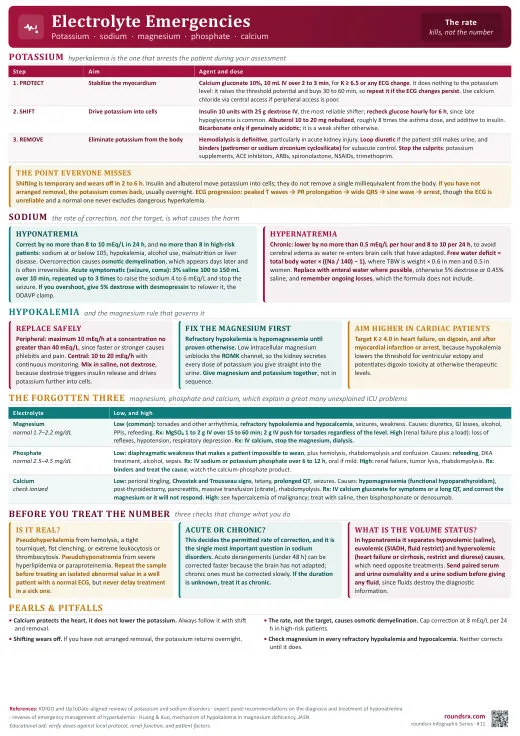
📄 Also in the series: Hypokalemia (#151) goes deeper on potassium alone: severity and ECG findings, the replacement arithmetic and why it over-promises, the magnesium rule, and the urine K⁺/creatinine workup. For the hyperkalemia emergency algorithm see Hyperkalemia.