Quick Reference
🩸 Transfusion Guide
Blood product thresholds, transfusion reactions, and special considerations. Know when to transfuse and when to hold.
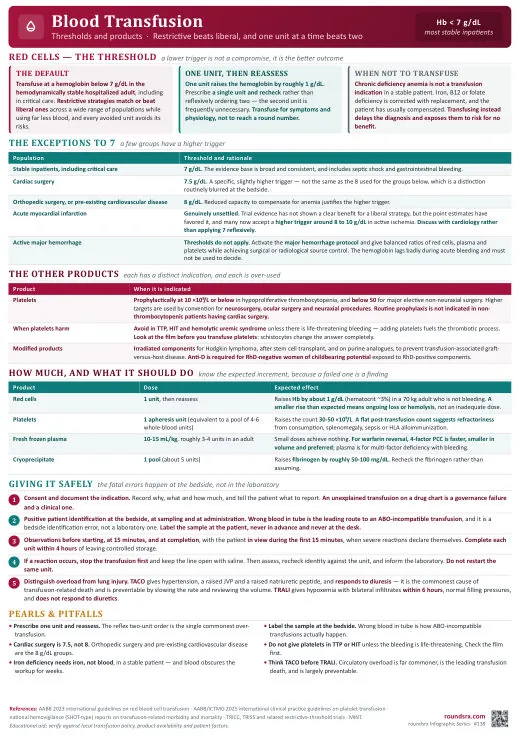
| Product | Threshold | Expected Response | Key Notes |
|---|---|---|---|
| pRBCs | Hgb < 7 (general) Hgb < 8 (ACS, symptomatic cardiac) Hgb < 10 (some surgical/active bleed) | 1 unit ↑ Hgb ~1 g/dL | Restrictive (Hgb < 7) is preferred over liberal in most patients. TRICC, 1999; FOCUS, 2011 |
| Platelets | < 10K (prophylactic) < 20K (fever/infection) < 50K (active bleeding/procedure) < 100K (neurosurgery/CNS procedure) | 1 unit ↑ plt ~30–50K | Do NOT transfuse in TTP/HIT (worsens thrombosis). In ITP, only if active severe bleeding. |
| FFP | Active bleeding + INR > 1.5 Urgent warfarin reversal (with PCC) DIC with bleeding Massive transfusion (1:1:1) | ~10–15 mL/kg | NOT for correcting mildly elevated INR without bleeding. Liver disease INR is NOT an indication for FFP alone. |
| Cryoprecipitate | Fibrinogen < 150 (DIC) Fibrinogen < 200 (MTP) Uremic bleeding (contains vWF) | 10 units ↑ fibrinogen ~70 mg/dL | Contains: fibrinogen, factor VIII, vWF, factor XIII. Use for fibrinogen replacement primarily. |
🚨 Transfusion Reactions
Febrile Non-Hemolytic (most common)
→ Fever, chills. Stop transfusion, acetaminophen (Tylenol). Rule out hemolytic.
Allergic (urticarial)
→ Hives, itching. Stop, diphenhydramine (Benadryl) 25-50mg IV. If mild and resolves, can restart slowly.
Anaphylaxis
→ Hypotension, bronchospasm, angioedema. STOP. Epinephrine (Adrenalin) 0.3mg IM. IgA deficiency is classic risk factor.
Acute Hemolytic (most dangerous)
→ ABO incompatibility. Fever, flank pain, dark urine, DIC. STOP IMMEDIATELY. NS bolus, send type & screen recollection. Can be fatal.
TRALI (Transfusion-Related Acute Lung Injury)
→ Acute respiratory distress within 6h. Bilateral infiltrates. No volume overload. Supportive care. #1 cause of transfusion-related death.
TACO (Transfusion-Associated Circulatory Overload)
→ Dyspnea, HTN, pulmonary edema. Volume overload. Diuretics. Transfuse slowly in CHF/elderly.
→ Fever, chills. Stop transfusion, acetaminophen (Tylenol). Rule out hemolytic.
Allergic (urticarial)
→ Hives, itching. Stop, diphenhydramine (Benadryl) 25-50mg IV. If mild and resolves, can restart slowly.
Anaphylaxis
→ Hypotension, bronchospasm, angioedema. STOP. Epinephrine (Adrenalin) 0.3mg IM. IgA deficiency is classic risk factor.
Acute Hemolytic (most dangerous)
→ ABO incompatibility. Fever, flank pain, dark urine, DIC. STOP IMMEDIATELY. NS bolus, send type & screen recollection. Can be fatal.
TRALI (Transfusion-Related Acute Lung Injury)
→ Acute respiratory distress within 6h. Bilateral infiltrates. No volume overload. Supportive care. #1 cause of transfusion-related death.
TACO (Transfusion-Associated Circulatory Overload)
→ Dyspnea, HTN, pulmonary edema. Volume overload. Diuretics. Transfuse slowly in CHF/elderly.
📋 Practical Tips
Before transfusing:
• Type & screen on file? (valid 72h at most institutions)
• Consent obtained?
• Two-nurse verification at bedside (check patient ID, blood band, product label)
• Pre-medicate with acetaminophen ± diphenhydramine if prior reactions
During transfusion:
• Vitals at: baseline, 15 min, 30 min, 1 hour, completion
• pRBCs: infuse over 1–2 hours (max 4 hours per unit)
• Give furosemide (Lasix) 20mg IV between units if CHF risk
• STOP transfusion for: fever > 1°C, rigors, hypotension, chest pain, dyspnea, dark urine
Special situations:
• Jehovah's Witness: Respect refusal. Document clearly. Cell saver may be acceptable.
• Massive transfusion: 1:1:1 ratio. Calcium with every 4 units. Warm products.
• Irradiated products: Required for immunocompromised (BMT, Hodgkin, intrauterine transfusion) -prevents TA-GVHD
• CMV-negative: For CMV-negative transplant recipients and pregnant women
• Type & screen on file? (valid 72h at most institutions)
• Consent obtained?
• Two-nurse verification at bedside (check patient ID, blood band, product label)
• Pre-medicate with acetaminophen ± diphenhydramine if prior reactions
During transfusion:
• Vitals at: baseline, 15 min, 30 min, 1 hour, completion
• pRBCs: infuse over 1–2 hours (max 4 hours per unit)
• Give furosemide (Lasix) 20mg IV between units if CHF risk
• STOP transfusion for: fever > 1°C, rigors, hypotension, chest pain, dyspnea, dark urine
Special situations:
• Jehovah's Witness: Respect refusal. Document clearly. Cell saver may be acceptable.
• Massive transfusion: 1:1:1 ratio. Calcium with every 4 units. Warm products.
• Irradiated products: Required for immunocompromised (BMT, Hodgkin, intrauterine transfusion) -prevents TA-GVHD
• CMV-negative: For CMV-negative transplant recipients and pregnant women