Quick Reference
ACLS Algorithms & Code Timer
Cardiac arrest protocols, drug dosing, and your Code Clock app for real-time code documentation.
⏱️
Code Clock App
Real-time code documentation with CPR tracking, medication logging, and automatic timing. Opens in a new tab.
🚀 Launch Code Clock →
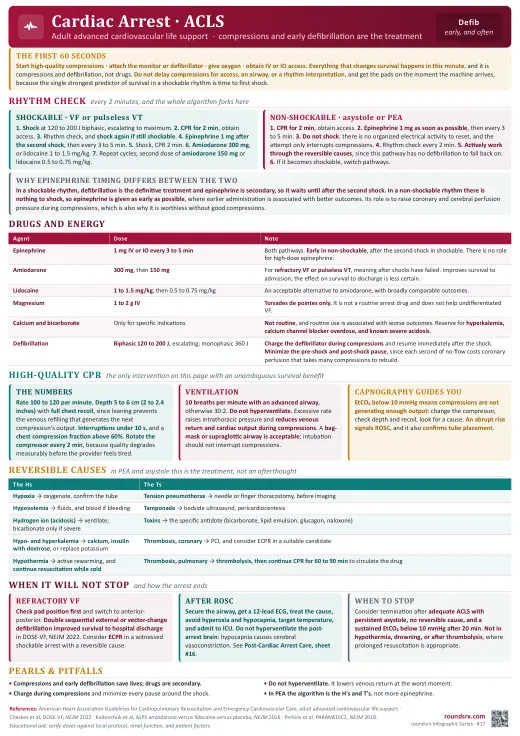
Cardiac Arrest -Adult Algorithm
Start CPR immediately. Rhythm check every 2 minutes. Push hard (≥ 2 inches), push fast (100–120/min), full recoil, minimize interruptions (< 10 sec for rhythm checks).
⚡ Shockable: VF / pVT
Shock
Defibrillate: biphasic 120–200J (or per device). Monophasic 360J. Resume CPR immediately × 2 min.
2 min
Rhythm check. If still VF/pVT → shock again. Resume CPR. Give epinephrine 1 mg IV/IO q3–5 min.
4 min
Rhythm check. If still VF/pVT → shock + amiodarone 300 mg IV/IO bolus. (2nd dose: 150 mg).
Ongoing
Continue 2-min cycles: CPR → rhythm check → shock if VF/pVT → epi q3–5 min. Search for reversible cause (H's & T's).
🔇 Non-Shockable: PEA / Asystole
Immediately
CPR + epinephrine 1 mg IV/IO as soon as access obtained. No shock for PEA/asystole.
2 min
Rhythm check. If PEA/asystole → resume CPR. Epi 1 mg q3–5 min.
Key
Find and treat the cause. PEA has a cause -run through H's & T's aggressively. Asystole is usually a terminal rhythm.
Transition
If rhythm changes to VF/pVT → switch to shockable pathway immediately.
ACLS Drug Dosing
| Drug | Dose | Indication | Notes |
|---|---|---|---|
| Epinephrine (Adrenalin) | 1 mg IV/IO q3–5 min | All cardiac arrest rhythms | Give immediately in PEA/asystole. After 2nd shock in VF/pVT. No max dose. |
| Amiodarone (Cordarone) | 300 mg IV/IO first dose, 150 mg second | Refractory VF/pVT | Give after 3rd shock. Alternative: lidocaine 1–1.5 mg/kg. |
| Lidocaine | 1–1.5 mg/kg IV first, 0.5–0.75 mg/kg repeat | Alternative to amiodarone for VF/pVT | Max 3 mg/kg total. |
| Atropine | 1 mg IV q3–5 min (max 3 mg) | Symptomatic bradycardia | NOT for cardiac arrest (removed from ACLS arrest algorithm). Still used for bradycardia with pulse. |
| Adenosine (Adenocard) | 6 mg rapid IV push → 12 mg if needed | Stable regular narrow-complex SVT | Rapid push + immediate flush. Half-life 6 seconds. Warn patient: transient chest pressure/flushing. |
| Calcium chloride | 1–2 g (10–20 mL of 10%) IV slow push | Hyperkalemia, Ca-channel blocker OD, hypermagnesemia | Via central line preferred (tissue necrosis if infiltrates). Calcium gluconate 3g is alternative via peripheral. |
| Sodium bicarbonate | 1 mEq/kg IV | Hyperkalemia, TCA overdose, severe acidosis (pH < 7.1) | Not routine in cardiac arrest. Only for specific causes. |
| Magnesium sulfate | 1–2 g IV over 5–20 min | Torsades de Pointes, hypomagnesemia | First-line for Torsades. Also useful in refractory VF. |
Reversible Causes -H's & T's
| H's | Intervention |
|---|---|
| Hypovolemia | Volume resuscitation, blood products |
| Hypoxia | Secure airway, ventilate |
| Hydrogen ion (acidosis) | Bicarb, treat cause |
| Hypo/Hyperkalemia | Calcium, insulin/glucose, dialysis |
| Hypothermia | Active rewarming |
| T's | Intervention |
|---|---|
| Tension PTX | Needle decompression → chest tube |
| Tamponade | Pericardiocentesis |
| Toxins | Specific antidotes |
| Thrombosis (PE) | tPA 50 mg IV push |
| Thrombosis (MI) | PCI / cath lab |
Bradycardia with Pulse -Algorithm
Symptomatic? Hypotension, altered mental status, chest pain, acute HF → treat. Asymptomatic bradycardia → monitor.
1st Line
Atropine 1 mg IV q3–5 min (max 3 mg). Ineffective in transplanted hearts (denervated) and infra-nodal block (Mobitz II, 3rd degree).
If Atropine Fails
Transcutaneous pacing -apply pads, set rate 60–80, increase mA until capture. Sedate if conscious. OR dopamine 5–20 mcg/kg/min or epinephrine 2–10 mcg/min infusion as bridge.
Definitive
Transvenous pacing for persistent symptomatic bradycardia. Cardiology consult for permanent pacemaker if underlying cause is irreversible (complete heart block, SSS).
Tachycardia with Pulse -Algorithm
Unstable (hypotension, AMS, chest pain, acute HF)? → Synchronized cardioversion immediately. Do not delay for diagnosis.
| Rhythm | Width | Treatment |
|---|---|---|
| SVT (regular narrow) | Narrow (< 120 ms) | Vagal maneuvers → adenosine 6 mg → 12 mg. If refractory: diltiazem or cardioversion. (The old 6-12-12 sequence is superseded; AHA lists two doses.) |
| Afib/Aflutter (irregular narrow) | Narrow | Rate control: diltiazem or metoprolol. If unstable: cardioversion. See Afib with RVR topic. |
| Monomorphic VT (regular wide) | Wide (> 120 ms) | Stable: amiodarone 150 mg IV over 10 min. Unstable: synchronized cardioversion. If pulseless: defibrillate. |
| Polymorphic VT / Torsades | Wide, irregular | Magnesium 2g IV. If pulseless: defibrillate (unsynchronized). Stop offending drugs (QTc prolongers). Overdrive pacing. |
| Wide-complex uncertain | Wide | Treat as VT until proven otherwise. Amiodarone if stable. Cardioversion if unstable. Never give adenosine or CCB to wide-complex tachycardia of unknown origin. |
Post-Arrest: ROSC Checklist
- 12-lead ECG → STEMI → cath lab immediately
- SpO₂ target 94–98% -avoid hyperoxia
- PaCO₂ target 35–45 -avoid hypocapnia
- MAP ≥ 65–70 (norepinephrine first-line)
- Targeted temperature management -prevent fever > 37.7°C
- Continuous EEG monitoring (seizures in 30–40%)
- Full workup: echo, labs, CT head if no clear cardiac cause
- Secondary prevention ICD evaluation before discharge -any survivor of VF or hemodynamically unstable VT arrest NOT due to a transient/reversible cause is a Class I indication for ICD. Reversible causes (acute MI with complete revascularization, corrected electrolytes, drug-induced QT, commotio cordis) generally don't qualify. Evidence: AVID 1997, CIDS 2000, CASH 2000.
- → See full Post-Cardiac Arrest (ROSC) topic for details