Acute Abdomen
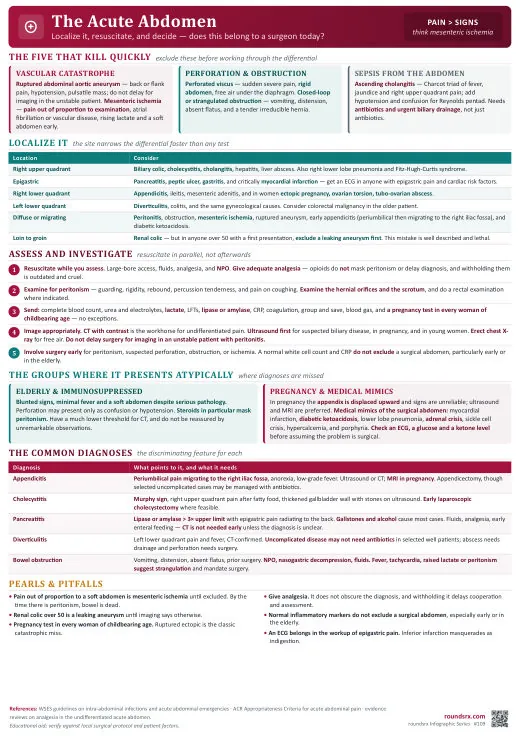
| Location | Key Diagnoses |
|---|---|
| RUQ | Cholecystitis, hepatitis, hepatic abscess, Fitz-Hugh-Curtis, RLL pneumonia |
| Epigastric | Peptic ulcer, pancreatitis, MI (inferior), aortic dissection/aneurysm |
| LUQ | Splenic infarct/rupture, pancreatitis (tail), LLL pneumonia |
| RLQ | Appendicitis, Meckel's, ovarian torsion, ectopic pregnancy, IBD |
| Suprapubic | UTI, urinary retention, ovarian torsion, ectopic pregnancy, cystitis |
| LLQ | Diverticulitis, ovarian pathology, sigmoid volvulus, IBD |
| Periumbilical | Early appendicitis, SBO, mesenteric ischemia, AAA rupture |
| Diffuse | Perforated viscus, peritonitis, mesenteric ischemia, DKA, SBO |
- ABCs -stabilize hemodynamics first
- IV access, fluids, labs -CBC, BMP, lipase, LFTs, lactate, UA, β-hCG (all women)
- Pain control -Morphine (MS Contin) or Fentanyl (Sublimaze). Treating pain does NOT mask surgical findings.
- NPO -if surgical cause suspected
- Surgery consult -peritonitis, free air, hemodynamic instability
- Perforated viscus (free air under diaphragm)
- AAA rupture
- Mesenteric ischemia with infarction
- Strangulated hernia/SBO
- Testicular/ovarian torsion
- Ectopic pregnancy with hemodynamic instability
- CT abdomen/pelvis with IV contrast -workhorse imaging for acute abdomen ACR Appropriateness Criteria, 2018
- Upright CXR -free air under diaphragm (perforated viscus)
- US -RUQ (biliary), pelvic (OB/GYN pathology), bedside FAST
- CBC, BMP, lipase, LFTs, lactate, UA
- β-hCG -ALL women of childbearing age. Ectopic kills.
- Type & screen if surgical candidate
| Drug | Dose | Purpose |
|---|---|---|
| Morphine (MS Contin) | 2–4 mg IV q2–4h | Pain control -does NOT mask surgical exam |
| Ketorolac (Toradol) | 15–30 mg IV | NSAID -good for renal colic, biliary colic |
| Ondansetron (Zofran) | 4 mg IV | Anti-emetic |
| Piperacillin-Tazobactam (Zosyn) | 3.375 g IV q6h | Broad-spectrum if peritonitis/perforation |
| IV NS/LR | Bolus 1–2 L | Volume resuscitation |
Patient: 55-year-old man with chronic NSAID use presents with sudden-onset severe epigastric pain radiating to the right shoulder (Kehr sign). Rigid abdomen, rebound tenderness, absent bowel sounds.
Key findings: Upright CXR shows free air under right hemidiaphragm. Lactate 3.2, WBC 18K. Tachycardic, BP 95/60.
Management:
- NPO, IV fluids, broad-spectrum antibiotics (piperacillin-tazobactam)
- Emergent surgery consult for exploratory laparotomy and repair
- Pain control with IV fentanyl (does NOT mask surgical exam)
Teaching point: Free air under the diaphragm = perforated viscus until proven otherwise. This is a surgical emergency - surgical repair within 24 hours is associated with decreased mortality Soreide et al., 2015. Do not delay for CT if clinical picture is clear and patient is unstable.
Patient: 72-year-old woman with atrial fibrillation (not on anticoagulation) presents with severe periumbilical pain for 6 hours. Pain is 10/10 but abdomen is soft and non-tender on palpation.
Key findings: Pain out of proportion to exam. Lactate 5.8. WBC 22K. CT angiography shows SMA thromboembolism with bowel wall thickening.
Management:
- Emergent vascular surgery consult for embolectomy vs endovascular intervention
- IV heparin anticoagulation
- Aggressive IV fluid resuscitation, broad-spectrum antibiotics
- If peritonitis develops, emergent laparotomy for bowel resection
Teaching point: Pain out of proportion to exam + atrial fibrillation + elevated lactate = mesenteric ischemia until proven otherwise. CTA abdomen is the study of choice Bala et al. (ACS Surgery), 2022. Mortality exceeds 60% if diagnosis is delayed beyond 12 hours.
Patient: 28-year-old woman presents with 18 hours of periumbilical pain that has migrated to the RLQ. Anorexia, nausea, low-grade fever (38.2C). Positive McBurney point tenderness, positive Rovsing sign.
Key findings: WBC 14K with left shift. Beta-hCG negative. CT abdomen/pelvis shows dilated appendix (12 mm) with periappendiceal fat stranding and an appendicolith.
Management:
- NPO, IV fluids, IV antibiotics (cefoxitin or ceftriaxone + metronidazole)
- Surgery consult for appendectomy (laparoscopic preferred)
- If perforated with abscess: percutaneous drainage + antibiotics, delayed interval appendectomy in 6-8 weeks
Teaching point: Classic appendicitis presents with visceral pain (periumbilical) migrating to somatic pain (RLQ) as inflammation involves the parietal peritoneum. Always check beta-hCG in women of childbearing age to rule out ectopic pregnancy. Laparoscopic appendectomy remains the gold standard WSES Guidelines, 2020.
Patient: 55-year-old man with chronic NSAID use presents with sudden-onset severe epigastric pain radiating to the right shoulder (Kehr sign). Rigid abdomen, rebound tenderness, absent bowel sounds.
Key findings: Upright CXR shows free air under right hemidiaphragm. Lactate 3.2, WBC 18K. Tachycardic, BP 95/60.
Management:
- NPO, IV fluids, broad-spectrum antibiotics (piperacillin-tazobactam)
- Emergent surgery consult for exploratory laparotomy and repair
- Pain control with IV fentanyl (does NOT mask surgical exam)
Teaching point: Free air under the diaphragm = perforated viscus until proven otherwise. This is a surgical emergency - surgical repair within 24 hours is associated with decreased mortality Soreide et al., 2015. Do not delay for CT if clinical picture is clear and patient is unstable.
Patient: 72-year-old woman with atrial fibrillation (not on anticoagulation) presents with severe periumbilical pain for 6 hours. Pain is 10/10 but abdomen is soft and non-tender on palpation.
Key findings: Pain out of proportion to exam. Lactate 5.8. WBC 22K. CT angiography shows SMA thromboembolism with bowel wall thickening.
Management:
- Emergent vascular surgery consult for embolectomy vs endovascular intervention
- IV heparin anticoagulation
- Aggressive IV fluid resuscitation, broad-spectrum antibiotics
- If peritonitis develops, emergent laparotomy for bowel resection
Teaching point: Pain out of proportion to exam + atrial fibrillation + elevated lactate = mesenteric ischemia until proven otherwise. CTA abdomen is the study of choice Bala et al. (ACS Surgery), 2022. Mortality exceeds 60% if diagnosis is delayed beyond 12 hours.
Patient: 28-year-old woman presents with 18 hours of periumbilical pain that has migrated to the RLQ. Anorexia, nausea, low-grade fever (38.2C). Positive McBurney point tenderness, positive Rovsing sign.
Key findings: WBC 14K with left shift. Beta-hCG negative. CT abdomen/pelvis shows dilated appendix (12 mm) with periappendiceal fat stranding and an appendicolith.
Management:
- NPO, IV fluids, IV antibiotics (cefoxitin or ceftriaxone + metronidazole)
- Surgery consult for appendectomy (laparoscopic preferred)
- If perforated with abscess: percutaneous drainage + antibiotics, delayed interval appendectomy in 6-8 weeks
Teaching point: Classic appendicitis presents with visceral pain (periumbilical) migrating to somatic pain (RLQ) as inflammation involves the parietal peritoneum. Always check beta-hCG in women of childbearing age to rule out ectopic pregnancy.