Acute Decompensated Heart Failure
| Profile | Perfusion | Congestion | Management |
|---|---|---|---|
| Warm & Wet (~70%) | Adequate (warm extremities, normal mentation) | Yes (JVD, edema, crackles) | IV diuresis. This is the most common profile. Furosemide, monitor UOP, daily weights. |
| Cold & Wet (~20%) | Impaired (cold, clammy, AMS, low UOP) | Yes | ICU. Inotropes (dobutamine/milrinone) + diuresis. May need invasive monitoring. Consider mechanical circulatory support (MCS) early. |
| Cold & Dry (~5%) | Impaired | No | Cardiogenic shock. Pressors + inotropes + MCS. See Cardiogenic Shock topic. |
| Warm & Dry (~5%) | Adequate | No | Compensated. Optimize oral GDMT. Do NOT over-diurese. Symptom management. |
- Dyspnea, orthopnea, paroxysmal nocturnal dyspnea
- Rapid weight gain (> 2 kg in 48 hrs)
- Leg edema, fatigue, decreased exercise tolerance
- JVD, S3 gallop, pulmonary crackles, pitting edema
- Elevated JVP = elevated filling pressures (wet)
- Cool extremities, narrow pulse pressure = low output (cold)
| Test | Why |
|---|---|
| BNP / NT-proBNP | Most sensitive. Very high NPV for ruling out HF. BNP > 400 or NT-proBNP > 900 supports ADHF. |
| CXR | Pulmonary vascular congestion, Kerley B lines, cardiomegaly, pleural effusions. Fastest imaging. |
| Echo | Definitive. EF (HFrEF vs HFpEF), wall motion abnormalities, valvular disease, pericardial effusion. |
| BMP | Cr (tracks with diuresis), Na⁺ (hyponatremia = poor prognosis), K⁺, bicarb. |
| Troponin | Rule out ACS as trigger. Demand ischemia common in ADHF. |
| ECG | STEMI trigger? Afib with RVR? New LBBB? |
| CBC, LFTs, TSH | Anemia worsens HF. Congestive hepatopathy. Thyroid disease is reversible cause. |
- Medication non-adherence -most common, especially diuretics and sodium restriction
- Dietary indiscretion -sodium/fluid overload
- ACS / ischemia -always rule out with troponin + ECG
- Afib with RVR -loss of atrial kick + tachycardia-mediated worsening
- Uncontrolled HTN -flash pulmonary edema
- Infection / sepsis -increased metabolic demand on failing heart
- Worsening renal function -impaired diuresis
- Anemia, thyroid disease, PE, medication changes (NSAIDs, CCBs, TZDs)
| Drug (Brand) | Dose | Role | Key Notes |
|---|---|---|---|
| Furosemide (Lasix) 1ST LINE | 40–200 mg IV bolus or 10–40 mg/hr infusion | First-line diuretic. Decongestion. | 1–2.5× home oral dose IV. Monitor UOP, K⁺, Mg, Cr daily. Continuous infusion may cause less ototoxicity than large boluses. |
| Bumetanide (Bumex) ALTERNATIVE | 1–4 mg IV | Alternative loop diuretic. 40:1 ratio (furosemide 40 mg ≈ bumetanide 1 mg). | More predictable oral bioavailability than furosemide. Some prefer in outpatient setting. |
| Metolazone (Zaroxolyn) ADD-ON | 2.5–10 mg PO 30-60 min before loop diuretic | Sequential nephron blockade. Overcomes diuretic resistance. | Thiazide-like. Works even at low GFR (unlike HCTZ). Massive electrolyte shifts -monitor K⁺, Mg, Na aggressively. |
| Chlorothiazide (Diuril) ADD-ON (IV) | 500–1000 mg IV 30 min before loop diuretic | IV thiazide for sequential nephron blockade. Use when NPO or fast onset needed. | Only IV thiazide in US. Onset 15 min, duration 6–12h. Fails below eGFR 30 (unlike metolazone). Expensive (~$40–80 per dose). Severe hypokalemia, hyponatremia -monitor K⁺, Mg, Na aggressively. Dose BEFORE the loop, never after. |
| Acetazolamide (Diamox) ADD-ON | 500 mg IV daily × 3 days | Proximal tubule block (carbonic anhydrase inhibitor). Add-on for diuretic resistance and when metabolic alkalosis develops from loop diuresis. | ADVOR, 2022: successful decongestion at day 3 42% vs 30% (12% absolute increase, NNT < 9; RR 1.46) when added to loop. Works upstream of the loop so it stacks with thiazide (different site). Watch for metabolic acidosis (expected from mechanism) and hypokalemia. Dose-reduce at low eGFR. |
| Tolvaptan (Samsca) AQUARETIC / NICHE | 15–30 mg PO daily (inpatient start only) | V2 receptor antagonist (aquaretic). Excretes free water only, no Na effect. For hypervolemic hyponatremia (Na < 125) when further diuresis would worsen sodium. | EVEREST, 2007: symptom and weight benefit, no mortality benefit. Must start inpatient -rapid Na correction risk (ODS). Avoid in cirrhosis (hepatotoxicity). Short-term bridge only. |
| Nitroglycerin (Tridil) HYPERTENSIVE ADHF | 5–200 mcg/min IV drip | Preload reduction. Rapid relief of dyspnea in flash pulmonary edema with SBP > 140. | Venodilator predominantly. Titrate to symptom relief. Avoid if SBP < 90, severe AS, RV infarct, or PDE5 inhibitor use (sildenafil within 24h). |
| Nitroprusside (Nipride) SPECIALIZED | 0.3–5 mcg/kg/min IV | Afterload + preload reduction. Refractory hypertensive ADHF. | Requires arterial line. Cyanide toxicity risk > 48h or > 2 mcg/kg/min. Thiocyanate levels if prolonged. Avoid in renal failure (thiocyanate accumulation). |
| Dobutamine (Dobutrex) COLD & WET | 2–20 mcg/kg/min IV | Inotrope for low-output state. Cold & Wet profile. | ↑ CO, ↑ HR. Never use alone if MAP < 65 -pair with NE. Tachyphylaxis after 72h. See Inotropes Guide. |
| Milrinone (Primacor) COLD & WET / RV | 0.125–0.75 mcg/kg/min IV (skip loading dose) | Inodilator. RV failure, pulmonary HTN, patients on chronic BB. | ↓ PVR (key advantage in RV failure). Renally cleared -dose-adjust in AKI. Longer half-life (2–3h) than dobutamine's ~2 min. |
| Norepinephrine (Levophed) 1ST LINE PRESSOR | 0.05–1 mcg/kg/min IV (titrate to MAP ≥ 65) | First-line vasopressor for hypotension or cardiogenic shock complicating ADHF. Pair with dobutamine or milrinone if low CO. | SOAP II, 2010: preferred over dopamine (fewer arrhythmias, better cardiogenic shock outcomes). Central line preferred (extravasation necrosis risk peripherally). Once pressors needed, hold ACEi/ARB/ARNI, BB, MRA, SGLT2i until off pressors. |
| Ferric carboxymaltose (Injectafer) INPATIENT IRON | 15 mg/kg IV (max 750 mg/dose) × 2 doses separated by ≥ 7 days | Iron repletion in iron-deficient HF. Give during admission, not outpatient, for maximum event reduction. | AFFIRM-AHF, 2020: 26% reduction in HF hospitalizations at 52 weeks. Criteria: ferritin < 100 OR ferritin 100–299 + TSAT < 20%. Screen every ADHF admission. Avoid in active infection. Rare anaphylaxis (safer than older iron dextran). |
| Drug Class | During ADHF | When to Hold |
|---|---|---|
| ACEi / ARB / ARNI* *ARNI = Angiotensin Receptor-Neprilysin Inhibitor (sacubitril-valsartan) | Continue unless hypotensive or AKI | SBP < 90, Cr rising > 30%, K⁺ > 5.5 |
| Beta-blocker | Reduce dose if decompensated. Do NOT stop abruptly. | Cardiogenic shock, symptomatic bradycardia, severe hypotension |
| MRA* (spironolactone) *MRA = Mineralocorticoid Receptor Antagonist (spironolactone, eplerenone) | Continue if K⁺ stable | K⁺ > 5.0, AKI |
| SGLT2i* *SGLT2i = Sodium-Glucose Co-Transporter 2 Inhibitor (dapagliflozin, empagliflozin) | Continue if tolerated. EMPULSE, 2022: empagliflozin started in-hospital ADHF → clinical benefit. | eGFR < 20, DKA risk |
- HOLD: ACEi / ARB / ARNI, beta-blocker, MRA, SGLT2i, nitrates, hydralazine
- START: norepinephrine for MAP, plus dobutamine for low CO (milrinone preferred if RV failure or pulmonary HTN)
- CONTINUE (at adjusted dose): loop diuretic, titrated to UOP and MAP. Decongestion is still needed, just carefully.
- Resume sequentially once off pressors, MAP stable > 65, and Cr not rising: ACEi/ARB first, then beta-blocker, then MRA, then SGLT2i. Titrate back to home doses before discharge.
| Drug Class | Why it comes off | Notes |
|---|---|---|
| NSAIDs STOP | Prostaglandin inhibition blunts loop diuretic response, drives AKI, increases HF hospitalizations. | Includes ibuprofen, naproxen, ketorolac, diclofenac, and COX-2 inhibitors (celecoxib). Use acetaminophen or adjuvants for pain. |
| Non-DHP CCBs (diltiazem, verapamil) STOP in HFrEF | Negative inotropy worsens HF exacerbation. Contraindicated in HFrEF. | Amlodipine and felodipine are the only CCBs considered safe in HFrEF. Non-DHPs are OK in HFpEF when rate control is needed. |
| Thiazolidinediones (pioglitazone, rosiglitazone) STOP | PPAR-γ activation drives Na and water retention. Increased HF hospitalization; contraindicated in NYHA III-IV. | Switch diabetes management to SGLT2i or GLP-1 RA (both reduce HF events). |
| Saxagliptin HOLD / SWITCH | SAVOR-TIMI 53 showed an increased HF hospitalization signal. Sitagliptin and linagliptin appear safer. | Switch to sitagliptin, or better, to SGLT2i or GLP-1 RA. |
| Pregabalin / gabapentin HOLD | Peripheral edema is common and can mimic or worsen HF volume overload. | Especially hold if edema is disproportionate to the congestion picture. Consider duloxetine or TCA for neuropathic pain. |
| High-dose glucocorticoids MINIMIZE | Mineralocorticoid activity at high doses drives Na and water retention, HTN. | Not always possible to stop (autoimmune disease). Use lowest effective dose. Hydrocortisone has less mineralocorticoid effect at replacement doses. |
| Anti-arrhythmics with negative inotropy (flecainide, propafenone, disopyramide) AVOID in HFrEF | Class IC agents increase mortality in structural heart disease (CAST). Disopyramide is negatively inotropic. | Amiodarone and dofetilide are the only rhythm-control agents considered safe in HFrEF. |
| Excess IV fluids STOP | Overzealous maintenance fluids or high-Na medication carriers undo diuresis. Reconcile total Na and volume intake daily. | Convert IV meds to concentrated formulations. Use D5W as carrier when a drip is essential. |
- Step 0: Address reversible causes first. Stop NSAIDs (prostaglandin inhibition blunts loop response). Treat hypotension (kidneys can't diurese if MAP is too low, may need pressors to perfuse them). Switch PO to IV when gut edema is present. Check TSH (hypothyroid fluid retention mimics resistance). Consider bilateral renal artery stenosis if ACE-induced AKI pattern.
- Step 1: Max the loop. Double the IV dose (up to 200 mg furosemide IV bolus), switch from PO to IV, or start a continuous infusion (10-40 mg/hr). Gut edema makes PO absorption unreliable, so IV is the default in ADHF.
- Step 2: Add a tubular co-blocker (sequential nephron blockade). Two options at different tubular sites that can be used alone or stacked: thiazide (metolazone PO or Diuril IV) blocks the distal tubule, and acetazolamide 500 mg IV daily × 3 blocks the proximal tubule. ADVOR 2022: acetazolamide added to loop produced successful decongestion in 42% vs 30% at day 3 (12% absolute increase, NNT < 9; RR 1.46). Acetazolamide is particularly useful when loop diuresis has caused metabolic alkalosis. Give the thiazide 30-60 min before the loop.
- Step 3: Start an SGLT2 inhibitor if not already on one. Dapagliflozin 10 mg PO or empagliflozin 10 mg PO. EMPULSE / EMPAG-HF 2022: in-hospital start during ADHF reduced weight, NT-proBNP, and clinical events. Also foundational GDMT with mortality benefit. Drop the loop dose ~25% when starting to avoid over-diuresis.
- Step 4: Albumin + furosemide sandwich if serum albumin < 2.5 g/dL. See full breakdown at the bottom of this section.
- Step 5: Tolvaptan if hypervolemic AND hyponatremic (Na < 125). Blocks ADH at the collecting duct so the kidney excretes free water only, no Na effect. Must start inpatient (rapid-correction risk). Avoid in liver disease. EVEREST 2007 showed symptom and weight benefit without mortality benefit.
- Step 6: Ultrafiltration or dialysis if all pharmacologic options fail and the patient remains volume-overloaded with AKI or refractory acidosis.
| Feature | Furosemide (Lasix) | Chlorothiazide (Diuril) | Metolazone (Zaroxolyn) |
|---|---|---|---|
| Class | Loop | Thiazide (IV only in US) | Thiazide-like (PO only) |
| Role | Primary diuretic | Add-on for resistance | Add-on for resistance |
| Site of action | Thick ascending limb (NKCC2) | Distal tubule (NCC) | Distal tubule (NCC) |
| Route | IV or PO | IV only | PO only |
| Typical dose | 20-200+ mg IV | 500-1000 mg IV | 2.5-10 mg PO |
| Onset | IV 5 min / PO 30 min | IV 15 min | PO 60 min |
| Duration | ~2 h | 6-12 h | 12-24 h (longest) |
| % filtered Na blocked (alone) | ~25% (most potent single agent) | ~3-5% | ~5% |
| Works at eGFR < 30? | Yes | No | Yes (unique among thiazides) |
| Cost per dose | Pennies | ~$40-80 | Pennies |
| Main toxicities | Hypokalemia, hypomagnesemia, ototoxicity (high dose / rapid push), pre-renal AKI | Severe hypokalemia, hyponatremia, hypomagnesemia | Same as Diuril but longer and more profound (24h action window) |
| One-liner | The engine | Fast IV turbo | Long-acting PO turbo |
- Patient can swallow, any eGFR: metolazone 2.5-10 mg PO 30-60 min before the loop. Default choice. Cheap, long-acting, works in advanced CKD.
- NPO, or need fast predictable onset: Diuril 500-1000 mg IV 30 min before the loop. Works in 15 min. Expensive. Fails below eGFR 30.
- eGFR < 30: metolazone is the only option. Diuril and HCTZ lose efficacy at this level of renal function.
- Reaching for Diuril when metolazone PO would work. Diuril is expensive ($40-80 per dose vs pennies for metolazone) and shorter-acting. If the patient can swallow and isn't in fulminant gut edema, metolazone is the default.
- Giving the thiazide after or with the loop. The synergy depends on the thiazide being at the distal tubule BEFORE the loop dumps Na downstream. Dose the thiazide 30-60 min first, every time.
| Drug | Dose | Mechanism | When to reach for it |
|---|---|---|---|
| Acetazolamide (Diamox) ADVOR 2022 | 500 mg IV daily × 3 days | Proximal tubule carbonic anhydrase inhibitor. Blocks Na/HCO₃ reabsorption upstream of the loop. | Added to loop in ADHF → 46% more successful decongestion at day 3. Especially useful when loop diuresis has caused metabolic alkalosis. Can stack with thiazide (different site). |
| Dapagliflozin / Empagliflozin GDMT + DIURESIS | Dapa 10 mg PO / Empa 10 mg PO daily | Proximal tubule SGLT2 block. Modest natriuresis plus mortality/HF-hospitalization benefit independent of diabetes. | Start in-hospital during ADHF if not already on one. EMPULSE / EMPAG-HF 2022 showed reduced weight, NT-proBNP, clinical events. Drop loop ~25% to avoid over-diuresis. |
| Tolvaptan (Samsca) NICHE | 15-30 mg PO daily (inpatient start only) | V2 receptor antagonist (aquaretic). Blocks ADH at collecting duct. Excretes free water only, no Na effect. | Hypervolemic AND hyponatremic (Na < 125) when further diuresis would worsen sodium. Liver toxicity limits long-term use. Avoid in cirrhosis. |
| Hypertonic saline + high-dose furosemide NICHE / EU | 3% saline 150 mL + furosemide 250-500 mg IV, BID | Tonicity gradient mobilizes interstitial Na back into the vascular space, so the loop has more Na to excrete. | Refractory HF failing standard escalation. More European than US practice. SMAC-HF 2011. Avoid if Na > 140. |
- NSAIDs (including ketorolac), prostaglandin inhibition blunts loop response. Stop them.
- Hypotension, kidneys can't diurese below a perfusion threshold. MAP < 65 may need pressor support before more diuretic.
- Gut edema, PO furosemide bioavailability drops dramatically. Switch to IV.
- Hypothyroidism, fluid retention mimics volume overload. Check TSH.
- Bilateral renal artery stenosis, ACE-induced AKI looks like diuretic resistance. Consider if Cr jumps on ACEi/ARB with diuretic.
- Non-adherence to sodium restriction, ask the family what the patient is actually eating.
- Hypoalbuminemia < 2.5, impairs loop delivery to its tubular target (see sandwich, Step 4).
- "Renal-dose dopamine" (1-3 mcg/kg/min), no benefit. ROSE-HF 2013 was the definitive nail in the coffin. Don't order it.
- Nesiritide (recombinant BNP), ASCEND-HF 2011 neutral on outcomes, increases hypotension. Abandoned in most centers.
- Aggressive fluid restriction in cardiogenic shock, the kidneys need perfusion pressure. Restricting fluid here worsens AKI without improving congestion.
- Oncotic pull. Albumin raises plasma oncotic pressure, mobilizing interstitial fluid back into the vascular space so the loop has volume to diurese.
- Drug delivery. Furosemide is ~95% albumin-bound. In hypoalbuminemia, less drug reaches the proximal tubule for active secretion, so less reaches its NKCC2 target. Supplementing albumin restores drug delivery to the thick ascending limb.
- Diuretic-resistant edema despite max loop + thiazide
- Serum albumin < 2.5 g/dL
- Nephrotic syndrome with anasarca
- Cirrhotic refractory edema
- ICU third-spacing / capillary leak
- Post-op volume overload with low albumin
- Albumin 25% 100 mL IV (25 g) over 30 min
- Then furosemide 40-80 mg IV push at the end of the infusion
- Repeat q6-12h if needed
Patient: 68 y/o M with HFrEF (EF 25%), presenting with 10-lb weight gain, orthopnea, and bilateral leg edema. Home furosemide 80 mg PO BID.
Key findings: JVP 14 cm, bibasilar crackles, 3+ pitting edema. BNP 3,200, Cr 1.6 (baseline 1.2), K⁺ 3.2.
Management:
- IV furosemide 160 mg bolus (2x home oral dose), monitor UOP, target > 200 mL in 2h
- UOP 80 mL in 2h, double to 320 mg IV, add metolazone 5 mg PO 30 min prior
- Continue GDMT: SGLT2i safe in-hospital EMPULSE, 2022
- Replete K⁺ aggressively (target > 4.0), daily weights and strict I/Os
Teaching point: Diuretic resistance requires dose escalation (ceiling effect), then sequential nephron blockade with metolazone. A Cr bump ≤ 0.3 is acceptable during active diuresis.
Patient: 72 y/o F with HFrEF (EF 15%), presents with confusion, cool mottled extremities, and anasarca. SBP 78.
Key findings: MAP 52, narrow pulse pressure, lactate 4.1, Cr 3.2 (baseline 1.4), BNP 8,400. Echo: EF 12%.
Management:
- ICU admission, cold and wet profile (low CO + congestion)
- Start dobutamine 5 mcg/kg/min to improve cardiac output before diuresis
- Once MAP improves, add IV furosemide for decongestion
- Reduce BB dose but do NOT discontinue abruptly
Teaching point: Cold and wet is the most dangerous profile. These patients need inotropes before diuresis, you cannot diurese a heart that is not generating adequate forward flow.
Patient: 58 y/o M, no cardiac history, 1 week of progressive dyspnea with new AF and RVR (HR 152).
Key findings: JVP 12 cm, S3 gallop, BNP 2,800. Echo: EF 30%, dilated LV, moderate MR.
Management:
- Rate control with IV amiodarone (avoid diltiazem in HFrEF, negative inotrope)
- IV furosemide 40 mg (diuretic-naive starting dose)
- Initiate all 4 GDMT pillars: ARNI + BB + MRA + SGLT2i PARADIGM-HF, 2014
- Anticoagulation for AF, coronary angiogram to rule out ischemic etiology
Teaching point: Tachycardia-mediated cardiomyopathy from uncontrolled AF is reversible with rate/rhythm control. Start all 4 GDMT pillars early, do not wait to titrate one before starting the next.
Patient: 58M with newly diagnosed HFrEF (EF 25%), BP 118/72, HR 78, K⁺ 4.2, Cr 1.1. Currently on no cardiac medications.
🔄 Old approach: Start ACEi → wait weeks → add BB → wait weeks → add MRA → months later maybe ARNI. Patients spent months without full therapy.
New approach (2022 AHA/ACC, STRONG-HF, 2022): Start all 4 pillars within 1–2 weeks at low doses. Don't wait for one to reach target before starting the next.
| Timepoint | Action |
|---|---|
| Day 1 (Admission) | SGLT2i: Dapagliflozin (Farxiga) 10mg daily -start immediately, no titration needed, minimal BP effect. Easiest pillar to add on day 1. |
| Day 2–3 | ARNI: Sacubitril-valsartan (Entresto) 24/26mg BID -if SBP > 100 and off pressors. Go straight to ARNI (skip ACEi if new diagnosis). If already on ACEi, must wash out 36h before starting ARNI. Check BMP: K⁺ and Cr before adding MRA. |
| Day 3–5 (once near-euvolemic, off pressors) | Beta-blocker: Carvedilol (Coreg) 3.125mg BID -start low. Do NOT start during active decompensation or on inotropes (risk of cardiogenic shock). Wait until diuresis has taken effect and hemodynamics are stable. MRA: Spironolactone (Aldactone) 25mg daily -if K⁺ < 5.0 and eGFR > 30. |
| All 4 pillars on board within 1 week. Now uptitrate in parallel: | |
| Week 2 | Entresto → 49/51mg BID, carvedilol → 6.25mg BID (if BP and HR tolerate). |
| Week 4 | Entresto → 97/103mg BID (target dose), carvedilol → 12.5mg BID. |
| Week 8 | Carvedilol → 25mg BID (target dose). |
Key principles:
- Each drug reduces mortality independently -every day without full GDMT is a missed opportunity.
- Hypotension (SBP < 90) is the main limiting factor -prioritize ARNI > BB > MRA if BP-limited.
- "Creatinine bumps" of 0.3–0.5 are acceptable when starting RAAS inhibitors -don't reflexively stop.
- SGLT2i + MRA together are safe -monitor K⁺ but the risk of hyperkalemia is lower than feared.
Patient: 64F with known HFrEF (EF 20%), presents with orthopnea, PND, bilateral crackles, JVP 14cm, 2+ pitting edema. BP 142/88, SpO₂ 90% on RA.
Profile: Wet & Warm (congested, adequate perfusion) -most common presentation.
Immediate:
- Sit upright, O₂ to maintain SpO₂ > 92%. BiPAP if respiratory distress.
- Furosemide (Lasix) 80mg IV push (give 2× their home oral dose as IV dose -she takes 40mg PO daily → give 80mg IV; can escalate to 100mg / 2.5× if prior dose was inadequate). Can redose in 2h if < 100mL UOP.
- If inadequate response: double the dose → 160mg IV. If still inadequate → add metolazone (Zaroxolyn) 5mg PO 30 min before next lasix dose (sequential nephron blockade).
Monitoring: Strict I&Os, daily weights (goal: net negative 1–2L/day), BMP BID (watch K⁺ and Cr -"creatinine bumps" of 0.3–0.5 are acceptable if patient is decongesting).
Home GDMT: Continue metoprolol succinate (Toprol XL) at current dose (do NOT uptitrate during decompensation, but do NOT stop unless cardiogenic shock). Hold ACEi/ARNI if hypotensive or Cr rising sharply.
Discharge when: Stable on oral diuretics × 24h, ambulatory SpO₂ > 92%, weight at or near dry weight, scheduled HF clinic follow-up within 7 days.
| Parameter | Frequency | Target / Action |
|---|---|---|
| Daily weights | Every morning, same scale, before breakfast | Target 1-2 kg/day net loss during active diuresis. Weight gain > 2 lbs/day = fluid retention → uptitrate diuretics. |
| Strict I&Os | Every shift (q8h tallies) | Net negative 1-2 L/day during active diuresis. UOP ≥ 0.5 mL/kg/hr. If UOP drops, consider diuretic dose increase or combination diuretic therapy. |
| BMP (K⁺, Cr, Na⁺) | Daily while on IV diuretics; q1-2 days after RAAS inhibitor initiation or titration | K⁺ 4.0-5.0 (RAAS inhibitors raise K⁺, diuretics lower it). Cr rise ≤ 0.3 acceptable with diuresis. Na < 130 → consider fluid restriction. |
| Blood pressure | q4-6h inpatient; each clinic visit outpatient | SBP ≥ 90 for ARNI/ACEi/ARB titration. Tolerate asymptomatic SBP 90-100 if on GDMT. Hold vasodilators if symptomatic hypotension. |
| Heart rate | q4-6h inpatient; each visit outpatient | Resting HR 60-70 on maximally tolerated beta-blocker. Do NOT uptitrate BB during active decompensation. |
| BNP / NT-proBNP | Admission and pre-discharge (trend) | > 30% reduction from admission = adequate decongestion. Discharge BNP predicts readmission risk. |
| Echocardiogram (EF) | Reassess at 3-6 months after GDMT optimization | EF improvement on GDMT may reclassify HFrEF → HFimpEF. Continue all GDMT even if EF improves. |
| Telemetry | Continuous during IV diuresis and inotrope use | Monitor for AF, VT, bradycardia from BB/digoxin. Discontinue when stable on oral regimen. |
| Functional status | Each assessment | Dyspnea improvement, orthopnea resolution, exercise tolerance, appetite. The exam matters more than the labs. |
| Test | Rationale | Key Values |
|---|---|---|
| BNP / NT-proBNP | Diagnosis and prognostication. Trend to assess treatment response. | BNP >400 pg/mL or NT-proBNP >900 pg/mL (age <75) supports HF. Obesity falsely lowers BNP. Full high/low breakdown ↓ |
| TTE (echocardiogram) | Classify HFrEF (EF ≤40%) vs HFpEF (EF ≥50%). Assess wall motion, valves, diastolic function, RVSP. | EF ≤40% = HFrEF. EF 41–49% = HFmrEF. LA dilation, elevated E/e′ suggest elevated filling pressures. |
| BMP | Cr (cardiorenal syndrome), K⁺ (before RAAS inhibitors), Na⁺ (hyponatremia = poor prognosis), bicarb | Cr rise >0.3 from baseline = cardiorenal. Na <135 = independent mortality predictor. |
| CBC | Anemia worsens HF (high-output physiology). Infection as precipitant. | Hgb <10 → evaluate and treat anemia. Leukocytosis → infectious trigger? |
| Iron studies | Iron deficiency (even without anemia) worsens HF outcomes. IV iron improves symptoms. | Ferritin <100 OR ferritin 100–299 + TSAT <20% = iron deficient. Treat with IV iron FAIR-HF, 2009. |
| TSH | Hyper- and hypothyroidism are reversible causes of HF. | Check in all new HF diagnoses. |
| ECG | Ischemia, arrhythmia (new AF), LVH, LBBB (CRT candidacy if QRS ≥150 ms). | LBBB + EF ≤35% + QRS ≥150 ms → strong CRT indication. |
| Troponin | Rule out ACS as trigger for decompensation. Chronic mild elevation common in HF. | Acute rise-and-fall → ACS workup. Chronic low-level elevation = myocardial stress (not necessarily ACS). |
| CXR | Pulmonary edema (cephalization, Kerley B lines, effusions), cardiomegaly. | ~20% of ADHF patients have a normal CXR. Do not rely on CXR alone to rule out HF. |
| Condition | Why it raises BNP |
|---|---|
| Cardiac (the signal you want) | |
| Heart failure (HFrEF and HFpEF) | Volume and pressure overload stretch the ventricular wall, the intended diagnostic signal. Degree of elevation tracks severity and prognosis. |
| Atrial fibrillation | Atrial stretch plus the rapid ventricular rate raise BNP independent of HF, so new AF can push BNP into the “HF range” and muddy the diagnosis. Interpret cautiously in AF. |
| ACS / myocardial ischemia | Ischemic wall stress and stunning raise BNP; a high BNP post-MI predicts higher HF and mortality risk (prognostic, not just diagnostic). |
| Valvular disease (AS, MR) | Chronic pressure (AS) or volume (MR) load stretches the ventricle even before symptoms; rising BNP can flag the time for intervention. |
| Myocarditis, cardiac contusion, post-cardiac surgery, post-cardioversion | Direct myocardial injury or stress releases BNP transiently. |
| Non-cardiac (raises BNP without HF, the traps) | |
| Older age | BNP rises with age regardless of HF. Use age-adjusted NT-proBNP cutoffs: <450 (age <50), <900 (50–75), <1800 (>75) pg/mL to rule in acute HF. |
| CKD / renal failure | Reduced clearance raises baseline levels. NT-proBNP is affected more than BNP because NT-proBNP is cleared only by the kidney. Use higher cutoffs in CKD and trend rather than relying on a single value. |
| Pulmonary embolism | Acute RV pressure overload stretches the right ventricle; an elevated BNP in PE marks RV strain and worse prognosis (risk-stratification, not diagnosis). |
| Pulmonary hypertension, cor pulmonale, severe COPD | Chronic RV pressure overload stretches the RV, raising BNP from the right side of the heart. |
| Sepsis / critical illness | Cytokine-mediated myocardial depression plus volume shifts raise BNP; very common in the ICU and a frequent reason a BNP is hard to interpret there. |
| Female sex | Higher baseline BNP than men at any given age, a population effect to keep in mind near cutoffs. |
| Anemia, high-output states (cirrhosis, hyperthyroidism) | Increased cardiac work and circulating volume raise wall stress and therefore BNP. |
| Condition | Why BNP is low despite real HF |
|---|---|
| Obesity (especially BMI >35) | Adipocytes express natriuretic peptide clearance receptors (NPR-C), so BNP is cleared faster and runs low. A “normal” BNP does not rule out HF in an obese patient, consider halving the cutoff (roughly 50 pg/mL). NT-proBNP is less affected. |
| Flash (hyperacute) pulmonary edema | In the first 1–2 hours (e.g., hypertensive flash edema) BNP has not had time to rise. A low early value does not exclude acute HF, recheck a few hours later. |
| HFpEF vs HFrEF | Lower ventricular wall stress in HFpEF means lower BNP for the same degree of congestion; a meaningful minority of acute HFpEF presents with near-normal BNP. |
| Constrictive pericarditis / tamponade | The constrained ventricle cannot stretch, so BNP stays lower than the congestion suggests. Useful discriminator: BNP is markedly lower in constrictive pericarditis than in restrictive cardiomyopathy, which helps tell the two apart. |
| Stable, compensated chronic HF on optimal therapy | Lower wall stress than during decompensation, BNP falls toward the patient’s “dry” baseline. Trend against that personal baseline, not a population cutoff. |
- Use NT-proBNP if the patient is on sacubitril/valsartan (ARNI, Entresto), the hard rule. Neprilysin inhibition blocks BNP breakdown so BNP is falsely elevated and uninterpretable; NT-proBNP is not a neprilysin substrate and stays valid.
- NT-proBNP also has the edge for sample stability (half-life ~1–2 h vs BNP ~20 min, less minute-to-minute noise) and has well-validated age-adjusted rule-in cutoffs (>450 if <50y, >900 if 50–75, >1800 if >75).
- Lean BNP in advanced CKD, both rise with renal impairment but NT-proBNP rises more (renal-only clearance), so BNP is marginally less confounded. Soft preference, both still need adjusted cutoffs.
- Never compare a BNP value to an NT-proBNP value, NT-proBNP runs roughly 5–10× higher. Pick one assay and trend that same one across the admission and between visits.
- CKD raises NT-proBNP more than BNP, because the kidney is NT-proBNP’s only exit.
- Obesity lowers BNP more than NT-proBNP, because NPR-C clearance acts on active BNP.
- Sacubitril/valsartan (ARNI, Entresto) makes BNP go UP and become unreliable, neprilysin inhibition blocks BNP breakdown. NT-proBNP is not a neprilysin substrate, so use NT-proBNP to monitor patients on an ARNI.
- Do not switch assays mid-course. Pick BNP or NT-proBNP and trend the same one, the numeric scales are not interchangeable.
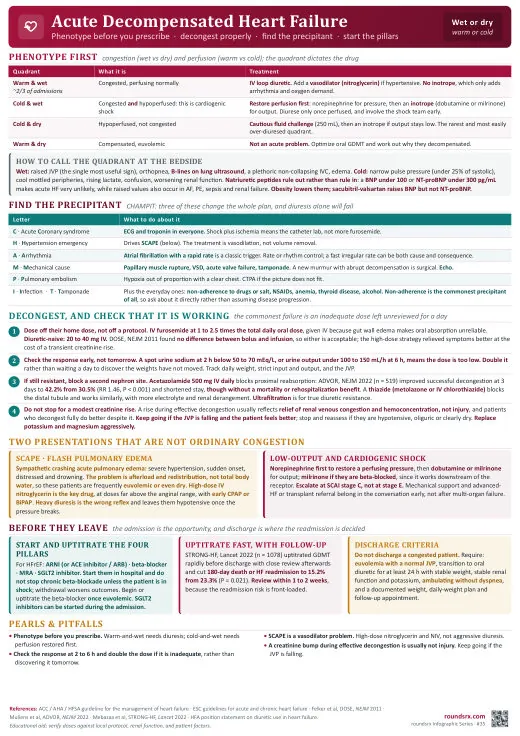 ⤢ Tap to open full size
Text version
🧪 Workup: BNP/NT-proBNP, BMP, troponin, echo, CXR, iron studies. Identify precipitant.
💧 Diurese: IV furosemide 1–2.5× home dose. UOP goal 0.5–1 mL/kg/hr. Add metolazone if resistant.
💊 GDMT: Continue ACEi/ARNI, BB (reduce dose, don’t stop), MRA, SGLT2i. Initiate before discharge.
📈 Monitor: Daily weight, I/Os, BMP (Cr, K⁺), telemetry. Cr bump ≤0.3 acceptable during diuresis.
🏠 Discharge: Stable on PO diuretics ≥24h, at dry weight, GDMT initiated, 7-day follow-up, daily weight education.