Acute Kidney Injury (AKI)
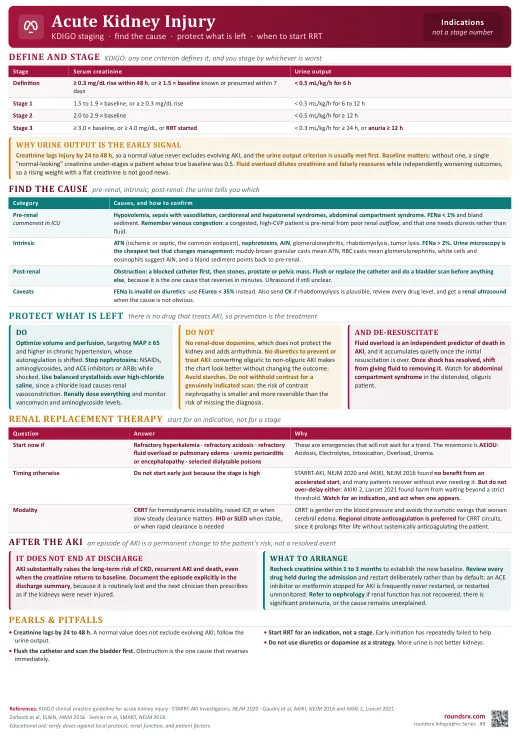
- Terlipressin is first-line for HRS-AKI in the US (FDA approved 2022), replaces midodrine + octreotide as the preferred regimen when available. CONFIRM, 2021
- Contrast-associated AKI is overestimated. N-acetylcysteine and bicarbonate are not recommended; isotonic saline only for eGFR <30. PRESERVE, 2018 · AMACING, 2017 Don't withhold needed imaging for moderate CKD.
- SGLT2 inhibitors: Hold during acute illness / volume depletion, but resume after recovery, they are renoprotective long-term. EMPA-KIDNEY, 2022
- Early vs delayed RRT: Watchful waiting is preferred for stage 2/3 AKI without emergent indications. STARRT-AKI, 2020 · AKIKI, 2016
- Furosemide stress test (1–1.5 mg/kg IV; UOP <200 mL/2h predicts progression) is now an accepted bedside risk-stratification tool.
- Biomarkers (TIMP-2 × IGFBP-7 / NephroCheck): FDA-cleared for early AKI prediction in ICU patients, adoption variable, not yet standard of care.
- Patiromer / SZC have replaced SPS (Kayexalate) for non-emergent hyperkalemia, faster onset, lower risk of intestinal necrosis.
| Stage | Creatinine Criteria | Urine Output |
|---|---|---|
| 1 | ↑ ≥ 0.3 in 48h OR 1.5–1.9× baseline | < 0.5 mL/kg/hr × 6–12h |
| 2 | 2.0–2.9× baseline | < 0.5 mL/kg/hr × ≥ 12h |
| 3 | ≥ 3× baseline OR ≥ 4.0 mg/dL OR RRT initiated | < 0.3 mL/kg/hr × ≥ 24h or anuria × 12h |
- Volume depletion: vomiting, diarrhea, poor intake, diuresis
- Low CO states: heart failure, cardiogenic shock
- Renal hypoperfusion: ACEi/ARB in bilateral RAS, NSAIDs, hepatorenal syndrome
- ATN (most common intrinsic): ischemia, nephrotoxins (aminoglycosides, contrast, myoglobin, vancomycin)
- Glomerulonephritis: RBCs + protein + RBC casts on UA
- AIN (interstitial nephritis): drug-induced (PCN, NSAIDs, PPIs), eosinophiluria
- Vascular: renal artery thrombosis, TTP, HUS
- Bilateral ureteral obstruction, BPH, bladder outlet obstruction
- Check with renal ultrasound + bladder scan
- UA with microscopy -RBC casts (GN), waxy/granular casts (ATN), eosinophils (AIN), protein
- FENa = (UNa × PCr) / (PNa × UCr) × 100
< 1% = pre-renal or early contrast nephropathy
> 2% = ATN (intrinsic)
Note: FEUrea more reliable in patients on diuretics (< 35% = pre-renal)
- BMP -creatinine trend, K⁺, bicarb, BUN:Cr ratio (> 20:1 suggests pre-renal)
- CBC, LFTs
- Complement, ANA, ANCA, anti-GBM -if GN suspected
- Renal ultrasound -hydronephrosis, echogenicity, kidney size
- Review all medications -nephrotoxins, ACEi/ARBs, NSAIDs (full renal dosing reference)
- Volume resuscitation with IV crystalloid (LR preferred SMART, 2018)
- Hold ACEi/ARBs, NSAIDs, diuretics until creatinine stabilizes
- Treat underlying cause (heart failure, hepatorenal syndrome, hemorrhage)
- Expect creatinine to improve within 24–48h if truly pre-renal
- Supportive care -no specific treatment accelerates recovery
- Strict I&Os, careful fluid management (avoid overload)
- Aggressive electrolyte management (K⁺, bicarb, phosphate)
- Avoid contrast, nephrotoxins
- Foley catheter if BPH/bladder outlet obstruction → expect post-obstructive diuresis
- Urology consult for ureteral obstruction (stenting vs percutaneous nephrostomy)
- Monitor for post-obstructive diuresis (replace 50–75% UOP with IV fluids)
| Letter | Indication | Details |
|---|---|---|
| A | Acidosis | Severe metabolic acidosis (pH < 7.1) refractory to bicarb infusion |
| E | Electrolytes | Refractory hyperkalemia (K⁺ > 6.5 with ECG changes despite medical Rx -insulin/glucose, calcium, patiromer/Lokelma) |
| I | Ingestions | Toxic alcohols (methanol, ethylene glycol), lithium, salicylates -dialyzable toxins |
| O | Overload | Volume overload causing pulmonary edema/respiratory failure refractory to diuretics |
| U | Uremia | Uremic encephalopathy (asterixis, AMS, seizures), uremic pericarditis (friction rub -pericardial effusion risk) |
| Trial | Year | Finding |
|---|---|---|
| AKIKI | 2016 | Early RRT (within 6h of KDIGO 3) vs delayed (watchful waiting for AEIOU indication) in critically ill AKI -no mortality difference. 49% of delayed group never needed dialysis at all. |
| IDEAL-ICU | 2018 | Early vs delayed RRT in septic shock with AKI -no benefit. Stopped early for futility. 38% of delayed group avoided RRT entirely. |
| STARRT-AKI | 2020 | Largest trial (n=2,927). Accelerated vs standard RRT initiation -no 90-day mortality benefit. Accelerated group had more catheter-related bloodstream infections and hypotension during dialysis. |
Patient: 72M admitted for pneumonia, Cr rising 1.0 → 2.4 over 48h (KDIGO Stage 2)
Step 1 -Pre-renal vs Intrinsic vs Post-renal:
- BUN/Cr ratio: 42 (> 20:1 → suggests pre-renal)
- FENa: 0.4% (< 1% → pre-renal)
- Urine Na: 8 mEq/L (< 20 → avid Na retention = pre-renal)
- UA: No casts, no protein (argues against ATN or glomerulonephritis)
- Renal US: No hydronephrosis (rules out post-renal obstruction)
Assessment: Pre-renal AKI from volume depletion. Management: IV LR boluses, hold ACEi. Cr improved to 1.8 at 24h → confirms pre-renal.
Patient: 68M with CKD Stage 3 (baseline Cr 1.8), underwent cardiac catheterization with contrast 48h ago. Cr now 3.2. UOP declining.
Workup:
- FENa: 2.8% → intrinsic (ATN pattern)
- UA: Muddy brown granular casts → classic for ATN
- Timeline: Cr rise 24–72h post-contrast = classic contrast nephropathy
Management:
- IV isotonic fluids, NS or LR at 1 mL/kg/hr. Avoid volume overload (monitor lung exam, JVP).
- Hold all nephrotoxins, metformin, ACEi, NSAIDs, aminoglycosides.
- No more contrast for at least 48–72h. If urgent need → minimize volume + use iso-osmolar contrast.
- Expect peak Cr at 3–5 days, recovery over 7–14 days. If no recovery by day 14 → may need nephrology consult.
Key lesson: CKD + contrast = high risk. Pre-hydration with IV NS reduces risk. NAC (N-acetylcysteine) has been debunked, no benefit (PRESERVE trial, 2018).
Patient: 34M found down after drug overdose (unknown duration). Cr 4.6 (baseline normal). CK 85,000. Dark tea-colored urine. K⁺ 6.2 with peaked T-waves on ECG.
Pathophysiology: Muscle breakdown → myoglobin released → precipitates in renal tubules → ATN. Also causes massive K⁺ and phosphate release and Ca²⁺ sequestration.
Treatment:
- Aggressive IV fluids: NS at 200–300 mL/hr initially. Target UOP > 200–300 mL/hr to flush myoglobin. May need 10–15 L/day.
- Hyperkalemia: Calcium gluconate 1g IV (cardioprotection), insulin + D50, kayexalate. Continuous telemetry.
- Monitor CK q6–12h until trending down. Monitor compartment pressures if limb swelling.
- Avoid calcium repletion even if Ca²⁺ is low, it deposits in damaged muscle. Only give calcium for symptomatic hypocalcemia or ECG changes.
- Dialysis if refractory hyperkalemia, acidosis, or fluid overload despite aggressive IVF.
Key lesson: CK > 5,000 = rhabdo risk for AKI. Flood with fluids early, the best treatment is prevention of tubular precipitation. Always check CK in any "found down" patient.
Text version
- FENa < 1% / BUN:Cr > 20
- Volume depletion, low CO
- NSAIDs, ACEi/ARB
- Rx: IV fluids, hold nephrotoxins
- Cr improves in 24–48h
- FENa > 2% / muddy brown casts
- ATN: ischemia, contrast, aminoglycosides
- AIN: drugs (PPIs, NSAIDs, PCN)
- GN: RBC casts + proteinuria
- Rx: Supportive, avoid nephrotoxins
- Hydronephrosis on U/S
- BPH, bladder outlet obstruction
- Ureteral obstruction
- Rx: Foley or urology consult
- Watch for post-obstructive diuresis
- (UNa × PCr) ÷ (PNa × UCr) × 100
- < 1% = Pre-renal
- > 2% = ATN (intrinsic)
- Use FEUrea if on diuretics (< 35% = pre-renal)
- A -Acidosis (pH < 7.1)
- E -Electrolytes (refractory K⁺)
- I -Ingestion (toxic)
- O -Overload (refractory)
- U -Uremia (pericarditis, encephalopathy)
Patient: 82 y/o F with HTN and DM2, admitted for gastroenteritis with 3 days of vomiting/diarrhea. Home meds: lisinopril, ibuprofen PRN.
Key findings: HR 104, BP 92/58, dry mucous membranes. Cr 3.1 (baseline 1.0), BUN/Cr 32, FENa 0.3%, urine osm 620, bland sediment.
Management:
- Hold nephrotoxins: stop lisinopril and ibuprofen (ACEi + NSAID + dehydration = classic triple hit)
- Volume resuscitation with LR, reassess Cr at 24-48h
- Monitor UOP ≥ 0.5 mL/kg/hr
- Cr improved 3.1 → 2.2 → 1.4 over 72h confirming pre-renal recovery
Teaching point: FENa < 1% with concentrated urine (osm > 500) confirms avid sodium retention. The ACEi + NSAID + dehydration combination is the most common iatrogenic cause of pre-renal AKI.
Patient: 70 y/o M with CKD3 (baseline Cr 1.8) and DM2, Cr rises to 3.4 at 48h post-contrast CT. On furosemide chronically.
Key findings: UOP 25 mL/hr, FEUrea 58% (FENa unreliable on diuretics), urine microscopy: muddy brown granular casts. KDIGO stage 2.
Management:
- Supportive care, no specific treatment reverses established ATN
- Avoid further nephrotoxins, dose-adjust renally cleared medications
- Maintain euvolemia (ATN does not respond to volume loading)
- Monitor for dialysis indications (AEIOU mnemonic)
Teaching point: Use FEUrea when patients are on diuretics. Muddy brown granular casts are pathognomonic for ATN. NAC for contrast prophylaxis was debunked by PRESERVE, 2018.
Patient: 65 y/o M with BPH and prostate cancer, presents with anuria x24h, nausea, and confusion. K⁺ 7.1 with peaked T waves.
Key findings: Cr 8.2 (baseline 1.1), pH 7.18, bicarb 12. Renal US: bilateral hydronephrosis. Bladder scan 1,200 mL.
Management:
- Calcium gluconate 1g IV stat for cardiac membrane stabilization
- Foley catheter, 1,400 mL immediate drainage; anticipate post-obstructive diuresis
- Insulin 10U + D50 + albuterol 10 mg neb for K⁺ shifting
- Urology for nephrostomy tubes if needed; dialysis if refractory hyperkalemia/acidosis
Teaching point: Always get renal ultrasound in AKI to rule out obstruction, the most readily treatable cause. Post-obstructive diuresis causes massive electrolyte losses; monitor BMP q6h and replace IVF at 50-75% of UOP.
| Parameter | Frequency | Target / Action |
|---|---|---|
| Vitals | q4h floor, q1–2h ICU | HR, BP, RR, SpO₂, Temp -notify for significant deviations |
| Labs (BMP, CBC) | Daily AM or as indicated | Trend Cr, K⁺, WBC, Hgb -adjust treatment based on trajectory |
| Disease-specific markers | Per clinical context | See Overview and Management tabs for condition-specific targets |
| I&Os | Strict if volume-sensitive | UOP ≥ 0.5 mL/kg/hr. Net fluid balance guides diuresis or resuscitation. |
| Telemetry | Continuous if indicated | Arrhythmia detection. Discontinue when no longer indicated (reduces alarm fatigue). |
| Clinical response | Each assessment | Symptom improvement, functional status, appetite, mental status -the exam matters more than labs |
| Drug | Dose | Onset / Notes |
|---|---|---|
| Calcium gluconate 10% | 1–2 g IV over 2–5 min (or CaCl₂ via central line) | 1–3 min · membrane stabilization · K>6.5 or any ECG change |
| Insulin regular + D50 | 10 u IV + 25 g dextrose (check glc, recheck q1h ×4) | 15–30 min · drops K ~0.6–1.0 · hypoglycemia common, especially in AKI |
| Albuterol nebulizer | 10–20 mg neb (4–8× the asthma dose) | 15–30 min · drops K ~0.5–1.0 · additive to insulin |
| Sodium bicarbonate | 50–150 mEq IV (only if acidemic, pH <7.2) | Slow · best when AKI + metabolic acidosis · avoid in volume overload |
| Loop diuretic | Furosemide 40–80 mg IV (higher if known CKD) | Only if making urine · potassium-wasting |
| Patiromer / SZC | Patiromer 8.4 g PO daily · SZC 10 g PO TID ×48h then daily | Hours · for non-emergent K removal · bridge to definitive therapy |
| Hemodialysis | Emergent | Definitive · refractory hyperK, ESRD, or AEIOU criteria |
| Drug | Dose | Use |
|---|---|---|
| Furosemide | 40–80 mg IV bolus, double q2h to max 200 mg; or drip 5–20 mg/h | Volume overload only · does NOT prevent or treat AKI itself KDIGO |
| Bumetanide | 1–2 mg IV (≈40 mg furosemide) | Alternative if furosemide allergy or poor response |
| Metolazone | 2.5–10 mg PO 30 min before loop | Diuretic resistance · sequential nephron blockade · monitor K, Mg |
| Drug | Dose | Notes |
|---|---|---|
| Terlipressin CONFIRM, 2021 | 0.5–2 mg IV q4–6h (or continuous infusion) | First-line in US since FDA approval 2022. Hold for hypoxemia (SpO₂ <90%), black-box respiratory failure risk |
| Albumin 25% | 1 g/kg day 1 (max 100 g), then 20–40 g/day | Always paired with terlipressin / midodrine + octreotide |
| Midodrine + Octreotide | Mido 7.5–12.5 mg PO TID + Oct 100–200 mcg SC TID | Alternative if terlipressin unavailable / contraindicated |
| Norepinephrine | 0.5–3 mg/h IV | ICU alternative · titrate to MAP increase ≥10 mmHg |
- Stop immediately: NSAIDs, ACEi/ARB (during active AKI), aminoglycosides, IV contrast (when avoidable), SGLT2i (hold during acute illness), metformin (lactic acidosis risk if eGFR <30)
- Dose-adjust: Vancomycin (trough or AUC-guided), pip-tazo (extended infusion), cefepime (neurotoxicity at high levels in AKI), LMWH (switch to UFH if CrCl <30), DOACs, gabapentin/pregabalin, opioids (avoid morphine, codeine)
- Hold and reassess: Diuretics if pre-renal · spironolactone/eplerenone (hyperkalemia) · trimethoprim, tacrolimus (creatinine bumps)
- Resume after recovery: ACEi/ARB and SGLT2i once Cr stable and patient euvolemic, both are renoprotective long-term
- Isotonic saline 1–1.5 mL/kg/h ×6–12h before and after, only for eGFR <30 or AKI
- N-acetylcysteine: NOT recommended (PRESERVE), abandon this reflex order
- Bicarbonate infusion: NOT recommended over saline
- SGLT2i / metformin: Hold the day of contrast, resume 48 h later if Cr stable
- Sodium bicarbonate for severe metabolic acidosis (pH <7.2), BICAR-ICU, 2018
- Rasburicase 0.2 mg/kg IV ×1 for tumor lysis syndrome with uric acid >8 (screen for G6PD)
- Plasma exchange for TTP, anti-GBM, ANCA vasculitis with rapidly progressive GN
- High-dose steroids for biopsy-proven AIN (after stopping the offending drug), prednisone 1 mg/kg taper
- Calcitriol / phosphate binders: Reserve for prolonged AKI with CKD-MBD features, not routine