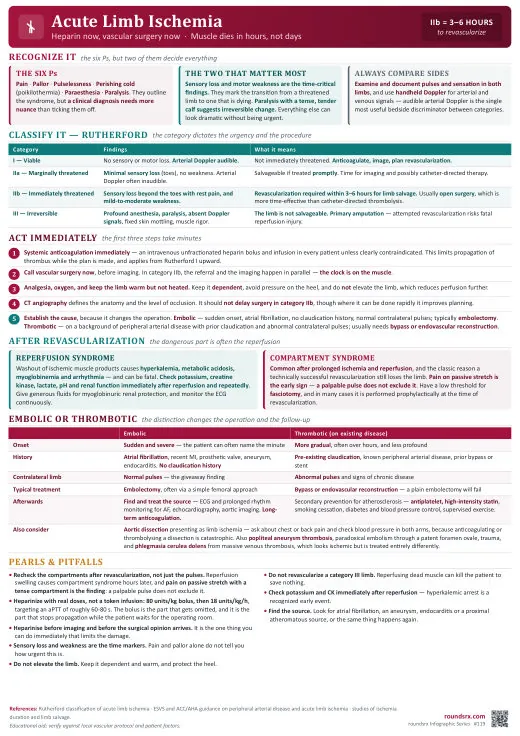
Acute Limb Ischemia
- Pain, sudden, severe
- Pallor
- Pulselessness
- Poikilothermia (cold)
- Paresthesia
- Paralysis (late = bad)
| Category | Status | Sensory | Motor |
|---|---|---|---|
| I | Viable | None | None |
| IIa | Marginally threatened | Minimal | None |
| IIb | Immediately threatened | Rest pain | Mild-moderate |
| III | Irreversible → amputation | Anesthetic | Paralysis |
| Feature | Embolism | Thrombosis (in-situ) |
|---|---|---|
| Onset | Sudden, dramatic (“bolt from the blue”) | More insidious (hours–days) |
| History | AF, recent MI, valvular disease, endocarditis | Known PAD, prior bypass/stent, claudication |
| Contralateral leg | Normal pulses | Often diminished pulses (bilateral PAD) |
| Location | Bifurcations (femoral, popliteal, aortic saddle) | At site of prior stenosis/graft |
| Collaterals | Absent (no time to develop) | Present (chronic disease) |
| Treatment | Embolectomy (Fogarty catheter) | Thrombolysis, angioplasty, or bypass |
| Rutherford Class | Time Window | Intervention |
|---|---|---|
| I, Viable | Not immediately threatened | Heparin + elective angiography within hours |
| IIa, Marginally threatened | Hours (urgent) | Catheter-directed thrombolysis (tPA 0.5–1 mg/hr × 12–24h) |
| IIb, Immediately threatened | Minutes to hours (emergent) | Surgical embolectomy or bypass, NO time for thrombolysis |
| III, Irreversible | Too late for salvage | Amputation ± palliative care. Revascularization risks fatal reperfusion injury |
- ABI, CTA (if stable). Labs: CBC, BMP (K+), lactate, CK, coags
- ECG for AF (common embolic source)
- Do NOT delay heparin for imaging
| Step | Action |
|---|---|
| 1 | Heparin 80u/kg bolus → 18u/kg/hr IMMEDIATELY |
| 2 | Vascular surgery consult STAT |
| 3 | Catheter-directed thrombolysis, embolectomy, or bypass |
| 4 | Post-reperfusion: watch compartment syndrome → fasciotomy |
| Drug | Dose | Notes |
|---|---|---|
| Heparin UFH | 80u/kg bolus, 18u/kg/hr | aPTT 60–80s. Prevents clot propagation |
| tPA (catheter-directed) | 0.5–1mg/hr intra-arterial | Rutherford I–IIa. Takes 12–24h |
Patient: 72F with known AF (not on anticoagulation, “refused warfarin”), presents with sudden onset left leg pain, pallor, and coldness 3 hours ago. No prior claudication.
Exam: Left leg pale, cool, no popliteal or pedal pulses. Sensation diminished over foot. Can still weakly dorsiflex toes. Right leg warm with normal pulses.
Classification: Rutherford IIa (sensory loss, minimal motor). Normal contralateral pulses + AF + sudden onset = embolic etiology.
Management:
- Heparin 80 u/kg bolus → 18 u/kg/hr started immediately in ED
- CTA confirms occlusion at left common femoral artery bifurcation (classic embolic location)
- Vascular surgery performs Fogarty balloon embolectomy under local anesthesia
- Completion angiogram shows restored flow. Pedal pulses return
- Post-op: monitor for compartment syndrome, K+ q2h, CK trending
- Long-term: Started apixaban 5 mg BID for AF (CHA₂DS₂-VASc = 4). Cardiology follow-up
Key lesson: Embolic ALI from AF is preventable with anticoagulation. Fogarty embolectomy is first-line for embolic ALI.
Patient: 65M with history of PAD (prior right SFA stent 2 years ago), DM2, smoking. Presents with 18 hours of worsening right foot pain and numbness. Reports baseline 1-block claudication.
Exam: Right foot mottled, cool. No pedal pulses. Cannot dorsiflex toes (motor deficit). Left leg has diminished but palpable dorsalis pedis pulse.
Classification: Rutherford IIb (motor deficit). Bilateral diminished pulses + PAD history + gradual onset = thrombotic etiology (likely in-stent thrombosis).
Management:
- Heparin bolus + infusion started immediately
- Rutherford IIb with motor deficit → NO thrombolysis (too slow). Taken to OR emergently
- Intra-op: thrombosed SFA stent with propagation into popliteal. Surgical thrombectomy + fem-pop bypass with reversed saphenous vein graft
- Post-op: pedal pulses restored. CK peaked at 8,200. K+ 5.8 → treated with calcium gluconate + insulin/dextrose
- Monitored for compartment syndrome, pressures remained <25 mmHg, no fasciotomy needed
- Long-term: Dual antiplatelet (ASA + clopidogrel), statin, smoking cessation, DM optimization
Key lesson: Rutherford IIb (motor deficit) = go to OR, not cath lab. Thrombotic ALI in PAD often needs bypass rather than simple embolectomy.
Patient: 58M s/p emergent embolectomy for Rutherford IIb ALI (6-hour ischemia time). Pulses restored in OR. Four hours post-op, develops tense calf swelling, escalating pain, and oliguria.
Labs: K+ 6.4, CK 45,000, Cr 2.8 (baseline 1.0), pH 7.22, lactate 8.5, urine dark brown (myoglobinuria).
Diagnosis: Reperfusion injury with rhabdomyolysis, hyperkalemia, and metabolic acidosis. Tense calf = compartment syndrome.
Management:
- Hyperkalemia: Calcium gluconate 1g IV (cardiac membrane stabilization), insulin 10 units + D50, kayexalate. Continuous telemetry for peaked T-waves
- Rhabdomyolysis: Aggressive IVF (target UOP 200–300 mL/hr), sodium bicarbonate drip to alkalinize urine (target urine pH >6.5)
- Compartment syndrome: Compartment pressures 42 mmHg → emergent four-compartment fasciotomy
- ICU admission: Continuous renal replacement therapy (CRRT) initiated for refractory hyperkalemia and acidosis. CK trended downward over 5 days
- Fasciotomy wounds closed with split-thickness skin graft at day 7
Key lesson: Reperfusion injury is the “second hit” after revascularization. Longer ischemia time = higher risk. Anticipate hyperK, rhabdo, and compartment syndrome. ICU monitoring is mandatory.
| Parameter | Frequency |
|---|---|
| Pulse checks | q1h |
| Compartment pressures | Post-reperfusion. >30mmHg → fasciotomy |
| K+, CK, Cr | q4–6h post-reperfusion |
| aPTT | q6h |