Acute Liver Failure
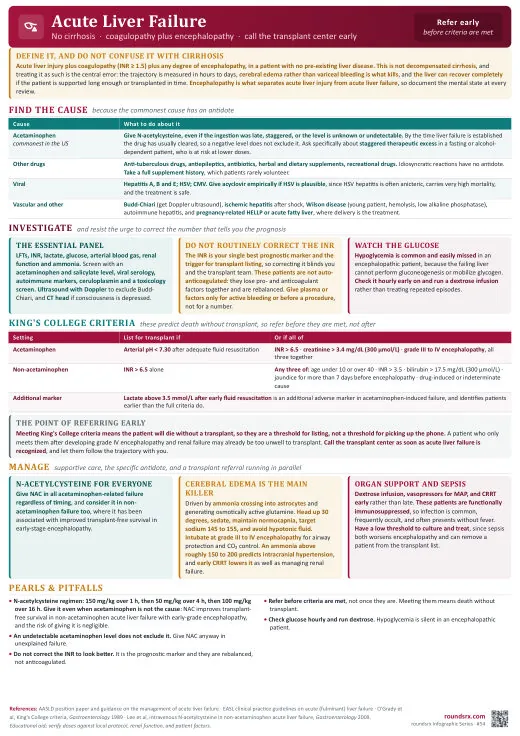
Acute liver failure (ALF) is defined by the triad: (1) Coagulopathy (INR ≥1.5), (2) Hepatic encephalopathy (any grade), and (3) No prior liver disease, with illness duration <26 weeks. It is a medical emergency with mortality >50% without transplant in many etiologies.
- Acetaminophen (acetaminophen), #1 cause in US/UK. Best prognosis of all causes. Often unintentional (supratherapeutic dosing).
- Viral hepatitis, HAV, HBV (most common worldwide), HEV (especially in pregnancy)
- Autoimmune hepatitis, can present fulminantly
- Wilson disease, suspect in young patients with Coombs-negative hemolytic anemia + ALF
- Budd-Chiari syndrome, hepatic vein thrombosis
- Drug-induced, isoniazid, phenytoin, statins, herbal supplements, anti-TB drugs
- Pregnancy-related, HELLP syndrome, acute fatty liver of pregnancy (AFLP)
- Ischemic hepatitis, "shock liver" from hypoperfusion
- Mushroom poisoning, Amanita phalloides (death cap)
- Indeterminate, ~20% remain without identified cause
- Hyperacute: 0-7 days (acetaminophen, ischemic). Often better prognosis with higher chance of spontaneous recovery.
- Acute: 8-28 days
- Subacute: 29 days to 26 weeks (worst prognosis, less cerebral edema but more portal hypertension)
- N-acetylcysteine (NAC), IV protocol: 150 mg/kg over 1h, then 50 mg/kg over 4h, then 100 mg/kg over 16h. Continue until INR <1.5 or transplant.
- ICU admission, all ALF patients need ICU-level monitoring.
- Contact transplant center EARLY, do not wait for deterioration. Transfer may become impossible once cerebral edema develops.
- Intubate for Grade III-IV encephalopathy, airway protection. Avoid propofol if hemodynamically unstable.
- pH <7.3 after resuscitation, OR
- All three: INR >6.5 + Creatinine >3.4 mg/dL + Grade III-IV HE
- INR >6.5 alone, OR
- Any 3 of: age <10 or >40, non-A/non-B hepatitis or drug etiology, jaundice >7 days before HE onset, INR >3.5, bilirubin >17.5 mg/dL
- Cerebral edema: Elevate HOB to 30°. Mannitol 0.5-1 g/kg IV (if serum osm <320) or hypertonic saline (23.4%) for acute herniation. Avoid hyperthermia. Target Na 145-155 mEq/L with hypertonic saline prophylaxis.
- Hypoglycemia: D10 continuous drip. Check glucose q1-2h. Common and life-threatening (failed hepatic gluconeogenesis).
- Coagulopathy: Only treat if actively bleeding. Paradoxically balanced hemostasis (low pro- and anti-coagulant factors). Routine FFP is harmful.
- Infection: Low threshold for empiric antibiotics. Surveillance cultures daily. Up to 80% develop bacterial infection, 30% fungal.
- AKI: Common (50-70%). Avoid nephrotoxins. CRRT preferred over intermittent HD (less hemodynamic instability, better ICP control).
Etiology-specific workup should be sent simultaneously on arrival:
- Acetaminophen level, check even if not suspected (unintentional overdose is common)
- Viral serologies: HAV IgM, HBsAg, HBc IgM, HCV RNA (not just anti-HCV), HEV IgM (if pregnant or endemic area)
- Autoimmune: ANA, anti-smooth muscle antibody (ASMA), IgG levels
- Wilson disease: Ceruloplasmin (low), 24h urine copper, slit-lamp exam (Kayser-Fleischer rings). Alkaline phosphatase:bilirubin ratio <4 + AST:ALT ratio >2.2 suggests Wilson.
- Budd-Chiari: Doppler ultrasound of hepatic veins
- Pregnancy test, HELLP, AFLP
- Drug screen / toxicology, urine drug screen, medication reconciliation
- HSV, HSV PCR if immunocompromised or unexplained (consider empiric acyclovir)
- CBC, CMP (LFTs, BMP), coags (INR, PT, fibrinogen), lactate, ammonia level, lipase
- ABG (acid-base status), phosphate (prognostic, rising phosphate in acetaminophen ALF = failure to regenerate)
- Blood type and screen (anticipate possible transplant)
| Drug | Indication | Dose | Notes |
|---|---|---|---|
| N-acetylcysteine (NAC) | ALL ALF, first-line | 150 mg/kg IV over 1h → 50 mg/kg over 4h → 100 mg/kg over 16h | Continue until INR <1.5 or transplant. Improves transplant-free survival even in NON-acetaminophen ALF. Lee, Gastroenterology 2009 |
| Mannitol 20% | Cerebral edema / herniation | 0.5-1 g/kg IV bolus | Use if serum osm <320. Can repeat x1. Monitor serum osmolality. |
| Hypertonic saline (3% or 23.4%) | Cerebral edema prophylaxis | 3% NaCl infusion targeting Na 145-155 | Prophylactic hypernatremia reduces cerebral edema incidence. 23.4% (30 mL) for acute herniation. |
| Dextrose 10% (D10) | Hypoglycemia prevention | Continuous drip at 75-100 mL/h | Check glucose q1-2h. Hepatic gluconeogenesis fails, hypoglycemia is common and dangerous. |
| Lactulose | Hepatic encephalopathy | 30 mL PO/NG q2h titrated to 3-4 BMs/day | Role in ALF is less established than in cirrhotic HE, but often given. Avoid excessive diarrhea (volume depletion). |
| Piperacillin-tazobactam | Empiric antibiotics | 4.5 g IV q6h | Low threshold. Infection in up to 80%. Fungal prophylaxis (fluconazole) may be warranted. |
Patient: 28F presents with 5 days of nausea, vomiting, and jaundice. Reports taking "extra-strength Tylenol" ~4-6 g/day for 10 days for back pain. No prior liver disease.
Key findings: HR 110, BP 95/60, confused with asterixis (Grade II HE). ALT 8,400, AST 10,200, total bilirubin 8.5, INR 4.8, Cr 2.1, pH 7.28, lactate 6.2, acetaminophen level 45 mcg/mL.
Management:
- IV NAC immediately (150 mg/kg over 1h, then 50 mg/kg over 4h, then 100 mg/kg over 16h). Continue until INR < 2 and improving
- Do NOT correct INR prophylactically -- it is the best prognostic marker. Only give FFP/PCC if actively bleeding
- Apply King's College Criteria serially: pH < 7.3 after resuscitation = list for transplant
- ICU admission. Monitor glucose q1-2h (hepatic gluconeogenesis fails). For cerebral edema: hypertonic saline, target Na 145-155
Teaching point: Acetaminophen ALF has the best prognosis if treated promptly with NAC. Unintentional supratherapeutic dosing is more common than intentional overdose. Never correct INR prophylactically -- it masks prognosis.
Patient: 35F with no prior history, presents with 2 weeks of fatigue, jaundice, and dark urine. Now confused and unable to follow commands. PMH: Hashimoto thyroiditis.
Key findings: Jaundiced, Grade III HE. ALT 2,100, AST 1,800, total bilirubin 22, INR 3.6, IgG 3,200 (markedly elevated), ANA 1:640, anti-smooth muscle antibody positive. Viral hepatitis serologies negative.
Management:
- IV NAC for all non-acetaminophen ALF -- improves transplant-free survival in Grade I-II HE Lee, 2009
- Autoimmune hepatitis causing ALF: trial of methylprednisolone 60 mg IV daily. If no improvement in 7 days, proceed to transplant listing
- Transjugular liver biopsy to confirm diagnosis and assess for cirrhosis
- Early transplant hepatology involvement -- autoimmune ALF has worse prognosis than acetaminophen ALF if steroid-unresponsive
Teaching point: NAC benefits ALL causes of ALF, not just acetaminophen. Autoimmune hepatitis causing ALF can receive a steroid trial, but do not delay transplant evaluation. Elevated IgG + autoantibodies in a young woman = think autoimmune.
Patient: 22M presents with acute jaundice, confusion, and dark urine x 1 week. No medications. Sister diagnosed with Wilson disease at age 18.
Key findings: Kayser-Fleischer rings on slit lamp. AST 1,400, ALT 600 (AST:ALT > 2.2), ALP 45 (paradoxically LOW), total bilirubin 32, INR 5.2. Ceruloplasmin 8 (low). Hgb 7.2 with Coombs-negative hemolytic anemia (reticulocytes 8%, haptoglobin < 10, LDH 890). 24h urine copper 1,200 mcg.
Management:
- List for transplant immediately -- Wilson ALF has near-100% mortality without transplant. No medical therapy reverses fulminant Wilson
- Revised Wilson Prognostic Index > 11 = transplant indicated
- D-penicillamine and trientine are NOT effective in fulminant Wilson disease (too slow)
- Supportive: NAC, plasmapheresis or MARS as bridge to transplant to remove copper
Teaching point: Wilson ALF has a classic triad: Coombs-negative hemolytic anemia + very low ALP + AST:ALT > 2.2. The ALP:bilirubin ratio < 4 is highly specific. This is a transplant emergency -- chelation does not work fast enough.
Mrs. Patel is a 28-year-old woman presenting with 5 days of nausea, vomiting, and jaundice, now with confusion and asterixis. She reports taking "extra-strength Tylenol" for back pain, approximately 4-6 g/day for the past week. VS: T 37.2, HR 110, BP 95/60, RR 22. Labs: ALT 8,400, AST 10,200, total bilirubin 8.5, INR 4.8, Cr 2.1, acetaminophen level 45 mcg/mL, pH 7.28, lactate 6.2, ammonia 98. Hepatitis serologies pending. NAC drip started immediately. Transplant hepatology notified.
- INR, LFTs q6-12h, trending INR is your prognostic window. Rising INR despite NAC = worsening. Falling INR = recovery.
- Glucose q1-2h, hypoglycemia is life-threatening and common. D10 drip.
- Ammonia level q12-24h, levels >150-200 mcmol/L associated with cerebral herniation.
- Neuro checks q1-2h, grade encephalopathy (West Haven criteria). Grade III-IV requires intubation.
- Lactate q6-12h, rising lactate in acetaminophen ALF is a poor prognostic sign.
- BMP q6h, K+, Na+, creatinine, phosphate trending.
- Urine output, target >0.5 mL/kg/h. AKI develops in 50-70%.
- King's College Criteria, reassess at least daily for transplant listing urgency.
- ICP monitoring, controversial. Consider in Grade III-IV HE if transplant candidate. Target CPP >60 mmHg, ICP <20 mmHg.