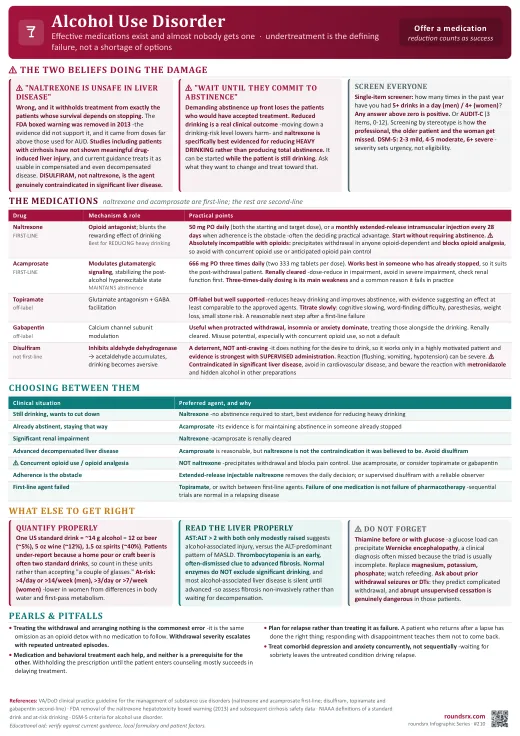
Alcohol Use Disorder
Alcohol use disorder is a chronic, relapsing medical condition with genuinely effective pharmacotherapy, and the central problem is that almost nobody gets it. Only a small minority of people with AUD ever receive a medication, despite first-line agents supported by good randomized evidence and recommended by guidelines. If a comparably effective treatment for a comparably lethal disease were prescribed this rarely, it would be regarded as a systems failure, and that is exactly what this is.
The medications are not a substitute for behavioral treatment and behavioral treatment is not a prerequisite for the medications. Either helps; together they help more. Withholding a prescription until the patient enters counseling is a barrier that mostly succeeds in delaying treatment.
- One US standard drink contains about 14 grams of pure alcohol: roughly 12 oz of regular beer (about 5%), 5 oz of wine (about 12%), or 1.5 oz of distilled spirits (about 40%). Patients systematically under-report because a home pour or a craft beer is often two standard drinks, so quantify in these units rather than accepting "a couple of glasses."
- At-risk drinking thresholds: for men, more than 4 drinks in a day or 14 per week; for women, more than 3 in a day or 7 per week. The lower limits for women reflect differences in body water and first-pass metabolism producing higher blood levels per drink.
- These thresholds identify risk, not disorder. A patient can exceed them without meeting criteria for AUD, and that patient is the one for whom a brief intervention has the most to offer.
- Alcohol is a leading driver of liver disease, and continued drinking is the single strongest determinant of outcome in alcohol-associated liver disease. It is also a prerequisite for transplant candidacy at most centers, which makes treating the AUD part of treating the liver.
- It is also a leading contributor to hypertension, atrial fibrillation, cardiomyopathy, pancreatitis, several cancers, falls, trauma and depression. A resistant hypertensive, a recurrent pancreatitis and a poorly controlled seizure patient may all have the same untreated diagnosis behind them.
- Withdrawal risk rises with each episode. Repeated untreated withdrawals are associated with escalating severity over time, which is another reason not to treat each admission as an isolated event.
- The single-item screener asks how many times in the past year the patient has had 5 or more drinks in a day (men) or 4 or more (women). Any answer above zero is positive and prompts a fuller assessment. It takes seconds and is the practical way to screen everyone rather than only those who fit a stereotype, which is how the professional, the older patient and the woman get missed.
- AUDIT-C is three questions on frequency, typical quantity and frequency of heavy episodes, scored 0 to 12. It quantifies severity and is well suited to repeat measurement over time.
- The full AUDIT adds items on dependence and harm for a more complete picture when the brief screen is positive.
- Ask in a normalizing, non-judgmental way and separately from the moral framing patients expect. How the question is asked strongly affects the honesty of the answer.
- AUD is a DSM-5 diagnosis requiring a problematic pattern of use causing clinically significant impairment or distress, graded by criteria count: 2 to 3 mild, 4 to 5 moderate, 6 or more severe.
- The criteria cluster into four groups: impaired control (drinking more or longer than intended, unsuccessful attempts to cut down, craving), social impairment (failure to fulfill obligations, interpersonal problems, giving up activities), risky use (hazardous situations, continued use despite physical or psychological harm), and pharmacologic features (tolerance, withdrawal).
- Severity drives urgency, not eligibility. Mild AUD still warrants treatment; medication is not reserved for the severe end.
| Assess | Why, and what to do |
|---|---|
| Liver panel and platelets | An AST:ALT ratio above 2 with both only modestly elevated suggests alcohol-associated liver injury, in contrast to the ALT-predominant pattern of metabolic dysfunction-associated steatotic liver disease. Thrombocytopenia is an early and often overlooked clue to advanced fibrosis and should trigger assessment for cirrhosis rather than being dismissed. Normal enzymes do not exclude significant drinking. |
| Fibrosis assessment | Because most alcohol-associated liver disease is asymptomatic until it is advanced, use a non-invasive assessment such as a fibrosis score or elastography in patients with sustained heavy use rather than waiting for decompensation to declare itself. |
| Nutrition, thiamine, electrolytes | Thiamine deficiency risks Wernicke encephalopathy, which is a clinical diagnosis and frequently missed because the classic triad is often incomplete. Give thiamine before or with glucose in the malnourished, since a glucose load can precipitate it. Check and replace magnesium, potassium and phosphate, and watch for refeeding. |
| Withdrawal risk history | Ask about prior withdrawal seizures or delirium tremens -the strongest predictors of a complicated withdrawal, and the information that decides whether the patient can safely reduce as an outpatient or needs supervised management. |
| Psychiatric comorbidity | Depression, anxiety, PTSD and other substance use disorders are common. Treat both conditions concurrently rather than sequencing them: waiting for sobriety before addressing depression, or the reverse, leaves the untreated condition driving relapse in the other. Ask directly about suicidality, since alcohol substantially raises risk. |
| Other substances and safety | Concurrent opioid use changes the medication choice (see naltrexone below). Ask about tobacco, benzodiazepines and stimulants, and about driving. |
| Drug | Mechanism & role | Practical points |
|---|---|---|
| Naltrexone FIRST-LINE | Opioid receptor antagonist; blunts the reinforcing, rewarding effect of drinking Best evidence for reducing heavy drinking | Oral daily, or a monthly extended-release injection where adherence is the obstacle, which is often the deciding practical advantage. Can be started while the patient is still drinking -abstinence is not a prerequisite. ⚠ Absolutely incompatible with opioids: it precipitates withdrawal in anyone opioid-dependent and blocks opioid analgesia, so it is the wrong choice with concurrent opioid use or an anticipated need for opioid pain control. |
| Acamprosate FIRST-LINE | Modulates glutamatergic signaling, stabilizing the hyperexcitable state that follows chronic alcohol exposure Supports abstinence rather than reducing intake | Works best in patients who have already stopped, so it suits the post-withdrawal patient aiming to stay abstinent. Renally cleared, so it needs dose reduction in impairment and is avoided in severe renal impairment -check renal function before prescribing. Three-times-daily dosing is its main practical weakness and a common reason it fails in practice. |
| Disulfiram not first-line | Inhibits aldehyde dehydrogenase, so acetaldehyde accumulates and drinking produces a deliberately aversive reaction | Deterrent, not anti-craving: it does nothing for the desire to drink, so it works only in a highly motivated patient, and evidence is strongest when administration is supervised by a partner or clinic. The reaction (flushing, vomiting, headache, hypotension) can be severe. ⚠ Contraindicated in significant liver disease and best avoided in cardiovascular disease; watch for alcohol in other preparations, and for the reaction with metronidazole. |
| Topiramate off-label, strong evidence | Multiple actions including glutamate antagonism and GABA facilitation | Off-label but well supported, reducing heavy drinking and improving abstinence, with some evidence suggesting an effect size at least comparable to the approved agents. Titrate slowly because of cognitive slowing and word-finding difficulty, paresthesias, weight loss and a small kidney stone risk. A reasonable next step after a first-line agent fails. |
| Gabapentin off-label | Modulates calcium channel subunits | Particularly useful when protracted withdrawal symptoms, insomnia or anxiety dominate, since it addresses those alongside drinking. Renally cleared. Has misuse potential, especially with concurrent opioid use, so it is not a default. |
| Clinical situation | Preferred agent, and why |
|---|---|
| Still drinking, wants to cut down | Naltrexone -it does not require abstinence to start and has the best evidence for reducing heavy drinking. |
| Already abstinent, wants to stay that way | Acamprosate -its evidence is for maintaining abstinence in patients who have already stopped. |
| Significant renal impairment | Naltrexone -acamprosate is renally cleared and needs adjustment or avoidance. |
| Advanced decompensated liver disease | Acamprosate is a reasonable choice, but naltrexone is not the contraindication it was long believed to be. Avoid disulfiram. |
| Concurrent opioid use or opioid therapy | Not naltrexone -it precipitates withdrawal and blocks analgesia. Use acamprosate, or consider topiramate or gabapentin. |
| Adherence is the main obstacle | Extended-release injectable naltrexone, which removes the daily decision, or supervised disulfiram in a motivated patient with a reliable observer. |
| Prominent insomnia, anxiety or protracted withdrawal | Gabapentin, which treats those symptoms alongside the drinking. |
| First-line agent has failed | Topiramate, or switch between first-line agents. Failure of one medication is not failure of pharmacotherapy, and sequential trials are normal in a chronic relapsing disease. |
- ⚠ Know the tension in the evidence for acamprosate. Guidelines place it first-line alongside naltrexone, but the largest US trial (COMBINE, 2006) found no benefit from acamprosate, with or without behavioral treatment, and no added benefit when combined with naltrexone. European trials had been more favorable, and the difference is often attributed to populations and to how soon after detoxification treatment began. The practical read: naltrexone has the more consistent evidence, and acamprosate remains a reasonable choice where naltrexone is unsuitable, such as with concurrent opioid use or when the patient is already abstinent.
- Brief intervention works for risky drinking that falls short of a disorder, and is a genuinely high-yield use of a few minutes: feedback on their intake against population norms, clear advice, and a specific agreed goal.
- Behavioral treatments with evidence include motivational interviewing, cognitive behavioral therapy and contingency management, along with mutual-help groups. Offer a specific referral rather than a generic suggestion, and remember that the medication should not wait for it.
- Plan for relapse rather than treating it as failure. This is a relapsing condition, and a patient who returns after a lapse has done the right thing. Responding with disappointment teaches them not to come back.
- Treat the withdrawal risk honestly. A patient with prior withdrawal seizures or delirium tremens should not simply be told to stop drinking, because abrupt unsupervised cessation is genuinely dangerous. Arrange supervised management.
"Mr. K is a 51-year-old man admitted with his second episode of alcohol-associated pancreatitis, drinking roughly a pint of spirits daily for about ten years, which is well above the at-risk threshold. He meets at least six DSM-5 criteria, so this is severe alcohol use disorder. His AST is roughly twice his ALT with both modestly elevated and his platelets are 118, which together point at alcohol-associated liver injury with possible advanced fibrosis, so I have requested non-invasive fibrosis assessment rather than assuming the enzymes tell the whole story. He has no history of withdrawal seizures or delirium tremens, and he is on CIWA monitoring with symptom-triggered treatment. The gap I want to close before discharge is that he has been admitted twice now and has never been offered medication for the underlying disorder. He is not ready to commit to abstinence but does want to cut down, so naltrexone fits: it can start while he is still drinking and its best evidence is for reducing heavy drinking. He is on no opioids, which is the main thing that would rule it out. I would specifically not withhold it for his liver numbers, since the hepatotoxicity warning was withdrawn and disulfiram rather than naltrexone is the agent contraindicated in liver disease. I have also started thiamine, replaced his magnesium and potassium, and made a specific behavioral treatment referral rather than a generic suggestion."
- Has medication for the disorder actually been offered, not just withdrawal management? This is the step most often missed on a withdrawal admission.
- Withdrawal severity and trajectory, and whether prior seizures or delirium tremens change the plan.
- Thiamine given, and given before or with glucose. Magnesium, potassium and phosphate replaced.
- Liver assessed beyond the enzymes -platelets, synthetic function, and fibrosis assessment arranged where drinking has been sustained.
- Comorbid depression, anxiety and suicidality addressed concurrently rather than deferred until sobriety.
- Discharge: a prescription in hand, a specific behavioral referral, an agreed goal that may be reduction rather than abstinence, and an explicit plan for what happens after a lapse.
| Decision | Approach and why |
|---|---|
| The core problem | Effective medications exist and almost nobody gets one. Undertreatment, not a shortage of options, is the defining failure. Medication and behavioral treatment each help and neither is a prerequisite for the other. |
| Screen | Single-item screener (5+ drinks in a day for men, 4+ for women, in the past year -any answer above zero is positive), or AUDIT-C. Screen everyone, because stereotype-driven screening misses the professional, the older patient and the woman. |
| Diagnose | DSM-5: 2-3 mild, 4-5 moderate, 6+ severe. Severity sets urgency, not eligibility -mild AUD still warrants treatment. |
| Standard drink | ~14 g alcohol = 12 oz beer / 5 oz wine / 1.5 oz spirits. At-risk: >4 per day or >14 per week (men), >3 or >7 (women). Quantify in these units; patients under-report because a home pour is often two. |
| First-line | Naltrexone (still drinking, wants to cut down; best evidence for reducing heavy drinking; start without abstinence) or acamprosate (already abstinent, maintaining it; renally cleared; three-times-daily dosing is its weakness). |
| ⚠ The liver myth | Naltrexone is not contraindicated in liver disease. The boxed warning was removed in 2013 and cirrhosis studies have not shown meaningful injury. Disulfiram is the agent actually contraindicated. The belief withholds treatment from the patients who most need to stop drinking. |
| ⚠ Opioids | Never naltrexone with opioid use or anticipated opioid analgesia -it precipitates withdrawal and blocks pain control. |
| Second-line | Topiramate (off-label, evidence at least comparable to first-line agents; titrate slowly for cognitive effects), gabapentin (when insomnia, anxiety or protracted withdrawal dominate), disulfiram (deterrent only, needs supervision and high motivation). |
| Goals | Reduction is a legitimate target. Demanding abstinence up front loses patients who would have accepted treatment. Plan for relapse rather than treating it as failure. |
| Don't forget | Thiamine before or with glucose; replace magnesium, potassium, phosphate. AST:ALT > 2 and low platelets point at alcohol-associated liver injury with possible advanced fibrosis. Prior withdrawal seizures or DTs mean abrupt unsupervised cessation is dangerous. |
- Offer a medication. The commonest error in this disease is treating the withdrawal, arranging nothing, and calling it care.
- Naltrexone is safe in liver disease. Disulfiram is the one to avoid there, and prescribing nothing is worse than either.
- Do not make abstinence the price of admission. Reduction counts, and it keeps the patient in the room.