Alcohol Withdrawal & DTs
- CIWA q1-2h
- Vitals q1-4h
- Mg, K, PO₄ q12h
- Seizure precautions
- DT watch 48-72h
- Blood glucose
| Time After Last Drink | Syndrome | Features |
|---|---|---|
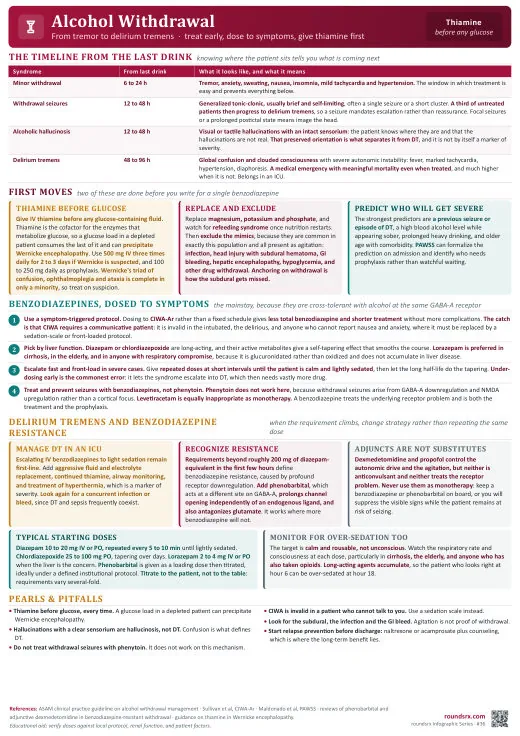
| 6–12 hours | Minor withdrawal | Tremor, anxiety, insomnia, nausea, tachycardia, hypertension, diaphoresis |
| 12–24 hours | Alcoholic hallucinosis | Visual/auditory/tactile hallucinations with intact sensorium (patient knows they're hallucinating). Not DTs. |
| 12–48 hours | Withdrawal seizures | Generalized tonic-clonic. Brief, self-limited. Risk of status epilepticus. Peak at 24h. Treat with benzodiazepines, NOT phenytoin (phenytoin doesn't work for withdrawal seizures). |
| 48–96 hours | Delirium tremens (DTs) | Altered sensorium (confusion, agitation, global disorientation) + autonomic instability (fever, tachycardia, HTN, diaphoresis) + hallucinations. Mortality 15–20% if untreated. |
| CIWA Score | Severity | Action |
|---|---|---|
| < 8 | Minimal | Monitor q4–8h. Supportive care. Thiamine, folate, banana bag. |
| 8–15 | Mild-moderate | Lorazepam 1–2 mg PO/IV q1h PRN. Reassess in 1h. |
| 16–20 | Moderate-severe | Lorazepam 2–4 mg IV q1h. Consider ICU admission. |
| > 20 | Severe / impending DTs | ICU. Lorazepam 4 mg IV q15–30 min until controlled. Consider phenobarbital. Load aggressively. |
| Drug (Brand) | Dose | Role | Key Notes |
|---|---|---|---|
| Lorazepam (Ativan) 1ST LINE | 1–4 mg IV q1h PRN (CIWA-guided) | First-line benzodiazepine. | No active metabolites (preferred in liver disease over diazepam). Propylene glycol toxicity with prolonged high-dose infusion. |
| Diazepam (Valium) 1ST LINE | 5–20 mg IV/PO q1h PRN | Alternative to lorazepam. Long-acting. | Active metabolites (accumulate in liver failure). Longer duration = smoother withdrawal. Often preferred for outpatient tapers. |
| Chlordiazepoxide (Librium) MILD-MODERATE | 25–100 mg PO q6h, taper over 3–5 days | Mild-moderate withdrawal (CIWA < 15). Oral only. | Long half-life (24–48h) with active metabolites → built-in self-taper, smoother withdrawal. No IV formulation -cannot use in severe withdrawal, NPO, or vomiting. Avoid in liver disease (active metabolites accumulate -use lorazepam instead). Ideal for low-risk floor patients on a fixed taper protocol. |
| Phenobarbital 1ST LINE / SEVERE | Load: 130–260 mg IV q15–30 min until controlled (total 10–20 mg/kg). Maintenance: 32–65 mg IV q6–8h. | Emerging first-line for severe AWS. Shorter ICU & hospital LOS vs benzos. | GABA-A agonist at different site than benzos, synergistic. Long half-life (80–120h) → self-tapering. Monitor for respiratory depression. Kessel, 2024: shorter LOS (2.8 vs 4.7 days), less ICU time, less mechanical ventilation vs benzos. Many centers now use front-loaded phenobarbital as primary agent for severe withdrawal Gold, 2007. |
| Dexmedetomidine (Precedex) ADJUNCT | 0.2–1.5 mcg/kg/hr IV | Adjunct only -NOT a standalone. | Reduces autonomic symptoms (tachycardia, HTN, agitation). Does NOT prevent seizures or DTs -always co-administer with a GABA agonist (benzo or phenobarbital). |
| Thiamine (Vitamin B1) GIVE FIRST | 500 mg IV TID × 3 days (high-dose Caine protocol if Wernicke suspected) or 100 mg IV daily minimum | Give BEFORE any glucose. | Glucose metabolism depletes thiamine → precipitates Wernicke encephalopathy (confusion, ataxia, ophthalmoplegia). Give thiamine to ALL alcohol withdrawal patients. |
Patient: 48M, daily vodka drinker (1 pint/day × 15 years), last drink 14 hours ago. Tremor, anxiety, tachycardia (HR 108), diaphoresis. CIWA score: 18.
| Time | CIWA | Action |
|---|---|---|
| Hour 0 | 18 (moderate-severe) | Lorazepam (Ativan) 2mg IV. Thiamine (Vitamin B1) 500mg IV (give BEFORE any glucose). Banana bag is NOT adequate thiamine -need 500mg IV. |
| Hour 1 | 16 | Lorazepam (Ativan) 2mg IV. Replete Mg (MgSO₄ 2g IV), K⁺, PO₄. |
| Hour 2 | 14 | Lorazepam (Ativan) 1mg IV. Reassess -trending down, good sign. |
| Hour 4 | 10 | Lorazepam (Ativan) 1mg IV. |
| Hour 6 | 7 | Hold. Below threshold. Monitor q2h. |
| Hour 12 | 5 | Continue monitoring. Total lorazepam = 6mg in first 6h. |
Red flags to escalate: CIWA > 20 despite treatment → increase frequency/dose → consider phenobarbital load (130–260mg IV q15–30min). Seizure → lorazepam 4mg IV STAT (NOT phenytoin -doesn't work for withdrawal seizures). Hallucinations with clear sensorium = alcoholic hallucinosis (not DTs). DTs = altered sensorium + autonomic storm → ICU + aggressive benzos/phenobarbital.
When to use Chlordiazepoxide (Librium) instead: CIWA < 15, able to take PO, no liver disease, low risk for DTs → fixed taper 25–100mg PO q6h over 3–5 days. Smoother withdrawal due to long half-life. Floor patients only.
- CIWA-Ar score
- CBC, BMP, Mg, PO₄
- LFTs, INR, albumin
- Lipase
- Blood alcohol level
- CT head if AMS/focal deficit/head injury
| Drug | Dose | Route | Notes |
|---|---|---|---|
| Lorazepam | 1-4mg IV q1h PRN | IV | CIWA≥8. Preferred liver disease. |
| Diazepam | 10-20mg IV | IV | Long-acting. Caution liver. |
| Chlordiazepoxide (Librium) | 25-100mg PO q6h taper | PO only | Mild-mod (CIWA<15). No IV form. Avoid liver disease. |
| Phenobarbital | 130-260mg IV | IV | Benzo-resistant |
| Thiamine | 500mg IV×3d | IV | BEFORE glucose |
| MgSO₄ | 2-4g IV | IV | Replace aggressively |
Patient: 48M with daily vodka use (1 pint/day x 15 years), admitted for cellulitis. Last drink 16 hours ago. Reports tremor, anxiety, nausea. No prior seizures or DTs.
Key findings: HR 108, BP 152/94, Temp 37.6°C, diaphoretic, bilateral hand tremor, mildly anxious but oriented. CIWA score: 18 (moderate). Magnesium 1.4, phosphorus 2.0, AST 180, ALT 95.
Management:
- CIWA-based symptom-triggered protocol: diazepam 10-20 mg PO q1h for CIWA ≥ 10 Saitz, 1994
- Symptom-triggered dosing is superior to fixed-schedule: less total benzo, shorter treatment
- Replete: magnesium sulfate 2g IV, thiamine 500 mg IV x 3 days (give BEFORE glucose), folate 1 mg, multivitamin
- Banana bag is inadequate: only contains 100 mg thiamine. Order high-dose thiamine separately
Teaching point: CIWA-based symptom-triggered therapy is the standard of care. Always give high-dose IV thiamine (500 mg) before any glucose-containing fluids. Banana bags contain inadequate thiamine for prophylaxis.
Patient: 55M with history of prior DTs and withdrawal seizures, admitted 48 hours ago with CIWA protocol. Now acutely agitated, hallucinating (seeing insects on walls), febrile, and tachycardic despite receiving diazepam 120 mg over past 6 hours.
Key findings: Temp 39.1°C, HR 138, BP 170/100, diaphoretic, globally confused, visual hallucinations, gross tremor. CIWA not assessable. CK 2,400 (rhabdomyolysis from agitation).
Management:
- ICU transfer: benzo-refractory DTs require ICU. Switch to IV midazolam or diazepam drip
- Add phenobarbital 130-260 mg IV q15-30min for benzo-resistant withdrawal Rosenson, 2013
- Dexmedetomidine drip as adjunct (reduces benzo requirement) -- NOT as monotherapy
- Aggressive IV hydration for rhabdomyolysis (target UOP 200-300 mL/hr), monitor CK, Cr, potassium
Teaching point: In DTs, benzodiazepine tolerance can be extreme (>1000 mg diazepam equivalents). Phenobarbital is the key second-line agent. Never use dexmedetomidine or propofol as monotherapy -- they do not prevent seizures.
Patient: 39M brought by EMS after witnessed generalized tonic-clonic seizure at home. Wife reports he quit drinking 2 days ago (12+ beers daily). Seizure lasted ~90 seconds, now postictal.
Key findings: Postictal: drowsy, confused, HR 118, BP 148/92, Temp 37.8°C, tongue laceration. No focal deficits. Glucose 95. No history of epilepsy. Blood alcohol level 0. Last drink ~36 hours ago.
Management:
- Immediate: lorazepam 2-4 mg IV to prevent recurrent seizure (withdrawal seizures recur in ~25% within 6-12 hours)
- Start long-acting benzodiazepine: diazepam or chlordiazepoxide loading. Phenytoin is NOT effective for withdrawal seizures
- CT head if: first seizure, focal features, prolonged postictal state, head trauma, or anticoagulated
- HIGH risk for DTs: withdrawal seizure + heavy daily use. Admit to monitored bed, aggressive benzo protocol, CIWA q1h
Teaching point: Alcohol withdrawal seizures peak at 12-48 hours and are typically generalized tonic-clonic. Phenytoin does NOT prevent recurrent withdrawal seizures -- only benzodiazepines work. A withdrawal seizure is a major risk factor for progression to DTs (onset 48-96h).
- CIWA q1-2h
- Vitals q1-4h
- Mg, K, PO₄ q12h
- Seizure precautions
- DT watch 48-72h
- Blood glucose
Text version
- Glucose before thiamine (precipitates Wernicke)
- Phenytoin for alcohol withdrawal seizures (doesn't work)
- Banana bag = inadequate thiamine (only 100 mg)
- Under-dosing benzos in DTs