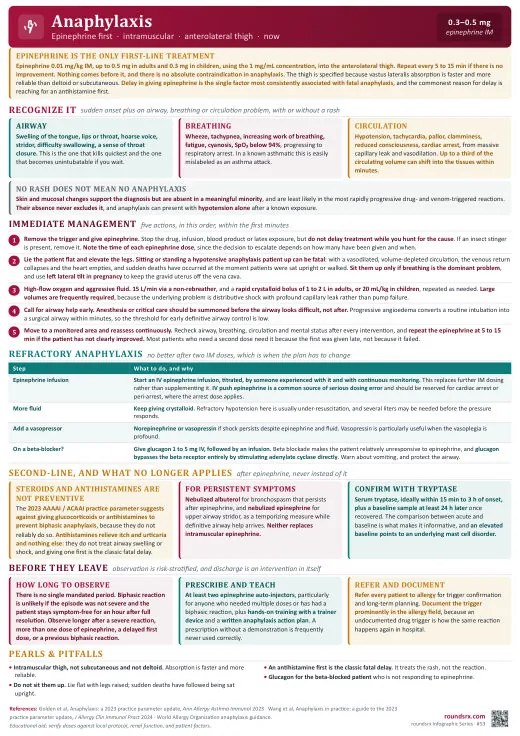
Anaphylaxis
- Criterion 1: Acute onset (minutes–hours) of skin/mucosal involvement (hives, flushing, angioedema) PLUS respiratory compromise (dyspnea, stridor, wheeze, hypoxia) OR hypotension/end-organ dysfunction
- Criterion 2: ≥ 2 of the following after exposure to LIKELY allergen: skin/mucosal symptoms, respiratory compromise, hypotension, persistent GI symptoms (cramping, vomiting)
- Criterion 3: Hypotension alone after exposure to KNOWN allergen for that patient
- Foods: peanuts, tree nuts, shellfish, milk, eggs (#1 cause in children)
- Medications: antibiotics (penicillin, cephalosporins), NSAIDs, contrast dye, anesthetic agents (#1 cause in perioperative setting)
- Insect stings: Hymenoptera (bee, wasp, hornet) -#1 cause of fatal anaphylaxis in adults
- Latex
- Idiopathic (~20% -no identifiable trigger)
| Step | Drug | Dose | Notes |
|---|---|---|---|
| 1. EPINEPHRINE | Epinephrine 1:1000 (1 mg/mL) GIVE FIRST | 0.3–0.5 mg IM (0.3–0.5 mL) in anterolateral thigh. Repeat q5–15 min if no improvement. | IM (not SubQ) -faster absorption IM Epinephrine Pharmacokinetics Trial, 2004. Anterolateral thigh (not deltoid) -better blood flow. Autoinjector: EpiPen 0.3 mg adult, 0.15 mg pediatric (< 30 kg). Most common error: not giving epi, giving it too late, or giving it SubQ. WAO Anaphylaxis Guidelines, 2020 |
| 2. Position | Supine with legs elevated (improves venous return). If vomiting → recovery position. If respiratory distress → sitting up. Do NOT have the patient stand or sit upright if hypotensive -can cause fatal "empty ventricle syndrome." | ||
| 3. IV access + fluids | NS bolus | 1–2 L rapid bolus (20 mL/kg peds) | Anaphylaxis causes massive vasodilation + capillary leak → distributive shock. Aggressive fluids needed. |
| 4. Adjuncts | Diphenhydramine 50 mg IV + famotidine (Pepcid) 20 mg IV | H1 + H2 blockers | Adjunctive ONLY -do NOT give instead of epinephrine. Antihistamines treat hives but do NOT reverse bronchospasm or hypotension. |
| 5. Steroids | Methylprednisolone 125 mg IV | Or dexamethasone 10 mg IV | Does NOT help acute anaphylaxis (takes 4–6h to work). May prevent biphasic reaction (occurs in ~5–20%, usually 1–72h later) Biphasic Anaphylaxis Review, 2015. Observe ≥ 4–6h after resolution. |
| Refractory | Epinephrine drip | 1–10 mcg/min IV | If ≥ 2 doses of IM epi fail → start epi drip. Glucagon 1–5 mg IV if on beta-blockers (epi may be ineffective due to β-blockade). Vasopressin for refractory hypotension. |
- Tryptase level -draw within 1–2h of onset (peaks at 1h). Confirms mast cell degranulation. A normal tryptase does NOT rule out anaphylaxis.
- CBC -baseline hematocrit, WBC
- BMP -renal function, electrolytes (epinephrine can cause hypokalemia)
- ECG -arrhythmias from epinephrine administration or myocardial involvement (Kounis syndrome -allergic MI)
- Trigger identification -detailed timeline of exposures (food, drugs, insect stings, latex, exercise)
- Allergist referral -4–6 weeks post-event for skin-prick testing and component testing
Patient: 42F, no known drug allergies. First dose IV piperacillin-tazobactam. Within 15 min: diffuse urticaria, lip swelling, wheeze, BP 72/38.
Key findings: Skin + respiratory + hypotension after allergen. HR 128, SpO2 91%, stridor developing.
Management:
- Epinephrine 0.5 mg IM anterolateral thigh (1:1000), FIRST, do not delay
- Stop offending antibiotic immediately
- NS 1-2L bolus; diphenhydramine 50 mg IV + famotidine 20 mg IV
- Methylprednisolone 125 mg IV; albuterol neb for bronchospasm
- Repeat epi q5-15 min if no improvement; epi drip if refractory
Teaching point: Most deaths from anaphylaxis result from delayed or withheld epinephrine. IM epinephrine has NO absolute contraindications. Antihistamines treat hives but do NOT reverse hypotension or airway obstruction. WAO, 2020
Patient: 67M, PMH CAD on metoprolol 100 mg BID. Bee sting 20 min ago. Flushing, tongue swelling, wheeze, BP 68/40, HR 52.
Key findings: Refractory hypotension despite 2 IM epi doses. HR blunted by beta-blocker.
Management:
- Glucagon 1-5 mg IV bolus, then 5-15 mcg/min, bypasses beta-receptor
- Epinephrine IV drip 1-10 mcg/min (ICU monitoring)
- Aggressive IVF 2-3L; have suction ready (glucagon causes vomiting)
Teaching point: Beta-blockers blunt the cardiac response to epinephrine. Glucagon bypasses the beta-receptor via direct adenylyl cyclase activation, producing positive inotropy and chronotropy independent of beta-receptors.
Patient: 25F with peanut allergy. Accidental exposure 6h ago. Initial reaction treated with EpiPen. Resolved. Now: recurrent urticaria, throat tightness, wheezing.
Key findings: Biphasic anaphylaxis (~5% of cases, within 1-72h). Risk factors: severe initial reaction, > 1 epi dose needed, delayed treatment.
Management:
- Repeat epinephrine 0.5 mg IM immediately
- Admit for extended observation (12-24h minimum)
- Continue H1 + H2 blockers and steroids
- Discharge with EpiPen, allergist referral, action plan, medical alert bracelet
Teaching point: Biphasic reactions are why all anaphylaxis patients need minimum 4-6h observation (12-24h if severe). All patients need an EpiPen prescription and allergist referral at discharge.
| Drug | Dose | Route | Role |
|---|---|---|---|
| Epinephrine (1:1000) | 0.3–0.5 mg | IM anterolateral thigh | FIRST-LINE -repeat q5–15 min. No contraindications in anaphylaxis. |
| Diphenhydramine | 50 mg | IV | H1 blocker -adjunct for urticaria/pruritus. Does NOT treat hypotension or bronchospasm. |
| Famotidine (Pepcid) | 20 mg | IV | H2 blocker -adjunct. Combined H1+H2 blockade more effective than H1 alone. |
| Methylprednisolone | 125 mg | IV | Prevents biphasic reaction (theoretical -weak evidence). Takes 4–6h to work. NOT for acute treatment. |
| Albuterol | 2.5 mg neb | Nebulized | For bronchospasm refractory to epinephrine. Continuous neb if severe. |
| Glucagon | 1–5 mg bolus, then 5–15 mcg/min | IV | For patients on beta-blockers. Bypasses β-receptor blockade → direct cAMP activation. Side effect: vomiting. |
| Epinephrine drip | 1–10 mcg/min | IV infusion | Refractory anaphylaxis (failed ≥2 IM doses). ICU-level monitoring required. |