Anticoagulation Management
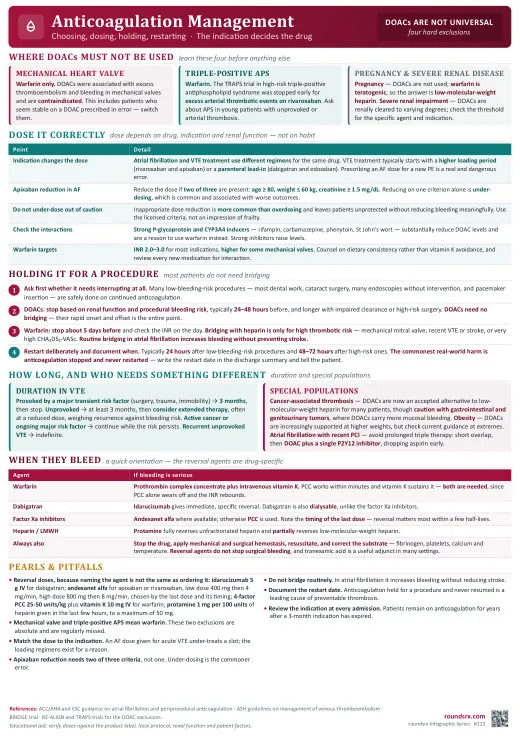
Anticoagulation management is one of the most common daily tasks on inpatient medicine. Key decisions: (1) Which agent? Heparin (UFH for acute, can titrate, dialyzable) vs LMWH (predictable, SQ, no monitoring) vs warfarin (outpatient, INR monitoring, cheap) vs DOAC (outpatient, no monitoring, fewer interactions, not all indications). (2) When to bridge? Only high-risk patients (mechanical valve, recent VTE < 3 months, prior thrombosis on interruption). (3) How to reverse? Warfarin: vitamin K ± 4-factor PCC. DOACs: idarucizumab (dabigatran), andexanet alfa (Xa inhibitors), or 4F-PCC. Heparin: protamine. Key intern skill: recognizing bleeding vs thrombotic risk and adjusting therapy accordingly.
Key distinction: the warfarin mandate is for rheumatic moderate-severe MS specifically, not any severe MS. The cause matters, not just the severity. Non-rheumatic severe MS (e.g., calcific MS from mitral annular calcification in the elderly) is not a DOAC contraindication, because it lacks the thrombogenic rheumatic left-atrial substrate INVICTUS studied; a DOAC is reasonable there (data are limited, so individualize if the LA is markedly enlarged/stagnant).
- Before starting anticoagulation: CBC, PT/INR, aPTT, Cr + CrCl (DOAC renal dosing), LFTs (hepatic clearance), HAS-BLED score (bleeding risk)
- Warfarin monitoring: INR (target 2-3 for most indications; 2.5-3.5 for mechanical mitral valve). Check INR daily inpatient until stable, then q1-4 weeks outpatient.
- Heparin monitoring: aPTT q6h after initiation or dose change (anti-Xa levels if aPTT unreliable -lupus anticoagulant, elevated baseline). Target aPTT per institutional protocol (usually 1.5-2.5× control).
- LMWH: No routine monitoring. Check anti-Xa level (peak, 4h post-dose) if: obesity (> 150 kg), CKD (CrCl < 30 → use UFH instead), pregnancy.
- DOACs: No routine monitoring. Check Cr + CrCl (dose-adjust apixaban/rivaroxaban at CrCl 15-30; dabigatran CI if CrCl < 30). Drug-specific anti-Xa (rivaroxaban, apixaban) or dTT (dabigatran) for special situations (overdose, pre-surgery, bleeding).
- Indication verification: AF (CHA₂DS₂-VASc ≥ 2 men, ≥ 3 women), VTE treatment, mechanical valve (warfarin only), antiphospholipid syndrome (warfarin preferred over DOACs TRAPS, 2018)
- VTE treatment: DOAC preferred (rivaroxaban or apixaban). Duration: provoked DVT = 3 months; unprovoked = extended (reassess annually). Cancer-associated VTE: LMWH or DOAC (edoxaban, rivaroxaban) [HOKUSAI VTE Cancer, 2018; SELECT-D, 2018]. Exception: GI/GU cancer with high bleed risk → LMWH preferred.
- AF anticoagulation: DOAC preferred over warfarin for nonvalvular AF [RE-LY, ROCKET AF, ARISTOTLE, ENGAGE AF-TIMI 48]. Exception: moderate-severe mitral stenosis or mechanical valve → warfarin only.
- Perioperative bridging:
- Most patients: do NOT bridge. BRIDGE, 2015 -bridging with LMWH in AF patients on warfarin increased bleeding without reducing thrombosis.
- Bridge ONLY high thrombotic risk (roughly > 10%/yr off anticoagulation):
- Mechanical valve: ANY mitral mechanical valve; any older caged-ball (Starr-Edwards) or tilting-disc (Björk-Shiley) valve; any mechanical valve + stroke/TIA within 6 months. Why: highest stasis and thrombogenicity, and a periprocedural clot here means valve thrombosis or disabling stroke. Exception: an isolated bileaflet aortic valve (St. Jude, On-X, CarboMedics) with no other risk factors is the one mechanical valve that does NOT need bridging (low-thrombogenicity, high-flow position; see box below).
- AFib: CHA₂DS₂-VASc ≥ 7, stroke/TIA within 3 months, or rheumatic (valvular) AF. Why: recent cardioembolism predicts early recurrence, and rheumatic mitral stenosis carries the highest AF stroke rate.
- VTE: VTE within the last 3 months, or severe thrombophilia (protein C/S deficiency, antiphospholipid syndrome, homozygous factor V Leiden). Why: clot is still organizing and recurrence risk is steepest in the first 3 months.
- Stop warfarin 5 days before. Stop DOAC 2-3 days before (longer if CKD). Resume 24-72h post-procedure depending on bleeding risk.
- Reversal:
- Warfarin: Vitamin K 10 mg IV (takes 6-24h). For urgent: 4-factor PCC (Kcentra) 25-50 units/kg (immediate). FFP only if PCC unavailable.
- Dabigatran: Idarucizumab (Praxbind) 5g IV -immediate, complete reversal. RE-VERSE AD, 2017
- Xa inhibitors (rivaroxaban/apixaban/edoxaban): Andexanet alfa (Andexxa) -expensive, limited availability. Alternative: 4-factor PCC 50 units/kg. ANNEXA-4, 2019
- Heparin: Protamine 1 mg per 100 units UFH given in last 2-3h (max 50 mg). Only 60% effective for LMWH.
| Feature | White clot (platelet-rich) | Red clot (fibrin/RBC-rich) |
|---|---|---|
| Location / flow | Arteries: high flow, high shear | Veins + stagnant cardiac chambers: low flow, stasis |
| Trigger | Endothelial injury: plaque rupture/erosion, exposed stent struts | Stasis + hypercoagulability (Virchow's triad) |
| Dominant mechanism | High shear unfolds vWF → platelet adhesion and aggregation; platelet-dominant | Coagulation cascade → thrombin → fibrin mesh that traps RBCs |
| Appearance | Pale, platelet-fibrin plug | Dark red, gelatinous, RBC-laden |
| Rate-limiting step | Platelet activation, so thrombin inhibition alone will not stop it | Fibrin formation, so antiplatelets barely touch it |
| Drug that works | Antiplatelets (aspirin, P2Y12, GP IIb/IIIa) | Anticoagulants (heparin/LMWH, warfarin, DOACs) |
| Platelet-rich / arterial → antiplatelet-led | Fibrin-rich / stasis → anticoagulant-led |
|---|---|
| ACS: STEMI, NSTEMI, unstable angina | Atrial fibrillation (LA appendage stasis → cardioembolism) Anticoagulate if CHA₂DS₂-VASc ≥ 2 (men) / ≥ 3 (women); score 1/2 = consider |
| Coronary stent thrombosis prevention (post-PCI) | VTE: DVT and PE Provoked by a transient factor: 3 months. Unprovoked or persistent risk: extended/indefinite (reassess bleeding risk annually) |
| Stable CAD / chronic coronary syndrome | LV thrombus (akinetic segment post-MI) |
| Atherothrombotic (non-cardioembolic) ischemic stroke/TIA | Mechanical heart valves |
| Peripheral arterial disease | Intracardiac thrombus / dilated cardiomyopathy |
| Needs an anticoagulant (the OAC) | ...PLUS needs DAPT (aspirin + P2Y12) |
|---|---|
| AF with elevated stroke risk (CHA₂DS₂-VASc) | PCI with coronary stent (the dominant reason) |
| Recent VTE (DVT/PE) on ongoing anticoagulation Treat ≥ 3 months (provoked by a transient factor) or extended/indefinite (unprovoked or persistent risk). Recurrence is steepest in the first 3 months, the high-risk "recent" window that justifies the overlap. | Acute coronary syndrome: STEMI / NSTEMI |
| Mechanical heart valve (warfarin, not a DOAC) | |
| LV thrombus (akinetic segment post-MI) |
| Phase | Regimen | Why |
|---|---|---|
| Peri-PCI (in-hospital, up to ~1 week) | Triple: DOAC + clopidogrel + aspirin | Stent-thrombosis risk is highest early, so a brief aspirin overlap is justified (longer only if very high ischemic risk). |
| Discharge → ~6-12 months | Double: DOAC + clopidogrel (no aspirin) | Dropping aspirin cuts bleeding while preserving ischemic protection (AUGUSTUS, PIONEER AF-PCI 2016, RE-DUAL PCI 2017). |
| After 12 months | DOAC monotherapy | 2023 AF guideline: stable CAD beyond 1 year → anticoagulant alone; adding any antiplatelet only adds bleeding. |
| Agent | Use in pregnancy | Why |
|---|---|---|
| LMWH (enoxaparin, dalteparin) PREFERRED | First-line for VTE treatment and prophylaxis and for most indications, all trimesters. Weight-based dosing; check anti-Xa in obesity, renal impairment, or mechanical valves. | Does NOT cross the placenta, so no fetal harm. Predictable outpatient SQ dosing, no INR monitoring. |
| UFH | When rapid reversibility is needed (peri-delivery), severe renal failure (CrCl < 30), or in the window just before neuraxial anesthesia. | Also does not cross the placenta. Short half-life and protamine-reversible, which is why it is favored around delivery. |
| Warfarin AVOID (valve exception) | Avoid in general. Retained only for mechanical heart valves in the 2nd and 3rd trimesters (ACC/AHA and ESC class IIa), then switched to LMWH/UFH at ~36 weeks before delivery. | Crosses the placenta → warfarin embryopathy (nasal hypoplasia, stippled epiphyses) at weeks 6-12, plus later fetal CNS injury and intracranial bleeding. But it is the most effective at preventing valve thrombosis, so maternal risk can outweigh fetal risk for mechanical valves. |
| DOACs (apixaban, rivaroxaban, dabigatran, edoxaban) CONTRAINDICATED | Do NOT use in pregnancy (or while breastfeeding). | Cross the placenta; inadequate safety data with signals of fetal harm. No role even in mechanical valves. |
| Fondaparinux | Second-line, only if HIT or LMWH allergy/intolerance. | Minimal placental transfer but limited pregnancy data, so reserved for when heparins cannot be used. |
| Warfarin (Coumadin) | Individualized (typically 2-10 mg daily) | PO | Required for mechanical valves + APS. INR monitoring. Drug/food interactions. Vitamin K dependent factors (II, VII, IX, X, protein C/S). |
| Heparin (UFH) | 80 U/kg bolus → 18 U/kg/hr | IV | Titratable, short half-life, dialyzable. Monitor aPTT q6h. Protamine for reversal. HIT risk. |
| Enoxaparin (Lovenox) | 1 mg/kg BID or 1.5 mg/kg daily | SQ | Predictable pharmacokinetics. Avoid if CrCl < 30 (accumulates). Anti-Xa for monitoring in special populations. |
| 4-Factor PCC (Kcentra) | 25-50 U/kg IV | IV | Warfarin reversal (immediate). Also used off-label for Xa inhibitor reversal. Contains factors II, VII, IX, X + protein C/S. |
When to suspect it: a platelet drop > 50% from baseline (or new thrombosis) 5-10 days after starting heparin. Rapid onset (< 24h) if there was heparin exposure within the prior ~100 days (pre-formed antibodies). More common with UFH > LMWH and in surgical > medical patients.
| Feature | 2 points | 1 point | 0 points |
|---|---|---|---|
| Thrombocytopenia | Fall > 50% AND nadir ≥ 20K | Fall 30-50% or nadir 10-19K | Fall < 30% or nadir < 10K |
| Timing | Day 5-10 (or ≤ 1 day if heparin within 30 days) | > Day 10 or timing unclear | < Day 4, no recent heparin |
| Thrombosis | New thrombosis, skin necrosis, or post-bolus systemic reaction | Progressive/recurrent or suspected thrombosis | None |
| oTher cause | None apparent | Possible | Definite other cause |
0-3 = low (HIT effectively excluded, do not test) · 4-5 = intermediate · 6-8 = high. Send antibody testing only if intermediate or high.
- Step 1, PF4-heparin antibody ELISA (immunoassay): highly sensitive, so a negative result rules HIT out. A positive is less specific (many antibodies are non-pathogenic); a higher optical density makes true HIT more likely.
- Step 2, serotonin release assay (SRA): the functional gold standard, highly specific, confirms pathogenic antibodies. Do not wait for it before acting.
- STOP all heparin -UFH and LMWH, SQ prophylaxis, line flushes, and heparin-bonded catheters. Why: any heparin keeps fueling antibody-mediated platelet activation.
- Start a non-heparin anticoagulant immediately at therapeutic dose: argatroban (hepatic clearance, use in renal failure), bivalirudin, fondaparinux, or a DOAC (increasingly used for stable HIT). Why: HIT is prothrombotic, so simply stopping heparin is not enough, the clot risk persists for weeks.
- Do NOT start warfarin until platelets recover (> 150K). Why: warfarin acutely drops protein C and triggers venous limb gangrene / skin necrosis in the prothrombotic HIT state. If the patient is already on warfarin, reverse it with vitamin K and overlap a non-heparin agent.
- Do NOT give prophylactic platelet transfusions. Why: it adds fuel to thrombosis; reserve platelets for active bleeding only.
- Duration: anticoagulate 4 weeks for isolated HIT (until platelet recovery) and 3 months if thrombosis occurred (HITT). Document a heparin allergy and avoid re-exposure.
Patient: 72M, on warfarin for mechanical aortic valve (INR target 2.5-3.5), needs elective hip replacement in 5 days. Current INR 3.0.
Key findings: Mechanical valve = high thromboembolic risk. CHA2DS2-VASc not applicable (valvular indication). No prior stroke or TIA. EF 55%.
Management:
- Stop warfarin 5 days pre-op (allow INR to drift to < 1.5)
- Mechanical valve = MUST bridge with therapeutic LMWH (enoxaparin 1 mg/kg BID) when INR < 2
- Hold LMWH 24h before surgery
- Resume warfarin evening of surgery; restart LMWH 24-48h post-op when hemostasis confirmed
- Stop LMWH when INR therapeutic (≥ 2.5 for mechanical valve)
Teaching point: Most AF patients do NOT need bridging. BRIDGE, 2015 showed bridging AF patients increased major bleeding 3-fold without reducing stroke. However, mechanical valves remain an absolute bridging indication due to catastrophic thrombotic risk.
Patient: 78F, on apixaban 5 mg BID for AF, presents with massive upper GI bleed (hematemesis, melena). Hemodynamically unstable.
Key findings: HR 118, BP 82/50. Hgb 6.2 (baseline 11.8). INR 1.3 (misleading on DOACs). Last apixaban dose 4 hours ago. Anti-Xa level 180 ng/mL (supratherapeutic).
Management:
- Hold apixaban immediately
- Reversal: andexanet alfa (Andexxa) IV bolus + infusion if available; otherwise 4-factor PCC 50 U/kg (off-label)
- Transfuse pRBC to Hgb > 7; FFP does NOT reverse DOACs
- Emergent EGD once hemodynamically stabilized
- After bleed resolved: reassess anticoagulation indication and risks vs benefits of resumption
Teaching point: Standard INR does NOT reliably reflect DOAC activity. Anti-Xa levels assess rivaroxaban/apixaban; thrombin time for dabigatran. Andexanet alfa reverses Xa inhibitors but is expensive. 4-factor PCC is the pragmatic alternative. ANNEXA-4, 2019
Patient: 34F, triple-positive antiphospholipid syndrome (lupus anticoagulant + anti-cardiolipin + anti-beta2-glycoprotein I), history of DVT + PE at age 28. On rivaroxaban 20 mg daily. Presents with acute left MCA stroke.
Key findings: CT head: no hemorrhage. CTA: left MCA occlusion. Thrombectomy performed. INR 1.1 despite rivaroxaban. Anti-Xa level therapeutic (ruling out non-adherence).
Management:
- This is a treatment failure on a DOAC in triple-positive APS
- Switch to warfarin (INR target 2-3, some experts target 3-4 for arterial events)
- Bridge with UFH drip until INR therapeutic
- DOACs are contraindicated in triple-positive APS
- Lifelong anticoagulation with warfarin - never switch to DOAC
Teaching point: TRAPS, 2018 was stopped early because rivaroxaban had significantly more arterial thrombotic events than warfarin in triple-positive APS. Warfarin is also the only option for mechanical heart valves (RE-ALIGN, 2013 showed excess valve thrombosis with dabigatran).
Mr. Davis is a 74-year-old man on warfarin for mechanical aortic valve (INR target 2.5-3.5) admitted for cholecystectomy. Current INR 3.1. Surgery planned in 3 days. Question: how do you manage his anticoagulation perioperatively?
- Warfarin INR: daily inpatient → weekly → q2-4 weeks when stable. Time in therapeutic range (TTR) target > 65%.
- Heparin aPTT: q6h after initiation or dose change until 2 consecutive values in range, then q12-24h.
- DOACs: Cr annually (more frequent if CKD). No routine drug levels. CBC at baseline + annually.
- Bleeding assessment: signs (hemoglobin drop, melena, hematuria, bruising), drug interactions (NSAIDs, antiplatelets, CYP3A4 inhibitors)
- HIT screening: platelet count q2-3 days on UFH × first 14 days. 4T score if platelet drop.
- CHA₂DS₂-VASc reassessment: annually for AF patients -score can change (new DM, HF, age threshold).