Aortic Dissection
| Type | Involvement | % of Cases | Mortality (Untreated) | Treatment |
|---|---|---|---|---|
| Stanford A | Ascending aorta (± descending) | ~60% | ~1–2% per hour for first 48h | Emergent surgery. Call CT surgery immediately. IRAD Registry, Hagan 2000 |
| Stanford B | Descending aorta only (distal to L subclavian) | ~40% | ~10% at 30 days | Medical management (BP + HR control). Surgery/TEVAR only if complicated. |
- "Tearing" or "ripping" chest/back pain -acute onset, maximal at onset (unlike MI which crescendos), may migrate as dissection propagates
- BP differential > 20 mmHg between arms -dissection flap compromising subclavian
- Pulse deficit -absent or diminished pulses in one limb
- Aortic regurgitation murmur (Type A -flap disrupts aortic valve)
- Stroke symptoms (carotid involvement), ACS/STEMI (coronary involvement), paraplegia (spinal artery), mesenteric ischemia, AKI (renal artery)
| Test | Role |
|---|---|
| CTA chest/abdomen/pelvis TEST OF CHOICE | Sensitivity > 95%. Shows intimal flap, true vs false lumen, extent, branch vessel involvement. Get with arterial phase + delayed phase. |
| TEE (transesophageal echo) | If too unstable for CT. Can be done at bedside / in OR. Excellent for Type A. Limited for distal descending. |
| CXR | Widened mediastinum (~60% sensitivity -absence does NOT rule out dissection). May see left pleural effusion. |
| D-dimer | Elevated in > 95% of dissections. Negative D-dimer has high NPV -can help rule out in low-pretest probability. Not reliable alone. |
- Emergent CT surgery consult -do not delay for any reason
- Ascending aorta replacement ± aortic valve repair/replacement ± coronary reimplantation
- Mortality without surgery: 50% at 48h. With surgery: 15–25%.
- Tamponade → emergent pericardiocentesis as bridge to OR (limited drainage -just enough to restore perfusion)
- Uncomplicated Type B: BP/HR control + pain management + ICU monitoring. Long-term oral BB + amlodipine. Repeat imaging at 48–72h, 1 month, 6 months, then annually. INSTEAD-XL, Nienaber 2013 ADSORB, Brunkwall 2014
- Complicated Type B (malperfusion, rupture, refractory pain, rapid expansion) → TEVAR (thoracic endovascular aortic repair) or open surgery.
| Drug (Brand) | Dose | Role |
|---|---|---|
| Esmolol (Brevibloc) 1ST LINE | 500 mcg/kg bolus → 50–200 mcg/kg/min | Preferred BB -ultra-short t½ (9 min), highly titratable. Stops fast if complications. |
| Labetalol (Trandate) 1ST LINE | 20 mg IV q10 min (max 300 mg) or 1–2 mg/min drip | α + β blocker. Good alternative if esmolol drip unavailable. Longer acting. |
| Nicardipine (Cardene) ADD-ON | 5–15 mg/hr IV | Add if BP not at target despite BB. Do NOT use alone without BB. |
| Nitroprusside (Nipride) ADD-ON | 0.3–5 mcg/kg/min | Potent vasodilator. Only use AFTER HR controlled -reflex tachycardia worsens shear stress. Cyanide toxicity > 48h. |
Patient: 58M, HTN and Marfan syndrome, presents with acute tearing chest pain radiating to back. Appears pale and diaphoretic.
Key findings: BP 180/110 right arm, 145/90 left arm (pulse deficit). HR 110. JVD, distant heart sounds, new diastolic murmur (AR). CTA: Stanford Type A dissection from aortic root to descending aorta. Pericardial effusion. Troponin elevated (RCA involvement).
Management:
- Esmolol 500 mcg/kg bolus then drip, target HR < 60 FIRST
- Then add nicardipine drip for SBP target < 120
- EMERGENT cardiac surgery consult, Type A = surgical emergency (mortality 1-2%/hour without surgery)
- Type and crossmatch 6 units pRBC, FFP, platelets available
- Do NOT give tPA or anticoagulation despite troponin elevation (would be fatal)
Teaching point: Type A dissection with pericardial effusion = blood tracking into the pericardium. This patient has a triad of dissection + tamponade + aortic regurgitation. The inferior STEMI pattern is from RCA ostial involvement by the dissection flap. If sent to cath lab for "STEMI," the anticoagulation will be catastrophic.
Patient: 64M, longstanding uncontrolled HTN (non-adherent), cocaine use. Presents with severe interscapular pain of sudden onset.
Key findings: BP 228/124, HR 96. No pulse deficits. Cr 1.3 (baseline). Lactate normal. CTA: Stanford Type B dissection from left subclavian to celiac trunk. No malperfusion.
Management:
- Esmolol drip, HR to < 60 first, then nicardipine for SBP 100-120
- IV morphine for pain control (pain drives sympathetic surge → worsens shear stress)
- Uncomplicated Type B = medical management (HR/BP control)
- Serial imaging (CTA in 48-72h, then 1, 3, 6, 12 months)
- Transition to oral labetalol + amlodipine when stable x 24h on drip
Teaching point: Uncomplicated Type B dissection is managed medically. Surgery only if complicated: malperfusion, rupture, refractory pain, or rapid expansion. INSTEAD-XL, 2013 showed benefit of TEVAR for uncomplicated Type B only at 5 years, not acutely.
Patient: 71F, HTN and DM2, initially managed medically for Type B dissection. 18 hours after admission, develops severe abdominal pain, bloody diarrhea, and rising lactate.
Key findings: Lactate 6.2 (was 1.1 on admission). Cr rising from 1.3 to 2.8. CT angiography: true lumen compression with SMA involvement. Absent bowel peristalsis.
Management:
- This is NOW a complicated Type B, emergent intervention required
- Vascular surgery / interventional radiology for TEVAR ± SMA stenting
- Continue aggressive HR/BP control
- NPO, NG tube, broad-spectrum antibiotics for possible bowel ischemia
- Monitor for bowel necrosis (may require exploratory laparotomy if peritonitis develops)
Teaching point: Malperfusion syndrome converts uncomplicated to complicated Type B and mandates urgent intervention. Rising lactate + end-organ dysfunction in a patient with known dissection should trigger immediate reimaging and surgical/IR consultation. Mesenteric ischemia from dissection carries mortality > 50% without intervention.
- Arterial line -continuous BP monitoring mandatory. SBP target 100-120 mmHg.
- HR q5-15 min during drip titration. Target HR <60 bpm.
- Urine output hourly -renal malperfusion if declining.
- Neuro checks q1-2h -carotid extension (stroke, altered mental status).
- Distal pulses q2-4h -bilateral radial, femoral, DP. New deficit = malperfusion.
- Serial CTA -if conservative management. 48-72h, then 1-2 weeks, 1/3/6/12 months.
| Test | Findings | Clinical Significance |
|---|---|---|
| CTA chest/abdomen/pelvis GOLD STANDARD | Intimal flap, true/false lumen, extent of dissection, branch vessel involvement | Sensitivity >95%. Defines Stanford type (A vs B), extent, malperfusion. Get full aorta (chest through pelvis). |
| CXR | Widened mediastinum (>8 cm), abnormal aortic contour, left pleural effusion | Insensitive (~60%) but may be first clue. Normal CXR does NOT rule out dissection. |
| Type & Screen | - | Prepare for potential emergent surgery. Crossmatch if Type A. |
| CBC | H/H for baseline | Serial Hgb to monitor for hemorrhage. Leukocytosis common (stress response). |
| BMP | Cr (baseline), electrolytes | Renal function -renal artery malperfusion? Baseline before contrast. |
| Coags (PT/INR, aPTT) | Baseline coagulation | Pre-surgical assessment. DIC can develop with extensive dissection. |
| Troponin | May be elevated | Coronary malperfusion (Type A extending into coronary ostia → STEMI mimic). Also consider concurrent ACS. |
| Lactate | Elevated if malperfusion | Mesenteric ischemia, limb ischemia, shock. Rising lactate = urgent surgical indication. |
| Drug | Dose | Route | Notes |
|---|---|---|---|
| Esmolol (Brevibloc) 1ST LINE -HR | 500 mcg/kg bolus, then 50-200 mcg/kg/min drip | IV | Target HR <60 bpm FIRST. Ultra-short half-life (9 min) -easily titratable. Preferred initial agent. |
| Nicardipine (Cardene) ADD FOR BP | 5-15 mg/hr IV drip | IV | Add AFTER beta-blocker for SBP target <120 mmHg. Smooth arterial vasodilator. No reflex tachycardia when BB already on board. |
| Labetalol (Trandate) ALTERNATIVE | 20 mg IV bolus, then 1-2 mg/min drip | IV | Combined alpha + beta blockade. Alternative to esmolol + nicardipine. Less titratable than esmolol. |
| Nitroprusside ADJUNCT ONLY | 0.25-10 mcg/kg/min | IV | NEVER without prior beta-blockade. Potent vasodilator -reflex tachycardia worsens dissection. Cyanide toxicity risk with prolonged use. |
| IV Morphine | 2-4 mg IV q5-15min PRN | IV | Pain control is critical -pain drives sympathetic surge → elevated HR/BP. Reduces shear stress. |
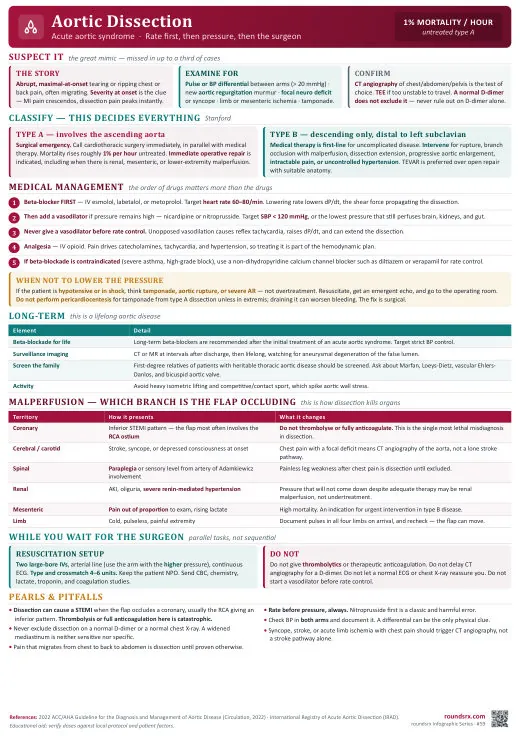
Text version
- Stanford Type A: ascending aorta involved → SURGICAL EMERGENCY
- Stanford Type B: descending only (distal to L subclavian) → medical management
- DeBakey I: ascending + descending. II: ascending only. III: descending only
- Mortality: Type A = 1-2%/hour without surgery
- Esmolol IV first (BB before vasodilator)
- Target HR < 60, then SBP 100-120
- Add nicardipine AFTER HR controlled
- Type A → CT surgery emergently
- Type B → ICU, medical management, serial imaging
- Stroke (carotid dissection)
- MI (coronary ostia involvement)
- Mesenteric ischemia (celiac/SMA)
- Renal failure (renal artery)
- Limb ischemia (iliac)
- Spinal cord ischemia (artery of Adamkiewicz)
- Vasodilator before BB (reflex tachy worsens dissection)
- Delaying CTA for other workup
- Missing Type A -always scan the ascending aorta
- Thrombolytics for "STEMI" that is actually dissection