Aortic Stenosis
- Causes: Degenerative/calcific (elderly), bicuspid aortic valve (younger)
- Triad (SAD): Syncope, Angina, Dyspnea (HF)
- Murmur: Crescendo-decrescendo systolic, radiates to carotids. Pulsus parvus et tardus
| Parameter | Mild | Moderate | Severe |
|---|---|---|---|
| AVA (cm²) | >1.5 | 1.0–1.5 | <1.0 |
| Mean Gradient | <25 | 25–40 | >40 |
| Vmax (m/s) | <3.0 | 3.0–4.0 | >4.0 |
| Symptom | Mechanism | Mean Survival Without AVR |
|---|---|---|
| Angina | LVH → ↑ O2 demand + ↓ coronary perfusion pressure | ~5 years |
| Syncope | Fixed CO + peripheral vasodilation (exercise) → cerebral hypoperfusion | ~3 years |
| Heart Failure | Chronic pressure overload → systolic dysfunction → decompensation | ~2 years |
- Type: Crescendo-decrescendo (diamond-shaped) systolic ejection murmur
- Location: Best heard at right upper sternal border (RUSB, aortic area)
- Radiation: To carotids bilaterally. Gallavardin phenomenon: may radiate to apex and mimic MR
- Severity clues: Late-peaking murmur = more severe. Soft/absent A2 = severely calcified, immobile valve. Paradoxical splitting of S2
- Pulsus parvus et tardus: Carotid pulse with diminished amplitude (parvus) and delayed upstroke (tardus), hallmark of significant AS
- Maneuvers: Murmur ↓ with Valsalva and standing (except HCM, which ↑). This helps distinguish AS from HOCM
- TTE, gold standard for diagnosis and severity
- ECG: LVH, LAE
- BNP if HF symptoms
- Cardiac cath: pre-op coronary assessment
| Scenario | Management |
|---|---|
| Asymptomatic severe | Serial echo q6–12mo. Exercise testing if questionable |
| Symptomatic severe | VALVE REPLACEMENT (TAVR or SAVR) |
| High surgical risk | TAVR PARTNER Trials |
| Low risk / young | SAVR |
| Factor | Favors TAVR | Favors SAVR |
|---|---|---|
| Age | ≥65–70 years | <65 years (durability concerns) |
| Surgical risk | High/intermediate STS score | Low STS score |
| Anatomy | Suitable vascular access, favorable anatomy | Bicuspid valve, small annulus, unsuitable access |
| Concomitant disease | Frailty, porcelain aorta, prior chest radiation | Concurrent CABG or other valve surgery needed |
| Valve durability | 10–15 year data emerging PARTNER 3, 2019 | 20–25 year durability established |
| Complications | Lower bleeding, AKI, AF risk | Lower paravalvular leak, pacemaker rate |
| Recovery | Shorter hospitalization (1–3 days) | Longer recovery (5–7 days inpatient) |
| Type | EF | Mechanism | Key Test |
|---|---|---|---|
| Classical (low EF) | <50% | Weak LV cannot generate gradient | Dobutamine stress echo, true severe AS: AVA stays <1.0, gradient rises. Pseudo-severe: AVA increases >1.0 |
| Paradoxical (preserved EF) | ≥50% | Small, hypertrophied LV with low stroke volume | Indexed AVA <0.6 cm²/m², stroke volume index <35 mL/m². CT calcium scoring aids diagnosis |
| Drug | Role | Caution |
|---|---|---|
| Furosemide | Symptom relief | Low doses. Aggressive diuresis → hypotension |
| ACEi/ARB | If concurrent HTN | Start very low. Dangerous hypotension in severe AS |
Patient: 78M with progressive exertional dyspnea and two episodes of exertional near-syncope over 3 months. Known moderate AS on echo 2 years ago.
Exam: Late-peaking crescendo-decrescendo systolic murmur at RUSB radiating to carotids. Pulsus parvus et tardus. S4 gallop. Soft A2.
Echo: AVA 0.7 cm², mean gradient 52 mmHg, Vmax 4.8 m/s. LVEF 55%. Concentric LVH.
Management:
- Severe symptomatic AS, Class I indication for valve replacement
- STS score 6.2% (intermediate risk). Heart Valve Team discussion
- CT angiography: suitable femoral access, no porcelain aorta
- Proceeded with TAVR (transfemoral approach) PARTNER 2, 2016
- Discharged day 2 on dual antiplatelet therapy (aspirin + clopidogrel x 3–6 months)
Teaching point: Classic presentation of severe symptomatic AS. Once symptoms develop, do not delay referral, survival drops steeply without intervention. TAVR is preferred for intermediate and high-risk patients.
Patient: 72F with ischemic cardiomyopathy (EF 30%) and worsening HF symptoms despite optimal GDMT. Echo shows AVA 0.8 cm² but mean gradient only 22 mmHg.
Diagnostic dilemma: Is this true severe AS or pseudo-severe AS (valve appears stenotic because weak LV cannot open it fully)?
Workup:
- Dobutamine stress echo: At peak dose, gradient increased to 48 mmHg, AVA remained 0.8 cm² = true severe AS
- If AVA had increased >1.0 cm² = pseudo-severe (valve not intrinsically stenotic)
- CT aortic valve calcium score: 1,850 AU (confirms severe calcification)
Management: Confirmed true severe AS with low EF. High surgical risk, proceeded with TAVR. Post-procedure, EF improved to 40% at 6-month follow-up (afterload reduction effect).
Teaching point: Low gradient does NOT exclude severe AS in patients with low EF. Dobutamine stress echo is the key test. CT calcium scoring provides complementary evidence.
Patient: 68M, incidental finding of severe AS on echo done for AF workup. AVA 0.9 cm², mean gradient 45 mmHg, Vmax 4.2 m/s. LVEF 65%. Patient denies all symptoms.
Question: Should he undergo valve replacement now?
Workup:
- Exercise stress test (appropriate in asymptomatic severe AS): Patient developed exertional dyspnea at 4 METs with SBP drop of 15 mmHg
- Abnormal BP response = occult symptom = indication for intervention
- BNP elevated at 380 pg/mL (suggests subclinical LV decompensation)
Management: Despite self-reported absence of symptoms, exercise test unmasked abnormal hemodynamic response. Referred for SAVR (age 68, low STS risk score 1.8%, long life expectancy favoring durable surgical valve).
Teaching point: Asymptomatic severe AS patients may be unknowingly limiting activity. Exercise testing can unmask symptoms and abnormal BP response. An abnormal BP response (failure to rise or drop >10 mmHg) is a Class IIa indication for AVR. Younger, low-risk patients generally favor SAVR for long-term durability.
| Parameter | Frequency |
|---|---|
| Echo | q6–12mo severe; q1–2y moderate |
| Symptoms | Every visit. New symptoms = refer for valve replacement |
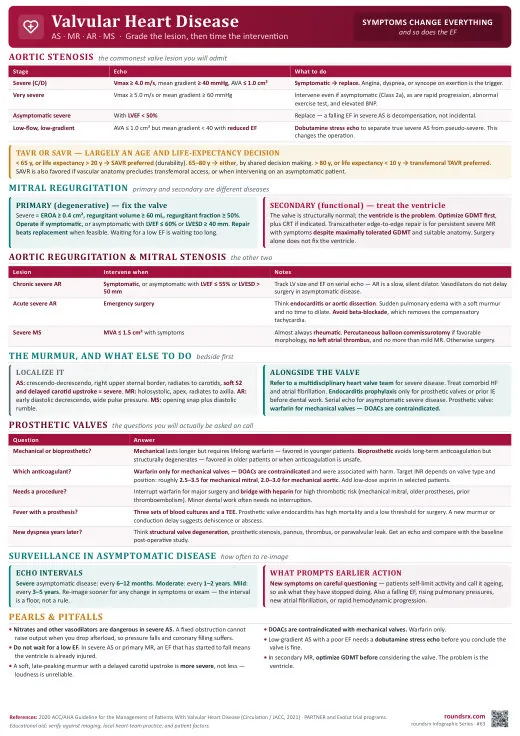
Text version
- TTE is the gold standard for both diagnosis and severity grading; everything below comes off the echo.
- Severe AS: AVA <1.0 cm², mean gradient >40 mmHg, Vmax >4.0 m/s.
- Moderate: AVA 1.0–1.5, mean gradient 25–40, Vmax 3.0–4.0. Mild: AVA >1.5, gradient <25, Vmax <3.0.
- Murmur: crescendo-decrescendo systolic at the right upper sternal border radiating to both carotids. Late-peaking means more severe; a soft or absent A2 means a heavily calcified immobile valve.
- Pulsus parvus et tardus (low amplitude, delayed upstroke) is the hallmark of significant AS on the carotid exam.
- Supporting workup: ECG for LVH and LAE, BNP if HF symptoms, cardiac cath for pre-op coronary assessment before valve surgery.
- Degenerative / calcific is the leading cause in the elderly. Bicuspid aortic valve is the cause in younger patients (~1–2% of the population), presenting 10–20 years earlier and carrying aortopathy, so image the ascending aorta.
- Triad is SAD: Syncope, Angina, Dyspnea (heart failure).
- Angina, mean survival ~5 years without AVR. LVH raises O₂ demand while coronary perfusion pressure falls.
- Syncope, ~3 years. Fixed cardiac output plus exercise-induced peripheral vasodilation means cerebral hypoperfusion.
- Heart failure, ~2 years. Chronic pressure overload leads to systolic dysfunction and decompensation.
- The onset of symptoms is the inflection point. Asymptomatic patients have near-normal survival, so refer the moment a symptom appears.
- Favors TAVR: age ≥65–70, high or intermediate STS score, suitable vascular access, frailty, porcelain aorta, prior chest radiation.
- Favors SAVR: age <65 (durability), low STS score, bicuspid valve, small annulus, unsuitable access, or concurrent CABG / other valve surgery needed.
- Durability: TAVR has 10–15 year data emerging; SAVR has 20–25 year durability established, which is why younger patients lean surgical.
- Trade-offs: TAVR has less bleeding, AKI, and AF; SAVR has less paravalvular leak and a lower pacemaker rate.
- Recovery: TAVR 1–3 days in hospital vs SAVR 5–7 days inpatient.
- Classical (EF <50%): the weak LV cannot generate a gradient. Dobutamine stress echo settles it: true severe AS keeps AVA <1.0 while the gradient rises; pseudo-severe opens the AVA >1.0.
- Paradoxical (EF ≥50%): a small hypertrophied LV with low stroke volume. Look for indexed AVA <0.6 cm²/m² and stroke volume index <35 mL/m²; CT calcium scoring adds supporting evidence.
- Echo q6–12 months for severe AS, q1–2 years for moderate, to catch progression before the patient decompensates.
- Ask about symptoms every visit. A new symptom is itself the referral trigger for valve replacement.
- Aggressive vasodilators in severe AS. These patients are preload-dependent, so vasodilation leads to syncope and death. Start ACEi/ARB very low if HTN coexists.
- Aggressive diuresis. Furosemide relieves congestion but low doses only; over-diuresis causes hypotension.
- Exercise testing in a symptomatic patient. Fixed cardiac output plus exercise vasodilation causes profound hypotension, syncope, arrhythmia, or sudden death. It is only for asymptomatic severe AS.
- Calling a low gradient "not severe" when the EF is low. Get the dobutamine stress echo before dismissing it.
- Mistaking AS for MR (Gallavardin phenomenon) when the murmur radiates to the apex. Check carotid radiation and pulsus parvus et tardus.
- Mistaking AS for HOCM. The AS murmur decreases with Valsalva and standing; HOCM increases. HOCM also has a brisk bifid carotid upstroke.
- Treating balloon aortic valvuloplasty as definitive. It is a temporary bridge only; restenosis occurs within 6–12 months in nearly all patients.
- Any symptom in severe AS (syncope, angina, dyspnea). This is the Class I indication and it does not wait for the next echo.
- Asymptomatic severe AS with an abnormal exercise BP response (failure to rise or a drop >10 mmHg), which is a Class IIa indication for AVR because it unmasks occult limitation.
- Confirmed true severe low-flow low-gradient AS on dobutamine stress echo, even though the resting gradient looks unimpressive.
- Known TAVR complications to counsel and watch for: paravalvular leak (most common), conduction disease with new LBBB or complete heart block needing a permanent pacemaker (~10–20%), vascular access injury, stroke, and rare but catastrophic coronary obstruction.
- PARTNER Trials: established TAVR as non-inferior or superior to SAVR in high and intermediate surgical risk, which is why TAVR is now the standard for those groups.
- PARTNER 2, 2016: TAVR non-inferior to SAVR in intermediate-risk patients.
- PARTNER 3, 2019: TAVR non-inferior to SAVR at 5 years in low-risk patients, the basis for the emerging 10–15 year durability picture.
- Evolut Low Risk, 2019: TAVR non-inferior to SAVR at 2 years in low-risk patients; TAVR is now approved across all surgical risk categories, which is exactly why the Heart Valve Team, not a single number, makes the call.
- No trial supports medical therapy as a substitute. Diuretics ease symptoms but do not alter the natural history.