ARDS -Acute Respiratory Distress Syndrome
| Criterion | Requirement |
|---|---|
| Timing | Within 1 week of clinical insult |
| Imaging | Bilateral opacities on CXR/CT (not explained by effusion/collapse) |
| Origin of edema | Not fully explained by heart failure or fluid overload |
| Oxygenation (P/F) | Used to grade severity (see below), with PEEP ≥ 5 cmH₂O |
| Severity | PaO₂/FiO₂ (P/F Ratio) | Mortality |
|---|---|---|
| Mild | 200–300 mmHg | ~27% |
| Moderate | 100–200 mmHg | ~32% |
| Severe | < 100 mmHg | ~45% |
| Cause | Approx % |
|---|---|
| Sepsis | ~40–50% |
| Pneumonia | ~30–40% |
| Aspiration | ~10–15% |
| Trauma / contusion | ~5–10% |
| Pancreatitis | ~3–5% |
| Massive transfusion (TRALI) | ~2–5% |
| Inhalational injury | < 2% |
- Pneumonia (bacterial, viral, fungal)
- Aspiration of gastric contents
- Pulmonary contusion, inhalation injury
- Near-drowning
- Sepsis (most common overall cause)
- Pancreatitis
- Massive transfusion / TRALI
- Burns, trauma, DIC
- Drug overdose (heroin, aspirin, cocaine)
| Step | Pathology |
|---|---|
| Lung insult | Infection, aspiration, trauma |
| Macrophage activation | Cytokine release (TNF-α, IL-1, IL-6) |
| Neutrophil recruitment | Endothelial damage |
| ↑ Capillary permeability | Protein-rich edema floods alveoli |
| Alveolar flooding | Impaired gas exchange, ↓ compliance, shunt physiology |
| Process | Effect |
|---|---|
| Type II pneumocyte proliferation | Surfactant restoration |
| Fibroblast activation | Collagen deposition |
| Alveolar repair | Partial recovery |
- Diffuse bilateral infiltrates
- "White lungs" in severe cases
- Dependent consolidation (gravity-dependent atelectasis)
- Ground glass opacities
- Better characterizes distribution -not required for diagnosis
| Mechanism | Meaning |
|---|---|
| Volutrauma | Excessive tidal volume → alveolar overdistension |
| Barotrauma | High airway pressure → pneumothorax, pneumomediastinum |
| Atelectrauma | Repeated alveolar collapse and reopening → shear injury |
| Biotrauma | Mechanical injury → systemic cytokine release → MODS |
- Acute onset dyspnea, tachypnea, worsening hypoxemia
- Bilateral crackles, diffuse infiltrates on CXR
- Refractory hypoxemia -O₂ sats not improving with supplemental O₂
- Decreased lung compliance (stiff lungs on vent -high plateau pressures)
- P/F < 150 despite FiO₂ 1.0 → severe ARDS, consider prone positioning immediately
- pH < 7.15 despite optimal vent → consider ECMO consultation
| Parameter | Target |
|---|---|
| SpO₂ | 88–95% |
| PaO₂ | 55–80 mmHg |
- ARDS mortality still 30–45%
- Most common cause is sepsis
- Low tidal volume ventilation saves lives ARDSNet, 2000
- Prone positioning improves survival PROSEVA, 2013
- Preventing ventilator-induced lung injury is critical
| Test | Purpose |
|---|---|
| ABG | Calculate P/F ratio (PaO₂ ÷ FiO₂). P/F < 300 = ARDS by Berlin criteria. Most important diagnostic step. |
| CXR | Bilateral opacities not explained by effusion or collapse (Berlin criterion) |
| Echo (bedside) | Rule out cardiogenic pulmonary edema (PCWP > 18 argues against ARDS). Fastest way to exclude cardiac cause. |
| BNP / NT-proBNP | Further differentiates cardiogenic vs non-cardiogenic edema |
| CBC, CMP, coags, lactate, procalcitonin | Assess severity, organ dysfunction, identify sepsis |
| Blood cultures | Identify infectious cause (sepsis = most common etiology) |
| CT chest | Dependent consolidation, ground glass opacities. Rules out PE/effusion. Not required for diagnosis. |
| BAL / sputum cultures | Identify infectious precipitant; obtain after securing airway |
| Feature | ARDS | Cardiogenic |
|---|---|---|
| PCWP | Normal (≤ 18 mmHg) | High (> 18 mmHg) |
| BNP | Normal or mildly elevated | High |
| Cause | Lung injury (sepsis, pneumonia, aspiration) | Heart failure |
| Edema fluid | Protein-rich exudate | Transudate |
| CXR pattern | Diffuse bilateral, peripheral | Perihilar "bat wing", Kerley B lines |
| Response to diuresis | Minimal improvement | Significant improvement |
| Heart size | Normal | Often enlarged |
PBW male = 50 + 2.3 × (height in inches − 60)
PBW female = 45.5 + 2.3 × (height in inches − 60)
If Pplat remains > 30 after reducing to 6 mL/kg, reduce further to as low as 4 mL/kg PBW. Increase RR to max 35 to maintain minute ventilation.
Driving pressure (Pplat − PEEP) < 12–15 cmH₂O may be advantageous in patients without spontaneous breathing LUNG SAFE, 2016. Higher plateau pressures correlated with mortality; the relationship was strongest above 29 cmH₂O.
ARDSNet Lower PEEP / FiO₂ Table:
| FiO₂ | 0.3 | 0.4 | 0.5 | 0.6 | 0.7 | 0.8 | 0.9 | 1.0 |
|---|---|---|---|---|---|---|---|---|
| PEEP | 5 | 5–8 | 8–10 | 10 | 10–14 | 14 | 14–18 | 18–24 |
| FiO₂ | 0.3 | 0.4 | 0.5 | 0.6 | 0.7 | 0.8 | 0.9 | 1.0 |
|---|---|---|---|---|---|---|---|---|
| PEEP | 12 | 14 | 16 | 18 | 18 | 20 | 22 | 22–24 |
Improves V/Q matching, recruits dependent lung, reduces compression by mediastinum. Meta-analysis confirmed benefit when applied within 36 hours of intubation for > 12 hrs/day in P/F < 200 Munshi, 2017. Associated with increased pressure sores (RR 1.22) but no increase in accidental extubation.
SSC, 2021: suggests intermittent NMBA boluses over continuous infusion (weak recommendation, moderate evidence). Overall, NMBAs reduce barotrauma (RR 0.55). ATS, 2024: conditional recommendation for NMBAs in early (<48h) severe ARDS (P/F ≤ 100). Cisatracurium preferred, may have anti-inflammatory pleiotropic effects. Typical dosing: 15 mg bolus then 37.5 mg/hr × 48h.
If NMBAs used, ensure adequate sedation and analgesia.
Early dexamethasone in moderate-to-severe ARDS (P/F ≤ 200): DEXA-ARDS, 2020: dexamethasone 20 mg IV daily × 5 days → 10 mg daily × 5 days. Reduced 60-day mortality (21% vs 36%, p=0.0047) and increased ventilator-free days. Start within 30h of ARDS diagnosis. This applies to non-COVID ARDS. Supported by CoDEX, 2020, which also showed dexamethasone increased ventilator-free days in moderate-severe ARDS.
Unresolving/fibroproliferative ARDS (after day 7): ARDS Steroid Trial, 2007: methylprednisolone 1 mg/kg/day with slow taper improved LIS score and reduced mechanical ventilation days. Do NOT start after day 14 -ARDSNet LaSRS, 2006: late initiation associated with increased 60- and 180-day mortality.
COVID-19 ARDS: RECOVERY, 2020: dexamethasone 6 mg/day × 10 days reduced 28-day mortality in patients on mechanical ventilation (29.3% vs 41.4%). CAPE COVID, 2020 found that low-dose hydrocortisone did not significantly reduce treatment failure in COVID pneumonia. REMAP-CAP, 2021 showed IL-6 inhibitors (tocilizumab, sarilumab) improved organ support-free days and survival in severe COVID when combined with corticosteroids.
| Therapy | Outcome |
|---|---|
| Late steroids (> day 14) | ↑ mortality when started after day 14 ARDSNet LaSRS, 2006. Early dexamethasone (within 30h) IS beneficial -see above. |
| Inhaled nitric oxide (iNO) | Transient oxygenation improvement only. No mortality benefit. Increases renal dysfunction. |
| Surfactant | Effective in neonatal RDS. Ineffective in adult ARDS. |
| High-frequency oscillation (HFOV) | Increased mortality. Trial stopped early. OSCILLATE, 2013 |
| Incremental PEEP recruitment | Increased 28-day mortality (RR 1.12). ART, 2017 ATS, 2024: strong recommendation against prolonged recruitment maneuvers. Higher PEEP WITHOUT recruitment maneuvers is conditionally recommended for moderate-severe ARDS. |
| IV beta-agonists (albuterol) | Increased mortality. BALTI-2, 2012 |
| Drug | Dose | Indication | Notes |
|---|---|---|---|
| Fentanyl (Sublimaze) | 25–200 mcg/hr IV | Analgesia (first-line) | Analgesia-first approach. Less histamine release and hypotension than morphine. Accumulates with hepatic/renal failure. |
| Propofol (Diprivan) | 5–50 mcg/kg/min IV | Sedation (first-line) | Rapid on/off -ideal for daily awakening trials. Monitor triglycerides q48h. Propofol infusion syndrome risk if > 80 mcg/kg/min > 48h. |
| Dexmedetomidine | 0.2–1.5 mcg/kg/hr IV | Light sedation (no NMBAs) | Preserves respiratory drive. Less delirium than benzos. May cause bradycardia/hypotension. Not appropriate for deep sedation. |
| Midazolam (Versed) | 0.02–0.1 mg/kg/hr IV | Sedation (2nd-line) | Accumulates in renal/hepatic failure → prolonged wake-up. Associated with more delirium. Avoid long-term use. |
| Drug | Dose | Indication | Notes |
|---|---|---|---|
| Cisatracurium (bolus) | 0.1–0.2 mg/kg IV PRN | Intermittent use in mod-severe ARDS SSC, 2021 | Preferred strategy per SSC 2021. Monitor ventilator synchrony. Does not require train-of-four for intermittent dosing. |
| Cisatracurium (infusion) | 0.1–0.2 mg/kg/hr IV × 48h | Severe ARDS with refractory dyssynchrony | ACURASYS, 2010: mortality benefit vs deep sedation. ROSE, 2019: no benefit vs light sedation + boluses. Monitor with train-of-four (target 1–2/4). |
| Drug | Dose | Indication | Notes |
|---|---|---|---|
| Methylprednisolone (Solu-Medrol) | 1 mg/kg/day IV → taper over 2 wks | Unresolving ARDS (fibroproliferative phase, day 7–14) | ARDS Steroid Trial, 2007. Do NOT start after day 14 ARDSNet LaSRS, 2006: late steroids = ↑ mortality. |
| Dexamethasone (early) | 20 mg IV daily × 5d → 10 mg × 5d | Moderate-severe ARDS (P/F ≤ 200), start within 30h | DEXA-ARDS, 2020: reduced 60-day mortality (21% vs 36%) and ↑ ventilator-free days in non-COVID ARDS. |
| Dexamethasone (COVID) | 6 mg IV/PO daily × 10 days | COVID-19 ARDS | RECOVERY, 2020: NNT 8 in ventilated COVID patients. |
| Furosemide (Lasix) | Titrated to even/negative fluid balance | Conservative fluid strategy | FACTT, 2006. Start after resuscitation phase. Monitor Cr and K⁺ closely. CVP or PAOP guidance if available. |
| Sodium Bicarbonate | 1–2 mEq/kg IV slow push or infusion | pH < 7.15 with permissive hypercapnia | Use sparingly. Does not improve outcomes. Temporizing for severe acidemia only. |
Patient: 55M, PMH DM2. Severe CAP (Strep pneumoniae). Intubated for hypoxemic respiratory failure.
Key findings: P/F 120 (moderate ARDS). Bilateral infiltrates. BNP 45. TV 420 mL (6 mL/kg PBW), PEEP 12, FiO2 0.7. Pplat 28, driving pressure 16.
Management:
- Lung-protective ventilation: TV 6 mL/kg PBW, Pplat ≤ 30 ARDSNet, 2000
- Driving pressure 16, reduce below 15 Amato et al., 2015
- Conservative fluid strategy FACTT, 2006
- P/F < 150, prone ≥ 16h/day PROSEVA, 2013
- Light sedation (RASS -1 to -2), daily SAT/SBT assessment
Teaching point: Driving pressure (Pplat - PEEP) < 15 is the strongest predictor of survival in ARDS.
Patient: 40F, previously healthy. Influenza A pneumonia. P/F 72 (severe) despite FiO2 1.0, PEEP 16.
Key findings: TV 330 mL (6 mL/kg PBW), Pplat 30, driving pressure 14. SpO2 85% supine.
Management:
- Prone immediately ≥ 16h/day PROSEVA, 2013
- Cisatracurium PRN boluses for dyssynchrony, not routine infusion ROSE, 2019
- Light sedation (RASS -2), avoid deep sedation
- If P/F remains < 80 after proning, consult ECMO center EOLIA, 2018
- Oseltamivir 75 mg BID for influenza
Teaching point: PROSEVA reduced mortality from 32.8% to 16%. ACURASYS vs ROSE: deep sedation was harmful, not paralytics magical. Use light sedation + PRN NMBA boluses.
Patient: 68M, PMH HFrEF (EF 25%). Bilateral infiltrates, intubated. P/F 180. Is this ARDS or decompensated HF?
Key findings: BNP 2800. Echo: EF 20%, dilated LV. Responds to IV furosemide. Cardiogenic pulmonary edema, NOT ARDS.
Management:
- IV furosemide drip, target negative fluid balance
- Do NOT apply low-TV strategy reflexively, volume overload, not ARDS
- Optimize HF management: afterload reduction, cardiology consult
- Daily SBT when oxygenation improves
Teaching point: Berlin criteria require bilateral opacities NOT fully explained by cardiac failure. ARDS = normal BNP/PCWP, no diuretic response. Cardiogenic = elevated BNP/PCWP, responds to diuresis.
- P/F ratio -calculate every morning from ABG. Trend drives all major decisions (prone, ECMO).
- Plateau pressure -perform inspiratory hold. Target ≤ 30 cmH₂O.
- Driving pressure (Pplat − PEEP) -target < 15 cmH₂O. Strongest independent predictor of mortality Driving Pressure Meta-Analysis, 2015.
- Tidal volume -confirm 6 mL/kg PBW. Recalculate if height was incorrectly entered.
- Static compliance = Vt / (Pplat − PEEP). Normal ~50–80 mL/cmH₂O. In ARDS typically 20–40.
- SpO₂ target -88–95%. Avoid hyperoxemia ICU-ROX, 2020: conservative O₂ therapy may benefit; liberal O₂ offers no advantage.
- Fluid balance -calculate 24h net. Target even or negative after resuscitation FACTT, 2006.
- ABG with P/F ratio
- Vent settings review: TV (mL/kg PBW), RR, FiO₂, PEEP, Pplat, driving pressure
- Sedation assessment: RASS score, daily awakening trial eligibility
- Spontaneous breathing trial (SBT) eligibility if improving
- Prone positioning: hours completed, plan for next cycle if P/F < 150
- Fluid balance: I/O, weight, diuretic needs
- DVT prophylaxis, stress ulcer prophylaxis (if high-risk SUP-ICU, 2018), HOB ≥ 30°
- Nutrition: enteral preferred, start within 48h SSC, 2021
- Source control: is the ARDS precipitant being treated?
- Worsening P/F despite optimal PEEP + prone → ECMO evaluation
- P/F < 80 on FiO₂ 1.0 → emergent ECMO referral
- pH < 7.15 despite max RR and permissive hypercapnia → ECMO or iNO as bridge
- Pplat > 30 despite TV 4 mL/kg → consider ECMO, rule out tension PTX or abdominal compartment syndrome
- New hemodynamic instability → rule out tension PTX, PE, auto-PEEP, RV failure from high PEEP
- Barotrauma (subcutaneous emphysema, pneumomediastinum, PTX) → reduce PEEP/TV, chest tube if indicated
- Precipitant resolving or resolved
- Hemodynamically stable (off or low-dose vasopressors)
- Adequate cough and gag reflex
- RASS −1 to +1 (awake, cooperative)
- No planned surgery or procedures requiring deep sedation
- Rapid shallow breathing index (RSBI) < 105 breaths/min/L
- Ventilator-associated pneumonia (VAP) -new fever, purulent sputum, new infiltrate on CXR after 48h of MV. Maintain HOB ≥ 30°, oral care, subglottic suctioning.
- Barotrauma -pneumothorax, pneumomediastinum, subcutaneous emphysema. Risk increases with Pplat > 30.
- ICU-acquired weakness -from NMBAs, steroids, immobility. Early mobilization when safe Early Mobilization Trial, 2009.
- Delirium -screen daily with CAM-ICU. Minimize benzos, sleep hygiene, early mobilization.
- RV failure -from high PEEP and pulmonary vasoconstriction. Monitor with echo. Reduce PEEP if RV dilation/failure suspected.
- Renal failure -common in ARDS. May be from underlying sepsis, contrast, or positive pressure effects on renal perfusion.
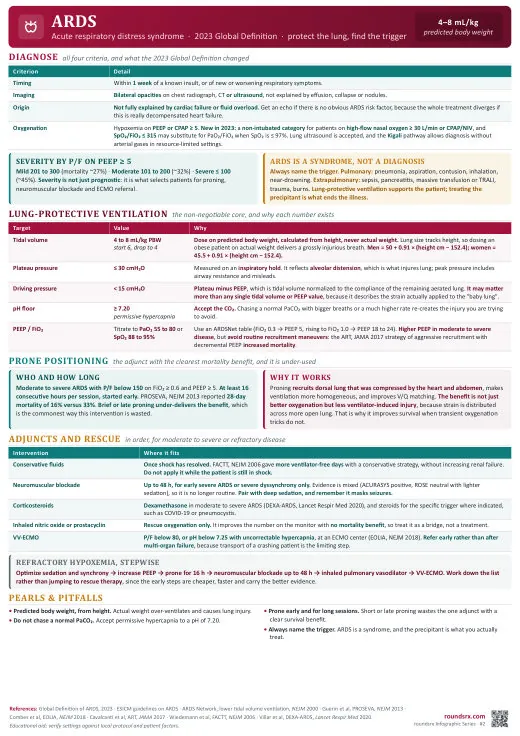
Text version
- Acute onset ≤ 1 week of clinical insult
- Bilateral opacities on CXR/CT
- Not explained by cardiac failure/fluid overload
- P/F < 300 with PEEP ≥ 5
- HFOV OSCILLATE, 2013
- Inhaled nitric oxide
- Routine steroids (non-COVID)
- Surfactant (adults)
- Incremental PEEP recruit ART, 2017
- IV albuterol BALTI-2, 2012
- High TV "for comfort"
- Delaying prone positioning
- Fluid overload post-resus
- Not calculating PBW (predicted body weight) from height
- Deep sedation without indication
- Late ECMO referral