Asthma
| Severity | Features | PEF | SpO₂ on RA | Disposition |
|---|---|---|---|---|
| Mild–Moderate | Speaks in sentences, RR < 30, HR < 120, alert | > 50% predicted | > 92% | ED treat & reassess; discharge if responsive |
| Severe | Speaks in phrases or words, accessory muscle use, RR > 30, HR > 120, agitated, pulsus paradoxus > 25 mmHg (tracks airflow obstruction severity; falls with improvement) | < 50% predicted | < 92% | Admit; consider ICU if no response in 1h |
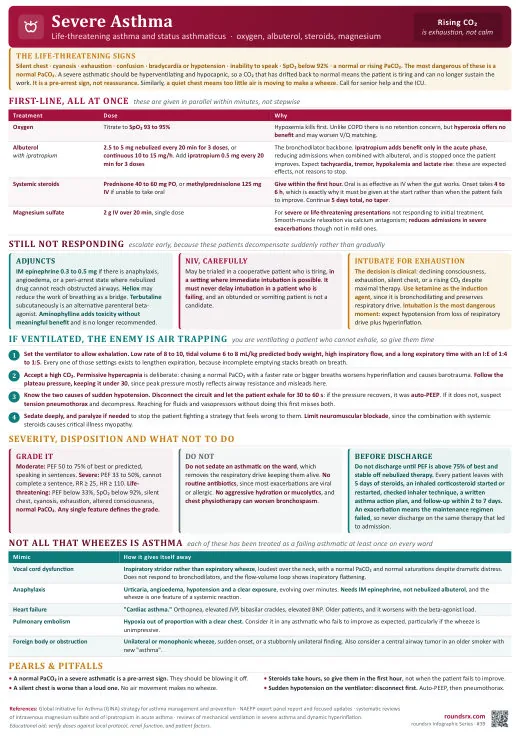
| Life-threatening / near-fatal | Silent chest, drowsy/confused, bradycardia, cyanosis, paradoxical chest/abdomen, exhaustion | < 33% predicted (or unable) | < 90% | ICU. Prepare for intubation. |
| "Quiet chest" is the most dangerous sign, no air movement = no wheeze. Rising PaCO₂ on a tiring asthmatic is impending arrest, not a relief. | ||||
| Decision | Acute asthma | AECOPD |
|---|---|---|
| Albuterol frequency | q20 min × 3 in first hour, front-loaded | q1–4 h scheduled, no q20 min loading |
| Continuous nebs (albuterol) | Yes for severe (albuterol 10–15 mg/hr via large-volume nebulizer) | Rarely; intermittent dosing works and chronic patients don't tolerate continuous |
| Ipratropium duration | First 3 nebs only (ceiling effect, Rodrigo 2005) | Continued throughout admission (often DuoNeb q4–6 h) |
| O₂ target | 92–95% CHANGED 2026, and do not start oxygen at all unless SpO2 < 92% | 88–92% (controlled O₂, avoid hypercapnic respiratory failure) AVOID, 2010 |
| Steroids | Prednisone 40–60 mg × 5 d | Prednisone 40 mg × 5 d REDUCE, 2013 |
| Antibiotics | Usually NO | YES if Anthonisen ≥ 2 of 3 (↑ dyspnea, sputum volume, sputum purulence) |
| NIV | Bridge only, low threshold to intubate | First-line for hypercapnic exacerbation (strong evidence; 65% relative reduction in intubation, 46% reduction in mortality per Cochrane meta-analysis, Osadnik 2017) |
| IV magnesium | 2 g IV over 20 min for severe (per 3Mg, 2013) | Not standard, weak evidence |
| Decompensation tempo | Hours | Days |
For severe / poor response, switch to continuous nebulization 10–15 mg/hr via large-volume nebulizer, can run uninterrupted for an hour or more.
Ipratropium 0.5 mg added to first 3 nebs only, no added benefit beyond that Rodrigo, 2005.
Systemic corticosteroids early (4–6h to take effect): prednisone 40–60 mg PO or methylprednisolone 60–125 mg IV. PO and IV equivalent if patient tolerating PO Rowe, 2001.
Reassess at 60 min: PEF, accessory muscle use, ability to speak. SABA continues throughout, the q20 min schedule is the floor, not the ceiling.
Watch out for: some EMR order sets default to a 30–60 min infusion, change the rate to 20 min (the 3Mg trial protocol).
Epinephrine 0.3–0.5 mg IM (1:1000) if anaphylactic component, peri-arrest, or unable to deliver inhaled bronchodilator effectively (silent chest).
Trial of NIV (BiPAP): start IPAP 10–12 / EPAP 4–5, titrate IPAP up by 2 q5–10 min (typical target 15–20) to RR < 25 and accessory muscle relief. Reassess at 1–2 h. Worsening pH, rising PaCO₂, drowsiness, or no clinical improvement = intubate, do NOT persist.
Ketamine for refractory bronchospasm: 0.5–1 mg/kg IV bolus, then 0.5–2 mg/kg/hr infusion. Direct bronchodilator + dissociative sedation. Bridge to intubation or buy time on NIV. Goyal, 2013 (review)
Heliox 70:30 or 80:20 helium:O₂. Lower density gas = lower turbulent flow = less work of breathing. Useful as a bridge; FiO₂ ceiling is the trade-off (cannot use if SpO₂ requirement > 30%).
Avoid: sedatives without airway control (worsens hypercapnia), aminophylline (no benefit, more toxicity), high-dose beta-blockers, NSAIDs in aspirin-sensitive asthma.
| Drug | Common (most patients) | Watch for / cautions |
|---|---|---|
| Albuterol (SABA) | Tachycardia, fine tremor, anxiety | Hypokalemia (β₂ shifts K⁺ into cells, repeat BMP after continuous nebs), lactic acidosis (β₂-driven type B, do NOT mistake for sepsis), hyperglycemia, QT prolongation at high cumulative doses, paradoxical bronchospasm (rare). |
| Ipratropium | Dry mouth, metallic taste | Mydriasis / acute angle-closure glaucoma if mask leaks into eye (use mouthpiece or seal mask). Urinary retention in elderly men with BPH. Avoid in true peanut/soy allergy (older formulations). |
| Prednisone / Methylprednisolone | Hyperglycemia, insomnia, mood lability, increased appetite | Anticipate insulin needs in diabetics (BG often jumps 100–200 within 24 h). Steroid psychosis at high doses or in elderly. HTN, fluid retention. GI upset (consider PPI if high-risk). No taper needed for ≤ 5 days. |
| Magnesium sulfate IV | Flushing, warmth, mild nausea | Hypotension with rapid infusion (the main reason for 20–60 min run-time). Diminished deep tendon reflexes at level > 4 mEq/L; respiratory depression / arrhythmia at > 8–10. Reduce dose in renal failure (accumulates, monitor reflexes). |
| Epinephrine IM | Palpitations, tachycardia, tremor, anxiety, HTN, headache | Arrhythmia and ischemia risk in elderly / CAD, but life-threatening asthma overrides relative contraindications. IM (not IV) for asthma; IV epi is for arrest only. Avoid mixing with beta-blocker on board if alternatives exist (unopposed alpha can spike BP). |
| IV / SQ Terbutaline | Tachycardia, tremor, palpitations | Tachyarrhythmias (continuous tele required), hypokalemia, lactic acidosis (β₂-driven), hyperglycemia, myocardial ischemia in CAD. Check ECG and electrolytes q2–4h on infusion. |
| Ketamine | Hypertension, tachycardia (often beneficial here), increased secretions, nystagmus | Laryngospasm (rare but dangerous in asthma, paradoxical airway compromise). Co-administer glycopyrrolate 0.2 mg IV to dry secretions. Emergence reactions on awakening (treat with low-dose midazolam). Theoretical ICP concern in TBI but not a contraindication in modern practice. |
| Heliox | None directly (inert gas) | FiO₂ ceiling: ratio is fixed (70:30 or 80:20), so cannot use if patient needs more O₂ than that delivers. Voice changes (Donald Duck effect) is harmless but disconcerting. Bridge only, does not treat the underlying obstruction. |
(1) Hypokalemia. β₂ activation drives Na/K-ATPase, shifting K⁺ into cells. Can drop serum K⁺ by 0.5–1 mEq/L within hours. Repeat BMP and replace.
(2) Type B lactic acidosis (β₂-driven). Mechanism: β₂ stimulation → ↑ adenylyl cyclase → ↑ intracellular cAMP → activates glycogenolysis (liver, muscle) and glycolysis → pyruvate generated faster than mitochondria can oxidize it → excess pyruvate is shunted to lactate via LDH. Also ↑ lipolysis adds to the metabolic load. This is aerobic glycolysis, NOT tissue hypoxia, so the lactate is not a marker of hypoperfusion. Increased work of breathing in severe asthma adds a smaller contribution from respiratory muscle lactate. Lewis 1986; Manthous 2001
Lactate often climbs to 4–8 mmol/L on continuous β₂ therapy. Do NOT chase it with fluids, broad-spectrum antibiotics, or pressors. It resolves over hours as the β₂ drip comes down. The diagnostic clue: lactate rises while the patient is otherwise improving (better PEF, dropping HR, normalizing BP).
- Cardiac or respiratory arrest
- Decreased level of consciousness, exhaustion, inability to maintain effort
- Rising PaCO₂ despite maximal therapy and NIV trial (not the absolute number, but the trend)
- Refractory hypoxia (SpO₂ < 90% on max O₂ + NIV)
- Hemodynamic instability not responding to fluids
| Step | Choice | Why |
|---|---|---|
| Pre-oxygenate | NRB + nasal cannula 15 L apneic O₂ | Asthmatics desat fast, FRC is shrunken with air trapping. HFNC if available. |
| Resuscitate before intubate | 500–1000 mL NS bolus, push-dose epi/phenylephrine ready | Positive-pressure ventilation drops preload severely in air-trapped patients. Pre-empt hypotension. |
| Induction | Ketamine 1.5–2 mg/kg IV | Drug of choice. Bronchodilator, preserves BP, dissociative. Avoid propofol (drops BP) and etomidate (no bronchodilation). |
| Paralytic | Rocuronium 1.2 mg/kg IV | Avoid succinylcholine if hyperK risk (severe acidosis can shift K⁺ up). Rocuronium reversible with sugammadex. |
| Tube size | Largest that fits (8.0–9.0 in adults) | Reduces airway resistance and allows bronchoscopy / pulmonary toilet. |
| Setting | Target | Why |
|---|---|---|
| Mode | Volume control (AC/VC) | Predictable Vt, lets you measure plateau and auto-PEEP precisely. |
| Tidal volume | 6–8 mL/kg PBW | Smaller Vt = less hyperinflation. Don't try to "blow off" CO₂ with bigger breaths. |
| Respiratory rate | 6–10 breaths/min | Long expiratory time. Slow rate is the single most important setting. |
| I:E ratio | 1:4 to 1:5 | Inspiratory time 0.8–1.0 s, leave the rest for exhalation. |
| Inspiratory flow | 80–100 L/min (high) | Deliver Vt fast so most of cycle is exhalation. |
| PEEP | 0–5 cm H₂O (low or zero) | Adding extrinsic PEEP can worsen hyperinflation. Some titrate to ~80% of measured auto-PEEP if patient is triggering. |
| Plateau pressure | < 30 cm H₂O | Reflects alveolar pressure; high plateau = barotrauma + hypotension risk. Peak pressure can be high (resistance) and that's OK if plateau is fine. |
| pH / PaCO₂ | Accept pH ≥ 7.15–7.20, any PaCO₂ | Permissive hypercapnia. Don't chase normocarbia, that's how you kill the patient. |
| Sedation | Deep + paralytic if needed | Ventilator dyssynchrony in asthma is fatal. Continue inhaled bronchodilators in-line with circuit. |
- Discharge if: PEF > 70% predicted, symptom improvement, can speak in full sentences, SpO₂ > 94% on RA. Send with: prednisone 40 mg × 5 days (no taper needed for ≤ 5 days), albuterol PRN, step up controller if needed.
- Admit if: PEF < 50% after treatment, persistent hypoxia, unable to speak in sentences, prior near-fatal asthma, high-risk features.
1. ICS-SABA is now a named Track 2 reliever from Step 1, so the alternative track no longer means "remember to take an ICS whenever you use your SABA," which depended on the patient doing two things. 2. Acute oxygen thresholds were revised DOWN: do not start supplemental oxygen unless SpO2 is below 92%, and target 92 to 95% rather than 93 to 95%. 3. Four new exacerbation flowcharts, split by age (adults/adolescents/children 6 to 11, and children 5 and under) and by setting (primary care, and urgent or emergency care), each grading mild, moderate, severe and life-threatening. 4. ICS-formoterol is now an alternative to SABA for mild exacerbations treated in primary care. 5. Two biologics added: depemokimab and an omalizumab biosimilar. 6. PRAM joins the pediatric severity tools. UNCHANGED The Track 1 / Track 2 architecture and the retirement of SABA-only monotherapy both carry over intact.
▶ How to Escalate Asthma Therapy, Step by Step (tap to expand)
| Check | What | Why |
|---|---|---|
| Confirm asthma | Spirometry: FEV₁/FVC < 0.70 + reversibility ≥ 12% AND ≥ 200 mL post-bronchodilator. If normal PFTs but symptoms classic: methacholine challenge (PC₂₀ < 8 mg/mL). | Symptoms alone overcall asthma. Without objective reversibility, you're treating an unproven diagnosis. Vocal cord dysfunction, GERD, post-viral cough mimic asthma and won't respond. |
| Assess control | Daytime symptoms > 2×/wk, nocturnal awakening, rescue use > 2×/wk, activity limitation → uncontrolled if any present | Drives initial step selection. ACT (Asthma Control Test) ≥ 20 = well-controlled, 16-19 = not well, ≤ 15 = very poor. |
| Check phenotype markers | Blood eos, total IgE, FeNO; consider allergy testing | Drives biologic choice if Step 5 is needed later. Get this baseline now, easier than retrospectively after starting OCS. |
| GINA Step | Track 1 (Preferred) | Track 2 (Alternative) | When |
|---|---|---|---|
| Step 1 | As-needed low-dose ICS-formoterol | As-needed ICS-SABA (single combination inhaler) NEW 2026, or low-dose ICS taken whenever SABA is used | Mild intermittent (symptoms < 2×/month, no risk factors). SYGMA (2018): PRN budesonide-formoterol reduced severe exacerbations 64% vs SABA alone. |
| Step 2 | As-needed low-dose ICS-formoterol | Daily low-dose ICS + SABA PRN | Mild persistent (symptoms ≥ 2×/wk or any nocturnal). START (2003): early ICS reduced severe exacerbations 44% over 3 years. |
| Step 3 | MART/SMART: low-dose ICS-formoterol maintenance + reliever (same inhaler) | Low-dose ICS-LABA + SABA PRN | Moderate. MART is one inhaler for both daily controller and rescue, reduces severe exacerbations vs separate inhalers. The patient self-titrates extra puffs when symptomatic; the ICS dose scales with need. |
| Step 4 | Medium-dose ICS-formoterol maintenance + reliever | Medium/high-dose ICS-LABA + SABA PRN, ± LAMA | Moderate-severe. Add LAMA (tiotropium 2.5 mcg daily) if still uncontrolled. CAPTAIN (2020), TRIMARAN/TRIGGER (2019): single-inhaler triple beats ICS-LABA on exacerbations. |
| Step 5 | Refer to specialist. High-dose ICS-LABA + LAMA. Phenotype-driven biologic. Low-dose OCS only as last resort. | Severe. See Step 5 details below for biologic selection. | |
- Technique: watch them use the inhaler (return-demonstration). > 50% of patients do it wrong (poor inhalation timing, no breath-hold, propellant in the mouth not the lungs). Spacer fixes a lot.
- Adherence: refill history, pharmacy data, candid "how often do you skip?" Self-report is unreliable; pharmacy refill is the truth.
- Triggers: occupational, allergens (cat, dust mite, cockroach, mold), tobacco smoke, ASA/NSAIDs (AERD), beta-blockers, GERD reflux at night, cold air, exercise.
- Comorbidities: GERD, chronic rhinosinusitis ± nasal polyps, vocal cord dysfunction, OSA, obesity, anxiety, eosinophilic granulomatosis (Churg-Strauss).
| Biologic | Target | Best For (Phenotype) | Dose |
|---|---|---|---|
| Omalizumab (Xolair) | IgE | Allergic asthma: IgE 30-1500 IU/mL, perennial allergen sensitization, eos any level | SC q2-4 wk based on weight + IgE |
| Mepolizumab (Nucala) | IL-5 | Eosinophilic asthma: eos ≥ 150 cells/μL on current treatment (or ≥ 300 in past year), ≥ 2 exacerbations/yr | 100 mg SC q4 wk |
| Benralizumab (Fasenra) | IL-5Rα | Same as mepolizumab; q8 wk dosing advantage | 30 mg SC q4 wk × 3, then q8 wk |
| Dupilumab (Dupixent) | IL-4Rα (IL-4 + IL-13) | Eos ≥ 150 OR FeNO ≥ 20, also helpful with comorbid nasal polyps, atopic dermatitis, eosinophilic esophagitis | 400 mg SC load, then 200-300 mg q2 wk |
| Tezepelumab (Tezspire) | TSLP | Works regardless of phenotype (T2-high OR T2-low). NAVIGATOR (2021): reduced exacerbations in eos and non-eos asthma. Pick this if biomarkers don't fit other biologics. | 210 mg SC q4 wk |
| Depemokimab NEW 2026 | IL-5 | Same eosinophilic phenotype as mepolizumab, but engineered for ultra-long half-life. Added to GINA 2026. Its advantage is dosing interval, not a new mechanism, so it competes on adherence and clinic burden rather than on efficacy in a new group. | SC every 6 months |
| Omalizumab biosimilar NEW 2026 | IgE | Same allergic-asthma indication and biomarkers as reference omalizumab. The point is cost: biologics run $30-50k/year and prior authorization is the usual barrier, so a biosimilar changes who can actually be started on anti-IgE. | As for omalizumab, weight and IgE based |
| Scenario | Do This | Why |
|---|---|---|
| Pregnancy | Continue all asthma meds. Budesonide is preferred ICS (most safety data). SABA, LABA, montelukast, ICS all considered safe. | Uncontrolled asthma in pregnancy is far more dangerous than the meds (preeclampsia, preterm birth, hypoxia). Don't undertreat. |
| Aspirin-exacerbated respiratory disease (AERD) | Avoid all NSAIDs + ASA. Add montelukast 10 mg (LTRA helps the leukotriene-driven phenotype). Consider aspirin desensitization in specialty allergy. | AERD triad: asthma + nasal polyps + NSAID sensitivity. Aspirin desensitization improves nasal polyps and asthma control long-term. Dupilumab is very effective in AERD given polyp/eos overlap. |
| Exercise-induced bronchospasm only | Pre-exercise ICS-formoterol or SABA 15 min before exercise; daily low-dose ICS if frequent | Pre-medication blocks the bronchospasm; chronic ICS dampens airway reactivity. SABA alone is acceptable for occasional symptoms in this single-trigger phenotype. |
| Vocal cord dysfunction misdiagnosed as asthma | Speech therapy, NOT asthma escalation. Confirm with laryngoscopy showing inspiratory adduction. | VCD doesn't respond to ICS or SABA. Patient comes in "uncontrolled" and gets escalated to triple therapy + biologic without ever fixing the actual problem. |
| Asthma with eosinophilia > 1500 + multisystem (rash, neuropathy, sinusitis) | Consider eosinophilic granulomatosis with polyangiitis (EGPA/Churg-Strauss); refer rheumatology, check ANCA, biopsy | EGPA mimics severe asthma but needs systemic immunosuppression (steroids, mepolizumab, rituximab). Missed EGPA causes vasculitic organ damage. |
| Severe attack at home | Patient-specific written asthma action plan (peak-flow zones, when to increase ICS-formoterol, when to start oral steroid, when to call/ED) | Self-management plans cut hospitalization ~30%. Provide one to every moderate-severe asthmatic at every visit. |
| Frequent exacerbations on optimized triple | Reassess phenotype, escalate to biologic; if biologic ineligible, consider bronchial thermoplasty in selected centers | Thermoplasty is FDA-approved 2010 for severe asthma; modest effect but option for biologic-failure / ineligible. Don't default to chronic oral steroids when a biologic is feasible. |
| OCS-dependent asthma (chronic prednisone, even low dose) | Biologic substitution preferred; mepolizumab, benralizumab, dupilumab, and tezepelumab all have OCS-sparing trial data | Long-term OCS causes osteoporosis, DM, cataracts, infection. Biologics let you wean. SIRIUS (mepo), ZONDA (benra), VENTURE (dupi), SOURCE (tezepelumab) all showed OCS reduction. |
| Step | Track 1 (Preferred) | Track 2 (Alternative) | Notes |
|---|---|---|---|
| Step 1 (Mild intermittent) | As-needed low-dose ICS-formoterol (e.g., budesonide-formoterol PRN) | As-needed ICS-SABA (single combination inhaler) NEW 2026, or low-dose ICS taken whenever SABA is used | No more SABA-only. SYGMA, 2018: PRN budesonide-formoterol was superior to SABA alone for severe exacerbation prevention. |
| Step 2 (Mild persistent) | As-needed low-dose ICS-formoterol | Daily low-dose ICS + SABA PRN | ICS reduces exacerbations, hospitalizations, and death from asthma. This is the foundation. START, 2003 |
| Step 3 (Moderate) | Low-dose ICS-formoterol maintenance + reliever (MART / SMART therapy) | Low-dose ICS-LABA + SABA PRN | MART (GINA term) = SMART therapy (NHLBI / US term) = Single (or Same) Maintenance And Reliever Therapy. One inhaler used for both daily controller and as-needed rescue. Reduces severe exacerbations vs traditional ICS-LABA + SABA PRN. FACET, 1997 |
| Step 4 (Moderate-severe) | Medium-dose ICS-formoterol maintenance + reliever | Medium/high-dose ICS-LABA + SABA PRN | Consider adding LAMA (tiotropium) if uncontrolled. Single-inhaler triple therapy (ICS/LABA/LAMA) reduces exacerbations vs ICS/LABA. CAPTAIN, 2020 · TRIMARAN/TRIGGER, 2019 · SHINE, 2014 |
| Step 5 (Severe) | Refer to specialist. High-dose ICS-LABA + LAMA. Phenotype: eosinophilic → add biologic (anti-IgE, anti-IL5, anti-IL4R). Low-dose OCS as last resort. | Biologics: omalizumab (Xolair) anti-IgE; mepolizumab (Nucala) / benralizumab (Fasenra) anti-IL-5; dupilumab (Dupixent) anti-IL-4Rα; tezepelumab (Tezspire) anti-TSLP. See Medications tab for trial citations and indication criteria. | |
| Feature | Asthma | COPD |
|---|---|---|
| Exacerbation tempo | Fast. Can go from "talking in sentences" to silent chest / peri-arrest in hours. Less reserve, acute bronchospasm on top of baseline normal lungs. | Slow. Usually builds over days. Patients tolerate higher PaCO₂ at baseline (chronic CO₂ retention). |
| Time to intubation | Sooner. Asthmatics tire and crash quickly once accessory muscles fail. NIV trial is shorter (1–2 h max), low threshold to intubate if not improving. | Later. NIV (BiPAP) avoids intubation in > 80% of COPD exacerbations strong NIV evidence base. Can support on NIV for many hours to days. |
| NIV response | Less validated. Used as a bridge, not a definitive therapy. If pH or PaCO₂ trending the wrong way at 1–2 h, intubate. | First-line for acute hypercapnic exacerbation (pH < 7.35, PaCO₂ > 45). Reduces intubation, mortality, and length of stay. |
| Age of onset | Usually childhood / young adult | Usually > 40, smoker |
| Reversibility | Reversible (FEV₁ improves ≥ 12% + 200 mL post-bronchodilator) | Irreversible (FEV₁/FVC stays < 0.70) |
| Inflammation | Eosinophilic (Th2, IgE-mediated) | Neutrophilic (CD8+, macrophages) |
| ICS role | Cornerstone of therapy | Add-on only if eos ≥ 300 |
- Spirometry -FEV₁/FVC <0.70 + reversibility
- Peak flow variability >20%
- Methacholine challenge -if normal PFTs + suspected asthma
- FeNO >25ppb → eosinophilic inflammation
- CBC eosinophils -biologic selection
- IgE -omalizumab candidacy
- Allergy testing
- CXR to exclude other diagnoses
| Drug | Dose | Route | Notes |
|---|---|---|---|
| Fluticasone/salmeterol | 100–500/50 BID | DPI | ICS/LABA, Steps 3–4 |
| Budesonide/formoterol | 80–160/4.5 | DPI | SMART/MART (controller + reliever) |
| Tiotropium Respimat | 2.5 mcg 2 puffs daily | Inhaler | LAMA add-on, Steps 4–5 |
| Prednisone | 40–60 mg × 5 d | PO | Exacerbation, no taper needed |
| Biologic | Target | Use when | Dose | Key trials |
|---|---|---|---|---|
| Omalizumab (Xolair) | Anti-IgE | Moderate-severe allergic asthma, age ≥ 6, IgE 30–700 IU/mL + perennial aeroallergen sensitivity (skin test or specific IgE +) | 75–375 mg SQ q2–4wk (weight + IgE based) | INNOVATE 2005 EXTRA 2011 |
| Mepolizumab (Nucala) | Anti-IL-5 | Severe eosinophilic asthma, age ≥ 6, eos ≥ 150 at start OR ≥ 300 in past 12 mo, ≥ 2 exacerbations/yr on high-dose ICS-LABA | 100 mg SQ q4wk (adult); 40 mg (peds 6–11) | DREAM 2012 MENSA 2014 SIRIUS 2014 |
| Benralizumab (Fasenra) | Anti-IL-5Rα (ADCC, depletes eos) | Severe eosinophilic asthma, age ≥ 12, eos ≥ 300 (some sources ≥ 150), uncontrolled on high-dose ICS-LABA | 30 mg SQ q4wk × 3 doses, then q8wk | SIROCCO 2016 CALIMA 2016 ZONDA 2017 |
| Dupilumab (Dupixent) | Anti-IL-4Rα (blocks IL-4 + IL-13) | Moderate-severe asthma, age ≥ 6, eos ≥ 150 OR FeNO ≥ 25, especially with atopic dermatitis / CRSwNP / EoE. Also OCS-dependent asthma regardless of phenotype | 200–300 mg SQ q2wk (after 400–600 mg load) | QUEST 2018 VENTURE 2018 |
| Tezepelumab (Tezspire) | Anti-TSLP (upstream alarmin) | Severe asthma, age ≥ 12, uncontrolled on high-dose ICS-LABA, regardless of eos or IgE. The choice when phenotype is unclear or biomarkers are low | 210 mg SQ q4wk | NAVIGATOR 2021 SOURCE 2022 |
- Allergic + IgE 30–700 + perennial allergen + → omalizumab
- Eos ≥ 300 alone → mepolizumab or benralizumab (q8wk wins on adherence)
- Eos ≥ 150 + atopic comorbidity (AD, CRSwNP, EoE) → dupilumab (treats all simultaneously)
- OCS-dependent regardless of biomarkers → dupilumab (VENTURE) or benralizumab (ZONDA)
- Eos low / phenotype unclear / non-Type 2 → tezepelumab (only biologic with proven non-Type 2 efficacy)
Patient: 22F, moderate persistent asthma on medium-dose ICS/LABA (non-adherent), presents with acute dyspnea, wheezing, and inability to speak in full sentences after URI exposure.
Key findings: HR 124, RR 32, SpO2 88% on RA. Peak flow 120 L/min (predicted 450). Accessory muscle use, paradoxical breathing. ABG: pH 7.38, pCO2 40 (ominous, should be low in acute asthma).
Management:
- Continuous albuterol nebulization + ipratropium 500 mcg neb q20min x 3
- Methylprednisolone 40-60 mg IV (or prednisolone 40-50 mg PO if tolerating; oral and IV are equally bioavailable, so IV buys nothing unless she cannot swallow). Give within the first hour, why: steroids take 4-6 h to act, so early dosing is what prevents the admission (NNT ~8)
- Magnesium sulfate 2g IV over 20 minutes (for severe exacerbation not responding to initial therapy)
- If worsening: BiPAP 12/5 as bridge; prepare for intubation with ketamine (bronchodilator properties)
- Post-stabilization: prednisone 40 mg x 5 days, restart ICS/LABA, check technique
Teaching point: A normal or rising pCO2 in acute asthma is an ominous sign. Patients with severe bronchospasm should be hyperventilating (low pCO2). A "normal" pCO2 of 40 means the patient is tiring and respiratory failure is imminent. Rowe et al., 2000
Patient: 35M, moderate persistent asthma on fluticasone/salmeterol 250/50 BID. Reports nocturnal symptoms 4x/week, rescue inhaler use daily, 2 ED visits in past 6 months. ACT score 12 (poorly controlled).
Key findings: Spirometry: FEV1 68% predicted, 14% improvement post-bronchodilator. FeNO 58 ppb (elevated, suggests eosinophilic inflammation). Blood eos 480/mcL.
Management:
- Before escalating: assess inhaler technique (observed return demo, incorrect MDI technique identified, corrected with spacer)
- Check adherence: pharmacy records show only 40% refill rate, counsel on importance
- Trigger assessment: cat at home, no mattress encasement, exercise in cold air
- If still uncontrolled after fixing above: Step 5, add tiotropium (Spiriva Respimat)
- If refractory: biologic evaluation, eos 480 + FeNO 58 = Type 2 high → consider dupilumab (Dupixent) or mepolizumab (Nucala)
Teaching point: Before adding expensive biologics, fix the basics: 70-80% of patients use inhalers incorrectly, and non-adherence is the most common reason for "refractory" asthma. Always check technique, adherence, and triggers before escalating GINA steps. SYGMA 1 & 2, 2018
Patient: 19M, severe persistent asthma, prior ICU admission x 2, presents in extremis. Unable to speak, minimal air movement ("silent chest"), altered consciousness.
Key findings: HR 140, RR 8 (bradypneic, pre-arrest), SpO2 78%, GCS 10. ABG: pH 7.12, pCO2 85, pO2 52. Peak flow unmeasurable.
Management:
- Emergent RSI: ketamine 2 mg/kg (bronchodilator) + rocuronium 1.2 mg/kg
- Ventilator settings: low RR (10-12), long expiratory time (I:E 1:4-1:5), low tidal volume
- Permissive hypercapnia (accept pCO2 60-80 as long as pH > 7.20)
- If PEA arrest post-intubation: disconnect from vent, compress chest to release trapped air (auto-PEEP)
- Continuous albuterol via ETT + methylprednisolone 40-80 mg IV daily (roughly 1 mg/kg; GINA equivalent of prednisolone 40-50 mg PO). Why not more: trials show no added benefit above this range and a real cost in hyperglycemia, myopathy and steroid psychosis, so "125 mg q6h" is not the status asthmaticus dose. Consider an IV epinephrine drip
Teaching point: The "silent chest" with bradypnea is pre-respiratory arrest. After intubation, the greatest danger is dynamic hyperinflation (breath stacking → auto-PEEP → decreased venous return → PEA arrest). If a patient crashes post-intubation, disconnect from the ventilator and manually decompress. Permissive hypercapnia saves lives in status asthmaticus.
- Spirometry at dx, 3-6mo, then q1-2y
- ACT ≤19 = not controlled
- Exacerbation frequency
- FeNO trending
- Inhaler technique -observe every visit
- Adherence -refill records
Text version
- Incorrect inhaler technique (70-80% use incorrectly -observe return demo)
- SABA-only treatment (all persistent asthma needs a controller)
- Not checking eos/FeNO before biologics
- Missing VCD (vocal cord dysfunction mimics asthma)