Atrial Fibrillation
| Type | Definition |
|---|---|
| Paroxysmal | Self-terminates within 7 days (usually < 48h) |
| Persistent | Lasts > 7 days, requires intervention to terminate |
| Long-standing persistent | Continuous > 12 months |
| Permanent | Rate control accepted; no further attempts at rhythm control |
| Valvular AF | AF with moderate-severe mitral stenosis or mechanical heart valve → requires warfarin (not DOACs) |
- Hypertension -most common modifiable risk factor
- Heart failure -AF and HF exacerbate each other
- Valvular disease -especially mitral stenosis/regurgitation
- Thyrotoxicosis -always check TSH in new AF
- Alcohol -"holiday heart" (binge drinking → AF)
- Post-operative -especially cardiac and thoracic surgery (30–50%)
- PE -AF can be the first sign of PE
- Sepsis / critical illness -new AF in ICU = search for underlying cause
- OSA, obesity, advancing age, pericarditis
- Absent P waves -replaced by irregular fibrillatory baseline
- Irregularly irregular R-R intervals (the hallmark)
- Narrow QRS (unless aberrant conduction or pre-existing BBB)
- Ventricular rate typically 100–180 bpm if untreated (RVR)
▶ How to Manage New AFib, Step by Step (tap to expand)
| Test | Why |
|---|---|
| 12-lead ECG | Confirm AFib (irregularly irregular, no P waves). Rule out flutter, WPW (delta wave), STEMI as trigger. |
| TSH | Thyrotoxicosis is a reversible cause of new AFib. Always check; missing it means treating downstream forever instead of fixing the trigger. |
| Echo (TTE) | Assess EF (drives rate control choice), valvular disease (mitral stenosis = warfarin-only), LA size (predicts ablation success), LV thrombus. |
| BMP + Mg | K+ and Mg are the #1 missed cause of refractory RVR. Target K+ > 4.0 and Mg ≥ 2.0 before declaring failed rate control. |
| BNP, troponin, CBC | BNP for HF severity; troponin for demand ischemia from RVR; CBC for anemia (anemic patients run faster). |
| Reversible triggers | Holiday heart (alcohol), OSA, pneumonia, PE, post-cardiac surgery, hyperthyroidism, sepsis. Treat the trigger first; many AFs resolve. |
| CHA₂DS₂-VASc | Action | Why |
|---|---|---|
| ≥ 2 in men, ≥ 3 in women | Anticoagulate with DOAC (apixaban, rivaroxaban, dabigatran, edoxaban) preferred over warfarin | 2023 ACC/AHA: DOAC is first-line for non-valvular AFib. Apixaban (5 mg BID; 2.5 mg BID if 2 of 3: age ≥ 80, Cr ≥ 1.5, weight ≤ 60 kg) has the best bleeding profile. |
| 1 in men, 2 in women | Shared decision-making; most patients benefit from anticoagulation | Stroke risk ~1-2%/yr at this band; DOAC reduces it ~65%. 2023 guideline shifted toward favoring anticoag in this borderline group. |
| 0 in men, 1 in women (woman's "1" is sex only) | No anticoagulation | Stroke risk < 1%/yr; bleeding risk on DOAC outweighs. |
- Mechanical heart valve (RE-ALIGN 2013: dabigatran caused excess strokes and bleeding vs warfarin).
- Moderate-severe mitral stenosis (rheumatic), INVICTUS (2022) confirmed warfarin superior to rivaroxaban.
- Antiphospholipid syndrome with triple-positive antibodies (TRAPS 2018: rivaroxaban inferior).
- End-stage renal disease/dialysis: apixaban or warfarin; avoid other DOACs.
| Favor Rate Control | Favor Rhythm Control |
|---|---|
| Older (> 75), asymptomatic, long-standing AFib, large LA (> 5 cm) | Younger, symptomatic, first episode, recent diagnosis (< 1 yr), tachycardia-mediated cardiomyopathy, HFrEF |
| Failed prior rhythm strategy, multiple cardioversions with relapse | EAST-AFNET 4 (2020): rhythm control within 1 year of diagnosis reduced CV death/stroke/HF hosp vs rate alone |
| AFFIRM (2002) and RACE (2002) showed no difference at population level | CASTLE-AF (2018): ablation in HFrEF + AFib reduced all-cause mortality 47% |
| EF | 1st Line | 2nd Line / Add-on |
|---|---|---|
| Preserved EF (normal or HFpEF) | Diltiazem (fast onset, COPD-safe) or metoprolol (also good for HTN/ACS) | Combination BB + non-DHP CCB only with caution (bradycardia); add digoxin if still high |
| Reduced EF (HFrEF, EF < 40%) | Metoprolol succinate, carvedilol, or bisoprolol (evidence-based for HFrEF) | Avoid non-DHP CCBs. Add digoxin (target 0.5-0.9 ng/mL) or amiodarone for refractory rate. |
| Critically ill / ICU | Esmolol (ultra-short β₁, stops fast if BP drops) or amiodarone if HFrEF or hemodynamically borderline | Avoid diltiazem in shock/sepsis (worsens BP). |
| Strategy | How | Why |
|---|---|---|
| Cardioversion (electrical or pharmacologic) | If onset < 48 hr: cardiovert with concurrent anticoagulation initiation. If ≥ 48 hr or unknown: ≥ 3 weeks of therapeutic anticoag OR TEE-guided to exclude LAA thrombus. Then continue ≥ 4 weeks anticoag post-cardioversion regardless of CHA₂DS₂-VASc. | Atrial mechanical stunning after cardioversion ↑ thrombus risk for weeks even with restored sinus. Long-term anticoag continues based on CHA₂DS₂-VASc, not the cardioversion success. |
| Antiarrhythmic drug (AAD) | No structural heart disease: flecainide or propafenone ("pill-in-pocket" possible). HFrEF or CAD: amiodarone (most effective, but toxic) or dofetilide (HFrEF safe, inpatient initiation). Avoid dronedarone in HFrEF (ANDROMEDA: harm). Sotalol if normal LV and QTc OK. | AADs in structural heart disease have proarrhythmic risk (CAST: Class IC ↑ mortality in post-MI). Choice driven by safety, not efficacy. |
| Catheter ablation | First-line for symptomatic paroxysmal AFib (EARLY-AF 2021, STOP-AF 2021); 2nd-line after AAD failure for persistent. Class I in HFrEF (CASTLE-AF 2018: 47% mortality reduction). | Modern ablation success ~70-80% at 1 year (paroxysmal), ~50-60% (persistent). The 2023 ACC/AHA guideline elevated ablation to first-line in paroxysmal symptomatic AFib. |
| Scenario | Do This | Why |
|---|---|---|
| Stroke risk high but DOAC contraindicated (recurrent major bleeding, intolerant) | LAA closure (Watchman, Amulet) | PROTECT-AF (2009), PREVAIL (2014), PRAGUE-17 (2020): LAA closure non-inferior to warfarin for stroke prevention with lower bleeding long-term. ~90% of AFib thrombi originate in the LAA. |
| Refractory rate despite all drugs | AV node ablation + permanent pacemaker ("ablate and pace") | Last resort for medication-refractory rate. Patient becomes pacemaker-dependent but rate is controlled. |
| Failed multiple ablations + AADs | Accept "permanent" AFib, optimize rate + anticoag | Some AFibs cannot be maintained in sinus; accept and protect from stroke and HF. |
| Scenario | Do This | Why |
|---|---|---|
| AFib + WPW (delta wave, pre-excited tachycardia) | NEVER give AV-nodal blockers (diltiazem, verapamil, BB, digoxin, adenosine). Use procainamide or DC cardiovert. | Blocking the AV node forces conduction down the accessory pathway → can degenerate to VF and death. The AV node is the patient's safety valve here. |
| AFib + sepsis / pneumonia / PE | Treat the trigger first; gentle rate control with esmolol or amiodarone if needed | Most secondary AFib resolves with the trigger. Aggressive rate control with diltiazem in sepsis drops BP. Long-term anticoag decision deferred until reassessment after recovery. |
| Post-cardiac-surgery AFib | Rate-control short-term; anticoagulate if persists > 48 hr; expect resolution in > 80% by 6 weeks | POAF is usually self-limited inflammation. Long-term anticoag decision at 6 weeks based on rhythm status and CHA₂DS₂-VASc. |
| Tachycardia-mediated cardiomyopathy (new HFrEF + AFib RVR) | Rhythm control preferred, ablation often curative; EF may recover fully on sinus restoration | The cardiomyopathy is the AFib's consequence, not its cause. Restoring sinus is disease-modifying. |
| Pregnancy + AFib | Avoid DOACs and warfarin (warfarin teratogenic 6-12 weeks); use LMWH for anticoag. Metoprolol or digoxin for rate. | DOACs cross placenta (no safety data, contraindicated); warfarin teratogenic in first trimester. LMWH is the standard. |
| Holiday heart (alcohol-triggered AFib) | Abstinence is the intervention; cardiovert acute episode, no chronic anticoag if CHA₂DS₂-VASc 0-1 and triggers avoidable | Resolves with sobriety. Don't commit to lifelong anticoag from one trigger-driven episode. |
| Subclinical AFib found on device monitoring (pacemaker, ICD, Holter) | Anticoagulate if episodes > 24 hr; uncertain < 24 hr. Apply CHA₂DS₂-VASc. | ARTESIA (2023): apixaban reduced stroke in subclinical AFib (episodes 6 min - 24 hr) but increased bleeding; balance individually. Episode duration matters. |
| AFib + recent ischemic stroke | Start DOAC at day 3-14 depending on infarct size (small → earlier; large → 7-14 days) | Hemorrhagic transformation risk early; stroke recurrence risk later. ELAN (2023) supported earlier (≤ 4 days) DOAC start in small-moderate strokes. |
| OSA + AFib | Treat OSA (CPAP); ablation success drops to ~20-30% without OSA treatment | Untreated OSA drives AFib recurrence even after successful ablation. CPAP improves rhythm-control success substantially. |
| Setting | First-Line | Dose | Notes |
|---|---|---|---|
| Preserved EF (HFpEF or normal) | Diltiazem | 0.25 mg/kg IV over 2 min → repeat 0.35 mg/kg in 15 min if needed → drip 5–15 mg/hr | Fastest onset. Can also use metoprolol. Avoid in pre-excitation (WPW). |
| Preserved EF (alternative) | Metoprolol tartrate | 5 mg IV push q5 min × 3 doses → 25–100 mg PO BID | Good if also hypertensive or ACS. Safer than diltiazem in borderline EF. |
| Reduced EF (HFrEF, EF < 40%) | Amiodarone | 150 mg IV over 10 min → 1 mg/min × 6h → 0.5 mg/min × 18h | Avoid CCBs and high-dose BB in HFrEF. Amio provides rate + rhythm control. Monitor QTc. |
| Reduced EF (alternative) | Digoxin | 0.25–0.5 mg IV load → 0.125–0.25 mg PO daily | Slow onset (hours). No acute rate control. Add-on for refractory rate. Check levels (0.5–0.9 ng/mL). RATE-AF, 2020: digoxin non-inferior to bisoprolol for rate control in permanent AF. |
| Critical illness / ICU | Amiodarone or esmolol | Esmolol: 500 mcg/kg IV bolus → 50–200 mcg/kg/min drip | Esmolol = ultra-short acting β₁ blocker. Ideal for hemodynamic uncertainty -stops fast if BP drops. |
| Strategy | Target HR | Evidence |
|---|---|---|
| Lenient (most patients) | < 110 bpm at rest | RACE II, 2010: lenient was non-inferior to strict. Less drug side effects. Preferred initial approach. |
| Strict (if symptomatic) | < 80 bpm at rest | Use if persistent symptoms despite lenient control. |
- 12-lead ECG -confirm AF, rule out flutter, WPW, STEMI
- TSH -always check. Thyrotoxicosis is a reversible cause.
- BMP -electrolytes (K⁺, Mg²⁺ -both must be repleted), renal function
- BNP/Echo -assess EF. Determines drug choice (CCB vs amio).
- Troponin -RVR can cause demand ischemia
- CBC -anemia worsens tachycardia and symptoms
- Mg²⁺ -replete aggressively (target ≥ 2.0). Low Mg = refractory RVR.
- Consider PE workup if new AF + dyspnea + tachycardia + hypoxia
| Drug | Dose | Best For | Avoid In |
|---|---|---|---|
| Metoprolol succinate 1ST LINE | 25–200 mg PO daily | First-line. HTN, HFrEF (evidence-based BB), ACS | Decompensated HF, severe bradycardia, asthma |
| Diltiazem (Cardizem) ER 1ST LINE | 120–360 mg PO daily | Preserved EF. Fast symptom relief. COPD-safe. | HFrEF (EF < 40%), WPW, concurrent BB |
| Verapamil (Calan) | 120–480 mg PO daily | Alternative CCB if diltiazem intolerant | Same as diltiazem. More constipation. |
| Digoxin (Lanoxin) | 0.125–0.25 mg PO daily | Add-on if BB/CCB insufficient. HFrEF. Sedentary patients. | Renal failure (adjust dose), hypokalemia (toxicity risk). Target level 0.5–0.9 ng/mL. |
| Amiodarone (Cordarone) HFrEF ONLY | 200 mg PO daily | HFrEF with refractory rate. Also provides rhythm control. | Long-term toxicities: thyroid, liver, lung, cornea, skin. Monitor TFTs/LFTs/PFTs q6 months. |
- Symptomatic despite adequate rate control
- Young patients with first episode
- AF duration < 1 year (higher success of maintaining sinus)
- Tachycardia-mediated cardiomyopathy
- EAST-AFNET 4, 2020: early rhythm control (within 1 year of diagnosis) reduced cardiovascular outcomes vs rate control alone
| Drug | Use | Key Caution |
|---|---|---|
| Flecainide (Tambocor) 1ST LINE | No structural heart disease ("pill-in-the-pocket" for paroxysmal AF) | Contraindicated in CAD, HFrEF, structural disease (proarrhythmic). Must give with AV nodal blocker. |
| Propafenone (Rythmol) | Same as flecainide -no structural disease | Same contraindications. Also has mild BB activity. |
| Amiodarone (Cordarone) | Structural heart disease, HFrEF -most versatile | Long-term toxicities (thyroid, pulmonary fibrosis, hepatotoxicity, corneal deposits). Not first-line in young patients. |
| Dofetilide INPATIENT ONLY | HFrEF, structural disease. Inpatient initiation required. | QTc prolongation → Torsades. Must monitor QTc × 3 days inpatient. Renally dosed. |
| Sotalol | No severe structural disease. Combined BB + class III. | QTc prolongation. Avoid in HFrEF, renal failure. Monitor QTc closely. |
| Ibutilide | Acute pharmacologic cardioversion (IV only) | QTc prolongation → Torsades (risk ~4%). Monitor on telemetry × 4h. Have Mg²⁺ and defibrillator ready. |
| Letter | Risk Factor | Points |
|---|---|---|
| C | Congestive heart failure (or LV dysfunction, EF ≤ 40%) | 1 |
| H | Hypertension (or on antihypertensive therapy) | 1 |
| A₂ | Age ≥ 75 years | 2 |
| D | Diabetes mellitus | 1 |
| S₂ | Stroke / TIA / thromboembolism (prior) | 2 |
| V | Vascular disease (prior MI, PAD, aortic plaque) | 1 |
| A | Age 65–74 years | 1 |
| Sc | Sex category -female | 1 |
- ≥ 7 → bridge with LMWH (high thrombotic risk). Also bridge regardless of score if stroke/TIA within 3 months or rheumatic AF.
- 5–6 → individualize by the bleeding risk of the procedure (moderate risk).
- ≤ 4 → do NOT bridge -bridging low-risk AF adds bleeding with no reduction in stroke (BRIDGE, 2015).
- Hypertrophic cardiomyopathy (HCM) with AF -Class I (2024 AHA/ACC HCM guideline). DOAC preferred.
- Cardiac amyloidosis with AF -anticoagulate even if sinus rhythm if intracardiac thrombus on imaging.
- Moderate-to-severe (rheumatic) mitral stenosis -warfarin only, NOT DOACs.
- Mechanical heart valve -warfarin only (RE-ALIGN: dabigatran failed).
- LA / LAA thrombus on TEE or cardiac CT -anticoagulate regardless of rhythm.
- Peri-cardioversion -anticoagulate ≥ 3 weeks before + 4 weeks after, or TEE-guided.
| Score (Male / Female) | Annual Stroke Risk | Recommendation |
|---|---|---|
| 0 (M) / 1 (F) | ~0.2–0.6% | No anticoagulation recommended |
| 1 (M) / 2 (F) | ~1.3–2.2% | Consider anticoagulation (discuss with patient -benefit may outweigh bleed risk) |
| ≥ 2 (M) / ≥ 3 (F) | ~2.2–15% | Anticoagulate. DOACs preferred over warfarin for non-valvular AF. |
| Drug | Dose | Key Points |
|---|---|---|
| Apixaban (Eliquis) PREFERRED | 5 mg PO BID (2.5 mg if ≥ 2 of: age ≥ 80, weight ≤ 60 kg, Cr ≥ 1.5) | Preferred DOAC. Lowest bleeding risk. ARISTOTLE, 2011: superior to warfarin for stroke prevention with less bleeding. |
| Rivaroxaban (Xarelto) ALTERNATIVE | 20 mg PO daily with dinner (15 mg if CrCl 15–50) | Once daily. ROCKET-AF, 2011: non-inferior to warfarin. Must take with food for absorption. |
| Dabigatran (Pradaxa) ALTERNATIVE | 150 mg PO BID (75 mg if CrCl 15–30) | RE-LY, 2009: 150 mg dose superior to warfarin for stroke; higher GI bleed. Reversible with idarucizumab. |
| Edoxaban (Savaysa) | 60 mg PO daily (30 mg if CrCl 15–50, weight ≤ 60 kg, or P-gp inhibitor) | ENGAGE AF-TIMI 48, 2013: non-inferior to warfarin. Do NOT use if CrCl > 95 (reduced efficacy). |
| Warfarin (Coumadin) VALVULAR ONLY | Titrate to INR 2.0–3.0 | Required for valvular AF (mechanical valve, moderate-severe mitral stenosis). TTR > 70% needed for benefit. Bridging with heparin may be needed. |
| Letter | Risk Factor | Points |
|---|---|---|
| H | Hypertension (uncontrolled, SBP > 160) | 1 |
| A | Abnormal renal/liver function (1 pt each) | 1–2 |
| S | Stroke (prior) | 1 |
| B | Bleeding (history or predisposition) | 1 |
| L | Labile INR (if on warfarin, TTR < 60%) | 1 |
| E | Elderly (age > 65) | 1 |
| D | Drugs (antiplatelets, NSAIDs) or alcohol (≥ 8 drinks/week) (1 pt each) | 1–2 |
Patient: 72F presents with palpitations, HR 142, irregularly irregular, BP 108/72. No prior Afib history.
Step 1 -Rate Control:
Metoprolol (Lopressor) 5mg IV push over 2 min. Repeat q5min × 3 doses (max 15mg). HR → 118.
Additional: metoprolol (Lopressor) 5mg IV → HR 98. Start metoprolol tartrate (Lopressor) 25mg PO q6h.
If HFrEF (EF < 40%): Avoid diltiazem -contraindicated (negative inotrope worsens HF). Use amiodarone (Cordarone) 150mg IV over 10 min → 1mg/min × 6h → 0.5mg/min × 18h. If preserved EF but hypotensive: diltiazem (Cardizem) 0.25 mg/kg IV bolus → drip 5-15 mg/hr is acceptable.
Step 2 -Anticoagulation:
CHA₂DS₂-VASc: Age 72 (+1), Female (+1) = 2 → Anticoagulate.
Start apixaban (Eliquis) 5mg PO BID (preferred DOAC). Reduce to 2.5 mg BID if ≥ 2 of: age ≥ 80, weight ≤ 60 kg, Cr ≥ 1.5 mg/dL. Note: 2 of 3, not all 3, residents commonly miss this and underdose.
Step 3 -Assess for Cause:
TSH (hyperthyroidism?), TTE (structural heart disease, valvular?), BMP (electrolytes), troponin (ACS trigger?).
Step 4 -Rate vs Rhythm Control:
New-onset, symptomatic → consider cardioversion if < 48h onset OR TEE-guided if > 48h. Otherwise rate control + anticoagulation × 3 weeks → then cardioversion.
Patient: 32M presents with HR 220, irregular wide-complex tachycardia. Known WPW. BP 100/62. ECG shows irregularly irregular wide QRS with varying morphology.
CRITICAL, Do NOT give AV nodal blockers:
No diltiazem, no metoprolol, no digoxin, no adenosine. These block the AV node and force conduction down the accessory pathway → can degenerate to VF.
Treatment:
Procainamide 20-50 mg/min IV (slows accessory pathway conduction).
If unstable → synchronized cardioversion.
If VF → defibrillate immediately.
Key Lesson:
Irregular wide-complex tachycardia = Afib with WPW until proven otherwise. AV nodal blockers can kill. Procainamide or cardiovert.
Patient: 68F admitted with pneumonia and septic shock, develops new Afib with RVR (HR 148). No prior cardiac history. This is likely rate-related, not a primary arrhythmia.
Treatment, Treat the underlying cause FIRST:
Fluids, antibiotics, source control. The Afib is a symptom of the sepsis, not the primary problem.
Rate Control:
Esmolol drip (short-acting, titratable), better than diltiazem in sepsis because diltiazem drops BP. Target HR < 110 (not < 80).
Do NOT cardiovert:
Rhythm will likely convert once sepsis resolves.
Anticoagulation:
CHA₂DS₂-VASc assessment, but defer starting anticoagulation until sepsis is stabilized.
Key Lesson:
New Afib in sepsis is usually a symptom, not the disease. Treat the infection. Use esmolol for rate control. Don't chase rhythm conversion.
- 12-lead ECG -confirm AF (irregularly irregular, no P waves). Rule out flutter, WPW (delta wave).
- TSH -hyperthyroidism is a reversible cause. Check in ALL new AF.
- BMP -electrolytes (K⁺, Mg²⁺), Cr (for DOAC dosing)
- CBC -anemia can worsen rate, infection can trigger AF
- TTE (echocardiogram) -assess LV function (EF), valvular disease, LA size, wall motion abnormalities
- Troponin -if chest pain or concern for ACS as trigger
- BNP/NT-proBNP -if concern for heart failure
- Consider: D-dimer/CTPA if PE suspected, sleep study if OSA suspected, alcohol history ("holiday heart")
| Category | First-Line | Key Pearl |
|---|---|---|
| Rate control | Metoprolol (Lopressor) (HFrEF) or Diltiazem (Cardizem) (preserved EF) | Diltiazem contraindicated if EF < 40%. Target HR < 110 at rest RACE II, 2010. |
| Rhythm control | Flecainide (Tambocor) (no structural disease) or Amiodarone (Cordarone) (HFrEF) | Flecainide is proarrhythmic in CAD/HFrEF. Amiodarone has cumulative organ toxicity. |
| Anticoagulation | Apixaban (Eliquis) 5 mg BID PREFERRED | Lowest bleeding risk among DOACs ARISTOTLE, 2011. Warfarin only for valvular AF (mechanical valve, MS). |
| Acute RVR | Diltiazem (Cardizem) 20 mg IV bolus → drip 5–15 mg/hr | Fastest onset. Can repeat bolus q15 min. Transition to PO within 24h. |
Patient: 74 y/o F with HTN, DM2, HFpEF (EF 55%), presents with palpitations and dyspnea. HR 148, irregularly irregular.
Key findings: BP 142/88, K⁺ 3.4, Mg 1.2, TSH normal, troponin negative. CHA₂DS₂-VASc = 5.
Management:
- Replete Mg > 2.0 and K⁺ > 4.0 first, most commonly missed cause of refractory RVR
- Diltiazem 20 mg IV bolus x2, then drip 10 mg/hr (CCB safe in preserved EF)
- Transition to diltiazem ER 180 mg daily
- Apixaban 5 mg BID (CHA₂DS₂-VASc ≥ 2) ARISTOTLE, 2011
Teaching point: Always replete Mg and K⁺ before concluding rate control is failing. Hypomagnesemia is the most commonly missed cause of refractory AF with RVR.
Patient: 66 y/o M with HFrEF (EF 30%), worsening dyspnea, HR 140. Known paroxysmal AF, non-compliant with metoprolol.
Key findings: BP 98/62, JVP elevated, bibasilar crackles. BNP 4,200. Echo: EF 28%.
Management:
- IV amiodarone 150 mg over 10 min then drip (CCBs contraindicated in HFrEF)
- Restart metoprolol succinate once rate controlled
- IV furosemide for congestion (warm and wet)
- Consider early rhythm control EAST-AFNET 4, 2020
Teaching point: Diltiazem and verapamil are contraindicated in HFrEF, negative inotropes that worsen heart failure. Use amiodarone or digoxin for rate control.
Patient: 28 y/o M with palpitations and near-syncope. HR 210, irregular wide-complex tachycardia. Known WPW.
Key findings: BP 86/54, ECG: irregularly irregular wide-complex tachycardia with delta waves and varying QRS morphology.
Management:
- DO NOT give AV nodal blockers (diltiazem, beta-blockers, digoxin, adenosine), risk of VF
- Hemodynamically unstable, synchronized cardioversion 120-200J biphasic
- If stable: IV procainamide (slows accessory pathway conduction)
- Refer for EP study and catheter ablation of accessory pathway
Teaching point: In AF with WPW, AV nodal blockers force conduction through the accessory pathway → VF → cardiac arrest. Procainamide or cardioversion are the only safe options.
| Parameter | Frequency | Target / Action |
|---|---|---|
| Heart rate | Continuous telemetry inpatient; daily resting HR outpatient | Resting HR < 110 bpm (lenient) RACE II, 2010. Stricter < 80 if symptomatic. |
| Rhythm | Telemetry inpatient; ambulatory monitor (Holter/Zio) outpatient | Assess AF burden, recurrence after cardioversion, breakthrough episodes on AAD |
| Electrolytes (K⁺, Mg²⁺) | Daily inpatient; q3–6 months outpatient | K⁺ > 4.0, Mg²⁺ > 2.0 -low levels promote AF and reduce AAD efficacy |
| Renal function | At DOAC initiation, then q6–12 months | Adjust DOAC dose per CrCl. Apixaban: 2.5 mg dose if ≥ 2 of (age ≥ 80, wt ≤ 60, Cr ≥ 1.5). |
| TSH | At diagnosis; annually if on amiodarone | Amiodarone causes both hyper- and hypothyroidism (iodine load) |
| LFTs, PFTs, TFTs | q6 months if on amiodarone | Monitor for hepatotoxicity, pulmonary fibrosis, thyroid dysfunction |
| QTc | Baseline + 3 days inpatient if starting dofetilide/sotalol | Hold if QTc > 500 ms. Dofetilide requires inpatient initiation. |
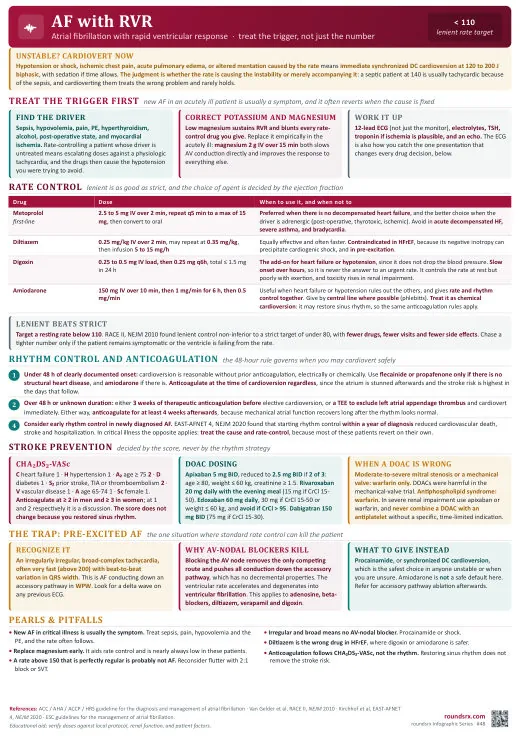
Text version
- CCB in HFrEF (negative inotrope → worsens HF)
- Not anticoagulating based on CHA₂DS₂-VASc
- Not checking TSH (hyperthyroidism is reversible cause)
- Not screening for OSA (#1 modifiable risk factor for AF recurrence)