Autoimmune Hepatitis
Autoimmune hepatitis (AIH) is a chronic inflammatory liver disease caused by loss of immune tolerance to hepatocytes. It predominantly affects young women (female:male ratio 4:1) but can occur at any age. Can present as acute hepatitis (AST/ALT often >1000) or chronic liver disease with insidious progression to cirrhosis. Associated with other autoimmune conditions (thyroiditis, UC, RA, celiac).
- Type 1 (80%) -ANA and/or anti-smooth muscle antibody (ASMA) positive. Adults predominantly. Most common worldwide.
- Type 2 -Anti-liver-kidney microsomal antibody (anti-LKM1) positive. More common in children. Tends to be more severe.
- Standard induction: Prednisone 40-60 mg daily, tapering over 4-8 weeks to 5-10 mg daily, PLUS Azathioprine (Imuran) 50 mg daily at week 2, uptitrated to 1-2 mg/kg.
- Alternative: Budesonide (Entocort) 9 mg daily -first-pass hepatic metabolism means fewer systemic side effects. BUT: do NOT use in cirrhotic patients (portosystemic shunts bypass first-pass metabolism, negating the benefit). Manns, Gastroenterology 2010
Azathioprine monotherapy (1-2 mg/kg daily) once steroids are tapered. Aim to maintain on the lowest effective azathioprine dose. Relapse rate is 80-90% if treatment is stopped -most patients need lifelong therapy.
- AST/ALT -often markedly elevated (>1000 in acute flares). Hepatocellular pattern.
- IgG levels -elevated IgG is the hallmark. Polyclonal hypergammaglobulinemia.
- ANA -positive in Type 1 (not specific for AIH)
- ASMA (anti-smooth muscle antibody) -more specific for Type 1 AIH
- Anti-LKM1 -diagnostic of Type 2 AIH
- Liver biopsy -interface hepatitis (lymphoplasmacytic infiltrate at the portal-parenchymal junction) is classic. May show bridging necrosis in severe cases.
- Rule out other causes:
- Viral hepatitis -Hep A IgM, HBsAg, anti-HBc, anti-HCV, Hep E IgM
- Drug-induced liver injury -thorough medication history
- Wilson disease -ceruloplasmin (especially in patients <40)
- Simplified AIH Scoring System -uses ANA/SMA titers, IgG levels, liver histology, and exclusion of viral hepatitis. Score >=7 = definite AIH.
| Drug | Dose | Route | Notes |
|---|---|---|---|
| Prednisone INDUCTION | 40-60 mg daily, taper to 5-10 mg over 4-8 weeks | PO | Standard induction. Monitor glucose, BP, bone density on prolonged use. |
| Azathioprine (Imuran) MAINTENANCE | 50 mg daily initially, uptitrate to 1-2 mg/kg | PO | Check TPMT BEFORE starting. Fatal myelosuppression if homozygous deficient. Monitor CBC q2 weeks x 2 months, then q3 months. AASLD 2020 |
| Budesonide (Entocort) | 9 mg daily (3 mg TID) | PO | Alternative to prednisone. First-pass metabolism = fewer systemic effects. Do NOT use in cirrhosis. |
| Mycophenolate (CellCept) | 1-2 g daily | PO | Second-line for azathioprine-intolerant patients. Teratogenic -avoid in pregnancy. |
| Tacrolimus (Prograf) | 1-6 mg daily (target trough 3-5 ng/mL) | PO | Salvage therapy for refractory AIH. Monitor trough levels and renal function. |
Patient: 32F with 3 weeks of fatigue, jaundice, RUQ pain. AST 1180, ALT 1420, T. bili 7.6, INR 1.2. IgG 3400 (markedly elevated). ANA 1:320, ASMA 1:160. Viral hepatitis negative. Biopsy: interface hepatitis with plasma cells.
Key findings: Type 1 AIH (ANA/ASMA positive). Simplified AIH score ≥ 7 = definite. Interface hepatitis with lymphoplasmacytic infiltrate is the hallmark histologic finding.
Management:
- Prednisone 40-60 mg daily (or budesonide 9 mg daily if non-cirrhotic), expect ALT improvement within 2 weeks
- Add azathioprine 50 mg daily after 2 weeks → titrate to 1-2 mg/kg (check TPMT first!)
- Goal: biochemical remission (normal ALT + IgG) within 6-12 months
- Taper prednisone slowly over 3-6 months → maintain on azathioprine monotherapy
- Relapse rate 80-90% if treatment stopped, most patients need lifelong azathioprine
Teaching point: AIH responds dramatically to steroids, if ALT does not improve within 2 weeks, reconsider the diagnosis. The combination of prednisone + azathioprine allows faster steroid taper and fewer steroid side effects.
Patient: 24F with 1 week of rapidly worsening jaundice, confusion. AST 2800, ALT 3200, T. bili 18, INR 3.8, albumin 2.4. IgG 4200. ANA 1:640. Developing hepatic encephalopathy grade II.
Key findings: Acute severe AIH with impending liver failure (INR > 1.5 + encephalopathy = acute liver failure criteria). Must decide quickly: steroids or transplant listing.
Management:
- Methylprednisolone 60 mg IV daily, trial of steroids for 7 days maximum
- If improving (bilirubin decreasing, INR improving by day 7): continue steroids, add azathioprine
- If NOT improving or worsening: list for emergent liver transplant (MELD exception)
- LILLE score or similar at day 7 to objectively assess steroid response
- ICU monitoring, lactulose for encephalopathy, FFP only if actively bleeding (don't mask INR trend)
Teaching point: Acute severe AIH gets a 7-day steroid trial, this is both diagnostic and therapeutic. If no response, proceeding with steroids delays transplant listing. The key is having a clear timeline and objective response criteria before starting.
Patient: 40F with known AIH in remission on azathioprine 150 mg daily. Stopped taking it 3 months ago (felt well). Now AST 680, ALT 820, IgG 2800, bilirubin 4.2. Previously well-controlled.
Key findings: AIH flare from medication non-compliance. This is the most common reason for relapse. Predictable, 80-90% relapse when therapy is withdrawn.
Management:
- Restart prednisone 30-40 mg daily (re-induce remission)
- Restart azathioprine at previous effective dose (150 mg daily)
- Taper prednisone once ALT normalizing → maintain azathioprine indefinitely
- Counsel: AIH requires lifelong therapy in most patients. Stopping medication risks flare → fibrosis progression
- Repeat liver biopsy if concern for interval fibrosis progression from uncontrolled inflammation
Teaching point: Each untreated flare accelerates fibrosis. Patients who relapse after stopping therapy should generally never attempt withdrawal again, the risk-benefit clearly favors lifelong low-dose azathioprine over recurrent flares and progressive liver damage.
Ms. Patel is a 28-year-old woman with no significant past medical history presenting with 2 weeks of fatigue, jaundice, and RUQ discomfort. Labs: AST 1,240, ALT 1,580, total bilirubin 8.4, INR 1.3, albumin 3.2. IgG markedly elevated at 3,200 (normal <1600). ANA 1:320, ASMA 1:160. Hepatitis A, B, C, E serologies negative. Ceruloplasmin normal. Liver biopsy: interface hepatitis with lymphoplasmacytic infiltrate. Simplified AIH score: 8 (definite AIH).
- LFTs (AST/ALT) -q2-4 weeks during induction, then q3 months on maintenance. Goal: normalization of transaminases.
- IgG level -normalize with successful treatment. Useful marker of disease activity.
- CBC -monitor for azathioprine myelosuppression. q2 weeks for first 2 months, then q3 months.
- TPMT result -must have before starting azathioprine.
- Liver biopsy -consider repeat biopsy before treatment withdrawal to confirm histologic remission (biochemical remission does NOT guarantee histologic remission).
- Hepatocellular carcinoma screening -if cirrhosis present, standard HCC screening (ultrasound + AFP q6 months).
- Bone density -DEXA if prolonged steroid use.
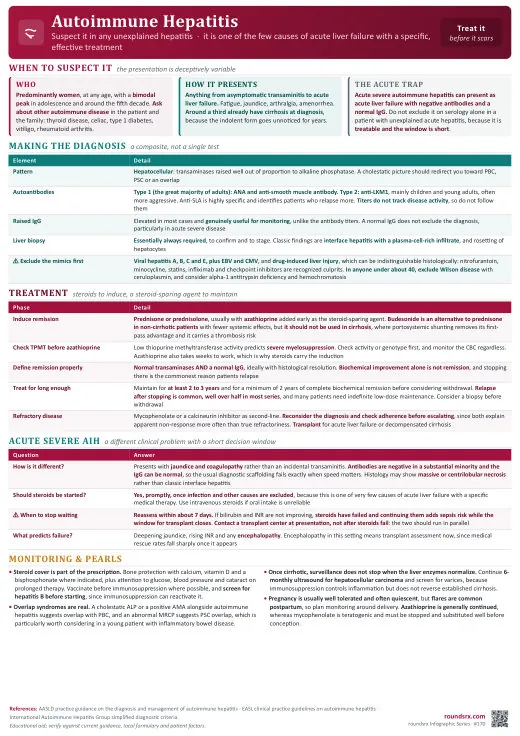
Text version
- Elevated IgG is the hallmark (polyclonal hypergammaglobulinemia), and it is what separates AIH from other hepatitides
- AST/ALT hepatocellular pattern, often >1000 in acute flares
- ANA and/or ASMA positive in Type 1 (80%, adults). ANA is not specific for AIH; ASMA is more specific
- Anti-LKM1 is diagnostic of Type 2 (more common in children, tends to be more severe)
- Liver biopsy shows interface hepatitis (lymphoplasmacytic infiltrate at the portal-parenchymal junction), bridging necrosis if severe
- Simplified AIH Score ≥7 = definite AIH, built from ANA/SMA titers, IgG, histology, and exclusion of viral hepatitis
- Viral hepatitis: Hep A IgM, HBsAg, anti-HBc, anti-HCV, Hep E IgM, because immunosuppressing active viral hepatitis is harmful
- Drug-induced liver injury: thorough medication history, DILI can mimic the biochemistry exactly
- Wilson disease: ceruloplasmin, especially in patients <40 where it is most likely to be missed
- Who gets it: predominantly young women (female:male 4:1), any age. Look for associated autoimmunity (thyroiditis, UC, RA, celiac)
- AST/ALT q2 to 4 weeks during induction, then q3 months on maintenance, because normalization of transaminases is the treatment goal
- IgG level alongside LFTs, it normalizes with successful treatment and is a useful marker of ongoing disease activity
- CBC q2 weeks for the first 2 months, then q3 months, to catch azathioprine myelosuppression before it becomes pancytopenia
- Repeat liver biopsy before any withdrawal attempt, because biochemical remission does NOT guarantee histologic remission
- HCC screening (ultrasound + AFP q6 months) if cirrhotic, standard cirrhosis surveillance applies
- DEXA if steroids are prolonged, to catch steroid bone loss. Also watch glucose and BP on prednisone
- Starting azathioprine without TPMT. Homozygous deficiency (~0.3%) means toxic metabolite accumulation and fatal pancytopenia
- Budesonide in a cirrhotic. Its whole advantage is ~90% first-pass hepatic clearance; portosystemic shunts bypass the liver, so you get full systemic steroid exposure with no benefit. Use prednisone
- Stopping therapy because the patient feels well. Non-compliance is the most common reason for relapse, and each untreated flare accelerates fibrosis
- Calling it AIH without excluding viral hepatitis, DILI, and Wilson. The autoantibodies are not specific enough to stand alone
- Continuing steroids past day 7 in acute severe AIH that is not responding, which just delays transplant listing
- INR >1.5 plus encephalopathy = acute liver failure. Methylprednisolone 60 mg IV daily as a 7-day maximum steroid trial, both diagnostic and therapeutic
- No improvement in bilirubin or INR by day 7: list for emergent transplant (MELD exception). Assess objectively (LILLE score or similar) rather than by gestalt
- ALT not improving within 2 weeks of steroids: reconsider the diagnosis, this disease normally responds fast
- Azathioprine intolerance or refractory disease: mycophenolate second-line, tacrolimus as salvage, both hepatology-directed
- Withdrawal attempt only if sustained biochemical remission >2 years, confirmed histologic remission on repeat biopsy, and labs q2 to 4 weeks after stopping
- Manns, Gastroenterology 2010: budesonide 9 mg daily is a valid prednisone alternative for induction in non-cirrhotic AIH, with fewer systemic steroid effects
- AASLD 2020: underpins the azathioprine maintenance strategy, TPMT testing before starting, and CBC monitoring q2 weeks × 2 months then q3 months
- Diagnostic triad to carry: elevated IgG + autoantibodies (ANA, ASMA, anti-LKM1) + interface hepatitis on biopsy