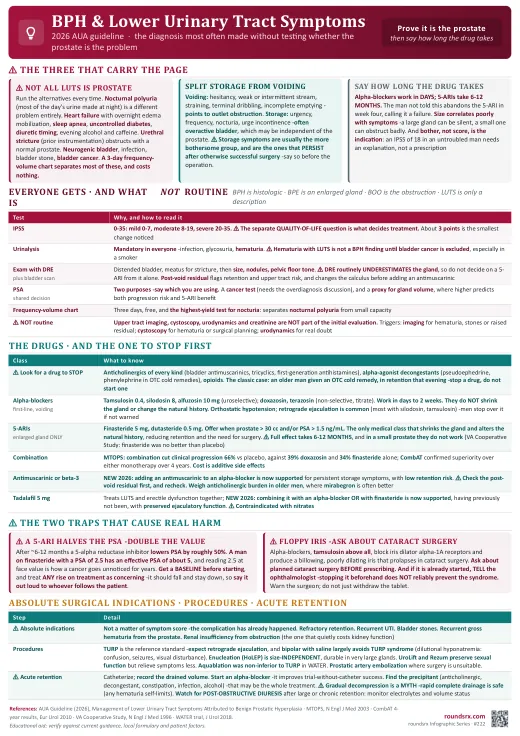
BPH & Lower Urinary Tract Symptoms
These get used interchangeably at the bedside, and the confusion is what produces a man on tamsulosin for symptoms his prostate is not causing.
| Term | What it actually means |
|---|---|
| BPH | A histologic diagnosis -hyperplasia of the transition zone. Extremely common with age and frequently asymptomatic. You cannot diagnose it from a symptom questionnaire. |
| BPE | Benign prostatic enlargement -the gland is big on examination or imaging. Size correlates poorly with symptoms: a large gland can be silent and a small one can obstruct badly, which is why treating on size alone fails. |
| BOO | Bladder outlet obstruction -the functional problem, demonstrated on flow studies. This is what surgery fixes. BPE is one cause among several (stricture, bladder neck contracture). |
| LUTS | The symptom complex, and the only one of the four you can observe in clinic. It is a description, not a diagnosis, and the whole workup exists to find out which of the above (if any) is producing it. |
Sort the symptoms before you prescribe, because the two groups respond to different drugs and a man whose dominant complaint is storage will not thank you for an alpha-blocker alone.
| Group | Symptoms | What it implies |
|---|---|---|
| Voiding (obstructive) | Hesitancy, weak or intermittent stream, straining, terminal dribbling, sensation of incomplete emptying, prolonged voiding time | Points toward outlet obstruction. Responds to alpha-blockers, 5-ARIs in an enlarged gland, and surgery. |
| Storage (irritative) | Urgency, frequency, nocturia, urge incontinence | Often overactive bladder, which may be secondary to obstruction or entirely independent. Frequently the more bothersome group, and the group that persists after otherwise successful surgery -warn the patient before, not after. |
| Test | Why, and how to read it |
|---|---|
| Symptom score (IPSS) | The validated instrument, and the one the guideline asks for in any man who is not catheter-dependent. Seven questions, 0 to 35: mild 0 to 7, moderate 8 to 19, severe 20 to 35. The separate quality-of-life question is the one that decides treatment, because bother, not score, is the indication. A score around 3 points is the smallest change a patient reliably notices, which is the yardstick for whether a drug is working. |
| History and medication review | Storage versus voiding split, duration, hematuria, prior instrumentation or catheterization (stricture), neurologic history, diabetes, fluid and caffeine and alcohol timing. Review every anticholinergic and decongestant. |
| Physical examination including DRE | Abdominal palpation for a distended bladder, the meatus and phallus for stricture or phimosis, and a digital rectal examination for a gross estimate of size, for nodules or asymmetry suggesting cancer, and for pelvic floor tone. Size on DRE is a rough estimate and routinely underestimates the gland, so do not use it alone to decide on a 5-ARI. |
| Urinalysis | Mandatory in everyone, to exclude infection, glycosuria and hematuria. Nonvisible hematuria with LUTS is not a BPH finding until bladder cancer has been excluded, particularly in a smoker. |
| PSA, after a shared decision | Two distinct reasons, and it helps to say which you are using. As a cancer test, it needs the usual discussion of overdiagnosis and life expectancy. As a proxy for prostate volume, where a higher PSA predicts a larger gland and therefore both a greater risk of progression and a greater likelihood of benefit from a 5-ARI. |
| Post-void residual | By bladder scan. Identifies incomplete emptying, which changes the safety calculus for adding an antimuscarinic and flags men at risk of retention and of upper tract damage. A markedly raised residual is a reason to involve urology rather than to keep titrating drugs. |
| Frequency-volume chart | Three days, free, and the single highest-yield test for nocturia. It distinguishes a small functional capacity from nocturnal polyuria, and it exposes the man drinking four cups of tea after dinner. |
| Uroflowmetry | Peak flow rate (Qmax) as an objective measure of obstruction severity. Useful before intervention, not required to start a drug in primary care. |
- Fluid timing rather than fluid restriction -reduce intake in the 3 to 4 hours before bed, since total restriction risks dehydration in an older adult without helping daytime symptoms.
- Cut evening caffeine and alcohol, both of which are diuretic and bladder irritants; this alone resolves a meaningful amount of nocturia.
- Double voiding and timed voiding for incomplete emptying, and bladder training for urgency.
- Move the diuretic dose earlier where the drug allows it, and treat the peripheral edema that redistributes overnight.
- Stop the offending drug -the anticholinergic, the decongestant- which is the highest-yield intervention on this list and the one most often skipped.
| Class | Agents and dosing | What to know |
|---|---|---|
| Alpha-blockers first-line for bothersome voiding symptoms | Tamsulosin (Flomax) 0.4 mg daily, Silodosin (Rapaflo) 8 mg daily, Alfuzosin (Uroxatral) 10 mg daily -relatively uroselective. Doxazosin (Cardura) and Terazosin (Hytrin) -non-selective, need titration. | Work within days to a couple of weeks, which is the reason to start here: the patient gets an answer quickly. They relax smooth muscle and do not shrink the gland or alter the natural history. Orthostatic hypotension and dizziness are the limiting effects, worst with the non-selective agents, at first dose, and when combined with a PDE5 inhibitor or antihypertensives. Retrograde ejaculation is common, most with silodosin and tamsulosin, and men stop the drug over it if not warned. The non-selective agents also lower blood pressure, which is occasionally useful but is not a reason to use them as antihypertensives. |
| 5-alpha reductase inhibitors only in an enlarged gland | Finasteride (Proscar) 5 mg daily, Dutasteride (Avodart) 0.5 mg daily. | Offer when the prostate is estimated above 30 cc and/or PSA is above 1.5 ng/mL, both for symptoms and to reduce progression. They genuinely shrink the gland and alter the natural history, reducing acute retention and the need for surgery -the only medical class that does. But they take 6 to 12 months for full effect, so a man expecting a rapid answer will abandon them at week four. In a small prostate they do not work: in the VA Cooperative Study, 1996 finasteride was no better than placebo over a year, in a cohort whose prostates were relatively small. |
| Combination alpha-blocker + 5-ARI | Any pairing; Dutasteride/Tamsulosin (Jalyn) exists as a single capsule. | For moderate to severe symptoms with an enlarged gland and a high risk of progression. In MTOPS, 2003 combination cut overall clinical progression by 66% versus placebo, against 39% for doxazosin and 34% for finasteride alone. CombAT, 2010 confirmed superiority over either monotherapy in men with enlarged glands over 4 years. The cost is additive side effects, so reserve it for men who actually have the progression risk. |
| Antimuscarinics and beta-3 agonists for storage-predominant symptoms | Solifenacin (Vesicare), Tolterodine (Detrol), Mirabegron (Myrbetriq). | NEW 2026 Adding an antimuscarinic to an alpha-blocker is now supported where storage symptoms persist, with evidence of symptom and quality-of-life benefit and a low risk of retention -tamsulosin plus solifenacin improved storage symptoms over tamsulosin alone. Check the post-void residual before adding one, and recheck after. In older men weigh the anticholinergic burden -confusion, falls, constipation, dry mouth, and the cumulative cognitive load- which is where mirabegron is often the better choice. |
| PDE5 inhibitor | Tadalafil (Cialis) 5 mg daily. | Improves LUTS and treats erectile dysfunction at the same time, which is a common pairing in this population. NEW 2026 Combining daily tadalafil with an alpha-blocker or with finasteride is now supported, having previously not been, with the added attraction of preserved ejaculatory function. ⚠ Absolutely contraindicated with nitrates, and watch additive hypotension with alpha-blockers. |
Some indications are absolute and are not a matter of symptom score, because the complication has already happened.
- Refractory urinary retention -failed trial without catheter, or repeated episodes.
- Recurrent urinary tract infection attributable to incomplete emptying.
- Bladder stones from chronic residual urine.
- Recurrent gross hematuria from the prostate, once other causes are excluded.
- Renal insufficiency from obstruction, which is the one that quietly costs kidney function.
- Bothersome symptoms despite adequate medical therapy, or a patient who would rather have a procedure than a lifetime of tablets -a legitimate preference, not a failure.
| Option | What it involves, and the trade-off |
|---|---|
| TURP | The long-standing reference standard against which everything else is measured. Retrograde ejaculation is expected in most men, which must be discussed before rather than after. ⚠ TURP syndrome -dilutional hyponatremia from absorbed hypotonic irrigant, causing confusion, seizures and visual disturbance- is a monopolar phenomenon and is largely avoided by bipolar TURP with saline irrigation, now widely used. |
| Enucleation HoLEP, ThuLEP | Size-independent, which is its defining advantage: durable results even in very large glands that would otherwise need open surgery. Steeper operator learning curve, and transient stress incontinence is the characteristic early complaint. |
| Simple prostatectomy | Open, laparoscopic or robotic, for very large glands where endoscopic options are unsuitable and enucleation is unavailable. |
| Prostatic urethral lift UroLift | Implants retract the lateral lobes rather than removing tissue. Its selling point is preserved sexual function, including ejaculation. In the sham-controlled L.I.F.T., 2013 symptom scores fell 11.1 points versus 5.9 with sham. Symptom relief is smaller than with TURP and it is unsuitable for a large median lobe, so it is a trade of magnitude and durability for sexual function. |
| Water vapor thermal therapy Rezum | Convective steam ablation, office-based, with sexual function largely preserved. Expect a period of worse symptoms and a catheter for several days while the treated tissue sloughs, which patients need warned about or they will think it failed. |
| Aquablation | Robotically executed, image-guided waterjet resection. In WATER, 2018 it was non-inferior to TURP for symptom improvement at 6 months with fewer safety events (26% versus 42%) and less ejaculatory dysfunction, at the cost of more early bleeding. |
| Prostatic artery embolization | Interventional radiology option for men who are poor surgical candidates or on anticoagulation. Less effective than TURP but avoids anesthesia and instrumentation. |
"Mr. D is a 68-year-old man referred for a prostate problem, and I want to start by saying I am not yet convinced the prostate is the whole story. His dominant complaint is waking four times a night, with only mild hesitancy and a reasonable stream, so this is storage-predominant rather than voiding-predominant. His IPSS is 16, moderate, but his quality-of-life response is the part that matters: he is bothered enough to want treatment. I asked him to keep a three-day frequency-volume chart, and it shows he produces most of his urine overnight, which is nocturnal polyuria and not something a prostate drug will fix. He has bilateral ankle edema, takes his furosemide at bedtime, and his wife describes loud snoring with witnessed apneas -so I would move the diuretic earlier, treat the edema, and refer for a sleep study before assuming this is BPH. His urinalysis shows no blood, no glucose and no infection. His examination shows a moderately enlarged smooth prostate with no nodules. He is on no anticholinergics and takes no decongestants, which I checked specifically. We discussed PSA and he wants it done; I have explained I am using it for two purposes, as a cancer test and as a proxy for gland size, and that if we later start a 5-alpha reductase inhibitor his PSA will halve and every future value must be doubled. If the nocturia persists once the reversible causes are addressed, my plan is an alpha-blocker for a rapid answer, with the expectation set that it works within days, and to warn him about retrograde ejaculation and dizziness before he starts rather than after."
- Storage versus voiding symptoms separated before any drug is chosen.
- Non-prostatic causes actively excluded -nocturnal polyuria, heart failure, sleep apnea, diabetes, stricture, neurogenic bladder.
- Medication list reviewed for anticholinergics, decongestants and opioids, and the offender stopped.
- Urinalysis done, hematuria taken seriously rather than attributed to the prostate.
- ⚠ Baseline PSA before any 5-ARI, and the halving explained and documented for whoever follows.
- Time-to-benefit stated explicitly -days for an alpha-blocker, 6 to 12 months for a 5-ARI.
- Sexual side effects discussed before prescribing, since retrograde ejaculation is the commonest reason men stop.
- ⚠ Cataract surgery asked about before starting an alpha-blocker, and the ophthalmologist told if one is already prescribed.
- Post-void residual checked before adding an antimuscarinic, and rechecked afterwards.
| Point | Detail |
|---|---|
| Four different words | BPH is histologic, BPE is an enlarged gland, BOO is the functional obstruction, LUTS is the symptom complex. Size correlates poorly with symptoms. |
| Split the symptoms | Voiding (hesitancy, weak stream, straining, incomplete emptying) versus storage (urgency, frequency, nocturia, urge incontinence). Different drugs, and storage symptoms are the ones that persist after successful surgery. |
| ⚠ Not all LUTS is prostate | Nocturnal polyuria, heart failure, sleep apnea, diabetes, diuretic timing, urethral stricture, neurogenic bladder, infection, bladder stone, bladder cancer. A three-day frequency-volume chart separates most of these and costs nothing. |
| ⚠ Look for a drug to stop | Anticholinergics, alpha-agonist decongestants, opioids. The older man in retention after an over-the-counter cold remedy is the classic case, and the treatment is stopping a drug rather than starting one. |
| Everyone gets | IPSS (mild 0-7, moderate 8-19, severe 20-35, plus the quality-of-life question that actually decides treatment), history and medication review, examination with DRE, urinalysis, PSA after a shared decision, and post-void residual. Not routine: upper tract imaging, cystoscopy, urodynamics. |
| Bother, not score | Watchful waiting with behavioral advice is a real option. Fluid timing, evening caffeine and alcohol, double voiding, earlier diuretic dosing come before any prescription. |
| Alpha-blockers | Work in days, relieve symptoms, do not change the natural history. Orthostatic hypotension and retrograde ejaculation (worst with silodosin and tamsulosin) are why men stop. |
| 5-ARIs | Only in an enlarged gland -above ~30 cc and/or PSA above 1.5. Take 6 to 12 months, but are the only class that shrinks the gland and reduces retention and surgery. Useless in a small prostate. |
| ⚠ The PSA trap | A 5-ARI halves the PSA. Double the measured value. Get a baseline before starting, and treat any rise on treatment as concerning. This is how a cancer gets missed. |
| ⚠ Floppy iris | Ask about planned cataract surgery before starting an alpha-blocker, and tell the ophthalmologist if one is already prescribed. Stopping the drug does not reliably prevent it, so the point is warning the surgeon, not withdrawing the tablet. |
| Combination | For enlarged glands with progression risk. MTOPS: 66% reduction in progression versus 39% doxazosin and 34% finasteride alone; CombAT confirmed superiority over either monotherapy across 4 years. |
| Newly supported in 2026 | NEW 2026 Daily low-dose tadalafil with an alpha-blocker or with finasteride, and an antimuscarinic added to an alpha-blocker for persistent storage symptoms, with low retention risk. Check the post-void residual first, and weigh anticholinergic burden in older men. |
| Absolute surgical indications | Refractory retention, recurrent UTI, bladder stones, recurrent gross hematuria from the prostate, renal insufficiency from obstruction. These are not a matter of symptom score. |
| Procedures | TURP is the reference standard (expect retrograde ejaculation; bipolar avoids TURP syndrome). Enucleation is size-independent. UroLift and Rezum preserve sexual function but relieve symptoms less. Aquablation was non-inferior to TURP in WATER with fewer safety events but more early bleeding. |
| ⚠ Acute retention | Catheterize, record the drained volume, start an alpha-blocker to improve the trial without catheter, and find the precipitant. Rapid complete drainage is safe -gradual decompression is a myth. Watch for post-obstructive diuresis after large or chronic retention. |
- Prove it is the prostate before you treat the prostate. A three-day frequency-volume chart and a medication review resolve more of this clinic than any drug does.
- Set the time-to-benefit expectation out loud. Alpha-blockers in days, 5-ARIs in 6 to 12 months. The man who does not know this stops the 5-ARI in week four and calls it a failure.
- Double the PSA on a 5-ARI. Get a baseline first, and treat any rise on treatment as a cancer question, not a dosing question.