Transfusion Medicine
| Product | Threshold | Evidence |
|---|---|---|
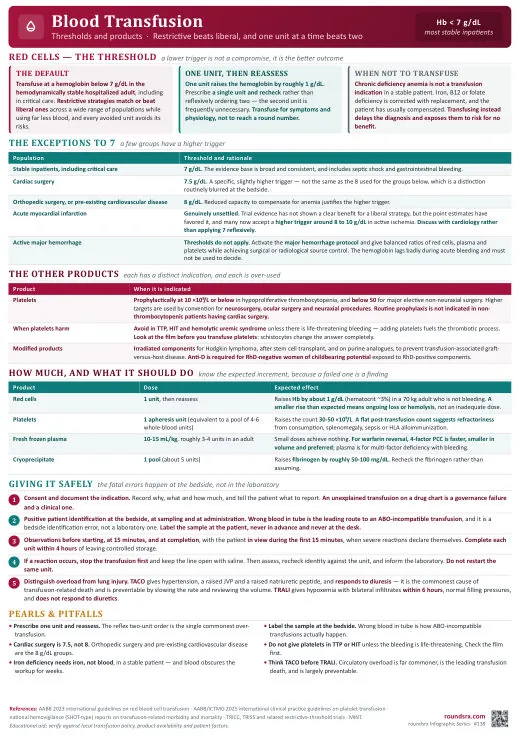
| pRBCs -general RESTRICTIVE | Hgb < 7 g/dL | TRICC, 1999: restrictive (7) non-inferior to liberal (10) in ICU. TRICS-III, 2017: confirmed in cardiac surgery. |
| pRBCs -ACS | Hgb < 8 g/dL (or symptomatic anemia) | REALITY, 2021: restrictive (8) vs liberal (10) -non-inferior for 30-day MACE in MI. |
| pRBCs -active bleeding | Hgb < 7–8, but transfuse to symptoms/hemodynamics | MTP: 1:1:1 ratio PROPPR, 2015 (pRBC:FFP:platelets). Don't wait for lab values in massive hemorrhage. |
| Platelets -general | < 10,000 (prophylactic) | Higher thresholds for active bleeding (< 50K), neurosurgery (< 100K), or procedures. |
| FFP | Active bleeding + INR > 1.5 | 15 mL/kg. Or 4F-PCC for warfarin reversal (faster, less volume). |
| Cryoprecipitate | Fibrinogen < 100–150 (DIC, massive transfusion) | 10 units raises fibrinogen ~50–70 mg/dL. Key product in DIC. |
| Product | Contains | Expected Effect | Special Considerations |
|---|---|---|---|
| pRBCs | Red blood cells in additive solution | ↑ Hgb ~1 g/dL per unit | Type & screen required. Irradiate if immunocompromised (prevent TA-GVHD). CMV-negative or leukoreduced for transplant candidates. |
| Platelets | Platelets (apheresis or pooled) | ↑ 30,000–50,000 per unit | ABO-compatible preferred. Room temperature storage (not refrigerated). 5-day shelf life. Highest bacterial contamination risk of all blood products. |
| FFP | All clotting factors | ↑ factor levels ~20–30% | ABO-compatible required. Thaw time ~30 min. Volume ~250 mL/unit (risk of TACO). |
| Cryoprecipitate | Fibrinogen, Factor VIII, vWF, Factor XIII | ↑ fibrinogen ~50–70 mg/dL per 10 units | Key for DIC, massive transfusion, factor XIII deficiency. Pooled (10 units = 1 dose). |
| Reaction | Timing | Features | Management | ||||||||||||||||||
|---|---|---|---|---|---|---|---|---|---|---|---|---|---|---|---|---|---|---|---|---|---|
| Acute hemolytic (ABO mismatch) | Minutes | Fever, flank pain, dark urine, hypotension, DIC. Most dangerous. Usually clerical error. | STOP immediately. IVF (prevent renal failure), send direct Coombs + repeat type & screen. Supportive ICU care. | ||||||||||||||||||
| Febrile non-hemolytic (FNHTR) | 1–6 hours | Fever, rigors. Most common reaction. Cytokines from donor WBCs. | Stop, rule out hemolytic. Acetaminophen. Leukoreduced products prevent recurrence. | ||||||||||||||||||
| Allergic (mild) | During | Urticaria, pruritus. No fever or hemodynamic changes. | Stop temporarily. Diphenhydramine 25–50 mg IV. Can resume slowly if mild. | ||||||||||||||||||
| Anaphylactic | Minutes | Hypotension, bronchospasm, angioedema. Often in IgA-deficient patients (anti-IgA antibodies). | Epinephrine 0.3–0.5 mg IM. IVF, steroids, bronchodilators. Future: washed or IgA-deficient products. | ||||||||||||||||||
| TRALI | ≤ 6 hours | Acute respiratory distress + bilateral infiltrates + hypoxia within 6h. No volume overload. Caused by donor antibodies activating recipient neutrophils in lungs. | Supportive (O₂, ventilation). Diuretics do NOT help (not a volume issue). Usually resolves 48–96h. Report to blood bank. | ||||||||||||||||||
| TACO | ≤ 6 hours | Volume overload → pulmonary edema, HTN, JVD. Distinguished from TRALI by: elevated BNP, response to diuretics, hypertension. | Diuretics. Slow transfusion rate for future products
🔍 Overview
Overview
Blood product transfusion is one of the most common inpatient procedures. Restrictive thresholds (Hgb < 7) are standard for most patients [TRICC, 1999; TRISS, 2014] -liberal transfusion does not improve outcomes and may worsen them. In acute coronary syndrome, threshold is Hgb < 8. Always transfuse 1 unit at a time and recheck before ordering more. Massive transfusion protocol (MTP): 1:1:1 ratio of pRBC:FFP:platelets + TXA 1g IV [CRASH-2, 2010; PROPPR, 2015]. Key reactions to recognize: TRALI (non-cardiogenic pulmonary edema, normal BNP, within 6h) vs TACO (volume overload, elevated BNP, responds to diuretics). Stop transfusion immediately for any suspected reaction. 🧪 Workup
Workup
🚨 Management
Management
📋 On Rounds
How do you distinguish TRALI from TACO?
Both present with respiratory distress + bilateral infiltrates within 6h of transfusion. TRALI: non-cardiogenic pulmonary edema (BNP normal or low, hypotension, no JVD, does NOT respond to diuretics). Caused by donor antibodies. TACO: cardiogenic volume overload (BNP elevated, hypertension, JVD, responds to diuretics). Risk factors: CHF, CKD, rapid infusion rate, multiple units. Key distinguisher: give furosemide. If they improve → TACO.
Why Hgb 7, not 10?
TRICC, 1999 randomized ICU patients to restrictive (Hgb 7) vs liberal (Hgb 10) transfusion. Restrictive was non-inferior for 30-day mortality and had fewer cardiac events. Multiple subsequent trials confirmed this across cardiac surgery TRICS-III, 2017, GI bleed Villanueva, 2013, and hip surgery FOCUS, 2011.
What is TRALI and how do you differentiate it from TACO?
Both present with respiratory distress during/after transfusion, but treatment is opposite. TRALI (Transfusion-Related Acute Lung Injury): non-cardiogenic pulmonary edema. Onset within 6h. Bilateral infiltrates on CXR. NO signs of volume overload (BNP normal/low, no JVD, no S3). Due to donor antibodies activating recipient neutrophils → capillary leak. Treatment: supportive (O₂, intubation if needed, NO diuretics).
What is the transfusion threshold for most hospitalized patients?
Restrictive threshold: Hgb < 7 g/dL for most hospitalized patients. TRICC, 1999 and TRISS, 2014: restrictive (Hgb < 7) was non-inferior to liberal (Hgb < 10) for mortality. Liberal transfusion did NOT improve outcomes and increased complications. Exception: Hgb < 8 for ACS/active cardiac ischemia (the MINT trial MINT, 2023 suggested possible benefit, though not definitive).
❓ How do you differentiate TRALI from TACO?
TRALI = non-cardiogenic pulmonary edema. Normal BNP, bilateral infiltrates within 6h, no fluid overload signs, does NOT respond to diuretics. Supportive care only -resolves 48-72h. TACO = volume overload. Elevated BNP, responds to furosemide, often hypertensive. Prevention: slow transfusion rate, furosemide between units in HF/CKD patients.
❓ What is the expected hemoglobin rise per unit of pRBC transfused?
~1 g/dL per unit in a 70 kg adult. If the post-transfusion Hgb rise is less than expected, consider: (1) ongoing hemorrhage, (2) hemolysis (check Coombs, LDH, haptoglobin), (3) hypersplenism, (4) volume overload diluting the measurement, (5) lab draw from a diluted line.
❓ When do you give cryoprecipitate and what does it contain?
Cryoprecipitate contains: fibrinogen (most important), Factor VIII, Factor XIII, vWF, and fibronectin. Give when fibrinogen < 100-150 mg/dL (DIC, massive transfusion, post-thrombolytics). Dose: 10 units (1 pool) raises fibrinogen ~70 mg/dL. In massive hemorrhage, check fibrinogen early and replace aggressively -it is the first factor to become critically depleted.
❓ What is a delayed hemolytic transfusion reaction (DHTR)?
DHTR occurs 3-14 days after transfusion due to anamnestic antibody response (patient was previously sensitized but antibody titer dropped below detection). Presents with: unexplained Hgb drop, new jaundice, dark urine, positive DAT. Especially dangerous in SCD patients -can cause hyperhemolysis (destruction of both transfused AND native RBCs). Prevention: extended phenotype matching.
❓ What does TXA do and when is it indicated in massive hemorrhage?
Tranexamic acid (TXA) inhibits fibrinolysis by blocking plasmin. Give 1g IV within 3 hours of hemorrhage onset -later administration may be harmful. Evidence: CRASH-2, 2010 -reduced mortality in trauma. WOMAN, 2017 -reduced death from postpartum hemorrhage. No benefit shown in GI bleeding HALT-IT, 2020. Include in all massive transfusion protocols.
Clinical Examples
📋 Case 1, Acute Hemolytic Transfusion Reaction
Patient: 62M receiving unit of pRBCs for Hgb 6.2. Within 15 min: rigors, fever 39.8°C, severe flank pain, dark urine. BP 82/48. Nursing notes: unit labeled "type A" but patient is "type O." Key findings: ABO-incompatible transfusion, the most dangerous transfusion reaction. Patient (type O) has preformed anti-A antibodies → immediate intravascular hemolysis → DIC, shock, renal failure. Almost always a clerical/labeling error. Management:
Teaching point: Acute hemolytic reactions are almost always human error, wrong blood to wrong patient. The bedside nurse check (patient ID + unit label + blood bank tag) is the last line of defense. Two-person verification at bedside prevents this lethal error. 📋 Case 2, TRALI vs TACO
Patient: 75F with HFrEF (EF 30%), received 2 units pRBCs for Hgb 6.8 (GI bleed). 4 hours after second unit: acute dyspnea, SpO₂ 84%, bilateral crackles, HTN (180/95). CXR: bilateral pulmonary infiltrates. BNP 2400. Key findings: Elevated BNP + hypertension + responds to diuresis = TACO (transfusion-associated circulatory overload), NOT TRALI. TRALI would have normal BNP, hypotension, and would NOT respond to furosemide. This patient's underlying HF + rapid transfusion → volume overload. Management:
Teaching point: The BNP is the best discriminator: TACO = elevated BNP (volume overload). TRALI = normal BNP (capillary leak). When in doubt, give furosemide, if the patient improves, it's TACO. TACO is now more common than TRALI since leukoreduction reduced TRALI incidence. 📋 Case 3, Massive Transfusion Protocol
Patient: 32F with ruptured ectopic pregnancy, HR 140, BP 68/30, Hgb 4.2. Actively hemorrhaging. MTP activated. Key findings: Class IV hemorrhagic shock (> 40% blood volume loss). Massive transfusion protocol (MTP) = ≥ 10 units pRBCs in 24h or ≥ 4 units in 1h. Goal: 1:1:1 ratio (pRBC:FFP:platelets) per PROPPR trial. Management:
Teaching point: The biggest mistakes in massive transfusion: (1) giving crystalloid instead of blood (dilutes coagulation factors), (2) forgetting calcium replacement (citrate toxicity → cardiac arrest), (3) not checking fibrinogen early (depletes before other factors). Resuscitate with blood, not saline. 📣 Sample Presentation
One-Liner
"Mr. Davis is a 68-year-old who developed rigors, fever 39.2°C, and back pain 20 minutes into a pRBC transfusion. BP dropped from 130/80 to 88/52. Transfusion stopped immediately."
Key Points to Cover on Rounds
Suspected acute hemolytic transfusion reaction (fever + hypotension + back pain during transfusion). Immediate actions: (1) transfusion STOPPED, (2) IV access maintained with NS, (3) patient ID rechecked against blood product -mismatch identified (wrong unit hung). Reaction workup sent: repeat type & screen, direct Coombs (DAT), free hemoglobin, LDH, haptoglobin, UA (hemoglobinuria). Blood bank notified immediately. IVF resuscitation for hypotension. Monitoring for DIC (PT/INR, fibrinogen, D-dimer q4h). Plan: supportive care, if Hgb still needed → crossmatch new unit with correct sample.
💊 Medications
Blood Products & Transfusion Medications
Premedication
Premedication (acetaminophen 650 mg PO + diphenhydramine 25–50 mg IV/PO) is only indicated if the patient has had a prior febrile or allergic transfusion reaction. Routine premedication for all transfusions is NOT recommended -it delays the transfusion, adds cost, and does not prevent serious reactions (TRALI, hemolytic). Leukoreduction is more effective than premedication for preventing FNHTR.
⚡ Summary
Summary
Restrictive Is the Default Transfuse red cells below 7 g/dL in most hospitalized patients. The old 10/30 rule is obsolete: TRICC and TRISS showed a restrictive strategy is as safe or safer. Exceptions where 8 is used: active coronary syndrome, and some post-operative orthopedic and cardiac surgery patients. One Unit at a Time, Then Reassess A single unit raises hemoglobin by about 1 g/dL in an average adult. Order one unit, then recheck and reassess rather than reflexively ordering two. Transfusion is a decision about the patient, not about a number: symptoms, ongoing bleeding and hemodynamics matter more than the value. Know the Other Product Thresholds Platelets: below 10,000 prophylactically, below 20,000 with fever or sepsis, below 50,000 for most procedures or active bleeding, below 100,000 for neurosurgery or ocular surgery. Plasma: for active bleeding or an urgent procedure with a significantly prolonged PT or aPTT, not to correct a number. Cryoprecipitate: for fibrinogen below 100 to 150. Do Not Transfuse to Normalize Labs Plasma given for a mildly abnormal INR in a non-bleeding patient does not reduce bleeding and does expose them to TRALI, TACO and allergic reactions. This is especially true in cirrhosis, where hemostasis is rebalanced and the INR overstates the bleeding risk. The number is not the patient. Stop the Transfusion for Any Suspected Reaction Stop, keep the line open with saline, check vital signs, and send the bag plus a fresh sample to the blood bank with a clerical recheck. Wrong blood to the wrong patient is the leading cause of fatal acute hemolytic reactions, so the identity check at the bedside is the highest-yield safety step in the whole process. Sort Reactions by Timing and Vitals Minutes with fever, flank pain and dark urine: acute hemolytic. Minutes with hypotension, bronchospasm and angioedema: anaphylaxis, think IgA deficiency. 1 to 6 h with fever and no hemolysis: febrile non-hemolytic, the commonest. Hypoxia with bilateral infiltrates: TRALI if hypotensive with a normal JVP, TACO if hypertensive with a raised JVP and BNP. Match the Product Modification to the Risk Irradiated to prevent transfusion-associated GVHD in the immunocompromised and in directed donations from relatives. Leukoreduced to reduce febrile reactions, alloimmunization and CMV transmission. Washed for IgA deficiency and recurrent severe allergic reactions. Ordering the wrong modifier in an at-risk patient is what causes transfusion-associated GVHD, which is over 90% fatal. Do Not Premedicate Routinely Acetaminophen and diphenhydramine before every unit does not prevent serious reactions and simply masks the early fever that would have prompted you to stop. Reserve premedication for patients with a documented prior febrile or allergic reaction. Consent, verify the type and screen, and use a filtered set with normal saline only, since dextrose hemolyzes and calcium-containing fluids clot in the line. 📄 One Pager
Text versionHematology · One Pager
Transfusion Medicine
Threshold Hgb < 7 for most. 1:1:1 for MTP. TRALI vs TACO: BNP differentiates. Stop + workup any suspected reaction. Type & screen before all transfusions.
Thresholds
Hgb < 7 for most patients [TRICC, TRISS]. Hgb < 8 for active cardiac ischemia. Massive hemorrhage: 1:1:1 ratio (pRBC:FFP:plt) + TXA [CRASH-2].
Reactions
Febrile non-hemolytic (most common): stop, workup, rule out hemolytic. Acute hemolytic: fever + hypotension + back pain → stop immediately, send DAT, free Hgb, haptoglobin. TRALI: non-cardiogenic edema (normal BNP). TACO: volume overload (high BNP → furosemide).
Special Products
Irradiated: immunocompromised (prevent TA-GVHD). CMV-negative: CMV-seroneg transplant patients. Leukoreduced: prevent febrile reactions. Washed: severe allergic reactions (IgA deficiency).
Key Drugs
pRBCs1 unit raises Hgb ~1 g/dL FFP10-15 mL/kg (INR correction) Platelets1 unit raises plt ~30-50K TXA1g IV (massive hemorrhage)
Pitfalls
Related Topics Acute Leukemia (AML / ALL)AmyloidosisAnemia WorkupAnemia WorkupAnticoagulation ManagementChemotherapy Toxicities
🩺 Health Check
|