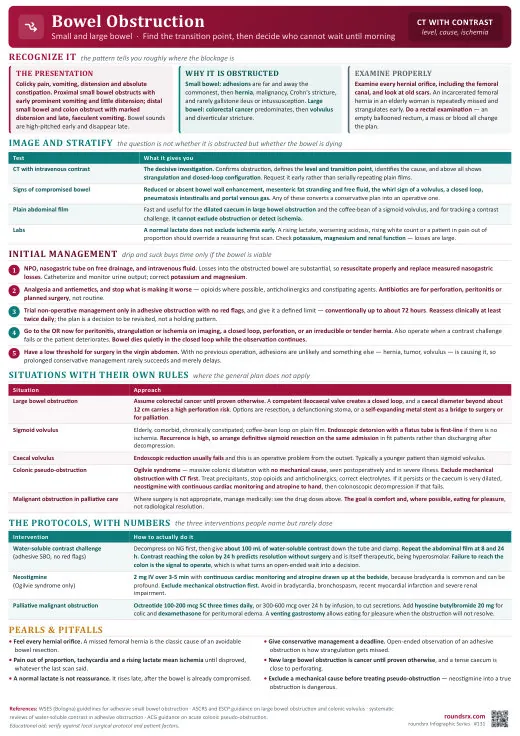
Bowel Obstruction: Small Bowel, Large Bowel and Ileus
| Feature | SBO | LBO |
|---|---|---|
| #1 Cause | Adhesions | Colorectal cancer |
| Other | Hernias, malignancy, Crohn | Volvulus (sigmoid > cecal) |
| Conservative | NGT, NPO, IVF ×48–72h | Depends on cause |
| Surgery | Complete, strangulation, failure to resolve | Cancer → resection. Cecal volvulus → surgery |
| Feature | SBO (Mechanical) | Ileus (Functional) |
|---|---|---|
| Cause | Adhesions (#1, 60–75%), hernias, tumor, volvulus | Post-operative, electrolyte imbalance, opioids, peritonitis |
| Imaging | Dilated proximal bowel + decompressed distal bowel + transition point | Diffuse dilation of small AND large bowel, no transition point |
| Air-fluid levels | Multiple, differential (step-ladder pattern) | Few, similar height |
| Management | NGT, NPO, IVF. Surgery if complete/strangulated. | Treat underlying cause. Bowel rest. Ambulation. |
| Feature | Partial SBO | Complete SBO |
|---|---|---|
| Gas in colon | Present | Absent |
| Passage of flatus/stool | May continue initially | Absent (obstipation) |
| CT findings | Transition point with some distal bowel gas | Discrete transition point, no distal gas, "small bowel feces sign" |
| Conservative trial | Resolves in 60-80% without surgery | Higher failure rate, closer surgical monitoring |
| Gastrografin useful? | Yes, both diagnostic and therapeutic | Less therapeutic benefit, more for surgical decision-making |
- Prior abdominal surgery - single greatest risk factor. Lower GI and pelvic surgeries have highest adhesion rates Menzies & Ellis, Ann Surg 1990
- Number of prior laparotomies - risk increases with each additional surgery
- Type of surgery - open > laparoscopic for adhesion formation Strik et al, Lancet 2016
- Peritonitis/contamination - inflammatory peritoneal environment drives adhesion formation
- Foreign bodies - mesh, drains, retained surgical materials
| Type | First-Line | Definitive |
|---|---|---|
| Sigmoid | Endoscopic decompression | Interval resection |
| Cecal | Surgery (scope does NOT work) | Right hemicolectomy |
| Finding | Significance |
|---|---|
| Transition point | Dilated proximal bowel → decompressed distal bowel. Identifies the site of obstruction. Distinguishes SBO from ileus (no transition point in ileus). |
| Air-fluid levels | Multiple, differential levels on upright film. Stepladder pattern classic for SBO. |
| Small bowel feces sign | Particulate matter in dilated SB near transition point. Suggests prolonged obstruction with bacterial overgrowth, and is about 82% specific for high-grade or complete obstruction Mayo-Smith, 1999. |
| Decreased bowel wall enhancement | Wall ischemia. Urgent surgical consultation, because a wall that does not take up contrast is losing its blood supply before it perforates. |
| Free fluid | Treat as strangulation until proven otherwise, particularly alongside a closed loop or a rising lactate. |
| Closed-loop obstruction | U-shaped or C-shaped dilated loop with 2 transition points converging. HIGH risk of strangulation → surgical emergency. |
| Pneumatosis intestinalis | Air within bowel wall = ischemia/necrosis. Requires urgent surgery. |
| Portal venous gas | Air in portal system = bowel necrosis. Extremely ominous sign. Emergency laparotomy. |
| Mesenteric haziness / stranding | Suggests venous congestion or early ischemia. Correlate with lactate. |
| Whirl sign | Swirling of mesentery and bowel around a point = volvulus or internal hernia. |
| Criteria | Conservative (Trial of Non-Op) | Operative (Go to OR) |
|---|---|---|
| Obstruction type | Partial SBO (contrast passes on CT) | Complete SBO, any LBO with obstruction |
| Etiology | Adhesive SBO (no virgin abdomen) | Hernia, closed-loop, volvulus, tumor |
| Clinical status | Stable, no peritonitis, tolerating NGT | Peritonitis, sepsis, hemodynamic instability |
| Labs | Normal lactate, normal WBC | Elevated lactate, leukocytosis, acidosis |
| Imaging | No closed-loop, no pneumatosis, no portal gas | Any sign of strangulation or ischemia |
| Time frame | Resolution expected within 48–72h | Failure to improve after 48–72h of conservative Rx |
- CT abdomen/pelvis with IV contrast, gold standard. Look for transition point, closed-loop, pneumatosis, portal venous gas
- CBC, BMP, lactate, lipase, type and screen
- Upright CXR if free air suspected (perforation)
- AXR: stepladder air-fluid levels (SBO), dilated colon >6 cm or cecum >9 cm (LBO)
| Segment | Upper Limit | What Dilation Above It Means and Why |
|---|---|---|
| Small bowel | 3 cm | SBO or ileus. A transition point from dilated to collapsed bowel means mechanical SBO; diffuse dilation of small and large bowel with no transition point favors ileus. The distinction decides whether surgery is involved. |
| Colon (transverse) | 6 cm | LBO, Ogilvie syndrome or toxic megacolon. Transverse colon above 6 cm plus systemic toxicity (fever, tachycardia, leukocytosis) in C. difficile or IBD is toxic megacolon, a surgical emergency, so stop opioids and antimotility agents and call surgery. |
| Cecum | 9 cm | The cecum is allowed to be widest, and it is also where the colon perforates first. By Laplace's law wall tension equals pressure times radius, so at the same intraluminal pressure the widest segment carries the highest wall tension. With a competent ileocecal valve an LBO becomes a closed loop and the cecum takes the pressure. |
- NGT decompression, NPO, IVF, serial exams q4–8h
- Gastrografin (diagnostic + therapeutic: reaches colon on 24h film = resolving)
- Complete obstruction, strangulation, closed-loop, failure to resolve 48–72h, incarcerated hernia
| Step | Action | Details |
|---|---|---|
| 1 | Confirm appropriateness | Partial adhesive SBO, no signs of strangulation, no complete obstruction, no peritonitis |
| 2 | Administer Gastrografin | 100 mL water-soluble contrast via NGT (or PO if no NGT). Clamp NGT ×2h after administration |
| 3 | Abdominal X-ray at 8–24h | Check if contrast has reached the colon/cecum |
| 4a | Contrast in colon = RESOLVING | Advance diet. High negative predictive value for need of surgery (~98%). Abbas meta-analysis, 2014 |
| 4b | Contrast NOT in colon by 24–48h | Likely requires operative intervention. Surgical consult if not already involved |
- 0-24h: NPO, NGT, IVF, serial exams. Administer Gastrografin if partial SBO
- 24h: Assess Gastrografin follow-through XR. If contrast in colon, continue conservative Rx
- 48-72h: Maximum window for conservative trial in partial SBO without improvement
- 72h+: If no resolution, strongly consider surgical exploration
| Etiology | Acute Management | Definitive Treatment |
|---|---|---|
| Colorectal cancer | Colonic stent (bridge to surgery) or diverting colostomy | Oncologic resection with primary anastomosis or Hartmann procedure |
| Sigmoid volvulus | Endoscopic decompression + rectal tube | Interval sigmoid resection (recurrence rate >50% without surgery) |
| Cecal volvulus | Surgery (endoscopy does NOT work) | Right hemicolectomy (cecopexy has high recurrence) |
| Pseudo-obstruction (Ogilvie) | Neostigmine 2 mg IV (monitor for bradycardia). Colonoscopic decompression if fails | Correct underlying cause (post-op, electrolytes, medications) |
| Drug | Role |
|---|---|
| NS / LR | Aggressive volume resuscitation |
| Gastrografin | 100mL via NGT (diagnostic + therapeutic) |
| Ondansetron | Antiemetic 4mg IV q6h |
| Pip-tazo / Cefepime + Metro | If strangulation/perforation suspected |
Patient: 54F with history of open appendectomy (20 years ago) and prior cesarean section. Presents with 24 hours of crampy abdominal pain, nausea, bilious vomiting ×4, and obstipation. No prior SBO episodes.
Exam: Abdomen distended, tympanitic, diffusely tender without rebound or guarding. High-pitched bowel sounds. No hernias on exam. Temp 37.1, HR 98, BP 110/70.
Labs: WBC 9.2, lactate 1.1, BMP notable for K+ 3.2, Cr 1.3 (baseline 0.8, dehydration).
CT abdomen/pelvis: Dilated small bowel loops up to 4.5 cm with a transition point in the RLQ at a band adhesion. Decompressed distal ileum and colon. No closed-loop, no pneumatosis, no portal venous gas. Small amount of contrast passes the transition point (partial SBO).
Management:
- Conservative: NGT placed (high output, 800 mL in first 4h), NPO, aggressive IVF with LR, K+ repletion
- Gastrografin challenge: 100 mL via NGT at 24h. AXR at 8h shows contrast reaching cecum → resolving
- NGT output declining. Clears by 36h. NGT removed
- Diet advanced: clears → low-residue → regular. Passing flatus and stool by 48h
- Discharged day 3 with dietary counseling and return precautions
Key lesson: Partial adhesive SBO without strangulation signs is the ideal candidate for conservative management. Gastrografin reaching the colon by 8–24h has a 98% negative predictive value for need of surgery.
Patient: 68M with history of multiple prior abdominal surgeries (cholecystectomy, ventral hernia repair with mesh). Presents with acute-onset severe periumbilical pain ×8 hours, now constant and worsening. Multiple episodes of non-bilious emesis.
Exam: Distended, rigid abdomen with involuntary guarding and rebound tenderness. Absent bowel sounds. Temp 38.9, HR 122, BP 88/54, lactate 6.8.
Labs: WBC 22,000, lactate 6.8, BMP with K+ 5.1, Cr 2.1, metabolic acidosis (pH 7.28, bicarb 16).
CT abdomen/pelvis: Closed-loop obstruction in mid-abdomen with C-shaped dilated loop, two adjacent transition points, pneumatosis intestinalis in the affected segment, mesenteric haziness, and small-volume free fluid. No portal venous gas.
Management:
- Resuscitation: 2L LR bolus, NGT (feculent output), Foley, broad-spectrum antibiotics (pip-tazo 4.5g IV)
- Emergency surgery: NO conservative trial, closed-loop + pneumatosis = strangulation. Taken to OR within 2 hours of arrival
- Intra-op: Dense adhesive band causing closed-loop. 60 cm of non-viable small bowel (dusky, no peristalsis, no Doppler signal). Small bowel resection with primary anastomosis
- Post-op ICU: continued antibiotics, serial lactate (normalized by 12h), nutrition via NG feeds on POD 3
- Discharged POD 7 tolerating regular diet
Key lesson: Peritonitis + hemodynamic instability + closed-loop + pneumatosis = NO role for conservative management. These patients need immediate operative intervention. Elevated lactate >4 with leukocytosis strongly suggests bowel ischemia.
Patient: 65M with no surgical history presents with acute-onset periumbilical pain x6h, nausea, and 2 episodes of vomiting.
Exam: Firm, tender, non-reducible mass in right inguinal region. Abdomen distended and tympanic. T 37.5, HR 105.
Labs: WBC 11.2, lactate 2.0. BMP unremarkable.
CT: Right inguinal hernia containing small bowel loop. Proximal small bowel dilated. Bowel wall enhancing normally.
Assessment: SBO from incarcerated inguinal hernia. No strangulation yet (lactate mildly elevated but wall enhancing). Virgin abdomen: always examine for hernias.
Management: Attempted bedside reduction failed. Urgent surgical hernia repair with reduction. Viable bowel confirmed intra-operatively. Mesh repair. Diet advanced day 1. Discharged day 2.
Patient: 73M with 3-week history of progressive constipation, abdominal distension, and colicky pain. No BM ×5 days. No prior abdominal surgery. 15 lb weight loss over 2 months.
Exam: Markedly distended abdomen, tympanitic. Mild diffuse tenderness, no peritonitis. Empty rectal vault on DRE. Temp 37.2, HR 90, BP 135/80.
Labs: WBC 11, lactate 1.4, Hgb 9.2 (microcytic, iron deficiency), CEA 28 (elevated).
CT abdomen/pelvis: Dilated colon (cecum 10 cm) with transition point at splenic flexure, circumferential mass causing near-complete LBO. No perforation. Multiple hepatic lesions concerning for metastatic disease. Ileocecal valve competent (no decompression into small bowel).
Management:
- Acute decompression: Interventional GI places a self-expanding metal stent (SEMS) across the obstructing lesion via colonoscopy, “bridge to surgery”
- Patient begins passing flatus and stool within 12h. Cecal dilation resolves on repeat AXR
- Staging workup: CT chest (no pulmonary mets), liver MRI confirms 3 bilobar hepatic metastases. Biopsy: moderately differentiated adenocarcinoma. KRAS mutant. Stage IVA
- MDT discussion: Given metastatic disease, neoadjuvant FOLFOX + bevacizumab started. Elective left hemicolectomy planned after 3–4 cycles if response to chemo
- Stent allows nutritional optimization and avoidance of emergent surgery (which carries 15–20% mortality in obstructed CRC vs <5% elective)
Key lesson: Colonic stenting as a bridge to surgery in malignant LBO allows decompression, staging, and optimization before definitive surgery. Emergent surgery for obstructing CRC has significantly higher morbidity and mortality than elective resection. CReST Collaborative, Lancet Oncol, 2022
| Parameter | Frequency |
|---|---|
| Abdominal exam | q4–8h |
| NGT output | q shift |
| CBC, lactate | q8–12h |