Burns Management
Rule of 9s for BSA estimation. Parkland formula for fluid resuscitation (4 mL × kg × %BSA burned). Major burns: ≥ 20% BSA, inhalation injury, circumferential, face/hands/genitals. Early intubation if airway concern.
🔍 Overview
Burn Classification
| Depth | Appearance | Sensation | Healing |
|---|---|---|---|
| Superficial (1st) | Red, dry, no blisters (sunburn) | Painful | 3–5 days, no scarring |
| Partial thickness (2nd) | Blisters, moist, pink/red | Very painful | Superficial: 2–3 wks. Deep: 3–8 wks, may need grafting |
| Full thickness (3rd) | White/brown/black, leathery, dry | Painless (nerves destroyed) | Requires excision and grafting |
| 4th degree | Extends to muscle, bone, tendon | Painless | Amputation may be required |
Rule of 9s (Adult BSA)
- Head: 9%
- Each arm: 9%
- Anterior trunk: 18%
- Posterior trunk: 18%
- Each leg: 18%
- Perineum: 1%
- Patient's palm ≈ 1% BSA
Inhalation injury clues: singed nasal/facial hair, carbonaceous sputum, stridor, hoarseness, facial burns. Intubate early -airway edema worsens over hours. Once obstructed, intubation becomes impossible.
Electrical Burns
| Type | Mechanism | Key Concerns |
|---|---|---|
| Low voltage (<1000V) | Household current | Can cause cardiac arrhythmias (VFib). Get ECG. Monitor 24h if abnormal. |
| High voltage (>1000V) | Severe deep tissue injury along current path | Damage often far worse than skin appearance. Rhabdomyolysis common → check CK, urine myoglobin, aggressive IVF for renal protection. Compartment syndrome risk → fasciotomy may be needed. Entry and exit wounds. |
| Lightning | Cardiac arrest (asystole), neurologic injury | Tympanic membrane rupture, cataracts. "Reverse triage" -treat those who appear dead first (cardiac arrest is often reversible with lightning). |
Chemical Burns
- Alkali burns (lye, cement, drain cleaner): MORE dangerous than acid. Cause liquefactive necrosis → deeper penetration. Irrigate with water for 30+ minutes.
- Acid burns: Coagulative necrosis → self-limiting depth. Irrigate with water.
- Hydrofluoric acid (HF): Uniquely dangerous. Fluoride binds calcium → hypocalcemia, fatal arrhythmias. Treat with topical calcium gluconate gel. IV calcium if systemic toxicity. Can be fatal even with small burns.
- Key point: IRRIGATE first, remove contaminated clothing. Do NOT try to neutralize (exothermic reaction → more damage).
Burn Center Transfer Criteria: ≥20% BSA partial/full thickness, full thickness >5% BSA, face/hands/feet/genitals/perineum/major joints, electrical burns (including lightning), chemical burns with threat of cosmetic/functional impairment, inhalation injury, circumferential burns, pre-existing conditions complicating management, children (if facility lacks pediatric capability).
🚨 Management
Parkland Formula (First 24h)
4 mL × body weight (kg) × %BSA burned = total LR in 24h. Give half in first 8 hours (from time of burn, not arrival), second half over next 16 hours. Only count 2nd/3rd degree burns. Titrate to urine output 0.5–1 mL/kg/hr (adults).
Key Interventions
- Airway -early intubation if inhalation injury suspected. Do NOT wait for desaturation.
- Escharotomy -circumferential full-thickness burns → compartment syndrome. Limb: loss of pulse. Chest: restricted ventilation. Emergent bedside incision through eschar.
- Tetanus prophylaxis
- Pain control -IV opioids (burns are extremely painful)
- Wound care -gentle debridement, topical antimicrobials
- Transfer to burn center -≥ 20% BSA, full thickness > 5%, face/hands/feet/genitals, inhalation, electrical/chemical, children
📋 Case 1, Major Thermal Burn with Inhalation Injury
Patient: 25M pulled from house fire. Singed nasal hair, carbonaceous sputum, stridor. 35% BSA partial thickness burns.
Action:
- Intubate NOW -do not wait for desaturation. Stridor + singed hair + carbonaceous sputum = inhalation injury. Airway edema will worsen rapidly.
- Parkland formula: 4 × 80kg × 35% = 11,200 mL LR in 24h. Give 5,600 mL in first 8h (from time of burn).
- Target UOP: 0.5–1 mL/kg/hr.
- Check COHb, obtain CXR, tetanus prophylaxis, IV morphine for pain.
📋 Case 2, Electrical Burn with Rhabdomyolysis
Patient: Electrician, 220V shock to right hand, exit wound left foot. Skin burns appear small. CK 15,000. Dark urine.
Action:
- Electrical burns are WORSE than they look. Deep tissue injury along current path -muscle, nerve, vessel damage far exceeds skin appearance.
- Aggressive IVF -target UOP 1–2 mL/kg/hr (higher than standard burn resuscitation for myoglobinuria).
- ECG monitoring × 24h -risk of cardiac arrhythmias.
- Watch for compartment syndrome -check pulses, compartment pressures if concern. Fasciotomy may be needed.
- Consider IV sodium bicarbonate to alkalinize urine and prevent myoglobin precipitation in renal tubules.
📋 Case 3, Hydrofluoric Acid Burn with Systemic Toxicity
Patient: Lab worker spills hydrofluoric acid on hand, small burn area. Develops tingling in hand, then cardiac monitor shows prolonged QT.
Action:
- HF acid burns are life-threatening even when small. Fluoride chelates calcium → hypocalcemia → arrhythmias.
- Apply topical calcium gluconate gel to affected area immediately.
- Check ionized calcium (iCa) -if low, give IV calcium gluconate.
- Continuous cardiac monitoring -prolonged QT, arrhythmias from hypocalcemia can be fatal.
- Irrigate thoroughly with water. Do NOT attempt to neutralize the acid.
🧪 Workup
- BSA estimation (Rule of 9s or Lund-Browder chart)
- CBC, BMP, lactate, coags
- Carboxyhemoglobin (COHb) -if enclosed-space fire (CO poisoning)
- ABG -metabolic acidosis, CO levels
- CXR -inhalation injury
- Type and screen
- Urine myoglobin -if electrical burn or rhabdomyolysis suspected
💊 Medications
| Drug | Dose | Purpose |
|---|---|---|
| Lactated Ringer's | Parkland formula | Resuscitation fluid of choice (NOT NS -hyperchloremic acidosis risk) |
| Morphine (MS Contin) | 0.1 mg/kg IV q2–4h | Pain -burns are extremely painful. IV only (poor absorption otherwise). |
| Silver Sulfadiazine (Silvadene) | Topical to wounds | Topical antimicrobial. Avoid on face (staining). Sulfa allergy caution. |
| Mafenide (Sulfamylon) | Topical | Penetrates eschar -used for ear burns (prevents chondritis). Painful on application. Can cause metabolic acidosis. |
| Tetanus prophylaxis | Tdap (or Td) 0.5 mL IM ± TIG 250 units IM | Give Tdap/Td if last booster > 5 years (dirty wound) or > 10 years (clean wound) or unknown status. Add tetanus immunoglobulin (TIG) 250 units IM for high-risk wounds (deep, contaminated, necrotic, burns) in patients with < 3 prior vaccinations or unknown status. Burns are considered tetanus-prone. |
📋 On Rounds
Pimp Questions
Why do you use Lactated Ringer's instead of Normal Saline for burn resuscitation?
Burns require massive fluid volumes (Parkland formula). Large-volume NS causes hyperchloremic metabolic acidosis (dilutional, from supraphysiologic Cl⁻ concentration). LR has a more physiologic electrolyte composition. Additionally, LR contains lactate which is converted to bicarbonate by the liver, providing a mild buffer effect.
When is escharotomy indicated?
Circumferential full-thickness burns that compromise circulation or ventilation. The burned eschar is inelastic -as underlying tissue swells, pressure rises. Limb: loss of distal pulses, paresthesias, pain with passive stretch (compartment syndrome). Chest: inability to ventilate (restricted chest wall expansion). Escharotomy is a bedside procedure -longitudinal incision through eschar to release pressure.
What is the significance of carboxyhemoglobin (COHb) levels?
CO binds hemoglobin with 250× greater affinity than O₂ → left-shifts the oxyhemoglobin curve → tissue hypoxia despite "normal" PaO₂. SpO₂ is UNRELIABLE -pulse ox cannot distinguish COHb from OxyHb. COHb > 15% is significant, > 25% is severe. Treatment: 100% O₂ via NRB (half-life of COHb drops from 5h to 1h). Hyperbaric O₂ for severe cases (COHb > 25%, neurologic symptoms, pregnancy).
Why is succinylcholine contraindicated in burn patients after 48 hours?
Burns cause upregulation of extrajunctional (immature) nicotinic acetylcholine receptors across the entire muscle membrane. Succinylcholine depolarizes ALL these receptors simultaneously → massive potassium release → fatal hyperkalemia. This risk begins ~48h post-burn and lasts 1–2 years. Use rocuronium instead.
A burn patient develops dark/tea-colored urine. What do you suspect and how do you treat?
Myoglobinuria from rhabdomyolysis (especially electrical burns or deep thermal burns). Myoglobin is nephrotoxic → can cause ATN and AKI. Treat: aggressive IV LR (target UOP 1–2 mL/kg/hr for myoglobinuria -higher than standard burn resuscitation), consider IV sodium bicarbonate to alkalinize urine (prevents myoglobin precipitation in tubules), monitor CK and renal function. Avoid mannitol (controversial).
⚡ Summary
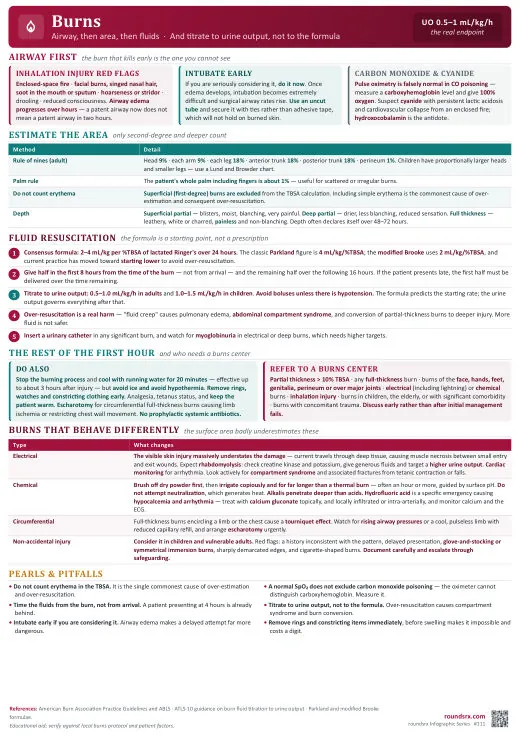
Airway First, and Early
Singed nasal or facial hair, carbonaceous sputum, hoarseness, stridor and facial burns mean intubate now. Airway edema worsens over hours and once the airway obstructs, intubation becomes impossible, and a surgical airway through a burned neck is a very poor alternative. Err toward early intubation: extubating an unnecessary tube the next day is trivial by comparison.
Classify the Depth
Superficial (first degree): red, dry, painful, heals in 3 to 5 days without scarring, and is excluded from the burn surface area calculation. Partial thickness (second): blistered, moist, very painful. Full thickness (third): white or leathery, dry and painless because the nerve endings are destroyed, always needing excision and grafting. Painlessness is a sign of depth, not of a minor burn.
Estimate the Area
Rule of 9s: head 9%, each arm 9%, each leg 18%, anterior trunk 18%, posterior trunk 18%, perineum 1%. The patient's palm including fingers is about 1% and is the practical tool for scattered burns. Overestimating the area over-resuscitates, which is the commonest error and causes its own harm.
Parkland, Then Titrate to Urine Output
4 mL × kg × %BSA of lactated Ringer over 24 h, with half in the first 8 h from the time of injury, not from arrival. The formula is a starting estimate, not a prescription: titrate to a urine output of 0.5 mL/kg/h in adults and 1 mL/kg/h in children. Over-resuscitation causes abdominal compartment syndrome, pulmonary edema and conversion of partial to full thickness burns.
Circumferential Burns Need Escharotomy
A circumferential full-thickness burn of a limb acts as a tourniquet as edema develops, so watch for loss of distal pulses, worsening pain and rising compartment pressures. A circumferential chest burn restricts ventilation and shows up as rising airway pressures. Escharotomy is a bedside procedure and should not wait for transfer.
Do Not Miss Carbon Monoxide and Cyanide
Pulse oximetry is falsely normal in carbon monoxide poisoning, because carboxyhemoglobin absorbs light like oxyhemoglobin. Get a co-oximetry level and give 100% oxygen, with hyperbaric therapy considered for severe poisoning or pregnancy. Suspect cyanide in an enclosed-space fire with a persistent lactic acidosis and normal oxygenation, and treat with hydroxocobalamin.
Electrical and Chemical Burns Break the Usual Rules
Electrical injury damages far more tissue than the skin suggests: expect rhabdomyolysis, so run higher fluids and target a larger urine output, monitor for arrhythmia, and look for compartment syndrome and associated fractures from tetanic contraction. Chemical burns: brush off dry powder first, then irrigate copiously with water; do not neutralize, since the reaction is exothermic and causes further injury. Hydrofluoric acid needs calcium gluconate and causes life-threatening hypocalcemia.
Know Who Gets Transferred
Burn center criteria: partial or full thickness of 20% BSA or more, full thickness above 5%, any burn to face, hands, feet, genitals, perineum or major joints, electrical and lightning injury, significant chemical burns, inhalation injury, and burns in patients with major comorbidity. Also: keep the patient warm, since burns lose thermoregulation and hypothermia worsens coagulopathy. Give tetanus prophylaxis, provide adequate analgesia, and do not give prophylactic systemic antibiotics, which select resistance without preventing burn wound infection.
Related Topics
Acute AbdomenAcute Limb IschemiaAnaphylaxisChest Pain WorkupHypothermia & DrowningNecrotizing Fasciitis / Gas Gangrene