Calciphylaxis (Calcific Uremic Arteriolopathy)
- 1–4% of dialysis patients per year (US registry data); higher in obese, diabetic, female ESRD patients.
- Female: male ratio ~3:1.
- Predominantly in ESRD on dialysis (~80–90% of cases). Non-uremic calciphylaxis exists but is rare (primary HPT, malignancy, autoimmune disease, alcoholic liver disease).
- Mean age ~55–60 years.
- 1-year mortality: ~45–55% overall; ~80% if central (truncal) lesions, ~50% if distal only.
- Matrix Gla protein (MGP) is the body's main vascular calcification inhibitor. It requires vitamin K-dependent γ-carboxylation to be active. Warfarin blocks this (the same mechanism that gives it anticoagulant effect against factors II/VII/IX/X), leaving uncarboxylated, inactive MGP and unleashing arterial calcification. This is why warfarin is a major risk factor.
- Fetuin-A, another circulating calcification inhibitor, is depleted in chronic inflammation and uremia.
- Hyperphosphatemia directly drives smooth-muscle osteoblast differentiation through the Pit-1 phosphate transporter.
- Result: medial calcification → intimal proliferation → microthrombi in dermal/subcutaneous arterioles → ischemic skin and fat necrosis → painful violaceous retiform purpura → ulceration.
Worked example (Case 1 from Rounds tab): Ca 9.8, P 6.4 → Ca × P = 9.8 × 6.4 = 62.7 mg²/dL², above the < 55 target → drives both passive and active calcification.
KDIGO 2017 caveat: the current CKD-MBD guideline moved away from rigid Ca × P targets because (1) single time-point calculations are unreliable (P fluctuates with meals and dialysis), and (2) the dominant biology is active vascular calcification (matrix Gla protein loss, BMP-2 upregulation, smooth-muscle osteoblast trans-differentiation), not just passive precipitation. Use Ca × P as a bedside check but treat Ca, P, and PTH individually. In calciphylaxis specifically, the product is still clinically useful because passive precipitation does matter at scale here.
| Risk Factor | Mechanism | Modifiable? |
|---|---|---|
| Warfarin use | Blocks vitamin K-dependent activation of matrix Gla protein → unleashes vascular calcification | YES Switch to apixaban |
| Calcium-based phosphate binders (calcium carbonate, calcium acetate) | Increase calcium load and Ca × P product | YES Switch to non-Ca binder |
| Hyperphosphatemia (P > 5.5) | Directly drives smooth-muscle osteoblast differentiation via Pit-1 | YES Diet, binders, intensified dialysis |
| Hyperparathyroidism (PTH > 300–500) | Bone resorption → ↑ Ca and P load on vasculature | YES Calcimimetics, parathyroidectomy |
| High Ca × P product (> 55) | Drives passive precipitation in addition to active calcification | YES Aggressive Ca and P control |
| Vitamin K deficiency | Same MGP pathway as warfarin (uncarboxylated MGP) | YES Supplement K1 1–10 mg/day |
| Active vitamin D analogues (calcitriol, paricalcitol) at high dose | Increase intestinal Ca absorption → ↑ Ca load | MAYBE Reduce dose if possible |
| SC injections (heparin, insulin, enoxaparin) at high-fat sites | Microtrauma triggers calciphylactic lesions at injection sites (a hallmark) | YES Rotate sites or switch route |
| ESRD on dialysis | Dominant substrate | NO Underlying disease |
| Female sex, obesity (BMI > 30), diabetes, white race | Demographic risk; mechanisms include adipose-tissue calcification, advanced glycation end-products | NO Non-modifiable |
| Chronic inflammation, hypoalbuminemia, malnutrition | Depletes fetuin-A; chronic CRP elevation | PARTIAL Address underlying |
| Hypercoagulable states (protein C/S deficiency, antiphospholipid) | Promotes microthrombosis in already-calcified vessels | PARTIAL Treat underlying |
- Painful (severe, opioid-requiring, often disproportionate to lesion size, this is the single most useful clinical pearl). Pain often precedes visible skin findings by days.
- Violaceous retiform purpura (net-like / livedo-like pattern) → indurated tender plaques → necrotic eschar with surrounding violaceous halo → ulceration with thick black eschar.
- Two distribution patterns:
- Central (proximal): trunk, abdomen, thighs, breasts, buttocks. Worse prognosis (1-year mortality ~80%). Often multiple, large lesions.
- Peripheral (distal): calves, feet, fingers, toes. Better prognosis (~50%).
- Predilection for adipose tissue: abdomen, thighs, breasts, buttocks. Helpful diagnostic clue.
- Lesions at SC injection sites (heparin, insulin) is a near-pathognomonic finding in dialysis patients.
- Usually not febrile at presentation unless ulcers are infected; fever is a sepsis red flag, not a primary feature.
| Mimic | Distinguishing Feature |
|---|---|
| Warfarin-induced skin necrosis | Onset days 3–10 of warfarin, protein C deficiency, breasts/buttocks/extremities, NO ESRD context required. Histology: thrombi without medial calcification. |
| Cellulitis / necrotizing fasciitis | Fever, leukocytosis, more diffuse erythema, lacks the retiform livedo pattern. Necrotizing fasciitis spreads fast in hours. |
| Atheroembolic disease (cholesterol emboli) | Recent vascular procedure, livedo + blue toes + eosinophilia + ↓ complement. Usually distal. |
| Vasculitis (cryoglobulinemia, ANCA, polyarteritis) | Systemic features (fever, arthritis, neuropathy, glomerulonephritis), positive serologies (ANCA, RF, cryocrit). |
| Pyoderma gangrenosum | Pustule → ulcer with violaceous undermined edge, IBD/RA association, pathergy (lesion at trauma sites). |
| Nephrogenic systemic fibrosis | Gadolinium exposure in advanced CKD, woody indurated plaques on extremities, NOT painful necrosis. |
| Oxalate vasculopathy | Primary hyperoxaluria or short bowel; calcium oxalate in tissue (not phosphate). Rare. |
- Ionized Ca, phosphate, PTH, 25-OH vitamin D, ALP, albumin: characterize the CKD-MBD axis. Look for high P, high Ca, high PTH, high Ca × P product.
- BMP, CBC: baseline.
- INR, PT, aPTT: especially if patient on warfarin (which is a major modifiable risk factor).
- Hypercoagulability workup if young, recurrent, or thrombotic features: protein C and S, antithrombin, factor V Leiden, antiphospholipid antibodies.
- Vitamin K status: PIVKA-II (proteins induced by vitamin K absence/antagonist) if available; otherwise empiric supplementation if on warfarin or poor intake.
- Wound cultures: if ulcerated, especially if febrile or systemic signs. Sepsis from infected ulcers is the leading cause of death.
- Inflammatory markers: CRP, ESR (often elevated, helps trend).
- Blood cultures if febrile.
- Plain X-ray: subcutaneous tram-track / arterial calcifications. Cheap, useful screening.
- Bone scan (Tc-99m bisphosphonate): subcutaneous radiotracer uptake at lesion sites. Sensitivity ~90%, useful when biopsy is too risky. Helpful to confirm diagnosis non-invasively.
- MRI: assess soft-tissue extent, deeper involvement. Avoid gadolinium in advanced CKD (NSF risk).
- CT: shows extent of subcutaneous calcification but adds radiation and contrast risk.
- Histology: medial calcification of small/medium dermal arterioles (von Kossa or Alizarin red stain), intimal proliferation, vascular thrombosis, panniculitis with fat necrosis.
- Use punch biopsy from edge of lesion (not center, where necrosis obscures findings).
- Avoid biopsying through ulcerated tissue.
| Step | Intervention | Why It Matters |
|---|---|---|
| 1. Sodium thiosulfate (STS) | Sodium thiosulfate 25 g IV over 30–60 min after each HD session (3×/week), continue 3–6 months minimum, often longer until healing | The cornerstone targeted therapy. Chelates calcium → soluble Ca-thiosulfate complex (cleared by dialysis), antioxidant, vasodilator (NO donor). Evidence: large case series (highest-quality available; no RCT). Side effects: metabolic acidosis (anion gap, treat with bicarb), nausea, hypotension, fluid overload. Reduce dose if these are intolerable. |
| 2. Stop warfarin | Switch to apixaban (Eliquis) 2.5–5 mg BID if anticoagulation is still needed | Warfarin inhibits γ-carboxylation of matrix Gla protein, the body's main vascular calcification inhibitor → unleashes calcification. Apixaban does not affect MGP. KDIGO 2017 endorses avoiding warfarin in calciphylaxis. If anticoagulation can be stopped entirely (e.g., AF with low CHA₂DS₂-VASc), do so. |
| 3. Stop calcium-based phosphate binders | Switch to non-calcium binder: sevelamer (Renvela), lanthanum (Fosrenol), ferric citrate (Auryxia), or sucroferric oxyhydroxide (Velphoro) | Calcium carbonate and calcium acetate add to systemic calcium load and Ca × P product. Non-Ca binders lower phosphate without driving calcification. |
| 4. Aggressive phosphate control | Target P < 5.5 mg/dL, Ca × P product < 55. Strict 800–1000 mg/day dietary P. Intensify dialysis (longer sessions, more frequent, low-Ca dialysate 2.0–2.5 mEq/L) | Hyperphosphatemia drives smooth-muscle osteoblast differentiation via Pit-1 transporter. Removing the phosphate driver is essential. Low-Ca dialysate avoids adding calcium during the very treatment that should be removing it. |
| 5. Hyperparathyroidism control | Cinacalcet (Sensipar) 30–180 mg PO daily (titrate to PTH 150–300) or etelcalcetide (Parsabiv) 5–15 mg IV after each HD. Refractory: parathyroidectomy | Calcimimetics activate the parathyroid Ca-sensing receptor → ↓ PTH → ↓ bone Ca and P efflux. Lower Ca, P, and PTH simultaneously, ideal for CUA. Parathyroidectomy reserved for medically refractory severe HPT (PTH > 800–1000 with hypercalcemia). |
| 6. Vitamin K supplementation | Vitamin K1 (phytonadione) 1–10 mg PO daily | Activates matrix Gla protein (the natural calcification inhibitor). Most ESRD patients are functionally K-deficient. Especially important if recently on warfarin. Small RCTs (VitaVasK, others) suggest reduction in vascular calcification. Cheap, low-risk. |
| 7. Wound care, conservative | Sterile non-adherent dressings, gentle cleansing. Avoid aggressive surgical debridement unless infected/septic; lesions can extend and become non-healing | The skin is ischemic; cutting healthy-looking edges propagates the lesion. Debride only frankly necrotic, infected tissue. Wound-care nursing service is invaluable. |
| 8. Pain control | Multimodal: opioids (often required), gabapentin or pregabalin for neuropathic component, ketamine drip in severe cases, regional blocks. Avoid fentanyl patches over lesions | Pain is severe and opioid-requiring. Fentanyl patches absorb erratically over necrotic skin, and the patch's heat further worsens local ischemia. Opioids are dialyzable variably (avoid morphine in ESRD; hydromorphone, fentanyl IV, methadone are options). |
| 9. Infection prevention & treatment | Low threshold for blood cultures and broad-spectrum antibiotics if febrile or systemic signs. Cover MRSA + Gram-negatives (vancomycin + cefepime or piperacillin-tazobactam, dose-adjusted for ESRD) | Sepsis from infected ulcers is the #1 cause of death. Don't wait for classic SIRS criteria; ESRD patients mount blunted febrile responses. |
| 10. Hyperbaric oxygen (HBOT) ADJUNCT | 2.0–2.4 ATA × 90 min, 5 days/week × 20–40 sessions | Increases tissue oxygen delivery, promotes angiogenesis, antimicrobial. Case series show benefit; not RCT-proven. Consider for severe or refractory cases at centers with HBOT expertise. |
| 11. Bisphosphonates CASE-SERIES ONLY | Pamidronate 30–90 mg IV every 4–8 weeks | Inhibits osteoclast-mediated Ca/P efflux from bone; possibly direct effect on vascular calcification. Evidence weak (case series). Not first-line; consider in refractory cases or when STS is contraindicated. |
| 12. Palliative care | Early integration, especially for severe/proximal disease | Mortality is high, pain is severe, and quality-of-life conversations are essential. Palliative care is not "giving up", it is good care. |
- Don't continue warfarin if there is any reasonable alternative (apixaban, no anticoagulation).
- Don't continue calcium-based binders, switch immediately.
- Don't aggressively debride non-infected lesions; the skin is ischemic and debridement extends necrosis.
- Don't use IV calcium for hypocalcemia unless symptomatic and severe; binds to phosphate → CaPO₄ precipitation worsens calciphylaxis.
- Don't use fentanyl patches over or near lesions.
- Don't use gadolinium MRI contrast in advanced CKD/ESRD without weighing NSF risk.
- Don't dismiss "bruise-like" pain in a dialysis patient as soft-tissue injury, painful retiform purpura is calciphylaxis until proven otherwise.
| Drug | Dose | Role | Key Notes & Why It Matters |
|---|---|---|---|
| Sodium thiosulfate CORNERSTONE | 25 g IV over 30–60 min after each HD session (3×/week) | Targeted therapy | Chelates Ca, antioxidant, vasodilator. Side effects: anion-gap metabolic acidosis (treat with bicarb), nausea, hypotension, volume overload. Reduce to 12.5 g if poorly tolerated. Continue 3–6+ months until healing. |
| Apixaban (Eliquis) | 2.5–5 mg PO BID | Anticoagulation if needed (replace warfarin) | Does not inhibit matrix Gla protein. Preferred over warfarin in calciphylaxis when anticoagulation is needed. Dose-adjust per ESRD: 2.5 mg BID if 2 of (age ≥ 80, weight ≤ 60 kg, Cr ≥ 1.5). |
| Sevelamer (Renvela) | 800–1600 mg TID with meals | Non-Ca phosphate binder | Polymeric, non-absorbed, no calcium load. Side effects: GI upset, metabolic acidosis. Less effective per-tablet than Ca-based binders (more pill burden). |
| Lanthanum (Fosrenol) | 500–1000 mg TID chewed with meals | Non-Ca phosphate binder | Effective at lower pill burden than sevelamer. Side effects: GI upset. Long-term tissue accumulation (theoretical concern, not clinically validated). |
| Ferric citrate (Auryxia) | 2 tablets (210 mg elemental Fe each) TID with meals | Non-Ca phosphate binder + iron source | Bonus iron repletion useful in CKD-related anemia. Side effects: dark stools, GI upset. Monitor ferritin and TSAT (avoid iron overload). |
| Sucroferric oxyhydroxide (Velphoro) | 500 mg (1 tab) TID chewed with meals | Non-Ca phosphate binder | Lowest pill burden of the iron-based binders. Minimal systemic iron absorption (vs ferric citrate). Side effects: dark stools, diarrhea. |
| Cinacalcet (Sensipar) | 30 mg PO daily, titrate to 30–180 mg/day | Calcimimetic for hyperparathyroidism | Activates parathyroid Ca-sensing receptor → ↓ PTH, ↓ Ca, ↓ P. Side effects: hypocalcemia (most common, monitor weekly initially), nausea, vomiting. |
| Etelcalcetide (Parsabiv) | 5 mg IV after each HD; titrate to 2.5–15 mg per session | Calcimimetic, IV alternative to cinacalcet | Better adherence than oral cinacalcet (given by dialysis nurse). Same hypocalcemia risk; monitor Ca closely. |
| Vitamin K1 (phytonadione) | 1–10 mg PO daily | Activates matrix Gla protein | Inexpensive, low-risk. Especially useful after stopping warfarin. Avoid if patient still requires warfarin (defeats anticoagulation). |
| Pamidronate ADJUNCT | 30–90 mg IV every 4–8 weeks | Bisphosphonate, weak evidence | Inhibits osteoclast-mediated bone resorption; may reduce vascular calcification. Side effects: hypocalcemia, osteonecrosis of jaw (rare), atypical femoral fractures. Renal dose-adjust. |
| Hydromorphone or methadone or fentanyl IV | Per pain protocol | Pain control | Avoid morphine in ESRD (active metabolite M6G accumulates → neurotoxicity). Avoid fentanyl patches over lesions (heat + necrotic skin). Methadone is dialyzable variably and safe in ESRD with care. |
| Gabapentin | 100–300 mg PO at HD only or 100 mg QHS | Neuropathic pain adjunct | Renally cleared, dose carefully in ESRD (much lower doses needed). Sedation, ataxia. |
Patient: 58F on HD × 6 years, AF on warfarin, BMI 34, DM. Painful violaceous abdominal/thigh lesions × 2 weeks.
Key findings: Multiple retiform plaques with central eschars on abdomen and medial thighs. Pain 10/10. Ca 9.8, P 6.4, PTH 540, Ca × P 63, INR 2.4. Bone scan: subcutaneous uptake.
Management:
- Sodium thiosulfate 25 g IV after each HD
- Switch warfarin → apixaban 5 mg BID
- Switch calcium acetate → sevelamer 800 mg TID
- Cinacalcet 30 mg daily, titrate for PTH 150–300
- Vitamin K1 5 mg PO daily
- Pain: hydromorphone PCA + gabapentin 100 mg at HD
- Wound care, derm, palliative care all engaged
Teaching point: Truncal lesions carry the worst prognosis (~80% 1-year mortality). Treatment requires removing every calcification driver simultaneously, not just adding sodium thiosulfate.
Patient: 64M on HD × 4 years, on enoxaparin for prior PE. New painful violaceous lesions at rotated SC injection sites on abdomen and thighs.
Key findings: Lesions correspond exactly to recent injection sites. P 5.8, PTH 380, Ca 9.4. No ulceration yet.
Management:
- Sodium thiosulfate 25 g IV after each HD
- Switch enoxaparin → oral apixaban (eliminate SC injections)
- Optimize phosphate (sevelamer titration)
- Cinacalcet for HPT
- Aggressive pain control
Teaching point: Lesions appearing at SC injection sites in a dialysis patient is near-pathognomonic for calciphylaxis. Microtrauma from injections triggers calcific lesions in already-vulnerable tissue. Switching to oral or IV routes (and eliminating SC heparin/insulin/enoxaparin where possible) is part of treatment.
Patient: 49F with primary biliary cholangitis (cirrhosis, MELD 18) and primary hyperparathyroidism, no CKD. Painful violaceous breast and thigh lesions.
Key findings: Ca 11.2, P 4.8, PTH 240 (high for normal renal function), albumin 2.5. Skin biopsy confirms medial arteriolar calcification.
Management:
- Sodium thiosulfate 25 g IV 3×/week (no dialysis, give as outpatient infusion)
- Cinacalcet for HPT, plus parathyroidectomy evaluation
- Vitamin K supplementation
- Aggressive nutrition (low albumin = low fetuin-A → loss of calcification inhibitor)
- Wound care; pain control
Teaching point: Non-uremic calciphylaxis exists (~10% of cases). Risk factors include primary HPT, malignancy, autoimmune disease (especially with hypoalbuminemia), and cirrhosis. Same treatment principles, but no dialysis to time the STS infusion against. Also a setting where biopsy is more important since the diagnosis is less clinically obvious than in classic ESRD.
- Pain: regimen, breakthrough use, opioid-rotation needs (avoid morphine, avoid fentanyl patches)
- Wound exam: extension of lesions, new lesions, signs of infection (purulence, surrounding cellulitis, fever)
- Phosphate, Ca, PTH: trending; binder dose adjustments; cinacalcet response
- STS tolerance: bicarb (anion-gap acidosis), nausea, BP, fluid status
- Anticoagulation: confirmed off warfarin; apixaban dose appropriate for renal function
- Infection screen: low threshold for cultures and broad-spectrum antibiotics
- Goals of care: revisit at every transition (new lesion, sepsis, refractory pain)
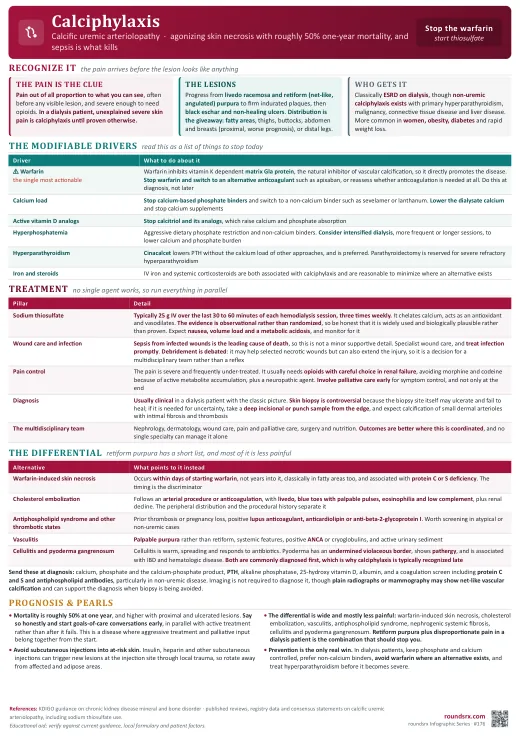
Text version
- ESRD (dialysis), painful violaceous retiform lesions on adipose-rich sites (abdomen, thighs, breasts)
- Lesions at SC injection sites is near-pathognomonic
- Bone scan: subcutaneous Tc-99m uptake (sensitivity ~90%)
- Biopsy if atypical: medial Ca²⁺ deposition (von Kossa), intimal proliferation, microthrombi
- Sodium thiosulfate 25 g IV after each HD × 3–6+ months
- Stop warfarin → apixaban 2.5–5 mg BID if anticoagulation needed
- Stop Ca-based binders → sevelamer / lanthanum / ferric citrate / sucroferric oxyhydroxide
- Phosphate < 5.5, Ca × P < 55, low-Ca dialysate, intensified HD
- Cinacalcet or etelcalcetide for HPT; parathyroidectomy if refractory
- Vitamin K1 1–10 mg/day
- Conservative wound care, debride only if infected; HBOT in select cases
- Pain: hydromorphone or methadone IV, gabapentin (low ESRD dose), avoid morphine and fentanyl patches
- Low threshold for sepsis workup and broad-spectrum antibiotics
- Palliative care early