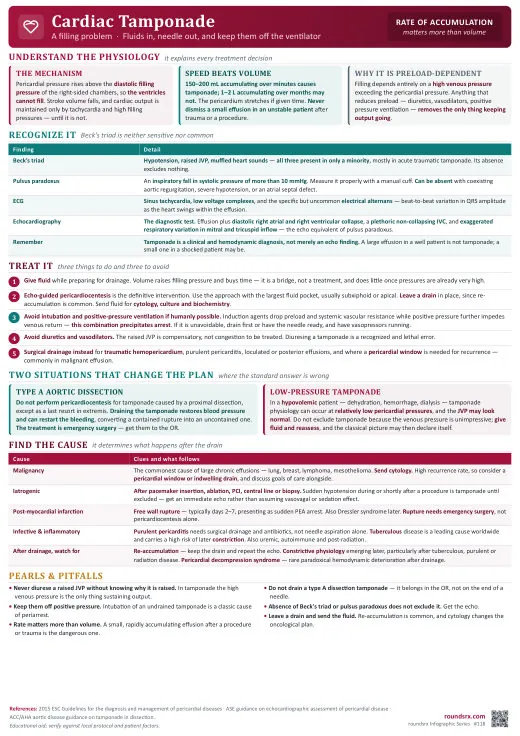
Cardiac Tamponade
| Category | Causes |
|---|---|
| Malignancy | Lung, breast, lymphoma, melanoma -most common cause of large effusions |
| Infection | Viral (Coxsackie, Echo), TB (especially in endemic areas), bacterial, fungal |
| Uremia | CKD/ESRD -hemorrhagic pericarditis |
| Iatrogenic | Post-cardiac surgery, catheterization, pacemaker insertion |
| Trauma | Penetrating chest injury, aortic dissection |
| Autoimmune | SLE, RA, scleroderma |
- IV fluids -aggressive volume resuscitation to maintain preload (bridge to pericardiocentesis)
- AVOID diuretics, nitrates, positive pressure ventilation (all reduce preload → cardiovascular collapse)
- Pericardiocentesis -echo-guided, subxiphoid approach. Aspirate even 20–30 mL can dramatically improve hemodynamics
- Pericardial drain -leave catheter if recurrent/malignant effusion
- Pericardial window -surgical option for recurrent tamponade
- Echocardiography -gold standard. RA/RV diastolic collapse, IVC plethora, respiratory variation in mitral/tricuspid inflow
- ECG -low voltage, electrical alternans (beat-to-beat QRS amplitude variation = swinging heart)
- CXR -"water bottle" heart silhouette
- Pulsus paradoxus -SBP drop > 10 mmHg with inspiration
| Finding | Description | Significance |
|---|---|---|
| RA collapse (systole) | Inward motion of RA free wall during ventricular systole | Most sensitive early sign (~85% sensitivity) |
| RV diastolic collapse | Inward motion of RV free wall during early diastole | Most specific finding (~90% specificity) |
| IVC plethora | Dilated IVC >2.1 cm with <50% inspiratory collapse | Elevated RA pressure; absence argues against tamponade |
| Respiratory variation | >25% variation in mitral inflow E velocity; >40% in tricuspid inflow | Reflects ventricular interdependence |
| Swinging heart | Heart oscillates within large effusion | Correlates with electrical alternans on ECG |
- Cardiac tamponade (~75-98%, pooled ~82%) - canonical setting. Magnitude tracks hemodynamic severity; disappears after pericardiocentesis. More sensitive than Beck's triad.
- Restrictive cardiomyopathy (< 20%) - reported but uncommon.
- Constrictive pericarditis (< 20%, often absent) - the rigid pericardium blocks transmission of inspiratory pressure swings to the LV, so pulsus is classically blunted or absent here. Kussmaul sign (rising JVP on inspiration) is the more typical finding.
- Massive pulmonary embolism (uncommon; described in case reports, rare in series) - the dilated RV constrains LV expansion (the dynamic face of reverse Bernheim, below). Physiology is sound, but pulsus is not a reliable bedside finding in PE.
- Severe asthma / status asthmaticus (~50% have pulsus > 10 mmHg in acute attacks; ~25-40% have > 20 mmHg in severe attacks) - air-trapping + huge inspiratory effort against obstruction. Pulsus > 25 mmHg correlates with FEV₁ < 40% predicted; falling pulsus = improvement.
- Severe COPD exacerbation (less prominent than asthma, no firm %) - same mechanism, but high baseline RA pressure blunts the inspiratory swing.
- Tension pneumothorax (uncommon; case-report level) - obstructive physiology, exaggerated inspiratory swings.
- Upper airway obstruction (variable; no firm data) - croup, severe laryngospasm, foreign body.
- Massive pulmonary embolism - the prototype. Acute RV pressure overload → septal bowing → LV underfilling → shock. This is why aggressive fluid loading in Category E PE can be catastrophic: more volume into a dilated RV worsens septal bowing and drops CO further. Guideline approach: modest 500 mL crystalloid trial, then norepinephrine ± dobutamine if no response.
- Acute RV infarction - same mechanism with an infarcted, dilated RV.
- Severe pulmonary HTN / cor pulmonale - chronic version; explains low CO despite preserved LV function.
- High PEEP / positive-pressure ventilation - raises RV afterload; reverse Bernheim contributes to the BP drop after intubation in marginal patients.
- Tamponade and constrictive pericarditis - pericardial constraint amplifies interdependence; reverse Bernheim is part of why LV filling fails here too.
| Step | Details |
|---|---|
| Positioning | Patient semi-upright (30–45°) to pool fluid inferiorly |
| Approach | Subxiphoid (most common), apical, or parasternal, echo-guided preferred |
| Needle | 18G spinal needle, advance toward left shoulder at 30° angle to skin |
| Confirmation | Aspiration of fluid; agitated saline echo contrast confirms intrapericardial position |
| Drainage | Place pigtail catheter for ongoing drainage if >100 mL or expected reaccumulation |
| Send fluid | Cell count, protein/LDH, glucose, Gram stain, culture, cytology, ADA (if TB concern) |
| Intervention | Details |
|---|---|
| IV NS bolus | 500–1000 mL -bridge to pericardiocentesis |
| Phenylephrine (Neo-Synephrine) | If hypotensive -maintain SVR as bridge. 100–200 mcg IV boluses |
| AVOID | Diuretics, nitrates, β-blockers, positive pressure ventilation |
Patient: 58F with metastatic breast cancer presenting with 2 weeks of progressive dyspnea, orthopnea, and chest pressure.
Vitals: HR 118, BP 88/62, RR 24, SpO2 93%. Pulsus paradoxus 18 mmHg.
Exam: JVD, muffled heart sounds, clear lungs (no pulmonary edema despite dyspnea, classic for tamponade vs CHF).
ECG: Low voltage, sinus tachycardia, electrical alternans.
Echo: Large circumferential effusion, RA systolic collapse, RV diastolic collapse, IVC plethora with no respiratory variation.
Management:
- IV NS 500 mL bolus as bridge
- Emergent echo-guided pericardiocentesis, 850 mL hemorrhagic fluid drained
- Pigtail catheter left in place for ongoing drainage
- Cytology: malignant cells consistent with breast adenocarcinoma
- Interventional oncology consulted for pericardial window given high reaccumulation risk
Teaching point: Malignant effusions are the #1 cause of tamponade in cancer patients. Clear lungs + JVD + hypotension = think tamponade, not CHF.
Patient: 64M with ESRD on hemodialysis (missed last 3 sessions) presenting with pleuritic chest pain, fever 38.2°C, and progressive dyspnea.
Vitals: HR 110, BP 92/58, RR 22. Pulsus paradoxus 14 mmHg.
Exam: Pericardial friction rub heard in 3 positions. JVD present. Bilateral lower extremity edema.
Labs: BUN 148, Cr 11.2, K 6.1. ECG: diffuse ST elevation (pericarditis pattern), low voltage.
Echo: Moderate-large effusion with early RA collapse. RV diastolic collapse not yet present.
Management:
- IV fluids for hemodynamic support
- Intensive daily hemodialysis, definitive treatment for uremic pericarditis
- Heparin-free dialysis to avoid worsening hemorrhagic effusion
- NSAIDs/colchicine have limited role in uremic pericarditis (unlike viral)
- Pericardiocentesis reserved if hemodynamic deterioration occurs
Teaching point: Uremic pericarditis is an indication for emergent dialysis. The effusion is often hemorrhagic. Must use heparin-free dialysis to avoid worsening bleeding into the pericardium.
Patient: 72M, day 4 post-anterior STEMI (LAD occlusion, delayed presentation). Sudden hemodynamic collapse with loss of consciousness.
Vitals: HR 130 (PEA on monitor), BP unobtainable.
Exam: Unresponsive, JVD, no heart sounds auscultated. EMD (electromechanical dissociation), electrical activity without pulse.
Bedside echo: Large pericardial effusion with echodense material (clot), RV collapse, no ventricular contraction visible.
Management:
- CPR initiated, IV fluids wide open
- Emergent pericardiocentesis attempted, aspiration of frank blood
- Emergent CT surgery consulted for surgical repair of free wall rupture
- Mortality >90%, most patients do not survive to the OR
Teaching point: Free wall rupture typically occurs 3–7 days post-MI when the necrotic myocardium is weakest. Risk factors: first MI, anterior wall, delayed reperfusion, elderly, female. PEA arrest post-MI = always consider tamponade from free wall rupture.