Cardiogenic Shock
| Cause | Key Features |
|---|---|
| Acute MI / ACS (~70–80%) | Most common cause. Large anterior STEMI, RV infarct. Emergent PCI/cath lab. SHOCK trial: early revascularization ↓ 6-month mortality SHOCK, 1999. |
| Acute decompensated HFrEF (~10–15%) | End-stage HF on maximal GDMT. Progressive pump failure. Bridge to LVAD/transplant or palliative. |
| Acute valvular emergency (~5–8%) | Acute severe MR (papillary muscle rupture post-MI), acute AR (endocarditis, aortic dissection), critical AS. Emergent surgical consult. |
| Fulminant myocarditis (~2–5%) | Viral (Coxsackie, parvovirus B19), giant cell, eosinophilic. Young patient, rapid-onset HF. MRI if stable, biopsy if refractory. May need mechanical circulatory support (MCS) bridge to recovery. |
| Category E PE (~2–3%) | RV failure from acute pressure overload. Not true "pump" failure -it's obstructive. tPA, catheter-directed therapy, or surgical embolectomy. |
| Cardiac tamponade (~1–2%) | Beck's triad: hypotension, JVD, muffled heart sounds. Pulsus paradoxus > 10 mmHg. Emergent pericardiocentesis. |
| Arrhythmia-induced (~1–2%) | Refractory VT/VF, complete heart block, tachycardia-mediated cardiomyopathy. Treat the rhythm -cardioversion, pacing, amiodarone. |
| Takotsubo (~1–2%) | Apical ballooning, post-emotional/physical stress. Often mimics STEMI. Usually recovers in days to weeks. Supportive care. |
| Post-cardiotomy (~2–6%) | Low CO syndrome post-cardiac surgery (CPB-related stunning). Milrinone or dobutamine. IABP/Impella if refractory. |
- Hypotension (SBP < 90) + cool, clammy extremities
- Mottled skin, cyanosis of peripheries
- Altered mental status (cerebral hypoperfusion)
- Oliguria / anuria (renal hypoperfusion)
- Elevated JVP, S3, pulmonary crackles (elevated filling pressures)
- Lactate > 2 (tissue hypoperfusion)
- Do NOT give aggressive fluids -will worsen pulmonary edema without improving CO
- Do NOT use beta-blockers, calcium channel blockers, or nitrates in acute CS
- ECG immediately -rule out STEMI (immediate cath lab activation), complete heart block, arrhythmia
- Bedside echo -EF, wall motion abnormalities, tamponade, valvular emergency, RV failure
- Troponin, BNP -confirm myocardial injury, severity of HF
- ABG -lactate, acid-base (metabolic acidosis = bad sign)
- BMP -creatinine, K⁺, glucose
- CXR -pulmonary edema, cardiomegaly
- Invasive monitoring (PA catheter / arterial line) -if diagnosis uncertain or refractory to treatment
| Shock Type | CO | SVR | PCWP |
|---|---|---|---|
| Cardiogenic | ↓↓ | ↑↑ | ↑↑ |
| Distributive (Septic) | ↑ or normal | ↓↓ | Low/normal |
| Hypovolemic | ↓ | ↑ | ↓↓ |
| Obstructive (PE/Tamponade) | ↓ | ↑ | Variable |
| Drug | Dose | Role | Notes |
|---|---|---|---|
| Norepinephrine (Levophed) 1ST LINE | 0.1–1 mcg/kg/min | First-line vasopressor | Preferred over dopamine in CS. Increases MAP without excessive tachycardia. |
| Dobutamine (Dobutrex) | 2–20 mcg/kg/min | Inotrope | ↑CO, ↓SVR. Use when MAP adequate but CO still low. Titrate to clinical response. Can cause arrhythmias. |
| Milrinone (Primacor) | 0.375–0.75 mcg/kg/min | Inotrope/vasodilator | PDE3 inhibitor. Good in chronic HF (not beta-blocked). Avoid if hypotensive (vasodilatory). Renally cleared. |
| Vasopressin (Pitressin) | 0.03–0.04 units/min | Vasopressor add-on | Nonadrenergic -useful adjunct to reduce catecholamine dose. Fixed dose. |
| Aspirin + Heparin | 325 mg PO + UFH per ACS protocol | ACS-associated CS | Antiplatelet + anticoagulation for PCI. Do not hold for hemodynamic instability. |
Patient: 59M, PMH HTN, smoking. Crushing chest pain x2h. ECG: ST elevation V1-V5. BP 78/50, HR 110, cold/clammy, JVP elevated.
Key findings: Lactate 5.8, troponin > 50, BNP 1200. Echo: anterior wall akinesis, EF ~15%. Cardiogenic shock from anterior STEMI.
Management:
- Emergent cardiac cath, do NOT delay for stabilization SHOCK, 1999
- Norepinephrine first-line, NOT dopamine SOAP II, 2010
- Dobutamine 2-20 mcg/kg/min if MAP adequate but CI < 2.2
- Activate MCS team early for Impella consideration
- Aspirin 325 mg + heparin per ACS protocol
Teaching point: The cath lab IS the treatment for MI-related CS. Every minute of delay = more infarct = deeper shock. Start pressors while preparing for PCI, not instead of PCI.
Patient: 72F, POD 5 from inferior STEMI. Sudden hypotension (BP 65/40), new loud holosystolic murmur at LLSB, acute respiratory distress.
Key findings: Echo: VSD with L-to-R shunt. PA catheter: O2 sat step-up from RA to RV. CI 1.6, PCWP 24.
Management:
- Norepinephrine for MAP support
- IABP for temporary support (reduces afterload, decreases L-to-R shunt)
- Emergent cardiac surgery, surgical VSD repair is definitive
- Nitroprusside if MAP tolerates (reduces shunt fraction)
Teaching point: Mechanical complications (VSD, papillary muscle rupture, free wall rupture) occur 3-7 days post-MI. Any acute deterioration in this window requires immediate echo. New murmur post-MI = VSD or acute MR until proven otherwise.
Patient: 45M with fulminant myocarditis. EF 5%, SCAI stage D. On max NE + dobutamine + vasopressin. Lactate rising 6 to 12.
Key findings: Refractory CS despite maximal medical therapy. Worsening multiorgan failure.
Management:
- VA-ECMO as bridge to recovery or transplant
- Add Impella for LV venting (ECPELLA), ECMO increases LV afterload
- Monitor for LV distension (aortic valve not opening = inadequate venting)
- Endomyocardial biopsy; empiric steroids if giant cell myocarditis suspected
- Transplant evaluation
Teaching point: VA-ECMO provides support but increases LV afterload. Without LV venting, the LV distends, worsening ischemia and pulmonary edema. IABP provides insufficient support IABP-SHOCK II, 2012.
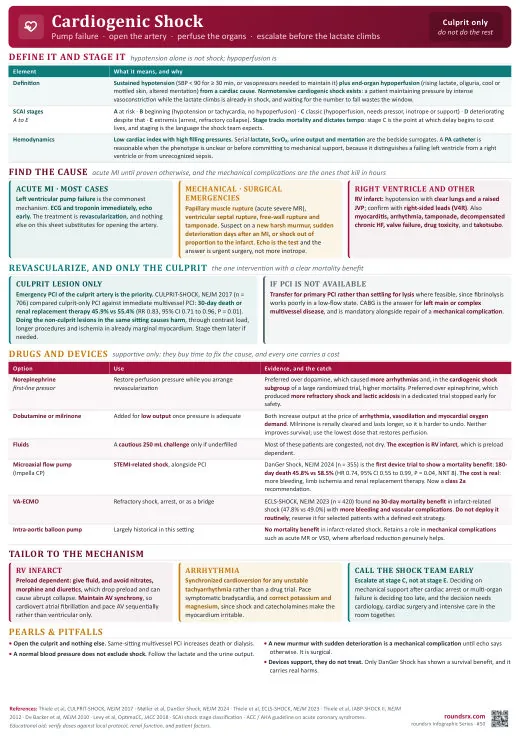
Text version
- SBP < 90 + CI < 2.2 + PCWP > 15
- Acute MI (large anterior STEMI)
- Acute valvular emergency
- Fulminant myocarditis
- Category E PE / tamponade
- ECG immediately -activate cath lab if STEMI
- Echo -EF, wall motion, tamponade, RV
- Troponin, BNP, ABG, lactate
- PA catheter if diagnosis unclear
- Dopamine (↑ arrhythmias)
- Beta-blockers
- CCBs
- Aggressive fluids
- IABP routinely