Cardiovascular-Kidney-Metabolic (CKM) Syndrome
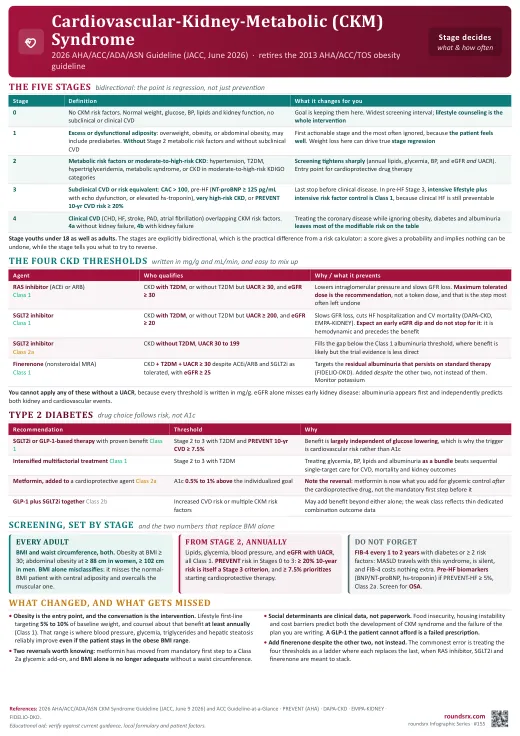
Obesity, type 2 diabetes, chronic kidney disease and cardiovascular disease are not four problems in four clinics. The 2026 guideline stages them as one syndrome, and the stage decides what you screen for, how often, and which drug you reach for first.
🧭 Staging
What this guideline is, and what it replaced. The 2026 AHA/ACC/ADA/ASN CKM Syndrome Guideline (JACC, June 9, 2026) is the first clinical practice guideline on CKM syndrome from the ACC and AHA. It retires and replaces the 2013 AHA/ACC/TOS obesity guideline NEW 2026. The argument is that treating obesity, T2DM, CKD and CVD as separate problems misses the fact that each one accelerates the others, so the guideline gives you a single staging system and hangs screening intervals and drug choice off the stage. Staging is recommended for youths under 18 as well as adults, because the point is to intervene before stage progression rather than after.
The Five Stages
| Stage | Definition | What it changes for you |
|---|---|---|
| Stage 0 | No CKM risk factors. Normal weight, glucose, blood pressure, lipids and kidney function, with no subclinical or clinical CVD | The goal is keeping them here. Screening is the widest-interval tier, and lifestyle counseling is the whole intervention |
| Stage 1 | Excess or dysfunctional adiposity: overweight or obesity, abdominal obesity, or dysfunctional adipose tissue, which may include prediabetes, without the metabolic risk factors of Stage 2 and without subclinical CVD | This is the first actionable stage and the one most often ignored, because the patient feels well. Weight loss here can drive true stage regression, which is the guideline's central optimistic claim |
| Stage 2 | Metabolic risk factors or moderate-to-high-risk CKD: hypertension, T2DM, hypertriglyceridemia, metabolic syndrome, or CKD in the moderate-to-high-risk KDIGO categories | The screening tier tightens sharply here (annual lipids, glycemia, BP, and both eGFR and UACR), and it is the entry point for cardioprotective drug therapy |
| Stage 3 | Subclinical CVD, or a risk equivalent. Subclinical coronary disease (CAC score above 100), subclinical heart failure (NT-proBNP ≥ 125 pg/mL with echo evidence of ventricular dysfunction, or elevated high-sensitivity troponin), very high-risk CKD (stage 4 to 5, or by KDIGO heat map), or a predicted 10-year CVD risk ≥ 20% by PREVENT | Treat as the last stop before clinical disease. In Stage 3 driven by pre-HF, intensive lifestyle plus intensive risk factor control is Class 1, because progression to clinical HF is still preventable at this point |
| Stage 4 | Clinical CVD (coronary heart disease, heart failure, stroke, peripheral artery disease, atrial fibrillation) overlapping with CKM risk factors. Subdivided into 4a without kidney failure and 4b with kidney failure | The CKM framing still changes management: the guideline's message is that treating the coronary disease while ignoring the obesity, diabetes and albuminuria leaves most of the modifiable risk on the table |
Why staging rather than another risk score: the stages are explicitly bidirectional. The guideline recommends staging in order to prevent progression and to promote regression through lifestyle change and weight loss. That is the practical difference from a risk calculator, which tells you a probability but implies nothing can be undone. It also lets you match the intensity of therapy to absolute risk and expected net benefit instead of treating every risk factor with equal force.
🔬 Screening
Screening Intensity Is Set by Stage
Reading the COR tags: COR is the Class of Recommendation, the ACC/AHA scale for how strongly a recommendation is backed. COR 1 means do it: benefit far outweighs risk, and the guideline words it "is recommended". COR 2a means it is reasonable: benefit still outweighs risk, worded "can be useful", so it is a judgment call rather than a default. COR 2b is weaker again ("may be considered"), and COR 3 means do not do it, either for no benefit or for harm. The tags earn their place here because this guideline mixes strengths: annual lipids, glycemia, blood pressure and eGFR with UACR are all COR 1, while pre-HF biomarker screening is only COR 2a, so the first set is expected of you and the second is a defensible choice you should be able to justify.
| What to check | Who and how often | Why this interval |
|---|---|---|
| BMI and waist circumference | Both, in every adult. Obesity at BMI ≥ 30 kg/m²; abdominal obesity at waist ≥ 88 cm in women, ≥ 102 cm in men | BMI alone misclassifies people: it misses the normal-BMI patient with central adiposity who carries the metabolic risk, and it overcalls the muscular patient. The guideline wants both numbers, which is the change from BMI-only practice |
| Lipids, glycemia, blood pressure | At least annually from Stage 2 upward COR 1 | Stage 2 means the metabolic risk factors are already present, so the question is no longer whether they will appear but how fast they are progressing and whether treatment is working |
| eGFR and UACR together | Both, at least annually from Stage 2 upward COR 1. UACR is added once the patient is Stage 2 or above | eGFR alone misses early kidney disease, because albuminuria appears first and independently predicts both kidney and cardiovascular events. You also cannot apply the drug thresholds below without a UACR, since they are written in mg/g |
| PREVENT risk | Stages 0 to 3, estimating 10-year and 30-year risk of ASCVD, heart failure and total CVD. Open the PREVENT calculator | Two thresholds do real work: ≥ 20% predicted 10-year CVD risk is by itself a Stage 3 criterion, and ≥ 7.5% prioritizes starting cardioprotective drug therapy. The same calculator now serves this guideline and the 2026 dyslipidemia guideline |
| Pre-heart-failure biomarkers | Adults with PREVENT-HF 10-year risk ≥ 5%: check natriuretic peptides (BNP or NT-proBNP) and high-sensitivity troponin COR 2a | It identifies the patient with structural or biochemical heart disease before symptoms, which is the window where intensive risk factor control still prevents clinical HF. A positive result moves the patient to Stage 3 and justifies cardiac imaging. How to interpret BNP vs NT-proBNP ↗ |
| FIB-4 index for liver fibrosis | CKM syndrome plus diabetes or ≥ 2 cardiometabolic risk factors: every 1 to 2 years COR 1 | MASLD travels with this syndrome and is usually silent. FIB-4 is calculated from age, AST, ALT and platelets, so it costs nothing extra, and it identifies who needs hepatology referral before cirrhosis |
| Obstructive sleep apnea | Selected patients, based on symptoms and risk | Untreated OSA drives resistant hypertension and atrial fibrillation, so it is a reversible contributor sitting inside the same syndrome |
| Social determinants of health | Routinely, in everyone | The guideline treats this as clinical data, not paperwork: food insecurity, housing instability and cost barriers predict both the development of CKM syndrome and failure of the treatment plan you are about to write. Prescribing a GLP-1 the patient cannot afford is a failed prescription |
💊 Management
How to read this section. The drug-level detail (doses, titration, side effects, renal adjustment) lives in the dedicated topics and is deep-linked below rather than repeated here. What this page owns is the routing question: given this patient's stage and their UACR and eGFR, which agent is indicated and at what threshold. Those thresholds are where the 2026 guideline is most specific, and where it is easiest to get wrong.
Obesity: the Entry Point for the Whole Syndrome
- Lifestyle modification is first-line, targeting at least 5% to 10% of baseline weight COR 1. That range is not arbitrary: it is where metabolic benefit reliably appears (blood pressure, glycemia, triglycerides, hepatic steatosis) even when the patient remains in the obese BMI range.
- Counsel about the benefits of 5% to 10% weight loss at least annually COR 1, because the guideline treats the conversation itself as the intervention that gets missed.
- Add obesity pharmacotherapy and metabolic or bariatric surgery as needed to reach that target. Weight loss is framed as the main lever for stage regression, not just risk factor control. Obesity and GLP-1 agents topic ↗
Type 2 Diabetes: Drug Choice Follows Risk, Not Just A1c
| Recommendation | Threshold | COR | Why |
|---|---|---|---|
| SGLT2 inhibitor or GLP-1-based therapy with proven benefit | CKM Stage 2 to 3 with T2DM and 10-year PREVENT-CVD ≥ 7.5% | 1 | These reduce cardiovascular events and mortality through mechanisms largely independent of glucose lowering, which is why the trigger is cardiovascular risk rather than A1c |
| Intensified multifactorial treatment targeting hyperglycemia, hypertension, dyslipidemia and albuminuria together | CKM Stage 2 to 3 with T2DM | 1 | Treating the risk factors as a bundle beats sequential single-target care for CVD, mortality and kidney complications |
| Metformin, added to a cardioprotective agent | A1c 0.5% to 1% above the individualized goal | 2a | Note the reversal from older practice: metformin is now positioned as the agent you add for glycemic control after the cardioprotective drug, rather than the mandatory first step before it |
| Combination GLP-1-based therapy plus SGLT2 inhibitor | Increased CVD risk or multiple CKM risk factors | 2b | May add cardiovascular benefit beyond either agent alone, but the weaker class reflects that the dedicated combination outcome data are still thin |
Choice between SGLT2i and GLP-1 is guided by the comorbidity mix: CKD, ASCVD, heart failure, obesity, severe hyperglycemia and MASLD each pull the decision. Outpatient diabetes topic ↗
Chronic Kidney Disease: Four Thresholds Worth Memorizing
| Agent | Who qualifies | COR | Why / what it prevents |
|---|---|---|---|
| RAS inhibitor (ACEi or ARB) at the maximum tolerated dose | CKD with T2DM, or CKD without T2DM but UACR ≥ 30 mg/g, and eGFR ≥ 30 | 1 | Reduces intraglomerular pressure and slows loss of kidney function while lowering CVD risk. Maximum tolerated dose is the recommendation, not a token dose, which is the step most often left undone |
| SGLT2 inhibitor | CKD with T2DM, or CKD without T2DM but UACR ≥ 200 mg/g, and eGFR ≥ 20 | 1 | Slows loss of kidney function and lowers HF hospitalization and CV mortality DAPA-CKD, 2020 EMPA-KIDNEY, 2023. Expect an early dip in eGFR and do not stop for it, it is hemodynamic and precedes the long-term benefit |
| SGLT2 inhibitor (weaker indication) | CKD without T2DM with UACR 30 to 199 mg/g | 2a | Fills the gap below the Class 1 albuminuria threshold, where benefit is likely but the trial evidence is less direct |
| Nonsteroidal MRA (finerenone) | CKD + T2DM + UACR ≥ 30 mg/g despite ACEi/ARB and SGLT2i as tolerated, with eGFR ≥ 25 | 1 | Targets the residual albuminuria that persists on standard therapy FIDELIO-DKD, 2020. Note it is an add-on, not a substitute: the qualifying condition is persistent albuminuria while already on the first two agents. Monitor potassium |
| GLP-1-based therapy with proven kidney benefit | CKD + T2DM + UACR ≥ 100 mg/g despite ACEi/ARB and SGLT2i as tolerated | 1 | The newest of the four, reducing loss of kidney function and kidney failure as well as CVD risk FLOW, 2024. The threshold is higher than the finerenone one (100 vs 30 mg/g), so read the UACR before choosing between them |
CKD topic, including renal dose adjustment ↗
When CVD Is Already Present (Stage 4)
- HFrEF: the CKM framing reinforces RAS inhibition (ARNI, ACEi or ARB) plus an SGLT2 inhibitor as part of quadruple therapy with a beta blocker and a steroidal MRA, chosen for their combined cardiovascular and kidney benefit. Chronic HF GDMT topic ↗
- HFmrEF and HFpEF: SGLT2 inhibitor is first-line GDMT. Add a GLP-1-based therapy when obesity or other CKM risk factors are present, and consider a nonsteroidal MRA in those with T2DM and CKD.
- ASCVD: management should explicitly include the CKM comorbidities, treating obesity with lifestyle, pharmacotherapy and surgery where appropriate, using cardioprotective antihyperglycemics for T2DM, and using kidney-protective agents for CKD. The failure mode this targets is the well-stented patient whose obesity, albuminuria and diabetes go unaddressed.
- Interdisciplinary care with a named point person is recommended once T2DM, CKD and CVD overlap, because the predictable failure in this population is not a missing recommendation but nobody owning the plan across cardiology, nephrology, endocrinology and primary care.
🎯 Rounds
Pimp Questions
What does CKM staging add that a risk calculator does not?
Direction. The stages are explicitly bidirectional, so the guideline recommends staging to prevent progression and to promote regression through weight loss and lifestyle change. A risk score gives a probability and implies nothing can be undone. Staging also matches treatment intensity to absolute risk and expected net benefit.
A patient has a PREVENT 10-year CVD risk of 24% with no known CVD. What CKM stage is that, and why?
Stage 3. A predicted 10-year CVD risk of at least 20% is by itself a Stage 3 criterion, even without imaging or biomarker evidence of subclinical disease. The separate 7.5% threshold is what prioritizes starting an SGLT2 inhibitor or GLP-1-based therapy in a patient with T2DM.
Why does the guideline insist on both eGFR and UACR rather than eGFR alone?
eGFR alone misses early disease. Albuminuria appears first and independently predicts kidney and cardiovascular events. Practically, every CKD drug threshold in the guideline is written in mg/g of UACR, so without it you cannot tell whether the patient qualifies for an SGLT2 inhibitor, finerenone, or a GLP-1.
T2DM, CKD, UACR 60 mg/g, eGFR 40, already on a maximally tolerated ARB and an SGLT2 inhibitor. What is next and why?
Add a nonsteroidal MRA such as finerenone (Class 1): the patient has T2DM with CKD and persistent UACR of at least 30 mg/g despite the first two agents, and the eGFR is above the 25 cutoff. A GLP-1-based therapy for kidney protection needs UACR of at least 100 mg/g, so this patient does not yet meet that threshold. Monitor potassium after starting.
Why is BMI alone no longer considered adequate for assessing adiposity?
It misclassifies in both directions. It misses the normal-BMI patient with central adiposity carrying the metabolic risk, and overcalls the muscular patient. The guideline recommends BMI and waist circumference together, with abdominal obesity at 88 cm or more in women and 102 cm or more in men.
Where has metformin moved in this guideline?
From mandatory first step to glycemic add-on. In CKM Stage 2 to 3 with T2DM and elevated CVD risk, the Class 1 recommendation is an SGLT2 inhibitor or GLP-1-based therapy. Metformin is Class 2a, added when the A1c sits 0.5% to 1% above the individualized goal, on top of the cardioprotective agent.
Clinical Scenario
A 52-year-old with BMI 34, waist 108 cm, hypertension on lisinopril, and A1c 7.4%. No known CVD. eGFR 68, UACR 45 mg/g. PREVENT 10-year CVD risk 9%.
Stage: this is CKM Stage 2, metabolic risk factors plus albuminuric CKD, and not Stage 3, since the PREVENT risk is below 20% and there is no subclinical CVD documented.
Screening that is now owed annually: lipids, glycemia and blood pressure, plus both eGFR and UACR. A FIB-4 is indicated every 1 to 2 years because he has diabetes plus other cardiometabolic risk factors.
Therapy: his PREVENT risk of 9% exceeds the 7.5% threshold, so the plan should include an SGLT2 inhibitor or a GLP-1-based therapy, choosing by comorbidity, and the obesity and albuminuria both argue for it. The lisinopril should be pushed to the maximum tolerated dose rather than left at the starting dose. Target 5% to 10% weight loss, with pharmacotherapy if lifestyle alone falls short.
The trap: reflexively starting metformin first and stopping there. On A1c alone that looks reasonable, but it leaves the Class 1 cardioprotective agent unstarted in a patient who qualifies for it on risk.
Stage: this is CKM Stage 2, metabolic risk factors plus albuminuric CKD, and not Stage 3, since the PREVENT risk is below 20% and there is no subclinical CVD documented.
Screening that is now owed annually: lipids, glycemia and blood pressure, plus both eGFR and UACR. A FIB-4 is indicated every 1 to 2 years because he has diabetes plus other cardiometabolic risk factors.
Therapy: his PREVENT risk of 9% exceeds the 7.5% threshold, so the plan should include an SGLT2 inhibitor or a GLP-1-based therapy, choosing by comorbidity, and the obesity and albuminuria both argue for it. The lisinopril should be pushed to the maximum tolerated dose rather than left at the starting dose. Target 5% to 10% weight loss, with pharmacotherapy if lifestyle alone falls short.
The trap: reflexively starting metformin first and stopping there. On A1c alone that looks reasonable, but it leaves the Class 1 cardioprotective agent unstarted in a patient who qualifies for it on risk.
⚡ Summary
One-Screen Summary
One Syndrome, Five Stages
Obesity, T2DM, CKD and CVD are staged together from 0 to 4 rather than managed as separate diseases. Stage 4 splits into 4a without kidney failure and 4b with it. The 2026 AHA/ACC/ADA/ASN guideline retires the 2013 obesity guideline, and staging applies to youths as well as adults, because the aim is to intervene before progression.
The Stages Run Both Ways
Staging exists to prevent progression and to promote regression through lifestyle change and weight loss. That is what separates it from a risk score, which quotes a probability and implies permanence. It also lets you scale therapy to absolute risk and expected net benefit instead of treating every risk factor identically.
Two PREVENT Numbers Do the Work
A predicted 10-year CVD risk of ≥ 20% is on its own a Stage 3 criterion. A risk of ≥ 7.5% prioritizes starting cardioprotective drug therapy in T2DM. Separately, PREVENT-HF ≥ 5% triggers natriuretic peptide and high-sensitivity troponin testing to find pre-heart-failure while it is still preventable.
Screening Tightens at Stage 2
From Stage 2 upward: lipids, glycemia and blood pressure at least annually, and both eGFR and UACR at least annually. eGFR alone is not enough, because albuminuria comes first and independently predicts events, and because every CKD drug threshold below is written in mg/g of UACR.
Measure the Waist, Not Just the BMI
Assess BMI and waist circumference together (obesity at BMI ≥ 30; abdominal obesity at ≥ 88 cm in women, ≥ 102 cm in men). BMI alone misclassifies in both directions, missing central adiposity at a normal BMI and overcalling the muscular patient. Target 5% to 10% weight loss, the range where metabolic benefit reliably appears.
In Diabetes, Risk Picks the Drug
At 10-year PREVENT-CVD ≥ 7.5%, an SGLT2 inhibitor or GLP-1-based therapy is Class 1, because the benefit is largely independent of glucose lowering. Metformin has moved to a Class 2a add-on when A1c sits 0.5% to 1% above goal, rather than the mandatory first step it used to be.
Four CKD Thresholds
RAS inhibitor at max tolerated dose (UACR ≥ 30, eGFR ≥ 30). SGLT2 inhibitor (T2DM, or UACR ≥ 200, eGFR ≥ 20). Finerenone added when UACR is still ≥ 30 despite both, eGFR ≥ 25. GLP-1 when UACR is still ≥ 100 despite both. The last two are add-ons, not substitutes, and their thresholds differ by more than threefold, so read the UACR before choosing.
The Failure Mode Is Ownership
Interdisciplinary care with a named point person is recommended once T2DM, CKD and CVD overlap. The predictable failure in this population is not a missing guideline recommendation, it is that no single clinician owns the plan. For the same reason, social determinants are assessed as clinical data: a GLP-1 the patient cannot afford is a failed prescription.
Related Topics
Obesity Management & GLP-1 AgentsOutpatient Diabetes ManagementChronic Kidney DiseaseOutpatient Lipid ManagementOutpatient Hypertension