Central Fever & Paroxysmal Sympathetic Hyperactivity
Both central fever and paroxysmal sympathetic hyperactivity are diagnoses of exclusion. Work through this list first, because most of it is treatable and some of it is lethal.
| Cause | What makes it likely, and how to exclude it |
|---|---|
| Infection always first | Ventriculitis or meningitis in anyone with an EVD, shunt, or skull base fracture -send CSF, do not just culture blood. Ventilator-associated pneumonia, urinary tract infection (usually catheter-associated), line infection, C. difficile, and sinusitis in a patient with a nasogastric or nasotracheal tube, which is easy to forget and easy to see on the CT you already have. |
| Venous thromboembolism | These patients are immobile, often with a contraindication to prophylaxis, so DVT and pulmonary embolism are common and are classic causes of unexplained fever. Low threshold for duplex ultrasound. |
| Drug fever | Phenytoin is the one to know in this population, and antibiotics are the other common culprit. It is diagnosed by stopping the drug, not by a test. |
| Blood in the wrong place | Subarachnoid and intraventricular blood are pyrogenic in their own right, and resorbing hematoma anywhere causes fever. This overlaps with central fever rather than being cleanly separate from it. |
| Other | Transfusion reaction, alcohol or benzodiazepine withdrawal (a common miss in trauma), seizure including non-convulsive status, acalculous cholecystitis, pressure injury, and pancreatitis. |
| ⚠ The hyperthermia syndromes | Neuroleptic malignant syndrome (these patients receive antipsychotics for agitation), serotonin syndrome, malignant hyperthermia, thyroid storm. Each is treated completely differently, which is why they belong on this list rather than being assumed away. |
- Negative cultures.
- No infiltrate on chest radiograph.
- A diagnosis of subarachnoid hemorrhage, intraventricular hemorrhage, or tumor.
- Fever onset within 72 hours of admission.
- Higher temperatures than infection typically produces, often above 39°C, and sometimes strikingly high.
- A plateau pattern with loss of the normal diurnal variation -the temperature sits high rather than swinging, which is a useful bedside discriminator from an infectious pattern.
- Poor or absent response to antipyretics, discussed below, which is often the first clue.
- Highest risk after subarachnoid hemorrhage, particularly with intraventricular extension, and after tumor, traumatic brain injury and any lesion involving the hypothalamus or brainstem.
| Component | What it does |
|---|---|
| Clinical Feature Scale | Grades the severity of the six cardinal features: heart rate, respiratory rate, systolic blood pressure, temperature, sweating and posturing. This is what you score during an episode. |
| Diagnosis Likelihood Tool | Scores the context: whether features are paroxysmal, whether they are triggered by normally non-painful stimuli, whether they occur simultaneously, whether other causes have been excluded, and whether the picture follows a severe acquired brain injury. |
| Combined | The two subtotals together give an estimate of the probability that what you are watching is PSH. The value of using it is that it forces the diagnosis to be made deliberately rather than by pattern-recognition after weeks of failed sepsis workups. |
- Most often after severe traumatic brain injury, particularly diffuse axonal injury. Also hypoxic-ischemic brain injury, where it tends to be more severe, and after stroke, hydrocephalus and infection.
- It emerges days to weeks after the injury, and characteristically as sedation is weaned, which is precisely why it is so often misattributed to withdrawal, pain, agitation or a new infection.
- ⚠ Episodes are triggered by stimulation -turning, suctioning, physiotherapy, pain, a distended bladder, constipation. This is both the strongest diagnostic clue and, as below, a genuine treatment target.
| Step | Detail and rationale |
|---|---|
| 1. Exclude infection properly | Cultures, chest radiograph, urine, and CSF if there is any drain, shunt or basal skull fracture. Then use the four Hocker features to decide whether you are entitled to stop antibiotics. Do this before reaching for cooling, because a cooled patient with ventriculitis simply looks better while getting worse. |
| 2. Antipyretics anyway | Acetaminophen is still reasonable to trial: it is cheap, safe at appropriate dosing, and many of these fevers are of mixed cause. Expect a limited response, and treat a poor response as diagnostic information rather than as a reason to escalate the dose. |
| 3. Physical cooling the mainstay | Surface or intravascular cooling to normothermia. This is the mainstay precisely because it bypasses the set-point pathway that antipyretics depend on. Automated feedback-controlled devices hold target far better than ice packs and blankets. |
| ⚠ 4. Manage shivering | Shivering undoes everything cooling was meant to achieve: it raises metabolic rate, oxygen consumption and intracranial pressure. Assess it formally with the Bedside Shivering Assessment Scale and treat in steps: Acetaminophen, Buspirone, magnesium, skin counter-warming (warm air to the face and hands while cooling the core, which is more effective than it sounds), then opioids and sedation, with neuromuscular blockade only as a last resort since it masks seizures and examination. |
| 5. Drugs, if refractory | The evidence is weak and mostly from case reports and small series. Bromocriptine (dopamine agonist), Propranolol, and Baclofen have the most published support, and a propranolol plus baclofen combination has been described as more effective than baclofen alone while also controlling heart rate. |
| Goal | Agents and what they contribute |
|---|---|
| ABORT an episode | Morphine is the cornerstone and is often dramatically effective, acting both centrally and by blunting the afferent stimulus that provoked the surge. Intravenous benzodiazepines also terminate episodes and help the motor component. |
| PREVENT: beta-blockade | Propranolol is the preferred beta-blocker because it is lipophilic and crosses the blood-brain barrier, unlike the more cardioselective agents, and it also reduces the catabolism that makes these patients waste away. It has the best supporting evidence of the preventive agents. |
| PREVENT: gabapentin | Gabapentin has become increasingly favored, acting on neuronal excitability rather than blocking the end-organ response. It is particularly useful for the ongoing background tone between paroxysms and for allodynia, where beta-blockers do little. |
| PREVENT: alpha-2 agonists | Dexmedetomidine for the intubated or acutely storming patient and Clonidine for longer-term oral therapy. They reduce central sympathetic outflow, which is complementary to beta-blockade rather than duplicating it. Watch for bradycardia and hypotension. |
| PREVENT: the motor component | Baclofen, including intrathecal baclofen in refractory cases, targets the posturing and spasticity that drive contractures. Bromocriptine is used mainly for the temperature and dystonic components. |
| ⚠ REMOVE TRIGGERS the underrated half | Since episodes are provoked by stimulation, look for the provocation before adding a fifth drug. Treat pain properly. Decompress a distended bladder. Treat constipation and fecal loading. Cluster nursing care rather than disturbing the patient hourly, and reduce unnecessary noise and handling. This is genuinely therapeutic, not merely supportive. |
| Support the consequences | Feed them aggressively, since caloric requirements are enormous and weight loss is rapid. Replace the fluid and electrolytes lost through sweating. Involve physiotherapy early for contracture prevention, because the posturing is what produces the long-term disability. |
"Mr. R is a 24-year-old man on day 11 after a severe traumatic brain injury with diffuse axonal injury, and over the last 48 hours he has had recurrent episodes of temperature to 39.4, heart rate to 150, systolic pressures in the 190s, tachypnea, drenching sweating and extensor posturing. Each episode lasts about 20 minutes and resolves. The overnight team has cultured him three times and restarted broad-spectrum antibiotics twice. What makes me think this is paroxysmal sympathetic hyperactivity rather than sepsis is the pattern: it is paroxysmal rather than sustained, all six features rise together, and the nurses have noticed it reliably follows turning and suctioning. His cultures are negative, his chest radiograph is clear, and his EEG showed no correlate during a captured episode, which also excludes seizure. I have reviewed the chart for haloperidol given the overlap with neuroleptic malignant syndrome, and he has had none, and the timing does fit sedation weaning so I have considered withdrawal, which may be contributing. My plan is morphine to abort episodes, propranolol as background therapy because it crosses the blood-brain barrier and will also reduce his catabolism, and I would add gabapentin for the ongoing tone between episodes. Just as importantly, I want the triggers addressed: his bladder scan shows retention, he has not had a bowel movement in four days, and we should cluster his cares rather than disturbing him hourly. He has lost 6 kg, so I have asked nutrition to increase his caloric target, and physiotherapy is seeing him today for contracture prevention."
- ⚠ Infection excluded properly -cultures, chest radiograph, urine, and CSF if there is an EVD, shunt or basal skull fracture.
- VTE considered, with a low threshold for duplex ultrasound in an immobile patient.
- Drug chart reviewed for phenytoin, antibiotics and antipsychotics.
- The four Hocker features applied before continuing antibiotics in a persistently febrile patient.
- Normothermia targeted actively, with a formal shivering score if cooling.
- Episodes documented as paroxysmal or sustained, and whether all features rise together, since that is what separates storming from sepsis.
- Triggers hunted -bladder, bowels, pain, handling- before another drug is added.
- Calories and fluids escalated to match the catabolic load, with weight tracked.
- Physiotherapy involved early for contracture and heterotopic ossification prevention.
| Point | Detail |
|---|---|
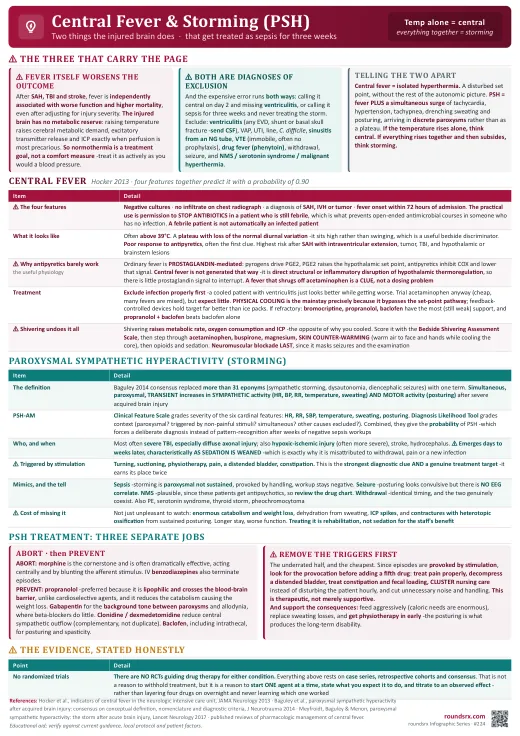
| Why it matters | Fever independently worsens outcome after SAH, TBI and stroke. The injured brain has no metabolic reserve, so normothermia is a treatment goal, not a comfort measure. |
| ⚠ Both are diagnoses of exclusion | Exclude ventriculitis (any EVD or shunt), VAP, UTI, line infection, C. difficile, sinusitis from an NG tube, VTE, drug fever (phenytoin), withdrawal, seizure, and the hyperthermia syndromes (NMS, serotonin syndrome, malignant hyperthermia). |
| Central fever: the four features | Negative cultures + no infiltrate on chest radiograph + SAH, IVH or tumor + onset within 72 hours predict central fever with probability 0.90. Its practical use is permission to stop antibiotics in a still-febrile patient. |
| How it looks | Often above 39°C, a plateau with loss of diurnal variation, and poor response to antipyretics. Highest risk after SAH with intraventricular extension. |
| ⚠ Why antipyretics fail | Ordinary fever is prostaglandin-mediated and antipyretics lower the PGE2-driven set point. Central fever is direct disruption of hypothalamic thermoregulation, so there is little prostaglandin signal to block. A fever that ignores acetaminophen is a clue, not a dosing problem. |
| Cooling, and its hazard | Physical cooling is the mainstay because it bypasses the set-point pathway. ⚠ Shivering undoes it, raising metabolic rate, oxygen use and ICP. Score with the Bedside Shivering Assessment Scale; acetaminophen, buspirone, magnesium, skin counter-warming, then sedation, with paralysis last since it masks seizures. |
| ⚠ Central fever vs storming | Central fever is isolated hyperthermia. PSH is fever PLUS simultaneous tachycardia, hypertension, tachypnea, sweating and posturing, in discrete paroxysms rather than a plateau. |
| PSH-AM | Clinical Feature Scale grades severity of six features (HR, RR, SBP, temperature, sweating, posturing); Diagnosis Likelihood Tool grades context. Combined, they estimate the probability of PSH. |
| Who and when | Most often severe TBI with diffuse axonal injury, also hypoxic-ischemic injury. Appears days to weeks later, typically as sedation is weaned, which is why it is misread as withdrawal or agitation. |
| ⚠ Triggered by stimulation | Turning, suctioning, pain, bladder distension, constipation. This is the strongest diagnostic clue and a treatment target. |
| Mimics | Sepsis (but storming is paroxysmal and provoked by handling), seizure (no EEG correlate), NMS (check for antipsychotics), withdrawal (same timing, and they coexist), PE, serotonin syndrome, thyroid storm. |
| Treatment: three jobs | ABORT with morphine (cornerstone) or benzodiazepines. PREVENT with propranolol (lipophilic, crosses the blood-brain barrier, reduces catabolism), gabapentin (background tone), clonidine or dexmedetomidine, baclofen for posturing. REMOVE TRIGGERS -bladder, bowels, pain, cluster care. |
| ⚠ The evidence | No randomized trials exist for either condition. Everything rests on case series and retrospective cohorts, so add one agent at a time and titrate to an observed effect. |
| Cost of missing it | Massive catabolism and weight loss, dehydration, ICP spikes, contractures and heterotopic ossification, longer stay, worse outcome. Feed aggressively and involve physiotherapy early. |
- Exclude infection before you blame the brain, and exclude the brain before you commit to three weeks of antibiotics. The error runs in both directions, and the Hocker features tell you which way to go.
- A fever that ignores acetaminophen is telling you something. Central fever is not prostaglandin-mediated, so cool it physically rather than escalating the dose.
- If the temperature rises alone it is central; if everything rises together in paroxysms it is storming. And before adding a fifth drug for storming, check the bladder and the bowels.