Chemotherapy Toxicities
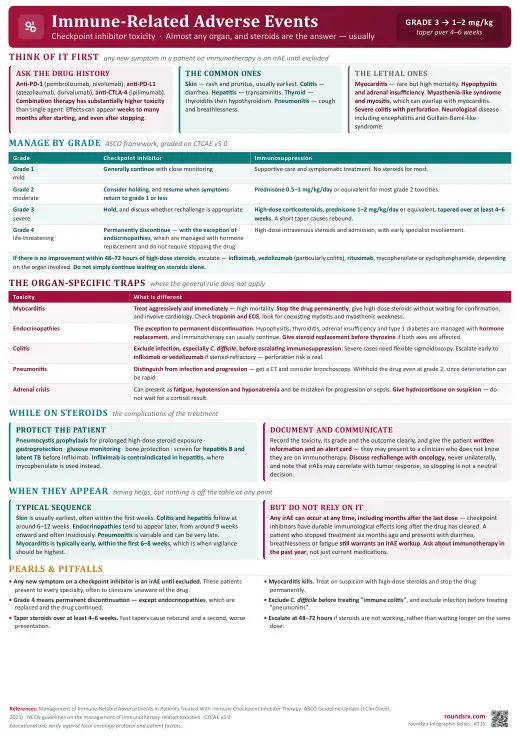
Chemotherapy toxicities are a leading cause of treatment discontinuation, ICU admission, and death in cancer patients. The intern must recognize organ-specific toxicities by drug class: anthracyclines (cardiotoxicity), bleomycin (pulmonary fibrosis), cisplatin (nephro/oto/neurotoxicity), vinca alkaloids (neuropathy), cyclophosphamide (hemorrhagic cystitis), checkpoint inhibitors (immune-related adverse events in any organ). Key principle: know which chemo the patient received and its expected toxicity profile.
| Grade | Severity | Action | Steroids |
|---|---|---|---|
| Grade 1 | Mild symptoms | Continue checkpoint therapy, close monitoring | None (topical steroids for skin if needed) |
| Grade 2 | Moderate, interferes with ADLs | Hold checkpoint therapy until resolves to Grade ≤ 1 | Oral prednisone 0.5–1 mg/kg/day, taper over 4–6 weeks |
| Grade 3 | Severe, hospitalization required | Hold checkpoint therapy, inpatient management | IV methylprednisolone 1–2 mg/kg/day, taper over ≥ 4 weeks |
| Grade 4 | Life-threatening | Permanently discontinue checkpoint therapy | IV methylprednisolone 1–2 mg/kg + specialty consult (infliximab for colitis, MMF for hepatitis) |
| Organ | Presentation | Workup | Treatment |
|---|---|---|---|
| Skin | Maculopapular rash, pruritus, vitiligo | Clinical exam, biopsy if severe | Topical steroids, oral antihistamines; systemic steroids if Grade ≥ 3 |
| GI (Colitis) | Diarrhea (watery, may be bloody), crampy abdominal pain | C. diff (rule out), CT abdomen, colonoscopy with biopsy | Steroids; infliximab if steroid-refractory |
| Hepatitis | AST/ALT elevation, usually asymptomatic | LFTs, hepatitis panel, autoimmune markers, imaging | Steroids; mycophenolate if refractory (NOT infliximab, hepatotoxic) |
| Pneumonitis | Cough, dyspnea, hypoxia | CT chest (ground-glass opacities), PFTs, bronchoscopy/BAL | Hold therapy, high-dose steroids, infliximab or MMF if refractory |
| Endocrine | Thyroiditis → hypothyroidism, adrenal insufficiency, new-onset T1DM, hypophysitis | TSH/free T4, AM cortisol, ACTH, glucose, pituitary MRI | Hormone replacement (levothyroxine, hydrocortisone, insulin), often lifelong |
| Neuro | Myasthenia gravis, encephalitis, Guillain-Barré, peripheral neuropathy | EMG/NCS, MRI brain, LP, AChR antibodies | High-dose steroids, IVIG, plasmapheresis; permanently discontinue therapy |
| Cardiac | Myocarditis (chest pain, dyspnea, arrhythmia, high mortality) | Troponin, BNP, ECG, echo, cardiac MRI, endomyocardial biopsy | High-dose IV steroids immediately; permanently discontinue; cardiology consult |
- Know the regimen -review the chemo protocol. Each drug has specific toxicities.
- CBC with differential -nadir timing varies: 7-14 days for most agents, 4-6 weeks for nitrosoureas
- BMP, LFTs, LDH -organ toxicity screening
- Troponin + BNP + echo -if anthracycline cardiotoxicity suspected
- CT chest -bleomycin/checkpoint pneumonitis
- UA -hemorrhagic cystitis (cyclophosphamide/ifosfamide)
- TSH -checkpoint inhibitor thyroiditis (most common irAE)
- AM cortisol -checkpoint hypophysitis
- Lipase -checkpoint pancreatitis
- Anthracycline cardiotoxicity: Echo (EF decline > 10% to below 50% = hold). Dexrazoxane for cardioprotection if cumulative dose high. Standard HF therapy if cardiomyopathy develops. Lifetime dose limits: doxorubicin 450-550 mg/m².
- Bleomycin lung toxicity: Stop bleomycin. Steroids (prednisone 1 mg/kg). Avoid high FiO₂ -oxygen worsens bleomycin lung injury (free radical mechanism). Keep SpO₂ 88-92% target.
- Typhlitis (neutropenic enterocolitis): CT abdomen (bowel wall thickening, pneumatosis). Broad-spectrum abx (pip-tazo + vanc). NPO + IV fluids. Surgery if perforation/peritonitis.
- Hemorrhagic cystitis: Aggressive IVF hydration. Continuous bladder irrigation (CBI). MESNA prophylaxis with cyclophosphamide/ifosfamide (binds acrolein metabolite). Urology if severe clot retention.
- Checkpoint inhibitor irAEs: Grade 1 → continue + monitor. Grade 2 → hold checkpoint, prednisone 0.5-1 mg/kg. Grade 3 → hold checkpoint, methylprednisolone 1-2 mg/kg. Grade 4 → permanently discontinue, methylprednisolone 1-2 mg/kg ± infliximab (colitis) or mycophenolate (hepatitis). [NCCN irAE Guidelines]
| Drug | Dose | Route | Notes |
|---|---|---|---|
| MESNA | 60-100% of cyclophosphamide dose | IV | Prevents hemorrhagic cystitis. Binds acrolein (toxic metabolite) in bladder. Give with cyclo/ifosfamide. |
| Dexrazoxane | 10:1 ratio to doxorubicin | IV | Iron chelator. Cardioprotection for cumulative anthracycline doses ≥ 300 mg/m². |
| Amifostine | 910 mg/m² IV pre-cisplatin | IV | Nephroprotection for cisplatin. Free radical scavenger. Causes hypotension. |
| Prednisone | 1-2 mg/kg daily | PO | irAEs Grade 2+. Taper over 4-6 weeks minimum. Too-rapid taper → flare. |
| Infliximab | 5 mg/kg IV | IV | Steroid-refractory checkpoint colitis. NCCN irAE, 2024 |
| Ondansetron | 8 mg IV pre-chemo | IV | Acute emesis. Add dexamethasone + NK1 antagonist for high emetogenic regimens. |
| Palonosetron | 0.25 mg IV | IV | Longer-acting 5-HT3 for delayed emesis prevention. |
Patient: 62M with metastatic melanoma on nivolumab (cycle 6). Presents with 4 days of watery diarrhea (8 episodes/day), diffuse crampy abdominal pain, low-grade fever. No blood in stool.
Diagnosis: Grade 3 immune-mediated colitis.
Key findings:
- Grade 3, ≥ 7 stools/day over baseline, requires hospitalization
- C. diff negative, must rule out infectious etiologies first
- CT abdomen: diffuse pancolitis with wall thickening and fat stranding
- Hold nivolumab, do not continue checkpoint therapy during Grade 3 irAE
Treatment: IV methylprednisolone 1–2 mg/kg/day. GI consult for colonoscopy with biopsy. If no improvement in 48–72 hours → infliximab 5 mg/kg. Slow steroid taper over ≥ 6 weeks once improved.
Mr. Davis is a 58-year-old man with metastatic melanoma on pembrolizumab (cycle 8) presenting with 5 days of watery diarrhea (8-10 episodes/day), crampy abdominal pain, no blood. Afebrile. Exam: diffuse abdominal tenderness, no peritoneal signs. Labs: WBC 11K, Cr 1.4 (baseline 0.9). C. diff negative. CT: diffuse colonic wall thickening. TSH 12 (baseline 2.5).
| Feature | Hodgkin Lymphoma | Non-Hodgkin Lymphoma |
|---|---|---|
| Frequency | ~10% of lymphomas | ~90% of lymphomas |
| Age | Bimodal (20s and 60s) | Median age 60-70 |
| Pathognomonic cell | Reed-Sternberg cell (CD15+/CD30+) | Varies by subtype (CD20+ B-cell most common) |
| Spread pattern | Contiguous (node to adjacent node) | Non-contiguous (can skip nodal groups) |
| Mediastinal mass | Very common (especially nodular sclerosis) | Less common (except primary mediastinal B-cell) |
| B symptoms | Common, affects staging | Present but less impact on staging |
| Extranodal disease | Rare at presentation | Common (GI, skin, CNS, bone marrow) |
| Prognosis | Excellent (> 80% cure) | Varies: indolent (incurable but long survival) to aggressive (curable with chemo) |
| Treatment | ABVD or BV-AVD ± radiation | Depends on subtype: R-CHOP (DLBCL), watch-and-wait (follicular), intensive chemo (Burkitt) |
| Stage | Definition | Clinical Relevance |
|---|---|---|
| I | Single lymph node region | Early stage, favorable prognosis. HL: ABVD × 2-4 + radiation. DLBCL: R-CHOP × 3 + radiation or R-CHOP × 6. |
| II | Two or more lymph node regions on the same side of the diaphragm | |
| III | Lymph node regions on both sides of the diaphragm | Advanced stage. HL: ABVD × 6 or BV-AVD. DLBCL: R-CHOP × 6. Follicular: treat if symptomatic. |
| IV | Extranodal involvement (bone marrow, liver, lung parenchyma) |
Patient: 54F with NSCLC on pembrolizumab (cycle 4). Routine labs show TSH 45 mIU/L (baseline 2.1), free T4 0.3 ng/dL (low). Patient reports fatigue, weight gain, constipation.
Diagnosis: Checkpoint inhibitor thyroiditis → hypothyroid phase.
Key findings:
- TSH markedly elevated with low free T4, overt hypothyroidism
- Painless thyroiditis, may have had transient hyperthyroid phase (often missed)
- Most common endocrine irAE, occurs in 10–20% of anti-PD-1 patients
- Does NOT require holding checkpoint therapy, unlike most other irAEs
Treatment: Start levothyroxine 1.6 mcg/kg/day. Continue pembrolizumab. Monitor TSH q6–8 weeks and titrate. This is typically permanent, lifelong levothyroxine replacement needed.
Patient: 48M with advanced RCC on ipilimumab/nivolumab (cycle 3). Labs: AST 580 (14x ULN), ALT 640 (16x ULN), T. bili 2.1, ALP 180. Asymptomatic.
Diagnosis: Grade 3 immune-mediated hepatitis.
Key findings:
- AST/ALT > 10x ULN, Grade 3 hepatitis (5–20x ULN)
- Hepatitis panel negative, rule out viral hepatitis (HBV reactivation with immunotherapy)
- Ipilimumab/nivolumab combo, highest rate of irAEs (~60%), hepatitis in ~15%
- Often asymptomatic, caught on routine monitoring LFTs
Treatment: Hold ipilimumab/nivolumab. IV methylprednisolone 1–2 mg/kg/day. If refractory → add mycophenolate (NOT infliximab, it is hepatotoxic). Monitor LFTs daily until downtrending. Taper steroids over ≥ 4 weeks.
- CBC nadir -typically day 7-14 (day 21-28 for nitrosoureas). Check CBC before each cycle.
- Echo/MUGA q3 months on anthracyclines -stop if EF drops > 10% below baseline to < 50%
- PFTs before and during bleomycin -stop if DLCO drops > 20%
- Cr + Mg with cisplatin (nephrotoxicity + magnesium wasting)
- Audiometry with cisplatin (ototoxicity -irreversible high-frequency hearing loss)
- TSH q4-6 weeks on checkpoint inhibitors (thyroiditis → hypothyroidism)
- LFTs q2-4 weeks on checkpoint inhibitors (hepatitis)
- Urine output + UA with cyclophosphamide (hemorrhagic cystitis)