Chest Pain Workup
| Diagnosis | Key Features | Critical Action |
|---|---|---|
| ACS (STEMI/NSTEMI) | Substernal pressure, exertional, radiates to jaw/arm, diaphoresis, nausea. Risk factors: age, DM, HTN, smoking, family hx. | ECG within 10 min. Troponin. See STEMI / NSTEMI. |
| Aortic dissection | Tearing/ripping pain, maximal at onset, radiating to back. BP differential, pulse deficit, new AR murmur. | CTA chest/abdomen. BP/HR control. See Aortic Dissection. |
| Pulmonary embolism | Pleuritic pain, dyspnea, tachycardia out of proportion. Risk: immobility, surgery, cancer, OCP. | CTPA (or D-dimer if low pretest). See PE. |
| Tension pneumothorax | Acute pleuritic pain + dyspnea. Absent breath sounds, JVD, tracheal deviation, hypotension. | Clinical diagnosis → needle decompression. See Pneumothorax. |
| Esophageal rupture (Boerhaave) | Severe retrosternal pain after forceful vomiting. Subcutaneous emphysema, Hamman's crunch (mediastinal crackle). Left pleural effusion. | CT chest with oral contrast or water-soluble esophagram. Emergent surgical consult. Mortality > 50% if delayed > 24h. |
| Category | Diagnosis | Clues |
|---|---|---|
| Musculoskeletal (~35%) | Costochondritis, muscle strain | Reproducible with palpation, worse with movement/position, no cardiac risk factors. Most common cause of chest pain in ED. |
| GI (~15%) | GERD, esophageal spasm, PUD | Burning, postprandial, relieved by antacids. Esophageal spasm can mimic ACS (substernal, relieved by NTG). |
| Pulmonary | Pneumonia, pleuritis, asthma | Pleuritic (sharp, worse with inspiration), fever, cough, focal exam findings. |
| Cardiac (non-ACS) | Pericarditis, myocarditis, aortic stenosis | Pericarditis: positional (worse supine, better leaning forward), friction rub, diffuse ST elevation. |
| Psychiatric (~10%) | Panic attack, anxiety | Diagnosis of exclusion. Young, hyperventilation, perioral/extremity tingling, sense of doom. Still need ECG + troponin. |
| Test | When | What It Rules Out |
|---|---|---|
| ECG WITHIN 10 MIN | EVERY chest pain. No exceptions. | STEMI, arrhythmia, pericarditis, PE (S1Q3T3, RV strain), Brugada, WPW |
| Troponin | All chest pain concerning for ACS | Myocardial injury. Serial troponins at 0 and 3h (high-sensitivity). 0 and 6h (conventional). HiSTORIC, 2019 |
| CXR | All admitted chest pain | Pneumothorax, pneumonia, widened mediastinum (dissection), pleural effusion, rib fractures |
| D-dimer | Low-intermediate pretest probability for PE | PE (if negative + low Wells → ruled out). Do NOT order if high pretest → go straight to CTPA. |
| CTPA | PE suspected (high Wells, positive D-dimer) | PE. Also shows dissection incidentally. |
| CTA chest | Dissection suspected | Aortic dissection. Triple rule-out CTA can assess coronaries + PE + dissection in one scan (but requires specific protocol). |
| Question | Answer and Why |
|---|---|
| Why is it falsely LOW? | Many immunoassays capture a biotin-labeled antibody on a streptavidin-coated surface. Free biotin in the sample saturates the streptavidin, so the antibody-troponin complex is washed away uncaptured. Troponin is a sandwich assay, where signal is proportional to analyte, so less captured complex reads as less troponin. |
| What dose matters? | The daily requirement is ~30 mcg, and multivitamins (up to 1 mg) have not been reported to interfere. Interference appears at doses of 5 mg or more: typical hair/skin/nail products contain 5–10 mg (5,000–10,000 mcg), and 100–300 mg/day is used in multiple sclerosis and inborn metabolic disorders. |
| Who is at highest risk? | A dose taken in the last few hours (serum biotin peaks 1–2 h after ingestion), anyone on 100 mg/day or more, and CKD, because biotin is renally cleared and levels stay higher for longer. |
| What to do in acute chest pain? | You cannot wait out a washout, so do not try. Treat the ECG and the clinical picture, and never let a single normal troponin override a convincing ischemic story in a biotin user. Call the lab: ask whether your troponin assay is biotin-susceptible (the FDA maintains a list, and some manufacturers have reformulated) and whether the sample can be run on a platform that does not use biotin-streptavidin chemistry. |
| How long to hold for elective testing? | At least 8 h after a 5–10 mg dose, and at least 72 h on 100 mg/day or more (AACC/ADLM 2020 guidance), longer with renal impairment. Some low-threshold assays need up to 72 h even after ordinary supplement doses, which is why many labs simply advise 48–72 h. |
- ACS: ASA+heparin+serial troponin+cardiology
- PE: Wells→D-dimer or CTPA
- Dissection: CTA. A→surgery. B→HR/BP control.
- Tamponade: echo→pericardiocentesis
- Tension PTX: needle decompress→tube
- HEART 0-3 + 2 neg troponins → safe discharge
Patient: 64-year-old man with DM, HTN, and hyperlipidemia presents with 3 hours of substernal pressure radiating to the left arm. Diaphoretic, nauseous. BP 148/92, HR 88.
Key findings: ECG: ST depression in V3-V6 and I/aVL. Troponin 0.48 (elevated), repeat at 3h: 1.24 (rising). HEART score 8.
Management:
- ASA 325 mg chew STAT + heparin drip (60 u/kg bolus, 12 u/kg/hr)
- Metoprolol 25 mg PO (HR/BP allow), atorvastatin 80 mg PO
- Cardiology consult for early invasive strategy (cath within 24h)
- Continuous telemetry, serial ECGs with recurrent symptoms
Teaching point: HEART score 7-10 = 65% risk of MACE at 30 days. Rising troponin pattern confirms acute myocardial injury. Early invasive strategy with cath is indicated. TIMACS, 2009
Patient: 32-year-old previously healthy man presents with sharp pleuritic chest pain worse when lying supine, improved by leaning forward. Recent URI 1 week ago. Low-grade fever 38.1C.
Key findings: ECG: diffuse concave-up ST elevation with PR depression in limb leads, reciprocal PR elevation and ST depression in aVR. Troponin mildly elevated at 0.08 (myopericarditis). Echo: small circumferential pericardial effusion without tamponade physiology.
Management:
- NSAIDs (ibuprofen 600 mg TID) + colchicine 0.5 mg BID x 3 months
- Activity restriction until symptom resolution and CRP normalization
- Avoid anticoagulation (risk of hemorrhagic pericarditis)
Teaching point: PR depression is virtually pathognomonic for pericarditis and is never seen in STEMI. Diffuse (non-territorial) ST elevation with concave morphology distinguishes pericarditis from STEMI. Colchicine reduces recurrence by 50%. COPE, 2005
Patient: 38-year-old woman with no cardiac risk factors presents with left-sided sharp chest pain reproduced by palpation. No exertional component. Non-smoker, no family history of premature CAD.
Key findings: ECG: normal sinus rhythm, no ST changes. Troponin 0h: undetectable. Troponin 3h: undetectable. HEART score 1.
Management:
- HEART score 0-3 with two negative high-sensitivity troponins = safe for discharge
- Diagnosis: musculoskeletal chest pain (costochondritis)
- Outpatient follow-up with PCP, NSAIDs PRN
- Return precautions: recurrent pressure-type pain, exertional symptoms, syncope
Teaching point: HEART score 0-3 with 2 negative troponins at 0 and 3h has less than 1.6% risk of MACE at 30 days. This is one of the safest discharge criteria in emergency medicine. Reproducible chest wall tenderness makes musculoskeletal cause most likely.
| Drug | Dose | Route | Indication | Notes |
|---|---|---|---|---|
| Aspirin STAT | 325 mg chew STAT | PO (chew) | All suspected ACS | Chewing provides faster absorption than swallowing. Non-enteric coated. Give immediately -do not wait for troponin results. |
| Nitroglycerin | 0.4 mg SL q5min x 3 doses | SL | Chest pain relief | Reduces preload → decreases myocardial O2 demand. Contraindicated if SBP < 90, RV infarct, PDE5 inhibitor within 24–48h (sildenafil/tadalafil). |
| Morphine | 2–4 mg IV q5–15min PRN | IV | If NTG fails for pain | Use cautiously. May cause hypotension and respiratory depression. Some data suggests worse outcomes in NSTEMI -consider alternatives (fentanyl). |
| Heparin (UFH) | 60 u/kg bolus (max 4000u) → 12 u/kg/hr | IV drip | High-suspicion ACS | Anticoagulation for suspected ACS. Target aPTT 60–80 sec. Alternative: enoxaparin 1 mg/kg SQ q12h. |
| Metoprolol | 25 mg PO | PO | ACS if HR/BP allow | Beta-blocker -reduces myocardial O2 demand. Hold if: HR < 60, SBP < 100, signs of HF, PR > 0.24, 2nd/3rd degree AV block, active wheezing. |
| High-intensity statin | Atorvastatin 80 mg PO | PO | All ACS patients | Start immediately regardless of baseline LDL. Plaque stabilization. Continue lifelong. |
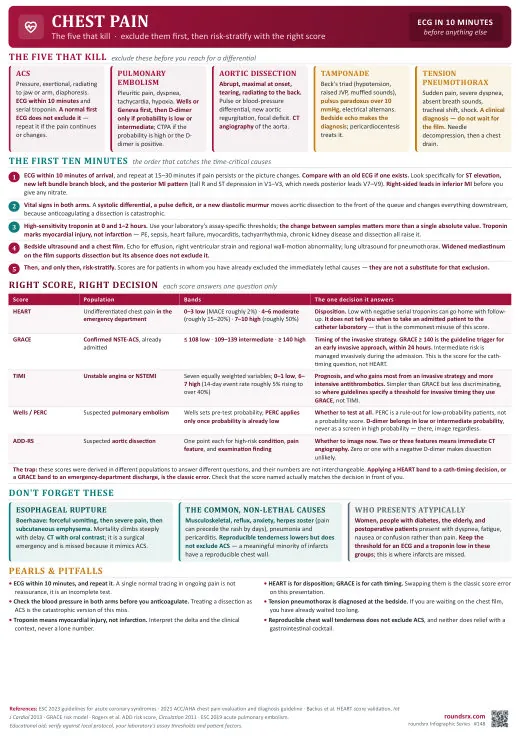
Text version
- Anchoring on "musculoskeletal" without ruling out ACS
- Missing posterior STEMI or Wellens pattern on ECG
- Not considering dissection (tearing pain, BP differential)
- Troponin at 0h only (need serial)