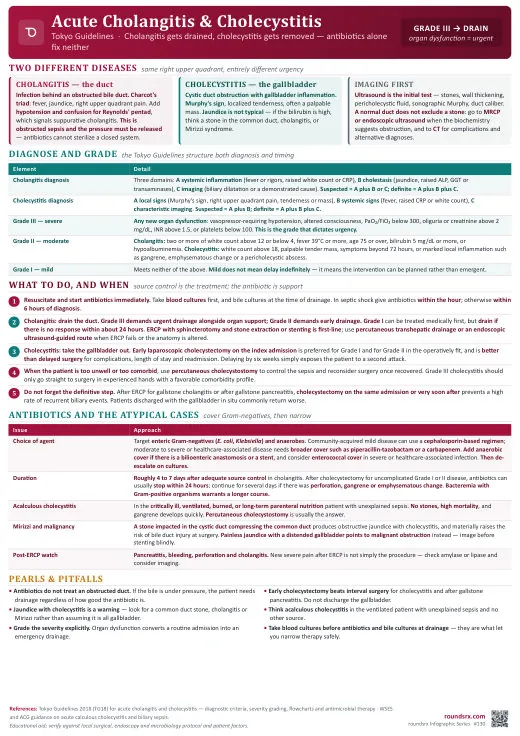
Cholangitis & Cholecystitis
| Feature | Acute Cholangitis | Acute Cholecystitis |
|---|---|---|
| Pathophys | Bile duct obstruction + infection → bacteremia | Gallbladder outlet obstruction (stone in cystic duct) → inflammation ± infection |
| Classic signs | Charcot triad: fever + RUQ pain + jaundice | Murphy sign: inspiratory arrest with RUQ palpation |
| Severe | Reynolds pentad: Charcot + AMS + shock | Gangrenous, emphysematous, perforated |
| Key labs | ↑ bili, ↑ ALP/GGT, ↑ WBC, + blood cultures | ↑ WBC, ± mild LFT elevation |
| Imaging | CBD dilation > 8 mm, ± stone visible | GB wall thickening, pericholecystic fluid, + Murphy on US |
| Treatment | ERCP within 24–48h (emergent if septic) | Cholecystectomy within 72h |
| Grade | Severity | Criteria | Management |
|---|---|---|---|
| Grade I | Mild | Does not meet Grade II or III criteria. Responds to initial antibiotics/fluids | Antibiotics + elective/semi-urgent biliary drainage |
| Grade II | Moderate | Any 2 of: WBC >12k or <4k, fever ≥39°C, age ≥75, total bili ≥5, albumin <2.5 | Antibiotics + urgent ERCP within 24-48h |
| Grade III | Severe | Organ dysfunction in ≥1: cardiovascular (vasopressors), neurologic (AMS), respiratory (P/F <300), renal (Cr >2.0), hepatic (INR >1.5), hematologic (plt <100k) | Emergent ERCP <12-24h + ICU + organ support |
| Grade | Severity | Criteria | Management |
|---|---|---|---|
| Grade I | Mild | Healthy patient, no organ dysfunction, mild GB inflammation | Early laparoscopic cholecystectomy PONCHO, 2015 |
| Grade II | Moderate | Any of: WBC >18k, palpable RUQ mass, duration >72h, gangrenous/emphysematous GB, pericholecystic abscess | Early chole by experienced surgeon or percutaneous drainage if high risk |
| Grade III | Severe | Organ dysfunction (cardiovascular, neurologic, respiratory, renal, hepatic, hematologic) | Percutaneous cholecystostomy (bridge) → interval cholecystectomy |
| Feature | MRCP | ERCP |
|---|---|---|
| Purpose | Diagnostic, non-invasive biliary imaging | Diagnostic + therapeutic, stone extraction, stent, sphincterotomy |
| Sensitivity (CBD stones) | 85-92% | 95-98% (gold standard) |
| When to use | Intermediate probability of CBD stone (equivocal US, mild LFT elevation) | High probability CBD stone, confirmed cholangitis, therapeutic intent |
| Risks | None (non-invasive) | Post-ERCP pancreatitis (5-10%), bleeding, perforation Elmunzer et al., 2012 |
| Key rule | Use to avoid unnecessary ERCP | Use when you plan to intervene |
- IV antibiotics -start immediately after blood cultures
- ERCP with sphincterotomy -biliary drainage within 24–48h. Emergent if Reynolds pentad. Khashab et al., 2012
- If ERCP fails: percutaneous transhepatic cholangiography (PTC) or surgical drainage
- Fluid resuscitation, vasopressors if septic shock
- Laparoscopic cholecystectomy within 72h -early surgery is safe and reduces hospital stay ACDC Trial, 2013
- NPO, IV fluids, antibiotics, pain control
- Percutaneous cholecystostomy -if too sick for surgery (bridge procedure)
| TG18 Grade | Drainage Timing | Method | Key Considerations |
|---|---|---|---|
| Grade I | Elective (within days) | ERCP preferred | Stabilize with antibiotics first. Schedule ERCP during working hours |
| Grade II | Urgent (24-48h) | ERCP preferred | Start antibiotics immediately. If not responding in 24h, escalate to emergent |
| Grade III | Emergent (<12-24h) | ERCP. If fails: PTC or surgical drainage | ICU admission. Vasopressors + antibiotics + urgent GI consult |
| Severity | First-Line | Alternative | Duration |
|---|---|---|---|
| Mild-Moderate (Grade I-II) | Piperacillin-Tazobactam 4.5g IV q6h | Ceftriaxone 2g IV daily + Metronidazole 500mg IV q8h | 4-7 days after source control Van Lent et al., 2019 |
| Severe (Grade III) | Meropenem 1g IV q8h | Imipenem-Cilastatin 500mg IV q6h | 7-14 days; de-escalate based on cultures |
| PCN allergy | Ciprofloxacin 400mg IV q12h + Metronidazole 500mg IV q8h | Aztreonam 2g IV q8h + Metronidazole 500mg IV q8h | Based on severity |
| Healthcare-associated | Meropenem 1g IV q8h ± Vancomycin (if MRSA risk) | Add antifungal if prior biliary stent/prolonged antibiotics | Tailor to cultures |
- RUQ ultrasound -first-line. GB stones, wall thickening, pericholecystic fluid, CBD dilation ACR Appropriateness Criteria, 2023
- MRCP -if US inconclusive for CBD stones
- HIDA scan -if cholecystitis diagnosis unclear (non-filling of GB = cystic duct obstruction)
- CBC, CMP (bilirubin, ALP, GGT, AST, ALT), lipase
- Blood cultures × 2 -before antibiotics in cholangitis
- Lactate -if concern for sepsis
| Drug | Dose | Indication |
|---|---|---|
| Piperacillin-Tazobactam (Zosyn) | 3.375–4.5 g IV q6h | First-line for moderate-severe (Tokyo Grade II/III), post-ERCP, or healthcare-associated cholangitis/cholecystitis. Covers Pseudomonas + anaerobes + Enterobacterales in one drug -see bile paradox alert below. TG18, 2018 |
| Ceftriaxone (Rocephin) ± Metronidazole (Flagyl) | 2 g IV q24h ± 500 mg IV q8h | Acceptable for mild (Tokyo Grade I) community-acquired biliary infection -ceftriaxone concentrates ~40% in bile (levels 5-10x serum). Add metronidazole for anaerobes if biliary-enteric anastomosis or impacted CBD stone. Does NOT cover Pseudomonas, so not for Grade II/III or post-ERCP. |
| Ciprofloxacin (Cipro) + Metronidazole (Flagyl) | 400 mg IV q12h + 500 mg IV q8h | Alternative if PCN allergy |
| Meropenem (Merrem) | 1g IV q8h | Severe/healthcare-associated cholangitis |
| Ketorolac (Toradol) | 15–30 mg IV q6h | Pain -preferred over opioids initially |
Ceftriaxone has ~40% biliary excretion, achieving bile concentrations 5-10x serum levels, which is exactly why it works for mild (Tokyo Grade I) community-acquired biliary infection. But the same property cuts both ways:
- No Pseudomonas coverage -matters in healthcare-associated cholangitis, prior ERCP or biliary stenting, recent broad-spectrum exposure, or any Tokyo Grade II/III disease.
- No anaerobe coverage -requires metronidazole add-on for B. fragilis. Anaerobic overgrowth is especially a concern with biliary-enteric anastomoses, impacted CBD stones, or any setting where bile stagnates.
- Pseudocholelithiasis paradox -the same high biliary concentration causes calcium-ceftriaxone precipitates that look like gallstones on US. Usually reversible within days to weeks of stopping. Higher risk with courses >10-14 days, doses >2 g/day, dehydration, or prolonged NPO (no bile flow to flush the precipitate).
Bottom line: ceftriaxone ± metronidazole is acceptable for Tokyo Grade I community-acquired cholangitis/cholecystitis. Pip-tazo (Zosyn) is first-line for Grade II/III, post-ERCP, healthcare-associated, or any case with prior broad-spectrum exposure -covers Pseudomonas + anaerobes + Enterobacterales in one drug per TG18, 2018.
Patient: 72F presents with 2 days of RUQ pain, fevers to 39.5°C, and jaundice. PMH: cholelithiasis (declined prior cholecystectomy). BP 82/54, HR 118, T 39.8°C, confused and somnolent.
Labs: WBC 22k, total bili 8.2, direct bili 6.1, ALP 580, AST 245, ALT 198, lactate 4.8, Cr 2.1 (baseline 0.9). Blood cultures drawn x2.
Imaging: RUQ US: CBD dilated to 12 mm with shadowing stone in distal CBD. Multiple gallstones in GB.
Assessment: Reynolds pentad (fever + RUQ pain + jaundice + AMS + shock) = TG18 Grade III cholangitis with organ dysfunction (cardiovascular, neurologic, renal).
Management:
- Resuscitation: 30 mL/kg LR bolus, norepinephrine started for MAP <65 despite fluids. ICU admission.
- Antibiotics: Meropenem 1g IV q8h (Grade III = broad-spectrum) started within 1 hour.
- Emergent ERCP: GI consulted immediately. ERCP performed within 8 hours. Sphincterotomy with stone extraction and plastic biliary stent placed. Purulent bile drained.
- Post-ERCP: Vasopressors weaned off within 24h. Mental status cleared by 36h. Creatinine normalized by day 3.
- Follow-up: Cholecystectomy performed on hospital day 5 after clinical improvement.
Key lesson: Reynolds pentad = TG18 Grade III = emergent ERCP. Do not delay drainage for imaging. Start broad-spectrum antibiotics (meropenem for Grade III) and resuscitate aggressively. Same-admission cholecystectomy once stabilized.
Patient: 45M presents with 18 hours of progressively worsening RUQ pain radiating to right scapula, nausea, and one episode of vomiting. No fever initially. Positive Murphy sign on exam. PMH: obesity, no prior biliary disease.
Labs: WBC 14.5k, total bili 1.8 (mildly elevated), ALP 145, AST/ALT mildly elevated, lipase normal.
Imaging: RUQ US: multiple gallstones, GB wall thickening to 5 mm, pericholecystic fluid, sonographic Murphy sign positive. CBD 5 mm (normal).
Assessment: TG18 Grade I acute calculous cholecystitis (healthy patient, no organ dysfunction).
Management:
- Initial: NPO, IV NS maintenance, ketorolac 15mg IV q6h for pain, piperacillin-tazobactam 3.375g IV q6h.
- Surgery consult: Laparoscopic cholecystectomy scheduled for hospital day 2 (within 72h of symptom onset).
- Operative note: Inflamed GB with omental adhesions. No CBD stones on intraoperative cholangiogram.
- Post-op: Tolerating diet same evening. Discharged POD1.
Key lesson: ACDC Trial, Ann Surg 2013 showed early cholecystectomy (within 72h) is preferred over delayed surgery. Normal CBD on US + mildly elevated bili = low risk for CBD stones, so intraoperative cholangiogram is sufficient without MRCP.
Patient: 58F presents with intermittent RUQ pain x3 days, now with dark urine and pale stools. No fever. Vitals stable. RUQ tender but no Murphy sign.
Labs: WBC 9.8k (normal), total bili 3.8, direct bili 2.9, ALP 420, GGT 380, AST 180, ALT 210. Normal lipase.
Imaging: RUQ US: gallstones present, CBD dilated to 9 mm, no definite stone visualized in CBD. No GB wall thickening or pericholecystic fluid.
Assessment: Choledocholithiasis (obstructive pattern LFTs + dilated CBD). No cholangitis (afebrile, normal WBC). No cholecystitis (no Murphy sign, no GB wall changes).
Risk stratification (ASGE):
- Dilated CBD (>6mm) + elevated bilirubin + abnormal LFTs = high probability of CBD stone
- No CBD stone visualized on US (sens ~50% for CBD stones), but high clinical suspicion
- Decision: High risk → proceed directly to ERCP (do not delay with MRCP)
Management:
- ERCP: 8mm stone found in distal CBD. Sphincterotomy + balloon sweep with complete stone extraction. Rectal indomethacin 100mg given for post-ERCP pancreatitis prophylaxis.
- Post-ERCP: LFTs trending down within 24h. Bili 2.1 → 1.4 by day 2.
- Cholecystectomy: Performed same admission (day 3). Uncomplicated.
Key lesson: Use ASGE risk stratification: high risk → ERCP directly. Intermediate risk → MRCP or EUS first. Low risk → proceed to cholecystectomy with intraoperative cholangiogram. Always give rectal indomethacin for post-ERCP pancreatitis prophylaxis.