Chronic Cough
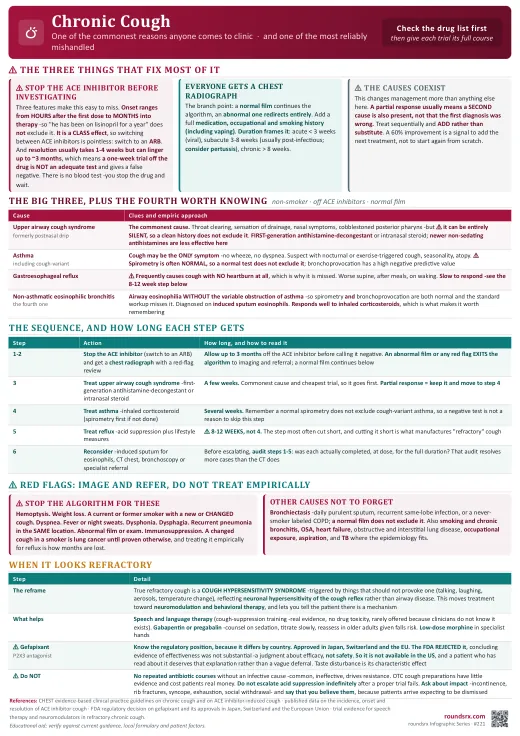
- Acute: under 3 weeks -usually viral upper respiratory infection, and usually needs nothing.
- Subacute: 3 to 8 weeks -most commonly post-infectious, which resolves on its own but slowly. Consider pertussis, particularly with paroxysms, post-tussive vomiting or a whoop; antibiotics at this stage limit transmission more than they change the patient's course.
- Chronic: more than 8 weeks -this is where a systematic approach earns its keep, because the differential is short and the same few causes account for most of it.
- A chest radiograph, in every patient with chronic cough. It is the branch point: a normal film moves you into the algorithm below, an abnormal one redirects entirely.
- A full medication and exposure history -ACE inhibitors above all, plus occupational and environmental exposures, and smoking including vaping.
- Spirometry where asthma is plausible, recognizing that normal spirometry does not exclude cough-variant asthma.
| Cause | Clues and empiric approach |
|---|---|
| Upper airway cough syndrome formerly postnasal drip | The commonest cause. Throat clearing, a sensation of drainage, nasal symptoms, cobblestoning of the posterior pharynx -but it can be entirely silent, so its absence on history does not exclude it. Treated empirically with a first-generation antihistamine-decongestant or intranasal corticosteroid; response supports the diagnosis. Newer non-sedating antihistamines are less effective here, which surprises people. |
| Asthma, including cough-variant | Cough may be the ONLY symptom -no wheeze, no dyspnea. Suspect it with nocturnal or exercise-triggered cough, seasonality, or atopy. ⚠ Spirometry is often normal, so a normal test does not exclude it; bronchoprovocation testing has a high negative predictive value where available. Treat with inhaled corticosteroids and allow several weeks for response. |
| Gastroesophageal reflux | Frequently causes cough without any heartburn at all, which is why it gets missed. Suspect it with cough that is worse when supine, after meals, or on waking. Treat with acid suppression plus lifestyle measures, and give it 8 to 12 weeks -reflux cough is slow to respond, and stopping at four weeks produces a false negative. |
| Non-asthmatic eosinophilic bronchitis the fourth one worth knowing | Airway eosinophilia WITHOUT the variable airflow obstruction of asthma, so spirometry and bronchoprovocation are both normal and it is missed by the standard workup. Diagnosed on induced sputum eosinophils where available. Responds well to inhaled corticosteroids, which makes it worth remembering rather than obscure. |
- Bronchiectasis -daily purulent sputum, recurrent same-lobe infection, or a never-smoker labeled COPD. A normal chest radiograph does not exclude it (see Bronchiectasis).
- Smoking and chronic bronchitis, obstructive sleep apnea, heart failure, obstructive airway disease, interstitial lung disease, and occupational or environmental exposure.
- Aspiration, particularly with neurologic disease or dysphagia, and tuberculosis where the epidemiology fits.
- Before concluding a cough is refractory, audit the workup rather than escalating. Was the ACE inhibitor genuinely stopped and for long enough? Did each empiric trial run its full course, at an adequate dose, and was it actually taken? Most "refractory" cough is an incompletely executed algorithm, and the commonest single reason is a reflux trial abandoned at four weeks.
- Remember that causes coexist, so a 60% improvement is a signal to add the next treatment, not to stop and re-think from scratch.
| Option | Detail |
|---|---|
| Speech and language therapy cough suppression training | Structured behavioral cough-suppression therapy has genuine evidence and no drug toxicity, which makes it a strong first choice where available. Frequently not offered because clinicians do not know it exists. |
| Gabapentin or pregabalin | Neuromodulators with supporting trial evidence in refractory cough. Counsel about sedation and dizziness, titrate slowly, and reassess -particularly in older adults, where these add to falls risk. |
| Low-dose morphine | Used in specialist practice for severe refractory cough. Effective, but with the expected opioid considerations, so this is a referral-level decision rather than a clinic default. |
| ⚠ P2X3 antagonists gefapixant | Know the regulatory position, because it differs by country. Gefapixant targets the P2X3 receptor implicated in cough hypersensitivity and is approved in Japan, Switzerland and the European Union. The evidence behind it is COUGH-1 and COUGH-2, 2022, in which the 45 mg twice-daily dose met the primary endpoint of 24-hour cough frequency while the 15 mg dose failed it in both trials -useful context for why the regulators diverged. The FDA rejected the application, concluding the evidence of effectiveness was not substantial -a judgment about efficacy, not safety. So it is not available in the US, and a patient who has read about it deserves that explanation rather than a vague deferral. Taste disturbance is its characteristic adverse effect. |
- ⚠ Do not treat chronic cough with repeated antibiotic courses in the absence of an infective cause. It is common, it does not work, and it drives resistance.
- Over-the-counter cough preparations have little evidence in chronic cough, and patients are often spending real money on them.
- Do not escalate acid suppression indefinitely when a properly conducted trial has failed -that is a prescribing cascade rather than a diagnosis.
- Acknowledge the impact. Chronic cough causes urinary incontinence, rib fractures, syncope, exhaustion and social withdrawal, and patients are routinely told it is nothing. Saying that you believe them is part of the treatment.
"Ms. N is a 58-year-old never-smoker with a dry cough for five months that is disrupting her sleep and has caused stress incontinence, which she was embarrassed to mention. She has been treated with three courses of antibiotics without benefit, which is a common pattern and does not work. The first thing I noticed is that she takes ramipril for hypertension, started about eight months ago -and the fact that the cough began several months after starting does not exclude it, because onset ranges from hours to months. So the first step is switching her to an ARB rather than another ACE inhibitor, since it is a class effect, and giving it a proper trial: I have told her it usually settles in one to four weeks but can take up to three months, because a one-week trial would produce a false negative and she would reasonably conclude it was not the drug. Her chest radiograph is normal and she has no red flags -no hemoptysis, weight loss, dyspnea or voice change. If the cough persists off the ACE inhibitor, my plan is sequential empiric treatment for the big three, starting with upper airway cough syndrome, then inhaled corticosteroids for possible cough-variant asthma, noting that normal spirometry will not exclude it, then a reflux trial run for a full 8 to 12 weeks rather than stopped early. I have also told her explicitly that I believe the cough is real and that we have a plan, because she arrived expecting to be dismissed."
- ⚠ ACE inhibitor stopped and switched to an ARB, with an adequate washout explained.
- Chest radiograph obtained in every patient with chronic cough.
- Red flags actively excluded -hemoptysis, weight loss, smoking history, dyspnea, dysphonia, recurrent same-site pneumonia.
- Empiric trials given adequate duration, especially reflux at 8 to 12 weeks.
- Partial response read as a second cause, not as failure of the first.
- No repeated antibiotic courses without an infective cause.
- Impact asked about directly -incontinence, sleep, rib pain, social withdrawal- since patients rarely volunteer it.
| Point | Detail |
|---|---|
| Duration defines it | Acute < 3 weeks (viral). Subacute 3-8 weeks (usually post-infectious; consider pertussis -antibiotics limit transmission more than they change the course). Chronic > 8 weeks. |
| ⚠ ACE inhibitor first | Stop it before investigating. Onset ranges from hours to MONTHS, so long-standing use does not exclude it. Class effect -switch to an ARB, not another ACE inhibitor. Resolution usually 1-4 weeks but up to ~3 months, so a one-week trial is a false negative. |
| Everyone gets | Chest radiograph plus a full medication, occupational and smoking (including vaping) history. Spirometry where asthma is plausible. |
| ⚠ Red flags | Hemoptysis, weight loss, current or former smoker with a changed cough, dyspnea, fever, dysphonia, recurrent same-site pneumonia, abnormal film or exam, immunosuppression. A changed cough in a smoker is lung cancer until proven otherwise. |
| The big three | In a non-smoker off ACE inhibitors with a normal film: upper airway cough syndrome (commonest; may be silent; first-generation antihistamine-decongestant, newer ones less effective), asthma including cough-variant (cough may be the ONLY symptom; normal spirometry does not exclude it), and reflux (often no heartburn at all; needs 8-12 weeks). |
| ⚠ They COEXIST | Partial response means a second cause is also present, not that the first was wrong. Treat sequentially and add rather than substitute. |
| The fourth one | Non-asthmatic eosinophilic bronchitis -airway eosinophilia without variable obstruction, so spirometry and bronchoprovocation are both normal. Induced sputum eosinophils. Responds well to inhaled corticosteroids. |
| Refractory cough | Audit the workup before escalating -most "refractory" cough is an incompletely executed algorithm, usually a reflux trial stopped at 4 weeks. True refractory cough is a cough hypersensitivity syndrome: speech therapy (real evidence, no toxicity, rarely offered), gabapentin or pregabalin, low-dose morphine in specialist hands. |
| ⚠ Gefapixant | P2X3 antagonist. Approved in Japan, Switzerland and the EU; REJECTED by the FDA for insufficient evidence of effectiveness (not safety), so not available in the US. Characteristic adverse effect is taste disturbance. |
| Do not | No repeated antibiotics without an infective cause. OTC preparations have little evidence. Do not escalate acid suppression indefinitely after a proper trial fails. Ask about impact -incontinence, rib fractures, syncope, exhaustion- and say you believe them. |
- Check the drug list before you investigate. Years on the drug does not rule it out, and a one-week stop does not rule it in.
- Partial response means add, not abandon. The big three coexist far more often than people expect.
- Give reflux 8 to 12 weeks. Stopping early is the single commonest way a treatable cough gets labeled refractory.