Chronic Insomnia
- Chronic insomnia disorder requires difficulty initiating or maintaining sleep at least 3 nights a week for at least 3 months, with daytime consequences (fatigue, impaired attention, mood disturbance, impaired function), occurring despite adequate opportunity and circumstances for sleep.
- That last clause is doing real work. Someone who sleeps five hours because they are working two jobs has insufficient sleep opportunity, not insomnia, and prescribing a hypnotic treats the wrong problem. Ask what time they get into bed and what time they must get up before anything else.
- The daytime consequence is part of the definition too. A short sleeper who feels well is not disordered, and does not need treating.
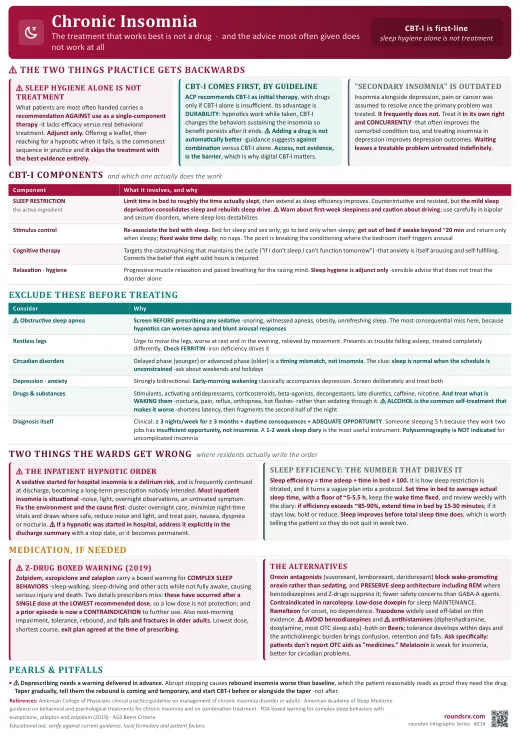
- Cognitive behavioral therapy for insomnia (CBT-I) is recommended as first-line treatment by the American College of Physicians, with medication discussed only if CBT-I alone is insufficient. Sleep medicine guidance agrees that CBT-I by itself is the most efficacious initial treatment.
- Its advantage is durability. Hypnotics work while they are being taken; CBT-I changes the behaviors and beliefs sustaining the insomnia, so benefit persists after treatment ends. That difference is the entire argument for the extra effort it requires.
- ⚠ Adding a drug to CBT-I is not automatically better. Guidance suggests against combination therapy rather than CBT-I alone, since behavioral treatment often produces meaningful and durable improvement without the risks that come with pharmacotherapy. The instinct to do both at once is not supported.
- Access is the real barrier, not evidence. Trained therapists are scarce, which is why digital and app-delivered CBT-I programs matter -they are a legitimate route to the first-line treatment rather than a lesser substitute, and they are what makes the recommendation actionable in a general clinic.
- No test makes the diagnosis. Take a careful sleep history: bedtime, sleep latency, awakenings and their cause, final wake time, time out of bed, naps, and what the patient does during a wakeful night.
- A sleep diary over 1 to 2 weeks is the single most useful instrument, because recall is unreliable and the diary usually reveals the pattern the history missed -most often that time in bed far exceeds actual sleep, which is the specific problem sleep restriction fixes.
- ⚠ Polysomnography is NOT indicated for uncomplicated insomnia. Order it when another sleep disorder is suspected -obstructive sleep apnea, periodic limb movements, parasomnia- not to confirm insomnia itself.
- Actigraphy is the step between the diary and the sleep lab. A wrist accelerometer worn for 72 hours to 14 consecutive days estimates total sleep time, sleep latency, wake after sleep onset and sleep efficiency across many nights, which is exactly what a single-night PSG cannot do. AASM 2018 suggests it in adults with insomnia disorder (conditional recommendation). It does not make the diagnosis and does not replace the diary -reach for it when objective numbers will change management: non-response to CBT-I, a patient asking for a higher hypnotic dose, self-report of questionable validity, or suspected paradoxical insomnia (sleep-state misperception, where the diary says 2 hours and actigraphy says 6). It is also the tool for a suspected circadian rhythm disorder, since a timing mismatch only declares itself over consecutive days.
- A consumer smartwatch is not actigraphy. The AASM guideline covers FDA-cleared clinical devices only; consumer trackers were deliberately excluded from the evidence review and are not validated to render a diagnosis. Patient ring or watch data is still worth opening as a conversation about their schedule, but do not treat its sleep-stage output as measurement.
- Ask the bed partner where possible, since snoring, witnessed apneas and leg movements are things the patient cannot report.
| Consider | Why it matters |
|---|---|
| ⚠ Obstructive sleep apnea | Screen before prescribing any sedative. Snoring, witnessed apneas, obesity, morning headache, unrefreshing sleep. This is the most consequential miss on the page, because hypnotics and other sedatives can worsen apnea and blunt arousal responses. See Obstructive Sleep Apnea. |
| Restless legs syndrome | An urge to move the legs, worse at rest and in the evening, relieved by movement. It presents as difficulty falling asleep and is treated entirely differently. Check ferritin, since iron deficiency drives it and repletion helps. Do not substitute actigraphy for EMG to diagnose periodic limb movement disorder -that is the single strong recommendation in the AASM actigraphy guideline; movement counts cannot distinguish periodic limb movements from ordinary motion. |
| Circadian rhythm disorders | Delayed sleep phase in younger patients and advanced phase in older ones produce "insomnia" that is really a timing mismatch. The clue is that sleep is normal when the schedule is unconstrained -ask about weekends and holidays. |
| Psychiatric conditions | Depression and anxiety are strongly bidirectional with insomnia. Early morning wakening classically accompanies depression. Screen deliberately, and treat both. |
| Medications and substances | Review the whole list: stimulants, activating antidepressants, corticosteroids, beta-agonists, decongestants, some beta-blockers, diuretics timed late, plus caffeine, nicotine and alcohol. Alcohol is the common self-treatment that makes it worse -it shortens sleep latency then fragments the second half of the night. |
| Medical causes of waking | Nocturia, pain, reflux, heart failure orthopnea, dyspnea, hot flashes. Treat what is waking them rather than sedating through it. |
| Component | What it involves, and why |
|---|---|
| Sleep restriction the active ingredient | Deliberately limit time in bed to roughly the time actually slept, then extend it gradually as sleep efficiency improves. It is counterintuitive and patients resist it, but the mild sleep deprivation it creates consolidates sleep and rebuilds the drive to sleep. ⚠ Warn about daytime sleepiness in the first week or two, and caution about driving; use with care in bipolar disorder and seizure disorders, where sleep deprivation can destabilize. |
| Stimulus control | Re-associate the bed with sleep. Bed for sleep and sex only, go to bed only when sleepy, get out of bed if awake beyond about 20 minutes and return only when sleepy again, fixed wake time daily, no napping. The point is to break the conditioning in which the bedroom itself triggers arousal. |
| Cognitive therapy | Targets the catastrophizing that maintains the cycle -"if I do not sleep I cannot function tomorrow" -because that anxiety is itself arousing and self-fulfilling. Also corrects unrealistic expectations, such as needing a solid eight hours. |
| Relaxation training | Progressive muscle relaxation, paced breathing. Useful for patients whose main complaint is a mind that will not stop. |
| Sleep hygiene | Adjunct only. Consistent schedule, dark cool room, limiting caffeine, alcohol and evening screens. Sensible advice that does not treat the disorder on its own. |
| Agent | Detail |
|---|---|
| Z-drugs zolpidem, eszopiclone, zaleplon | Effective short term, but see the boxed warning above. Also cause next-morning impairment (zolpidem doses were lowered for women, who clear it more slowly), tolerance, rebound insomnia on stopping, and falls and fractures in older adults. Use the lowest dose for the shortest period and plan the exit at the time of prescribing. |
| ⚠ Benzodiazepines | Avoid for insomnia, particularly in older adults, where they appear on the Beers criteria. Dependence, tolerance, cognitive impairment, falls, and dangerous interaction with opioids and alcohol. |
| Dual orexin receptor antagonists suvorexant, lemborexant, daridorexant | Block the wake-promoting orexin signal rather than sedating -a different mechanism from everything above. They preserve sleep architecture including REM, where benzodiazepines and Z-drugs suppress it, and are generally considered to carry fewer safety concerns than GABA-A modulators. Next-day somnolence is the main effect; contraindicated in narcolepsy. Cost and access are the practical limits. |
| Low-dose doxepin | At the low doses used for insomnia it acts as a selective histamine antagonist, useful specifically for sleep maintenance (waking in the second half of the night) with little anticholinergic burden at that dose. |
| Ramelteon | Melatonin receptor agonist, helpful for sleep onset, without dependence potential. |
| Trazodone | Very widely used off-label with limited supporting evidence for primary insomnia. Watch orthostatic hypotension and next-day sedation in older adults, and the rare risk of priapism. |
| ⚠ Antihistamines | Diphenhydramine and doxylamine, including most over-the-counter sleep aids, should be avoided -especially in older adults, where they are on the Beers list. Tolerance develops within days, and the anticholinergic burden brings confusion, urinary retention, constipation and falls. Patients often do not mention these because they are not "real medicines"; ask specifically. |
| Melatonin | Evidence in chronic insomnia is weak; it is more useful for circadian problems such as jet lag and delayed sleep phase. As a supplement, actual content varies considerably between products. |
"Mr. J is a 68-year-old man complaining of six months of waking at 3 am and being unable to return to sleep, with daytime fatigue affecting his driving. He has been taking over-the-counter diphenhydramine most nights, which he did not initially mention because he does not consider it a medication -it is on the Beers list, it has almost certainly stopped working through tolerance, and the anticholinergic burden is a concern at his age. His sleep diary shows he goes to bed at 9 pm and rises at 7 am, so he is spending ten hours in bed for about six hours of sleep, which is the specific pattern sleep restriction addresses. His wife reports loud snoring and witnessed pauses, so I have referred him for sleep study before considering any sedative, since a hypnotic in untreated apnea can worsen it. I screened for depression given the early-morning wakening and the PHQ-9 was mildly elevated, so that needs treating concurrently rather than waiting to see if sleep improves first. My plan is to stop the diphenhydramine with a warning about temporary rebound, refer to CBT-I with a digital program given local waiting times, and specifically not to start a hypnotic tonight."
- Is there adequate opportunity for sleep? Insufficient sleep opportunity is not insomnia and needs a different conversation.
- Sleep diary requested for 1 to 2 weeks before committing to a plan.
- OSA screened before any sedative is prescribed; restless legs and circadian disorders considered.
- Full medication and substance review, including over-the-counter sleep aids and alcohol used as a sleep aid.
- CBT-I offered as first-line, with a digital option where access is limited -not sleep hygiene alone.
- If prescribing: lowest dose, shortest course, exit plan agreed at the outset, and the complex-sleep-behavior warning given.
- Existing long-term hypnotic: review it, and plan a taper with CBT-I support rather than repeating the prescription unexamined.
| Point | Detail |
|---|---|
| Define it | Difficulty initiating or maintaining sleep ≥ 3 nights/week for ≥ 3 months, with daytime consequences, despite adequate opportunity. Insufficient opportunity is not insomnia. |
| ⚠ First-line is NOT a drug | CBT-I, per ACP, with medication only if CBT-I alone is insufficient. Its advantage is durability -benefit persists after treatment ends. Adding a drug to CBT-I is not automatically better; guidance suggests against combination over CBT-I alone. |
| ⚠ Sleep hygiene alone | Recommended AGAINST as monotherapy -it lacks efficacy on its own. Adjunct only. Handing over a leaflet is not treatment. |
| The active ingredient | Sleep restriction: limit time in bed to time actually slept, then extend. Counterintuitive and resisted, but it consolidates sleep and rebuilds sleep drive. Warn about first-week sleepiness and driving; care in bipolar and seizure disorders. |
| Exclude first | ⚠ OSA before ANY sedative (hypnotics worsen it), restless legs (check ferritin), circadian disorders (normal sleep on free schedules), depression (early-morning wakening), medications, and alcohol -which shortens latency then fragments the second half of the night. |
| ⚠ Z-drug boxed warning | Complex sleep behaviors (sleep-walking, sleep-driving) causing injury and death, after a single lowest-recommended dose. A prior episode is a CONTRAINDICATION. Plus next-morning impairment, tolerance, rebound, and falls in older adults. |
| Other agents | Orexin antagonists block wake signaling and preserve REM (contraindicated in narcolepsy). Low-dose doxepin for maintenance. Ramelteon for onset. Trazodone widely used, thin evidence. ⚠ Avoid benzodiazepines and antihistamines -both on Beers; diphenhydramine develops tolerance in days. |
| Comorbid insomnia | Treat it concurrently, in its own right. "Secondary insomnia" is outdated -it often does not resolve with the primary condition, and treating it improves the comorbidity too. |
| Deprescribing | Taper gradually and warn about rebound in advance, or the patient concludes they need the drug. Start CBT-I before or alongside, not after. |
- Offer CBT-I, not a leaflet and not a hypnotic. It is first-line, it lasts, and digital programs make it available.
- Screen for sleep apnea before you sedate anyone. That is the miss that does real harm.
- Ask what they already take. The over-the-counter antihistamine they do not consider a drug is often the problem.