Chronic Kidney Disease (CKD)
Progressive, irreversible loss of nephron function over months to years. Management centers on slowing progression (RAAS blockade + SGLT2i), treating complications (anemia, bone-mineral disease, acidosis), and timely dialysis planning.
🔍 Overview
Definition
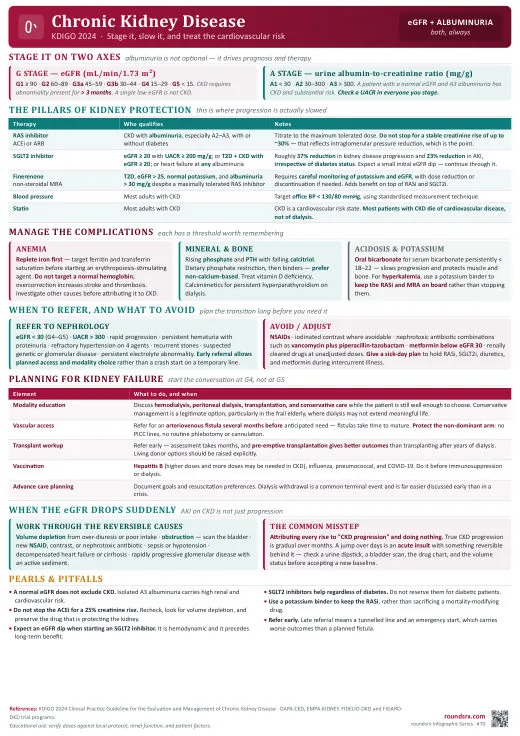
CKD is defined as abnormalities of kidney structure or function present for > 3 months with health implications. Requires either GFR < 60 mL/min/1.73m² OR markers of kidney damage (albuminuria, hematuria, structural abnormality, history of transplant) -or both. Classified by GFR stage (G1–G5) and albuminuria category (A1–A3).
GFR Staging (KDIGO)
| Stage | GFR (mL/min/1.73m²) | Description | Mortality Risk |
|---|---|---|---|
| G1 | ≥ 90 | Normal or high (with kidney damage markers) | Baseline |
| G2 | 60–89 | Mildly decreased | Slightly increased |
| G3a | 45–59 | Mild-moderately decreased | Moderately increased |
| G3b | 30–44 | Moderate-severely decreased | High |
| G4 | 15–29 | Severely decreased | Very high |
| G5 | < 15 | Kidney failure (ESKD) | Highest |
Albuminuria Categories
| Category | UACR (mg/g) | Description |
|---|---|---|
| A1 | < 30 | Normal to mildly increased |
| A2 | 30–300 | Moderately increased (microalbuminuria) |
| A3 | > 300 | Severely increased (macroalbuminuria) -high ESKD risk |
Both GFR and albuminuria independently predict progression and cardiovascular risk. A patient with G2 + A3 is higher risk than G3a + A1. Always classify both.
Etiology (Most Common → Least)
| Cause | % of ESKD | Key Features |
|---|---|---|
| Diabetes mellitus | ~45% | Most common cause worldwide. Nodular glomerulosclerosis (Kimmelstiel-Wilson). Progressive albuminuria → nephrotic range. |
| Hypertension | ~28% | Hypertensive nephrosclerosis. Arteriolar thickening → ischemic nephron loss. Often coexists with DM. |
| Glomerulonephritis | ~8% | IgA nephropathy (most common GN globally), FSGS, membranous, lupus nephritis. Active sediment (RBC casts). |
| Polycystic kidney disease (ADPKD) | ~5% | Autosomal dominant. Bilateral enlarged cystic kidneys on imaging. Family history. Tolvaptan slows progression TEMPO 3:3, 2012. |
| Other | ~14% | Reflux nephropathy, obstructive uropathy, interstitial nephritis, amyloidosis, myeloma kidney, sickle cell. |
Pathophysiology
Regardless of cause, CKD follows a common final pathway: initial injury → nephron loss → compensatory hyperfiltration in remaining nephrons → glomerular hypertension → progressive glomerulosclerosis → further nephron loss → cycle continues. RAAS activation drives this cycle -which is why ACEi/ARBs are foundational therapy. SGLT2 inhibitors reduce intraglomerular pressure by restoring tubuloglomerular feedback (constricting the afferent arteriole).
Key concept: After ~50% nephron loss, progression becomes self-sustaining even if the original insult is removed. This is why early intervention (BP control, RAAS blockade, SGLT2i) is critical -you're trying to break the hyperfiltration cycle before it becomes irreversible.
Presentation
- Early (G1–G3a): Usually asymptomatic. Detected incidentally on labs (elevated Cr, proteinuria on UA).
- Moderate (G3b–G4): Fatigue, nocturia (loss of concentrating ability), mild edema, anemia symptoms, pruritus.
- Severe (G5 / ESKD): Uremic symptoms -nausea, anorexia, metallic taste, asterixis, encephalopathy, pericarditis, bleeding diathesis (platelet dysfunction), volume overload, Kussmaul breathing (acidosis).
Uremic emergency: Uremic pericarditis (friction rub), uremic encephalopathy (asterixis, seizures), or refractory volume overload → emergent dialysis indication (AEIOU mnemonic from AKI topic).
🧪 Workup & Diagnosis
Diagnostic Workup
| Test | Purpose |
|---|---|
| BMP (Cr, BUN) | Calculate eGFR (CKD-EPI 2021). Two values ≥ 3 months apart confirm chronicity. |
| Urinalysis with micro | Proteinuria, hematuria, casts. Active sediment (RBC casts) → GN. Bland sediment → DM/HTN nephrosclerosis. |
| UACR (spot urine) | Quantify albuminuria. Most important prognostic marker. Repeat × 2 to confirm (transient proteinuria is common). |
| Renal ultrasound | Kidney size (small bilateral = chronic), echogenicity (increased = fibrosis), cysts (ADPKD), hydronephrosis (obstruction). |
| CBC | Anemia of CKD (normocytic, normochromic). EPO deficiency begins at G3. |
| Ca²⁺, PO₄, PTH, Vitamin D (25-OH) | CKD-MBD evaluation. Start monitoring at G3a. Expect: ↓ Ca, ↑ PO₄, ↑ PTH, ↓ Vit D. |
| Iron studies (ferritin, TSAT) | Iron deficiency is common and must be corrected before EPO agents. Target: ferritin > 100, TSAT > 20%. |
| Lipid panel | CVD risk assessment. CKD is a coronary risk equivalent. |
| HbA1c | Glycemic control if diabetic. Note: HbA1c is unreliable in ESKD (shortened RBC lifespan, EPO use). |
| Hepatitis B/C, HIV | Screen all CKD patients. Hep B vaccination if non-immune (double dose in CKD). |
When to Pursue Etiology
- Active urine sediment (RBC casts, dysmorphic RBCs) → glomerulonephritis workup: complement levels (C3/C4), ANA, anti-dsDNA, ANCA, anti-GBM, SPEP/UPEP, hepatitis serologies
- Nephrotic-range proteinuria (> 3.5 g/day) without DM → consider renal biopsy
- Rapidly declining GFR (> 5 mL/min/year) → urgent nephrology referral + biopsy
- Family history of kidney disease → ADPKD (US), Alport syndrome (genetic testing)
- Young patient with CKD → always pursue cause (GN, reflux, congenital)
Small bilateral kidneys (< 9 cm) on US = chronic, irreversible. Biopsy is usually not helpful at this stage -insufficient tissue. Exceptions: normal-sized kidneys in CKD (think DM nephropathy, amyloid, ADPKD, HIV nephropathy).
🚨 Management
▶ How to Manage CKD Stage by Stage (tap to expand)
Two parallel tracks at every stage: (1) Slow progression with the Big 4 (BP control, ACEi/ARB, SGLT2i, finerenone if diabetic), (2) Manage complications as nephron loss accumulates (anemia, bone-mineral, acidosis, K+, fluid). KDIGO 2024 added finerenone as a 4th pillar in diabetic CKD with albuminuria and pushed the SGLT2i threshold to eGFR 20.
Step 1: Confirm CKD and stage by GFR + albuminuria
| Check | What | Why |
|---|---|---|
| Confirm chronicity | Two abnormal values (eGFR < 60 or albuminuria) ≥ 3 months apart | A single abnormal BMP could be AKI, dehydration, or contrast. CKD requires chronicity by definition. |
| Stage by GFR + UACR | Use the "heat map": G1-G5 × A1-A3. A patient with G2A3 is higher risk than G3aA1. | Both axes independently predict ESKD and CV mortality. Staging by GFR alone undercalls risk. |
| Identify etiology | BMP, UACR, UA with micro, renal US; pursue further if active sediment, nephrotic proteinuria, rapid decline, young patient, or family hx | ~45% DM, ~28% HTN, ~8% GN, ~5% ADPKD. Etiology drives some choices (e.g., tolvaptan for rapid ADPKD, immunosuppression for GN). |
Step 2: Universal interventions for every CKD patient
| Pillar | How | Why |
|---|---|---|
| BP control | Target < 130/80 (< 120/80 if proteinuric per KDIGO 2024) | SPRINT and post-hoc CKD subgroup: intensive control reduces mortality without harming kidney function. BP > 130 accelerates progression and CV death. |
| ACEi or ARB | Maximally titrated to BP target; required if UACR ≥ 30 (A2 or A3) or proteinuric of any cause | Reduces intraglomerular pressure → slows progression and lowers proteinuria 30-50%. RENAAL, IDNT in diabetic CKD; AASK in hypertensive CKD even in Black patients. Expect Cr rise 10-30%, that's hemodynamic, not injury; only stop if > 30% or K+ > 5.5. |
| SGLT2 inhibitor | Dapagliflozin 10 mg or empagliflozin 10 mg daily; initiate down to eGFR 20, continue until dialysis | DAPA-CKD (2020): 39% reduction in CKD progression. EMPA-KIDNEY (2022): 28% reduction. Benefit independent of diabetes. Expect 3-5 mL/min initial eGFR dip, reverses. |
| Finerenone (if diabetic + albuminuria) | 10 mg daily (20 mg if K+ stable and eGFR ≥ 60); ADD to ACEi/ARB + SGLT2i, don't replace | FIDELIO-DKD (2020): 18% reduction in CKD progression. FIGARO-DKD (2021): 13% reduction in CV death/MACE. Non-steroidal MRA, less gynecomastia and less hyperkalemia than spironolactone. Class I in KDIGO 2024 for diabetic CKD. |
| Lifestyle | Sodium < 2 g/day, protein 0.6-0.8 g/kg/day (Stage 3+), smoking cessation, weight loss | Each independently slows progression. Don't restrict protein below 0.6 g/kg (sarcopenia risk). |
| CV risk reduction | Statin for all CKD G3-G5 not on dialysis (SHARP); ASA if established ASCVD; A1c < 7% if young, < 8% if frail/elderly | CKD is a CAD risk equivalent. Most CKD patients die of CV disease, not progress to ESKD. |
Step 3: Stage-specific add-ons
| Stage | What's New This Stage | Why |
|---|---|---|
| G1-G2 (eGFR ≥ 60) | Treat etiology, optimize Big 4, reassess every 6-12 months | Most patients are asymptomatic; the window for slowing progression is widest here. Don't wait for symptoms. |
| G3a (45-59) | Add CKD-MBD labs (Ca, PO4, PTH, 25-OH Vit D), anemia screening (CBC, iron studies), vaccines (Hep B, pneumococcal, COVID, flu, RSV, Shingrix) | EPO production drops at G3a. PTH starts rising. Hep B vaccination needs the higher CKD dosing (double dose) and works best while eGFR is still high. |
| G3b (30-44) | Nephrology referral if not already; start discussing future kidney replacement options; avoid nephrotoxins; review medication renal dosing | Two-year median to ESKD if eGFR declines > 3 mL/min/yr at this stage. Referral late is the #1 reason patients arrive at ESKD without a transplant or fistula plan. |
| G4 (15-29) | Kidney replacement therapy education (HD/PD/transplant). Pre-emptive transplant evaluation if eGFR < 20. Vascular surgery referral for AVF/AVG planning at eGFR ~20. | AVF maturation takes 3-6 months; placing it < 6 months before dialysis means starting with a catheter (higher infection/mortality). Pre-emptive transplant has better outcomes than transplant after dialysis start. |
| G5 (< 15) | Initiate KRT when uremic (not by GFR alone), or palliative pathway if appropriate; complete transplant workup if not done | IDEAL (2010): early-start dialysis offered no benefit over symptom-driven start. Don't initiate by number alone, watch for AEIOU indications. |
Step 4: Manage complications as they appear
| Complication | Threshold to Act | How |
|---|---|---|
| Anemia of CKD | Hb < 10 g/dL | Iron first (target ferritin > 100, TSAT > 20%). Then ESA (epoetin alfa, darbepoetin) targeting Hb 10-11.5 (NOT > 12, increased CV events in TREAT, CHOIR). Consider HIF-PHI (daprodustat) as oral alternative. |
| CKD-MBD | PO4 > 4.5, PTH > 2-9× upper limit, low 25-OH D | Dietary phosphate restriction → phosphate binders (sevelamer or lanthanum first; avoid Ca-based if vascular calcification). Vit D analogs (calcitriol or cinacalcet) for secondary hyperparathyroidism. |
| Metabolic acidosis | HCO3 < 22 | Sodium bicarbonate 650 mg PO TID, target HCO3 ≥ 22. Slows progression (UBI, 2014). Veverimer if available. |
| Hyperkalemia | K+ > 5.5 limiting RAAS | Patiromer or SZC to preserve RAAS rather than discontinue it (DIAMOND, AMBER). Diet education, avoid NSAIDs. |
| Volume overload | Edema, weight gain, dyspnea | Loop diuretic (furosemide, torsemide); often needs higher doses as eGFR falls. Sodium restriction. |
| Uremic symptoms | Nausea, pruritus, asterixis, encephalopathy, pericarditis | Indication to initiate dialysis (AEIOU). Pruritus: gabapentin or difelikefalin (kappa-opioid agonist, FDA-approved 2021). |
Step 5: KRT preparation in G4-G5
| Modality | When to Choose | Why |
|---|---|---|
| Pre-emptive kidney transplant | eGFR < 20, no exclusions; refer to transplant center for evaluation | Best long-term outcomes, lowest mortality. Pre-emptive (before dialysis) is better than post-dialysis. Living donor preferred over deceased. |
| Hemodialysis (HD) | Patient preference, in-center 3×/wk; home HD for some | Highest "rescue" capability for fluid/K+. AVF preferred over AVG over catheter (infection risk catheter >> graft > fistula). |
| Peritoneal dialysis (PD) | Patient preference, home-based, daily exchanges or cycler at night | Preserves residual kidney function longer, no vascular access needed, more lifestyle flexibility. Not for patients with prior abdominal surgery/adhesions. |
| Conservative / palliative | Frail elderly, dementia, multiple comorbidities where dialysis won't extend or improve quality of life | In octogenarians with multiple comorbidities, dialysis often doesn't extend life and worsens QoL. Honest conversations early. |
Shortcuts that override the ladder
| Scenario | Do This | Why |
|---|---|---|
| Cr rise > 30% on ACEi/ARB | Hold RAAS; screen for bilateral renal artery stenosis (renal duplex, MRA) | RAS unmasks itself when ACEi/ARB drops perfusion to the post-stenotic kidney. Don't just reflexively stop and move on. |
| Hyperkalemia on RAAS or finerenone | Try patiromer or SZC first; only stop the renoprotective drug if binders fail | RAAS-blockade and finerenone slow progression. Mortality and ESKD benefit is lost if discontinued. K+ binders preserve the regimen. |
| ADPKD with rapid progression (eGFR drop > 3 mL/min/yr or significant TKV growth) | Tolvaptan (Jynarque); requires LFT monitoring | TEMPO 3:4 (2012) and REPRISE (2017): tolvaptan slowed eGFR decline and total kidney volume growth. Only disease-modifier in ADPKD. |
| Diabetic CKD with persistent albuminuria on ACEi+SGLT2i | Add finerenone (titrate based on K+ and eGFR) | FIDELIO-DKD/FIGARO-DKD: additive benefit on top of RAAS+SGLT2i. The 4th pillar for diabetic CKD. |
| Iodinated contrast in eGFR 30-44 | Pre/post hydration (isotonic saline 1-1.5 mL/kg/hr); hold metformin and SGLT2i 48 hr; don't withhold contrast if clinically necessary | Contrast-associated AKI risk in modern era is modest; outdated reflexes to avoid contrast can delay diagnosis. PRESERVE, 2018: NAC and bicarb didn't help; isotonic saline is what works. |
| Pregnancy + CKD | Switch ACEi/ARB to labetalol, nifedipine, or methyldopa; close OB-nephro co-management | ACEi/ARB are teratogenic (renal dysgenesis, oligohydramnios). SGLT2i and finerenone also avoided. Pregnancy itself can accelerate CKD; risk stratify by pre-pregnancy eGFR. |
| Acute illness / NPO / vomiting / contrast / sepsis | Hold "DRAMA" sick-day meds: Diuretics, RAAS, ARBs/ARNI, Metformin, Anti-inflammatories (NSAIDs); also hold SGLT2i | Volume contraction + these drugs = AKI. Resume once eating/drinking and Cr stable. |
| AKI on top of CKD | Look for reversible cause (volume, obstruction, nephrotoxin, contrast, infection) before assuming progression | ~30% of "CKD progression" is actually superimposed AKI that recovers. Treat the AKI; reassess baseline in 3 months. |
| Refractory albuminuria despite max ACEi+SGLT2i+finerenone | Confirm adherence; refer for biopsy (GN missed at diagnosis); consider GLP-1 RA (FLOW trial, semaglutide reduced kidney events 24%) | FLOW (2024): semaglutide in diabetic CKD reduced major kidney + CV events 24%. New addition to the toolbox. Biopsy uncovers treatable GN (IgA, FSGS, lupus) in some "diabetic CKD" patients. |
| "Bad-looking" eGFR in muscular or amputee patient | Use cystatin C-based eGFR (eGFRcr-cys is more accurate) | Creatinine is muscle-mass dependent; low muscle (amputee, elderly, sarcopenia) overestimates eGFR. Cystatin C is muscle-independent. 2021 CKD-EPI race-free equation also recommended. |
Cornerstone Therapies -Slow Progression
The "Big 4" that change CKD trajectory: BP control, ACEi/ARB, SGLT2 inhibitor, finerenone (if diabetic CKD). Every CKD patient with albuminuria should be on the first three.
1. BP Control
Target < 120/80 mmHg if proteinuria present SPRINT, 2015. Target < 130/80 for all CKD KDIGO, 2024. First-line: ACEi or ARB (dual RAAS blockade).
2. ACEi / ARB
Foundational therapy if albuminuria (A2 or A3). Reduces intraglomerular pressure, slows progression, reduces proteinuria 30–50%. RENAAL, 2001: losartan reduced ESKD by 28% in diabetic nephropathy. IDNT, 2001: irbesartan similar benefit. Do NOT combine ACEi + ARB ONTARGET, 2008: no additional benefit, increased hyperkalemia + AKI.
Expect Cr to rise 10–30% after initiation -this is acceptable and expected. Only hold if Cr rises > 30% or K⁺ > 5.5.
Expect Cr to rise 10–30% after initiation -this is acceptable and expected. Only hold if Cr rises > 30% or K⁺ > 5.5.
3. SGLT2 Inhibitor
Add to ACEi/ARB in all CKD with eGFR ≥ 20 and albuminuria. Benefit is independent of diabetes status.
DAPA-CKD, 2020: dapagliflozin reduced CKD progression by 39%. Trial stopped early for efficacy. Benefit in both diabetic and non-diabetic CKD.
EMPA-KIDNEY, 2022: empagliflozin reduced progression by 28%. Benefit down to eGFR 20.
Mechanism: restores tubuloglomerular feedback → constricts afferent arteriole → reduces intraglomerular pressure. Also natriuretic, reduces weight, lowers BP.
Expect initial eGFR dip of 3–5 mL/min (like ACEi) -this is hemodynamic, not injury. Do not stop.
DAPA-CKD, 2020: dapagliflozin reduced CKD progression by 39%. Trial stopped early for efficacy. Benefit in both diabetic and non-diabetic CKD.
EMPA-KIDNEY, 2022: empagliflozin reduced progression by 28%. Benefit down to eGFR 20.
Mechanism: restores tubuloglomerular feedback → constricts afferent arteriole → reduces intraglomerular pressure. Also natriuretic, reduces weight, lowers BP.
Expect initial eGFR dip of 3–5 mL/min (like ACEi) -this is hemodynamic, not injury. Do not stop.
4. Finerenone (Kerendia)
Add in diabetic CKD with persistent albuminuria despite ACEi/ARB + SGLT2i.
FIDELIO-DKD, 2020: 18% reduction in kidney composite endpoint. FIGARO-DKD, 2021: 13% reduction in CV composite.
Non-steroidal MRA -less hyperkalemia than spironolactone. Requires K⁺ < 5.0 and eGFR ≥ 25 to initiate. Monitor K⁺ within 4 weeks.
FIDELIO-DKD, 2020: 18% reduction in kidney composite endpoint. FIGARO-DKD, 2021: 13% reduction in CV composite.
Non-steroidal MRA -less hyperkalemia than spironolactone. Requires K⁺ < 5.0 and eGFR ≥ 25 to initiate. Monitor K⁺ within 4 weeks.
Lifestyle & Supportive
- Dietary sodium restriction -< 2g/day. Enhances efficacy of RAAS blockade and reduces edema/HTN.
- Protein intake -0.8 g/kg/day in G3–G5 (not on dialysis). Excessive protein accelerates hyperfiltration.
- Glycemic control (DM) -HbA1c < 7% (individualize in elderly/frail). SGLT2i counts toward this.
- Smoking cessation -smoking accelerates CKD progression and CV risk.
- Statin therapy -CKD is a coronary risk equivalent. Statin for all G3–G5 not on dialysis SHARP, 2011: simvastatin/ezetimibe reduced major atherosclerotic events by 17%.
- Avoid nephrotoxins -NSAIDs, aminoglycosides, IV contrast (pre-hydrate if essential), herbal supplements.
- Vaccinations -Hepatitis B (double dose: 40 mcg), influenza annually, pneumococcal (PCV20 or PCV15 + PPSV23), COVID-19.
⚠️ Complications
CKD-Mineral Bone Disease (CKD-MBD)
Begins at G3. The kidneys fail to excrete phosphate and activate vitamin D → hyperphosphatemia → hypocalcemia → secondary hyperparathyroidism → renal osteodystrophy → vascular calcification → cardiovascular death.
| Parameter | CKD G3–G4 | CKD G5 / Dialysis | Treatment |
|---|---|---|---|
| Phosphate | Keep in normal range | Target 3.5–5.5 mg/dL | Dietary restriction → phosphate binders: sevelamer (Renvela), calcium acetate (PhosLo), lanthanum (Fosrenol) |
| Calcium | Maintain normal | Avoid hypercalcemia | Avoid calcium-based binders if hypercalcemic. Calcitriol (Rocaltrol) or paricalcitol (Zemplar) for active vitamin D. |
| PTH | Trend -no target | 2–9× upper normal | Calcitriol, cinacalcet (Sensipar), or parathyroidectomy if refractory. |
| Vitamin D (25-OH) | Replete if < 30 ng/mL | Replete | Ergocalciferol or cholecalciferol (inactive form) for deficiency. Active forms for secondary hyperPTH. |
Anemia of CKD
EPO production drops as renal mass decreases (begins G3). Results in normocytic, normochromic anemia. Always rule out iron deficiency first.
| Step | Action | Target |
|---|---|---|
| 1. Iron first | IV iron (ferric carboxymaltose or iron sucrose) if ferritin < 100 or TSAT < 20% | Ferritin 200–500, TSAT 20–30% |
| 2. ESA if needed | Epoetin alfa (Epogen/Procrit) or darbepoetin (Aranesp). Start if Hgb < 10 after iron repletion. | Hgb 10–11.5 g/dL. Do NOT target > 13 TREAT, 2009: ↑ stroke risk. CHOIR, 2006: ↑ CV events. |
| 3. HIF-PHI (newer) | Roxadustat (Evrenzo) -oral HIF-prolyl hydroxylase inhibitor. Stimulates endogenous EPO. | Alternative to injectable ESAs. Approved in CKD + dialysis. |
Never target Hgb > 13 g/dL with ESAs. TREAT, 2009: doubled stroke risk. CHOIR, 2006: increased CV events. CREATE, 2006: no benefit. Target 10–11.5 only.
Metabolic Acidosis
Impaired ammonium excretion → non-anion-gap metabolic acidosis (early) or anion-gap (late, from retained uremic toxins). Acidosis accelerates CKD progression, worsens bone disease, and promotes muscle wasting.
- Target serum bicarb ≥ 22 mEq/L
- Sodium bicarbonate tablets 650–1300 mg PO TID (1–3 mEq/kg/day)
- Bicarb CKD Progression Trial, 2010: bicarb supplementation slowed CKD progression by 60%
Other Complications
- Hyperkalemia -from impaired K⁺ excretion + ACEi/ARB/MRA. Manage with dietary restriction, patiromer (Veltassa), sodium zirconium cyclosilicate (Lokelma). Do NOT stop ACEi/ARB unless K⁺ > 5.5 persistently.
- Volume overload / edema -loop diuretics (furosemide). Dose escalation needed as GFR declines. Thiazides lose efficacy below GFR 30 (exception: metolazone for synergy).
- Cardiovascular disease -#1 cause of death in CKD. CKD is a coronary risk equivalent. Statin for all SHARP, 2011. Manage HTN aggressively.
- Uremic pruritus -gabapentin (renal dose), emollients, UVB phototherapy, difelikefalin (Korsuva) for dialysis patients.
- Uremic platelet dysfunction -prolonged bleeding time despite normal PT/INR. Treat with desmopressin (DDAVP) 0.3 mcg/kg IV for acute procedures. Conjugated estrogens for sustained effect.
💊 Medications
CKD-Specific Medications
| Drug (Brand) | Class | Dose | Indication | Key Points |
|---|---|---|---|---|
| Dapagliflozin (Farxiga) 1ST LINE | SGLT2i | 10 mg PO daily | CKD with eGFR ≥ 20 + albuminuria | DAPA-CKD, 2020. DM and non-DM. Do not initiate < 20. |
| Empagliflozin (Jardiance) 1ST LINE | SGLT2i | 10 mg PO daily | CKD with eGFR ≥ 20 | EMPA-KIDNEY, 2022. Benefits down to eGFR 20. |
| Finerenone (Kerendia) ADD-ON | Non-steroidal MRA | 10–20 mg PO daily | Diabetic CKD with albuminuria despite ACEi/ARB | FIDELIO-DKD, 2020. Requires K⁺ < 5.0 to start. Monitor K⁺ at 4 wks. |
| Sevelamer (Renvela) PREFERRED | Phosphate binder | 800–1600 mg with meals | Hyperphosphatemia (G4–G5) | Non-calcium binder. Preferred over calcium-based binders to avoid vascular calcification. |
| Calcitriol (Rocaltrol) | Active vitamin D | 0.25–0.5 mcg PO daily | Secondary hyperparathyroidism | Monitor Ca²⁺ (risk of hypercalcemia). Alternative: paricalcitol (Zemplar) -less hypercalcemia. |
| Cinacalcet (Sensipar) | Calcimimetic | 30–180 mg PO daily | Secondary hyperPTH on dialysis | Activates CaSR on parathyroid → suppresses PTH. GI side effects common. |
| Epoetin alfa (Epogen) AFTER IRON | ESA | 50–300 units/kg 3×/week IV/SC | Anemia of CKD (Hgb < 10) | Iron-replete first. Target Hgb 10–11.5. Never > 13 TREAT, 2009. |
| Darbepoetin (Aranesp) | ESA (long-acting) | 0.45 mcg/kg q2 weeks or monthly | Anemia of CKD | Less frequent dosing than epoetin. Same Hgb target. |
| Sodium bicarbonate | Alkali | 650–1300 mg PO TID | Metabolic acidosis (bicarb < 22) | Slows CKD progression. Watch for volume overload (Na⁺ content). |
| Patiromer (Veltassa) ADJUNCT | K⁺ binder | 8.4–25.2 g PO daily | Chronic hyperkalemia on RAAS blockade | Allows continuation of ACEi/ARB/MRA. Takes hours to work -not for acute hyperK. |
Drug Dosing in Renal Impairment
Renal impairment changes a drug in one of three ways: it becomes unsafe (stop or avoid), it accumulates (reduce the dose or extend the interval), or it needs level-guided dosing. Most drug labels use Cockcroft-Gault creatinine clearance (CrCl calculator), not eGFR, the two diverge at extremes of body size, so dose by CrCl and stage by eGFR. In AKI, kidney function is a moving target, assume the worst, dose conservatively, and recheck daily. Thresholds below are starting points, confirm against the current label for any unfamiliar drug.
1. Stop or avoid (highest-yield list)
| Drug | Threshold | Why | Use instead |
|---|---|---|---|
| NSAIDs | Avoid eGFR < 30; avoid prolonged use 30–59 | Afferent arteriolar vasoconstriction drops GFR → AKI, hyperkalemia, fluid retention, blunted antihypertensives, faster CKD progression. | Acetaminophen first-line; topical NSAID for localized pain; short low-dose course only if unavoidable. |
| Metformin | Contraindicated < 30; do not start < 45; if 30–44 cap at 1000 mg/day | Accumulation raises lactic acidosis risk. Also hold around iodinated contrast and acute illness. | SGLT2i or GLP-1 RA (also organ-protective); linagliptin if a gliptin is wanted. |
| Nitrofurantoin | Avoid CrCl < 30 | Low GFR gives inadequate urinary drug levels (treatment failure) plus systemic accumulation and pulmonary/neuro toxicity. Short courses only above 30. | For cystitis: cephalexin or amoxicillin-clavulanate (dose-adjusted); TMP-SMX if CrCl > 30. |
| Glyburide (sulfonylurea) | Avoid in advanced CKD | Renally cleared active metabolites cause prolonged, dangerous hypoglycemia. | Glipizide (hepatic metabolism) if a sulfonylurea is needed; better, an SGLT2i or DPP-4i. |
| Spironolactone / eplerenone | Caution eGFR 30–45; avoid < 30 | Impaired potassium excretion → hyperkalemia. If used at 30–50, start 25 mg every other day and recheck K⁺. | For diabetic CKD, finerenone (still monitor K⁺); for HTN, a thiazide-like or loop diuretic. |
| IV bisphosphonates (zoledronate) | Avoid eGFR < 30–35 | Dose- and infusion-rate-dependent nephrotoxicity (acute tubular injury). | Denosumab (not renally cleared, no dose adjustment), but watch for hypocalcemia and replete Ca / vitamin D. |
| Sotalol | Avoid in advanced renal failure | Renally cleared; accumulation prolongs QT → torsades. | Amiodarone (hepatic clearance) for rhythm; metoprolol or diltiazem for rate control. |
| Gadolinium (group I agents) | Avoid eGFR < 30 and dialysis | Nephrogenic systemic fibrosis. | Newer group II gadolinium agent (NSF risk near zero), lowest dose; or non-contrast MRI. |
2. Antibiotics (adjust or monitor)
| Drug | What to do | Why | Use instead |
|---|---|---|---|
| Vancomycin | Dose by AUC/levels, extend the interval as CrCl falls | Renally cleared and itself nephrotoxic. Trough/AUC-guided dosing prevents both under-treatment and AKI. | If AKI or level problems: linezolid or daptomycin for MRSA (no renal efficacy penalty; daptomycin interval extended). |
| Aminoglycosides (gentamicin, tobramycin) | Extend interval, monitor troughs, avoid if an alternative exists | Nephrotoxic (ATN) and ototoxic; toxicity rises with accumulation. | An anti-pseudomonal beta-lactam (cefepime, pip-tazo, meropenem, all dose-adjusted) per susceptibility. |
| Cefepime | Reduce dose per CrCl | Neurotoxicity (encephalopathy, myoclonus, nonconvulsive status epilepticus); ~85% of cases occur in renal impairment without dose adjustment. | Dose-adjust rather than swap; if neurotoxicity occurs, switch to meropenem or pip-tazo (also adjusted). |
| Piperacillin-tazobactam | Reduce per CrCl | Observational data long suggested additive AKI when paired with vancomycin, but the only randomized trial ACORN, 2023 found no difference in its primary AKI/death endpoint. Do not withhold pip-tazo on renal grounds alone. | Use AUC-guided vancomycin and monitor renal function either way. If you do prefer cefepime, prefer it for anaerobic sparing, and remember cefepime neurotoxicity accumulates in CKD. |
| Carbapenems (meropenem, imipenem) | Reduce per CrCl | Accumulation lowers the seizure threshold (imipenem most). Also lowers valproate levels. | Meropenem over imipenem (lower seizure risk); dose-adjust rather than swap class if carbapenem is indicated. |
| Fluoroquinolones | Levofloxacin reduce CrCl < 50; ciprofloxacin < 30 | Accumulation → QT prolongation, CNS effects, tendinopathy. | Moxifloxacin (no renal adjustment, hepatic) where the spectrum fits; otherwise a beta-lactam per organism. |
| TMP-SMX | Reduce dose CrCl < 30 | Trimethoprim blocks ENaC (hyperkalemia) and tubular creatinine secretion (a pseudo-rise in Cr, not true AKI). Distinguish before stopping. | Indication-dependent (no universal swap); for UTI use cephalexin, for PJP the dose is reduced rather than substituted. |
| Acyclovir / valacyclovir | Reduce per CrCl, hydrate, infuse IV slowly | Crystal nephropathy and neurotoxicity (confusion, myoclonus) when not adjusted. | Dose-adjust and hydrate rather than swap; valacyclovir PO over IV acyclovir when oral therapy is appropriate. |
3. Anticoagulants
Listed preferred-first. Apixaban is the DOAC of choice in CKD because it is the least renally cleared (~27%); rivaroxaban follows directly to make the contrast obvious (~36% renal, so it is dose-reduced earlier and avoided sooner). Dabigatran is the most kidney-dependent and the first to drop off.
| Drug | Threshold / action | Why | Use instead |
|---|---|---|---|
| Apixaban PREFERRED DOAC | Reduce to 2.5 mg BID if 2 of 3: age ≥ 80, weight ≤ 60 kg, Cr ≥ 1.5 | Least renally cleared DOAC (~27%), most usable in advanced CKD. Use in dialysis remains debated but it is the DOAC of choice when one is used. | This is the preferred alternative; if a DOAC is unsuitable, warfarin (INR-titrated) remains usable at any GFR. |
| Rivaroxaban | AFib CrCl 15–50 → 15 mg daily; avoid < 15 | More renally cleared than apixaban (~36%), so it accumulates sooner → bleeding. Same Xa-inhibitor class, but apixaban is preferred as function falls. | Apixaban (or warfarin) below CrCl 15. |
| Dabigatran | 75 mg BID if CrCl 15–30; avoid < 30 (contraindicated < 15) | ~80% renal clearance, the most kidney-dependent DOAC, so bleeding climbs fastest as function falls. | Apixaban (or warfarin) below CrCl 30. |
| Edoxaban | Reduce if CrCl 15–50; avoid if CrCl > 95 or < 15 | The > 95 paradox: it under-protects against stroke at high clearance, a classic exam point. | Apixaban or rivaroxaban if CrCl > 95; apixaban/warfarin if < 15. |
| Enoxaparin | Treatment dose 1 mg/kg once daily (not BID) if CrCl < 30; consider anti-Xa monitoring | Renal accumulation → bleeding. | IV unfractionated heparin (titratable, reversible, not renally cleared) in severe renal failure. |
4. Diabetes agents
| Drug | Threshold / action | Why | Use instead |
|---|---|---|---|
| SGLT2 inhibitors (dapa/empa) | Initiate eGFR ≥ 20 (empagliflozin) or ≥ 25 (dapagliflozin); continue until dialysis | Glucose-lowering fades below ~45, but renal and CV protection persists, so keep them on for the kidney benefit, not the sugar. | Below the initiation threshold, add a GLP-1 RA or linagliptin for glycemic control. |
| Sulfonylureas | Prefer glipizide; avoid glyburide | Glipizide is hepatically metabolized; glyburide has renally cleared active metabolites causing prolonged hypoglycemia. | Glipizide; or shift to an SGLT2i, GLP-1 RA, or linagliptin. |
| Insulin | Reduce total daily dose as eGFR falls | The kidney clears insulin; less clearance means longer action and more hypoglycemia. | Same agent, lower dose; favor titratable basal-bolus over fixed mixes for safety. |
| DPP-4 inhibitors | Reduce sitagliptin/saxagliptin; linagliptin needs no adjustment | Linagliptin is biliary/hepatically cleared, the go-to gliptin in CKD. | Linagliptin (no renal dose adjustment). |
| GLP-1 agonists | Generally no dose change | Watch for volume depletion from GI losses (nausea, vomiting), which can precipitate prerenal AKI. | No swap needed; hydrate and titrate slowly. A preferred class in CKD. |
5. Cardiovascular
| Drug | What to do | Why | Use instead |
|---|---|---|---|
| Digoxin | Reduce dose, monitor levels | Narrow therapeutic index and renally cleared; toxicity is worsened by the hypokalemia and hypomagnesemia common in CKD. | For rate control, a beta-blocker or non-DHP calcium channel blocker instead. |
| Atenolol, nadolol, sotalol | Accumulate as CrCl falls | Renally cleared beta-blockers build up (bradycardia, heart block); the hepatically cleared ones are safer in CKD. | Metoprolol or carvedilol (hepatic clearance, no renal adjustment). |
| ACEi / ARB | Not dose-reduced, but expect a Cr rise ≤ 30% (acceptable) and watch K⁺; hold during AKI or acute illness (sick-day rule) | Efferent arteriolar dilation drops GFR slightly; only a Cr rise > 30% or hyperkalemia signals true harm. They remain renoprotective long-term. | No swap, they are renoprotective; if intolerant from hyperkalemia, add a K⁺ binder (patiromer) rather than stopping. |
| Rosuvastatin | Max 10 mg/day if eGFR < 30 | Higher systemic exposure in renal impairment raises myopathy/rhabdomyolysis risk. | Atorvastatin (hepatic/biliary clearance, no renal dose cap). |
6. Analgesia, neuro, and miscellaneous
| Drug | What to do | Why | Use instead |
|---|---|---|---|
| Gabapentin / pregabalin | Reduce ~50% if CrCl < 60; CKD4 (15–29) ~200–700 mg/day; CKD5 or HD 100–300 mg with a dose after dialysis | > 90% renal elimination, accumulation causes sedation, myoclonus, and falls, a very common inpatient error. | Reduce dose rather than swap; for neuropathic pain a tricyclic (nortriptyline) or duloxetine avoids renal accumulation. |
| Morphine, codeine | Avoid in advanced CKD | The active metabolite morphine-6-glucuronide is renally cleared and accumulates → sedation and respiratory depression. | Hydromorphone or fentanyl (fentanyl is the safest opioid in renal failure). |
| Tramadol | Reduce dose | Metabolite accumulation plus a lowered seizure threshold. | Fentanyl or low-dose hydromorphone for opioid-requiring pain. |
| Allopurinol | Start low (50–100 mg), titrate to the urate target with monitoring | The active metabolite oxypurinol accumulates and can trigger allopurinol hypersensitivity syndrome (DRESS, SJS/TEN). Slow titration, not a fixed low cap, is current practice. | Febuxostat (hepatic metabolism, no renal dose adjustment); note the CARES CV-mortality signal, weigh in cardiac patients. |
| Colchicine | Reduce or avoid; never combine with a strong CYP3A4/P-gp inhibitor in renal failure | Accumulation → myoneuropathy and marrow suppression. | For acute gout, corticosteroids (oral or intra-articular); IL-1 inhibitor if refractory. |
| Lithium | Monitor levels closely, avoid volume depletion | Narrow index, renally cleared, and itself nephrotoxic (nephrogenic DI, chronic interstitial nephritis). | If nephrotoxicity develops, an alternative mood stabilizer (e.g., valproate, lamotrigine) in conjunction with psychiatry. |
| Iodinated contrast | Hydrate, minimize volume, hold metformin around the study | Contrast-associated AKI risk rises with lower baseline GFR. | Non-contrast CT/ultrasound, or MRI with a group II gadolinium agent, when feasible. |
🏥 Dialysis & Transplant
When to Start Dialysis
Mnemonic: AEIOU -Same as AKI. Initiate when medical management fails, not based on a GFR number alone.
| Indication | Details |
|---|---|
| A -Acidosis | Refractory metabolic acidosis despite oral bicarb |
| E -Electrolytes | Refractory hyperkalemia despite binders + dietary restriction |
| I -Intoxication | Uremic encephalopathy, uremic pericarditis (absolute indication) |
| O -Overload | Refractory volume overload despite max diuretics |
| U -Uremia | Symptomatic uremia (nausea, anorexia, asterixis, neuropathy) -typically GFR 5–10 |
Do NOT start dialysis based on GFR alone. IDEAL, 2010: early dialysis initiation (GFR 10–14) vs late (GFR 5–7) showed no survival benefit. Start for symptoms or complications, not a number.
Dialysis Modalities
| Modality | Access | Schedule | Best For | Disadvantages |
|---|---|---|---|---|
| Hemodialysis (HD) | AV fistula (best) > AV graft > tunneled catheter (worst) | 3×/week, 3–4 hrs/session | Most ESKD patients. Rapid solute/fluid removal. | Hemodynamic instability, vascular access complications, in-center schedule burden. |
| Peritoneal dialysis (PD) | Tenckhoff catheter (peritoneal) | Daily exchanges (CAPD) or nightly cycler (APD) | Patient autonomy, home-based, preserves residual renal function longer, better for hemodynamically fragile patients. | Peritonitis risk, protein loss, not ideal if prior abdominal surgery/hernias. |
| CRRT | Temporary dialysis catheter | Continuous (ICU only) | Hemodynamically unstable ICU patients (septic shock). Gentler fluid/solute removal. | ICU-only, resource intensive, requires anticoagulation of circuit. |
Access Planning
- AV fistula referral at eGFR ~20 (G4) -needs 2–3 months to mature before use. "Fistula first" approach.
- Protect the non-dominant arm -no blood draws, no IVs, no BP cuffs on the future fistula arm from G4 onwards.
- Avoid subclavian lines -causes subclavian stenosis, makes future fistula/graft on that side impossible. Use IJ if central access needed.
- Transplant evaluation -refer when GFR < 20. Pre-emptive transplant (before dialysis) has best outcomes. Living donor preferred.
BP target in ESRD: SBP, not MAP
For chronic dialysis BP management, follow SBP, not MAP. Vascular calcification widens pulse pressure in dialysis patients, so a "normal" MAP can hide a damaging SBP. Example: BP 180/60 gives MAP 100 (looks fine) but that 180 SBP is hammering the brain and heart every beat. KDOQI and KDIGO target SBP. Caveat: in acute settings (intra-dialytic crash, sepsis, peri-op), MAP still rules for organ perfusion.
📋 On Rounds
Pimp Questions
Why should you never combine ACEi + ARB in CKD?
ONTARGET, 2008: dual RAAS blockade (ramipril + telmisartan) vs either alone -no additional renal benefit, but significantly more hyperkalemia, hypotension, and acute kidney injury. Also: VA NEPHRON-D, 2013 stopped early for safety (losartan + lisinopril in diabetic nephropathy). Bottom line: one RAAS blocker is enough. If more antiproteinuric effect needed, add SGLT2i or finerenone.
Why does eGFR dip when you start an SGLT2 inhibitor?
SGLT2 inhibitors restore tubuloglomerular feedback -they increase sodium delivery to the macula densa, which signals afferent arteriolar constriction, reducing intraglomerular pressure. This is the therapeutic mechanism (same concept as ACEi reducing efferent tone). The initial eGFR dip of 3–5 mL/min reflects reduced hyperfiltration, not kidney injury. It stabilizes within weeks and long-term GFR slope is markedly better.
Why is HbA1c unreliable in ESKD?
Two reasons: (1) EPO/ESA therapy → increased reticulocyte production → younger RBCs → shorter glycation time → falsely LOW HbA1c. (2) Uremia → carbamylated hemoglobin → can interfere with some assays → falsely HIGH. Also, shortened RBC lifespan in ESKD (90 vs 120 days) → less glycation time. Alternative: use glycated albumin or fructosamine for glycemic monitoring in ESKD.
When should you refer for AV fistula creation?
At eGFR ~20 (CKD G4), or ~12 months before anticipated dialysis start. AV fistulas need 2–3 months to mature (some need 6 months). "Fistula first" -AVF has lowest infection rate, best long-term patency, and lowest mortality compared to grafts or catheters. Protect the non-dominant arm from G4 onwards (no IVs, no blood draws, no BP cuffs). Avoid subclavian central lines -causes stenosis that ruins ipsilateral fistula options.
Should you start dialysis early based on GFR alone?
No. IDEAL, 2010: randomized early start (eGFR 10–14) vs late start (eGFR 5–7) in 828 patients -no difference in mortality, CV events, infections, or quality of life. Early start just means more time on dialysis with no survival benefit. Start dialysis for symptoms (uremia, refractory volume overload, refractory hyperK, pericarditis) -not a number.
Clinical Examples
Case 1: CKD Stage 3b with Albuminuria
Presentation: 62M with T2DM and HTN. eGFR 38, UACR 450 mg/g, BP 134/82. Currently on Lisinopril (Prinivil) 40 mg daily.
Key Decisions:
- Add Dapagliflozin (Farxiga) 10 mg daily, DAPA-CKD, 2020 showed 39% reduction in CKD progression regardless of diabetes status
- Add Finerenone (Kerendia) 10–20 mg daily, FIDELIO-DKD, 2020 reduced CKD progression and CV events in diabetic kidney disease
- Expect initial eGFR dip of 3–5 mL/min after starting SGLT2i, this is the therapeutic mechanism (tubuloglomerular feedback), not injury. Continue if dip < 30% and stable.
- Monitor potassium at 2–4 weeks after starting finerenone (hold if K⁺ > 5.5 at initiation)
- Nephrology referral now, eGFR < 30 threshold approaching; early referral allows time for fistula planning if trajectory continues
Teaching point: SGLT2i + finerenone + ACEi/ARB triple combination is now guideline-supported for CKD with albuminuria and DM. Do NOT add ARB on top of ACEi (ONTARGET).
Case 2: CKD Stage 4, Pre-Dialysis Planning
Presentation: 75F with CKD G4. eGFR 18. Labs: bicarb 18, K⁺ 5.6, Hgb 9.2, PTH 310, PO₄ 5.4.
Active Problem List and Plan:
- Metabolic acidosis (bicarb 18): Start Sodium Bicarbonate 650 mg TID, target bicarb ≥ 22 (slows CKD progression per de Brito-Ashurst, 2009)
- Anemia (Hgb 9.2): Check iron studies first, replete iron (IV iron preferred if TSAT < 20%). If iron-replete, start Epoetin Alfa (Epogen) or Darbepoetin (Aranesp); target Hgb 10–11
- Hyperkalemia (K⁺ 5.6): Dietary potassium restriction + consider Patiromer (Veltassa) to allow continuation of RAAS blockade
- Secondary hyperPTH (PTH 310, PO₄ 5.4): Start phosphorus binder (e.g., Sevelamer (Renvela) 800 mg TID with meals)
- AV fistula referral, eGFR 18 means dialysis likely within 1–2 years; fistula needs 3–6 months to mature
- Modality discussion: Address HD vs PD vs transplant. Transplant eval at eGFR ~20. PD preferred if preserved residual function and self-care capable.
Teaching point: CKD G4 is a system, address all complications simultaneously. Do not defer anemia, acidosis, or MBD management while waiting for dialysis.
Case 3: Acute-on-Chronic Kidney Injury
Presentation: 55M with baseline CKD G3 (Cr 1.8). Admitted with Cr 4.2 after 5 days of ibuprofen for back pain + nausea/vomiting with poor PO intake.
Immediate Management:
- Hold nephrotoxins immediately: Stop all NSAIDs, hold ACEi/ARB, hold metformin (if applicable)
- IV fluids cautiously: NS or LR at 100–150 mL/hr to restore euvolemia, reassess frequently; avoid volume overload in underlying CKD
- Monitor closely: Daily BMP (K⁺, bicarb, Cr), urine output. Watch for hyperkalemia and need for emergent dialysis (AEIOU criteria)
- Trend creatinine: If Cr begins to fall within 48–72 hrs → AKI superimposed on CKD. If plateau or worsening → consider intrinsic AKI (NSAID-induced AIN) vs true CKD progression
- Renal recovery window: Do NOT restart ACEi/ARB until Cr returns to within 25% of baseline and patient euvolemic
- Distinguish AKI from CKD progression: True CKD progression requires eGFR decline > 5 mL/min/yr over ≥ 3 months, a single elevated Cr in an ill patient is not CKD progression
Teaching point: NSAIDs reduce prostaglandin-mediated afferent arteriolar dilation, in CKD, this causes acute hemodynamic AKI. This is the #1 avoidable AKI cause in CKD patients. Counsel all CKD patients to avoid NSAIDs absolutely.
Sample Presentation
📋 CKD -Outpatient Nephrology
"Mr. Patel is a 58-year-old man with Type 2 DM, HTN, and CKD Stage G3b-A3 (eGFR 38, UACR 820 mg/g). He is on lisinopril 40 mg daily, dapagliflozin 10 mg daily, and was recently started on finerenone 10 mg daily -K⁺ was 4.6 at 4-week check. His BP today is 128/76. Labs show Hgb 10.8, bicarb 21, Ca 8.9, PO₄ 4.8, PTH 128, 25-OH Vitamin D 18. Plan: start sodium bicarb 650 mg TID for acidosis, replete Vitamin D with ergocalciferol 50,000 units weekly × 8 weeks, recheck PTH/Ca/PO₄ in 3 months. AV fistula referral placed. Transplant evaluation in progress."
Monitoring Parameters -Chronic Kidney Disease
| Parameter | Frequency | Target / Action |
|---|---|---|
| eGFR and UACR | q3–6 months | Track progression rate. eGFR decline > 5 mL/min/year = rapid progression → reassess treatment, nephrology referral. UACR reduction with ACEi/ARB/SGLT2i = treatment working. |
| BMP (K+, bicarb, Ca, PO4) | q3–6 months (more often in G4–G5) | K+ < 5.5 (on RAAS blockade). Bicarb ≥ 22 (supplement if low). Ca/PO4 for CKD-MBD monitoring. |
| PTH | Annually (G3–G4), q3–6mo (G5/dialysis) | Rising PTH = secondary hyperparathyroidism → add phosphate binders, calcitriol, cinacalcet. Target 2–9x ULN on dialysis. |
| CBC (anemia) | q3–6 months | Hgb trending -anemia of CKD begins at G3. If Hgb < 10 → check iron studies → replete iron → then ESA if needed. |
| Iron studies (ferritin, TSAT) | q3–6 months | Ferritin > 100 (or > 200 on dialysis), TSAT > 20%. Iron-replete before starting ESA. |
| HbA1c (if diabetic) | q3 months | Target < 7% (individualize). Note: HbA1c unreliable in ESKD (shortened RBC lifespan, EPO use) -use fructosamine or CGM. |
| BP | Every visit + home monitoring | Target < 130/80 (KDIGO 2024). < 120/80 if tolerated with proteinuria SPRINT, 2015. |
| Lipids | Annually | CKD is a coronary risk equivalent. Statin for all G3–G5 not on dialysis. |
| Urinalysis | Annually | Monitor for active sediment (new hematuria, worsening proteinuria). |
| Hepatitis B/C screening | At diagnosis, then periodically | All CKD patients. Hep B vaccination if non-immune (double dose: 40 mcg). |
| Bone density (DEXA) | Consider in G3–G5 with fracture risk | CKD-MBD causes renal osteodystrophy. DEXA interpretation is complex in CKD -discuss with nephrology. |
CKD monitoring is a system. Every visit: BP, eGFR trend, UACR, K+, bicarb. Every 3–6 months: CBC, iron, Ca/PO4/PTH. Annually: lipids, HbA1c, UA, Hep B/C. Adjust medications based on trends, not single values.
Related Topics
Acid-Base DisordersCalciphylaxis (Calcific Uremic Arteriolopathy)Contrast-Induced NephropathyDialysis IndicationsHypernatremiaHyponatremia
⚡ Summary
Summary
Stage by Both GFR and Albuminuria
G1 to G5 by eGFR, A1 to A3 by urine albumin-to-creatinine ratio. Albuminuria is an independent predictor of progression and cardiovascular death, so staging on eGFR alone understates risk: a patient with a normal eGFR and an ACR above 300 is high risk. CKD requires abnormality persisting beyond 3 months, which is what separates it from AKI.
Four Interventions Slow Progression
RAAS blockade (ACE inhibitor or ARB) titrated to the maximum tolerated dose, an SGLT2 inhibitor, blood pressure control to a systolic below 120 where tolerated, and glycemic control in diabetes. SGLT2 inhibitors slow progression and reduce cardiovascular events regardless of diabetes status (DAPA-CKD, EMPA-KIDNEY), and they are now a cornerstone rather than a diabetes drug.
Expect and Tolerate the Creatinine Bump
A rise of up to about 30% after starting an ACE inhibitor, ARB or SGLT2 inhibitor is expected and reflects the intended hemodynamic effect. Do not stop the drug for it. Investigate a rise beyond 30%, which suggests volume depletion or bilateral renal artery stenosis. Recheck creatinine and potassium 1 to 2 weeks after any change.
Add Finerenone in Diabetic Kidney Disease
A non-steroidal MRA that reduces progression and cardiovascular events on top of RAAS blockade and an SGLT2 inhibitor (FIDELIO-DKD, FIGARO-DKD). Monitor potassium closely, since the combination of three agents that all raise it is where hyperkalemia becomes the limiting factor.
Treat the Complications as They Appear
Anemia: correct iron first, then an ESA targeting hemoglobin 10 to 11 g/dL, because higher targets increase stroke and thrombosis. Metabolic acidosis: bicarbonate to keep it above 22, which itself slows progression and preserves muscle. CKD-MBD: control phosphate with dietary restriction and binders, then vitamin D and a calcimimetic for hyperparathyroidism. Hyperkalemia: diet, diuretics and a potassium binder, so that the RAAS blocker can be continued.
Do Not Chase Every Number
Do not correct anemia to normal, do not normalize PTH, and do not treat mild asymptomatic hyperphosphatemia aggressively. Each of those instincts has been tested and each caused harm or no benefit. The targets in CKD are deliberately loose, and treating to a normal value is the commonest source of iatrogenic harm on this page.
Protect the Kidneys That Are Left
Avoid NSAIDs entirely, renally dose every drug, minimize contrast where a real alternative exists, and hold nephrotoxins during acute illness. Give sick-day guidance: hold the ACE inhibitor or ARB, the SGLT2 inhibitor, diuretics and metformin during vomiting, diarrhea or dehydration, since an AKI on CKD is what causes stepwise permanent loss.
Prepare for Replacement Before You Need It
Refer to nephrology at eGFR below 30, and start access planning at G4: a fistula needs months to mature, so a late referral means a catheter and its infection risk. Discuss hemodialysis, peritoneal dialysis, transplant and conservative management, and preserve the non-dominant arm veins by avoiding PICCs and unnecessary phlebotomy. Start dialysis for symptoms and complications, not for a number, since early initiation by eGFR alone does not improve outcomes (IDEAL).