Cirrhosis & Ascites
| Parameter | 1 Point | 2 Points | 3 Points |
|---|---|---|---|
| Bilirubin | < 2 | 2–3 | > 3 |
| Albumin | > 3.5 | 2.8–3.5 | < 2.8 |
| INR | < 1.7 | 1.7–2.3 | > 2.3 |
| Ascites | None | Mild (controlled) | Moderate-severe (refractory) |
| Encephalopathy | None | Grade I–II | Grade III–IV |
- MELD-Na = 3.78 × ln(bilirubin) + 11.2 × ln(INR) + 9.57 × ln(creatinine) + 1.32 × (137 − Na) − 0.025 × MELD + 6.43
- Used for transplant listing priority. Higher MELD = sicker = higher priority on the waitlist.
- MELD ≥ 15: transplant generally beneficial over medical management
- MELD ≥ 30: 3-month mortality > 50% without transplant
- Ascites -most common (see Ascites Management tab)
- Variceal hemorrhage -see Upper GI Bleed
- Hepatic encephalopathy -see Hepatic Encephalopathy
- SBP -see Spontaneous Bacterial Peritonitis
- Hepatorenal syndrome (HRS) -functional renal failure from splanchnic vasodilation
- Jaundice (bilirubin > 3 with liver failure)
| Send | Why |
|---|---|
| Cell count + differential | PMN ≥ 250/mm³ = SBP (treat immediately -don't wait for culture). This is the most important test. |
| Albumin | Calculate SAAG (serum albumin − ascites albumin). SAAG ≥ 1.1 = portal hypertension (cirrhosis, HF, Budd-Chiari). SAAG < 1.1 = non-portal (malignancy, TB, nephrotic, pancreatitis). |
| Total protein | Ascites protein < 1.5 g/dL = high risk for SBP → consider prophylaxis. |
| Culture (blood culture bottles at bedside) | Inoculate aerobic + anaerobic blood culture bottles with 10 mL each. Bedside inoculation ↑ yield from ~50% to ~80%. |
| Glucose, LDH, gram stain | If concerned for secondary peritonitis (perforation): glucose < 50, LDH > serum, polymicrobial → CT + surgery. |
- Functional renal failure -kidneys are structurally normal but underperfused due to splanchnic vasodilation + renal vasoconstriction
- HRS-AKI (Type 1): rapid Cr rise > 2× baseline in < 2 weeks. Median survival 2 weeks without treatment.
- HRS-CKD (Type 2): gradual, stable Cr elevation. Associated with refractory ascites.
- Diagnosis: no response to volume challenge (albumin 1 g/kg × 2 days), no shock, no nephrotoxins, no parenchymal disease on UA/imaging
- Treatment: Albumin 20–40 g/day + octreotide 200 mcg SC TID + midodrine 7.5–15 mg TID (splanchnic vasoconstrictors). Or norepinephrine drip in ICU (more effective). Definitive treatment: liver transplant. CONFIRM, 2021: terlipressin FDA-approved for HRS-AKI (improved renal function in ~30%).
| Setting | Management |
|---|---|
| No varices | EGD screening. Repeat in 2–3 years (compensated) or 1 year (decompensated). |
| Small varices, no red signs | NSBB (propranolol 20–40 mg BID or nadolol 20–40 mg daily or carvedilol 6.25–12.5 mg daily Bañares, 2002). Target HR reduction 25% or HR 55–60. |
| Medium/large varices | NSBB (carvedilol preferred) OR endoscopic variceal ligation (EVL). Both are first-line for primary prophylaxis. PREDESCI, 2019: NSBB in compensated cirrhosis with CSPH delayed decompensation. |
| Post-bleed (secondary prophylaxis) | NSBB + EVL (combination is superior to either alone) Lo, 2012. TIPS if rebleeding despite combo Early-TIPS, 2010. |
- CBC, BMP, LFTs, INR, albumin
- MELD-Na
- RUQ US + AFP q6mo -HCC screening
- EGD -variceal screening
- Paracentesis -new ascites or clinical change
- Hepatitis serologies
- Autoimmune/metabolic panel
- Ascites: Na restrict 2g/day + spiro/furosemide 100:40. LVP+albumin. TIPS if refractory.
- Varices: nadolol prophylaxis. Bleed: octreotide+ceftriaxone+banding.
- HE: lactulose+rifaximin. Find precipitant.
- SBP: ceftriaxone+albumin. Lifelong prophylaxis.
- HCC: US+AFP q6mo.
- Transplant: refer MELD≥15.
Patient: 58 y/o M with alcohol-related cirrhosis (Child-Pugh C, MELD-Na 22), presents with abdominal distension, fever 38.4°C, and diffuse abdominal pain.
Key findings: Tense ascites, shifting dullness. Paracentesis: PMN 680/mm³, SAAG 2.4. WBC 14K.
Management:
- Ceftriaxone 2g IV daily for SBP (PMN ≥ 250 = treat, do not wait for cultures)
- IV albumin 1.5 g/kg on day 1, 1 g/kg on day 3 Sort, 1999
- Therapeutic LVP + albumin 6-8g/L if > 5L removed Gines, 1988
- Lifelong SBP prophylaxis after resolution: norfloxacin or TMP-SMX
Teaching point: Any cirrhotic with fever, abdominal pain, or encephalopathy needs diagnostic paracentesis before antibiotics. PMN ≥ 250 = SBP regardless of culture result.
Patient: 62 y/o M with HCV cirrhosis, large-volume hematemesis. Known varices, not on beta-blocker prophylaxis.
Key findings: HR 128, BP 82/48, Hgb 6.2, INR 2.1, platelets 68K.
Management:
- Octreotide 50 mcg IV bolus then 50 mcg/hr (reduces portal pressure)
- Ceftriaxone 1g IV daily x7 days (antibiotics reduce mortality in variceal bleed)
- Restrictive transfusion: Hgb 7-8 (overtransfusion increases portal pressure)
- EGD within 12h for band ligation; nadolol for secondary prophylaxis
Teaching point: Do NOT correct INR with FFP, cirrhotic coagulopathy is rebalanced. FFP adds volume and worsens portal hypertension. Paracentesis is safe even with elevated INR.
Patient: 55 y/o F with NASH cirrhosis, MELD-Na 28, Cr rising 1.2 → 3.8 over 5 days despite albumin challenge.
Key findings: UNa < 10, bland sediment, renal US normal. Albumin 1.5 g/kg x2 days with no Cr improvement. FENa 0.2%.
Management:
- HRS type 1 (rapid Cr rise, no response to albumin volume challenge)
- Midodrine 7.5 mg TID + octreotide 100 mcg TID + albumin 25-50g daily
- If refractory: norepinephrine drip (ICU) or terlipressin CONFIRM, 2021
- Transplant evaluation, definitive treatment (> 80% mortality without transplant)
Teaching point: HRS is a diagnosis of exclusion. The albumin challenge (1.5 g/kg x2 days) is both diagnostic and therapeutic. Avoid NSAIDs, aminoglycosides, and ACEi/ARBs in all cirrhotics.
| Parameter | Frequency | Target / Action |
|---|---|---|
| Repeat paracentesis | At 48 hours | PMN should drop > 25% from baseline. If not improving → suspect resistant organism, secondary peritonitis, or wrong diagnosis. Broaden antibiotics and get CT abdomen. |
| BMP / Creatinine | Daily | HRS surveillance. Rising Cr despite albumin = hepatorenal syndrome → urgent nephrology + hepatology consult. Cr is the most important lab to trend. |
| Urine output | Strict I&Os | UOP < 0.5 mL/kg/hr or declining → early sign of HRS. Correlate with Cr trend. |
| Mental status | q4–8h | HE surveillance -SBP is the most common precipitant of hepatic encephalopathy. Worsening confusion → start/escalate lactulose. |
| Blood cultures | At diagnosis, repeat if persistent fever | Guide antibiotic narrowing once sensitivity data available. |
| Vitals | q4h | Fever curve, hemodynamics. Persistent fever > 72h on appropriate antibiotics → reconsider diagnosis. |
| Drug | Dose | Indication | Watch for |
|---|---|---|---|
| Lactulose 1ST LINE HE | 30 mL PO TID, titrated | Hepatic encephalopathy. Acidifies the colon so ammonia is trapped as ammonium and purged. | Titrate to 2 to 3 soft stools per day, not to a fixed dose. Overshooting causes dehydration and hypernatremia, which themselves precipitate encephalopathy. |
| Rifaximin | 550 mg PO BID | Added after a second episode of overt HE to prevent recurrence. | Minimal systemic absorption and well tolerated; cost is the main barrier. Used with lactulose, not instead of it. |
| Carvedilol (or propranolol, nadolol) | Carvedilol 6.25 mg daily, titrated | Non-selective beta-blockade for varices, primary and secondary prophylaxis. Carvedilol is generally preferred as it lowers portal pressure more. | Hold if systolic BP is below 90, in AKI, or in refractory ascites with hypotension, where NSBBs impair the compensatory response and worsen outcomes. |
| Spironolactone + furosemide | 100 mg : 40 mg, ratio maintained on uptitration | Ascites. Spironolactone is the backbone because the ascites is aldosterone-driven. | The ratio preserves potassium balance. Watch Na, K and creatinine. Stop diuretics in AKI, hyponatremia below 120, or encephalopathy. |
| Albumin 25% | 6 to 8 g per liter removed; 1.5 g/kg then 1 g/kg in SBP | After large-volume paracentesis over 5 L, in SBP, and as part of HRS treatment. | Prevents post-paracentesis circulatory dysfunction, and in SBP reduces renal failure and mortality. Give on day 1 and day 3 in SBP. |
| Ceftriaxone / cefotaxime | Ceftriaxone 1 to 2 g IV daily | SBP treatment, and short-course prophylaxis during variceal bleeding. | Diagnose SBP on an ascitic PMN count of 250 or more. Treat before the culture returns; cultures are negative in a substantial minority. |
| Octreotide | 50 mcg IV bolus, then 50 mcg/hr | Acute variceal bleeding, alongside antibiotics and endoscopy. | Splanchnic vasoconstriction reduces portal inflow. Continue for 3 to 5 days after control. |
| Terlipressin or midodrine + octreotide | With albumin in both cases | Hepatorenal syndrome (HRS-AKI). Terlipressin where available, otherwise midodrine plus octreotide. | Terlipressin carries a real risk of ischemic and respiratory complications; select patients carefully and monitor oxygenation. |
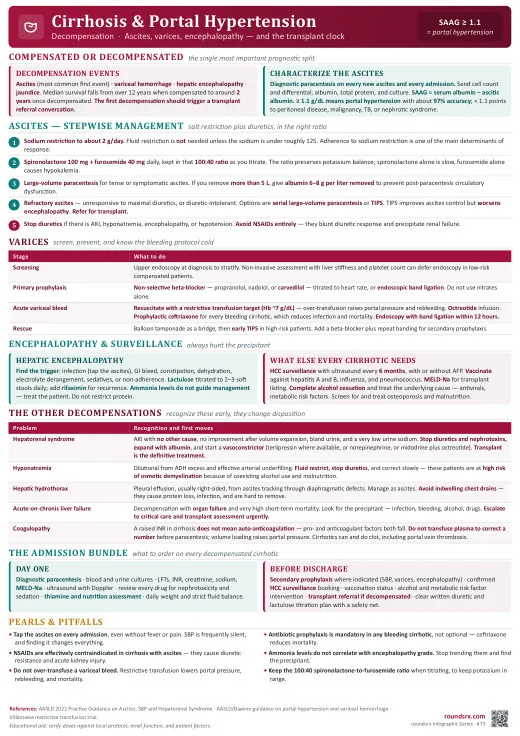
Text version
- NSAIDs (renal failure in cirrhotics)
- ACEi/ARBs (hypotension)
- Missing HCC screening
- Not doing diagnostic paracentesis for new ascites or clinical change