CLABSI & Line Infections
Central line–associated bloodstream infections (CLABSI) are among the most common and preventable healthcare-associated infections. The decision to remove vs salvage the line depends on the organism, patient stability, and line necessity. S. aureus and Candida CLABSI mandate line removal. Coagulase-negative Staph may be treated with lock therapy if the line is essential.
🔍 Overview
Key Concepts
- CLABSI: Laboratory-confirmed bloodstream infection in a patient with a central line in place for >2 calendar days, where the infection is not related to another source
- CRBSI: Catheter-related BSI, clinical definition requiring paired cultures showing differential time to positivity (≥2 hours) or quantitative culture from catheter tip ≥15 CFU (Maki roll-plate)
- Incidence: ~0.8–1.2 per 1,000 catheter-days in ICU (national average). Zero is the goal.
- Mortality: 12–25% attributable mortality. Each CLABSI adds ~$46,000 in healthcare costs and 7–10 extra hospital days.
- Most common lines: Non-tunneled CVC (highest risk) > PICC > tunneled CVC > implanted port (lowest risk)
Microbiology
| Organism | Frequency | Key Points |
|---|---|---|
| Coagulase-negative Staphylococci (CoNS: S. epidermidis) | ~35% | Most common overall. Biofilm-formers. Often low-virulence. May be contaminant, need ≥2 positive sets to confirm. Line salvage sometimes possible with lock therapy. |
| Staphylococcus aureus | ~15–20% | Line MUST be removed. High risk of metastatic seeding (endocarditis, osteomyelitis, epidural abscess). Always get TTE/TEE. Minimum 4–6 weeks if complicated. ID consult mandatory. |
| Enterococcus spp. | ~10% | E. faecalis (ampicillin-susceptible) vs E. faecium (often VRE). GI source possible. Remove line if possible. |
| Gram-negative rods | ~20% | Klebsiella, E. coli, Enterobacter, Pseudomonas, Acinetobacter. Consider GI/GU source. Pseudomonas, strong indication to remove line. |
| Candida spp. | ~10–15% | Line MUST be removed. Start echinocandin empirically. Ophthalmology consult (endophthalmitis). Blood cultures must be negative ×2 before stopping antifungals. Treat ≥14 days from first negative culture. |
Prevention, Central Line Bundle
Prevention is the best treatment. Central line bundles reduce CLABSI by 50–70%. Compliance must be monitored daily.
- Hand hygiene before and after line access
- Maximal barrier precautions at insertion (full drape, cap, mask, sterile gown, sterile gloves)
- Chlorhexidine skin antisepsis (2% CHG in 70% isopropyl alcohol), allow to dry completely
- Optimal site selection: Subclavian preferred (lowest infection rate), avoid femoral when possible (highest rate). Internal jugular intermediate.
- Daily review of line necessity, remove as soon as no longer needed (“line rounds”)
- CHG-impregnated dressings (Biopatch), change every 7 days or if soiled/loose
- Scrub the hub: 15-second scrub of catheter hub with alcohol or CHG before every access
🧪 Workup
Diagnostic Approach
| Test | How | Interpretation |
|---|---|---|
| Paired blood cultures (gold standard) | Draw one set from each lumen of the central line AND one set from a peripheral vein. Label clearly. | Differential time to positivity (DTP): If central line culture turns positive ≥2 hours before peripheral = strongly suggests CRBSI (sensitivity 85%, specificity 91%). |
| Peripheral blood cultures alone | ≥2 sets from separate peripheral sites | If line cannot be accessed or has been removed. Two sets positive with same organism = true bacteremia (especially important for CoNS). |
| Catheter tip culture (Maki roll-plate) | If line is removed: roll 5-cm distal tip across blood agar | ≥15 CFU with same organism growing from peripheral blood = CRBSI confirmed. Only useful if line is removed. Do NOT routinely culture tips of removed lines without clinical suspicion. |
Always draw peripheral cultures. Central-line-only cultures have a high false-positive rate (hub colonization). Without paired peripherals, you cannot distinguish CRBSI from contamination. Two sets of CoNS from the line alone = insufficient to diagnose CLABSI.
When to Suspect CLABSI
- Fever, rigors, or hemodynamic instability in a patient with a central line and no other obvious source
- Exit site erythema, purulence, or tenderness (suggests local infection ± CRBSI)
- Bacteremia with typical line organisms (CoNS, S. aureus, Candida) without another clear source
- New-onset sepsis within 48h of central line insertion or manipulation
- Rule out other sources first: UTI, pneumonia, surgical site, intra-abdominal, CLABSI is a diagnosis of exclusion per NHSN criteria
Additional Workup for S. aureus Bacteremia
Every S. aureus bacteremia requires:
- Repeat blood cultures every 24–48 hours until negative (document clearance)
- Echocardiography: TEE preferred (sensitivity 90–100% vs TTE 60–70% for endocarditis). Order on ALL S. aureus BSIs.
- ID consult, proven to reduce mortality and relapse in S. aureus bacteremia Fowler et al., 2003
- Look for metastatic foci: Osteomyelitis, epidural abscess, septic arthritis, septic emboli. MRI spine if back pain. Fundoscopic exam.
- Duration depends on classification: Uncomplicated (removable focus, negative TEE, clearance ≤72h, no metastatic infection) = 2 weeks. Complicated = 4–6 weeks.
🚨 Management
Line Removal vs Salvage, Decision Framework
| Organism | Remove Line? | Rationale |
|---|---|---|
| S. aureus | ALWAYS REMOVE | High risk of metastatic complications (endocarditis 25–30% if line retained). Biofilm impossible to eradicate with antibiotics alone. No exceptions. |
| Candida spp. | ALWAYS REMOVE | Cannot clear candidemia without removing focus. Each day of retained line increases mortality. Remove within 24 hours of positive culture. |
| Pseudomonas | STRONGLY RECOMMEND | Biofilm-former, difficult to eradicate. High failure rate with salvage. Remove unless truly irreplaceable. |
| GNRs (other) | REMOVE if possible | Preferred to remove. Salvage may be attempted with lock therapy in truly essential, difficult-to-replace lines + clinical improvement. |
| Enterococcus | REMOVE if possible | Remove preferred. VRE especially, limited treatment options make salvage risky. |
| CoNS (S. epidermidis) | SALVAGE may be attempted | Low-virulence organism. Salvage with antibiotic lock therapy + systemic antibiotics if line is truly essential (e.g., tunneled HD catheter, long-term TPN). Remove if failing, tunnel infection, or port pocket infection. |
Empiric Antibiotic Therapy
| Scenario | Empiric Regimen | Notes |
|---|---|---|
| Standard empiric | Vancomycin IV (MRSA/CoNS coverage) | Start immediately after cultures drawn. De-escalate by culture within 48–72h. |
| + GNR risk (ICU, immunocompromised, femoral line) | Vancomycin + Cefepime or Piperacillin-tazobactam | Add GNR coverage if severely ill, recent GNR colonization, or ICU patient. Cefepime for Pseudomonas risk. |
| Candida suspected (TPN, broad-spectrum abx, immunocompromised) | Add Micafungin 100 mg IV daily or Caspofungin 70 mg → 50 mg IV daily | Echinocandin preferred empirically (covers C. glabrata/krusei which are fluconazole-resistant). De-escalate to fluconazole if C. albicans + susceptible. |
Treatment Duration by Organism
| Organism | Duration (after line removal) | Key Points |
|---|---|---|
| CoNS | 5–7 days (if line removed) 10–14 days (if line salvaged + lock therapy) | Shortest course. Ensure ≥2 sets positive (not contaminant). If single set positive, likely contaminant, may not need treatment. |
| S. aureus | Minimum 4 weeks (2 weeks ONLY if ALL uncomplicated criteria met) | Uncomplicated: removable focus removed, negative TEE, clearance ≤72h, no implanted hardware, no metastatic infection. ID consult mandatory. 2-week course only with ALL criteria met. |
| Enterococcus | 7–14 days | Ampicillin for susceptible E. faecalis. Daptomycin or linezolid for VRE (E. faecium). |
| GNRs | 7–14 days | Narrow by sensitivities. Pseudomonas: 7–14 days with an anti-pseudomonal agent. May need combo therapy if MDR. |
| Candida | 14 days from first negative blood culture | Repeat cultures every 24–48h until negative. Ophthalmology consult (endophthalmitis in 10–15%). Remove line within 24h. Echinocandin → fluconazole step-down if susceptible. |
Antibiotic Lock Therapy
- Indication: Line salvage attempt for CoNS or low-virulence organisms when line is essential and cannot be easily replaced
- How: Instill concentrated antibiotic solution (vancomycin 5 mg/mL or daptomycin 5 mg/mL + heparin) into each lumen, dwell for ≥12 hours (ideally when line not in use)
- Duration: 10–14 days of lock therapy + systemic antibiotics simultaneously
- Contraindicated: S. aureus, Candida, Pseudomonas, tunnel infection, port pocket infection, septic shock
- Success rate: ~65–80% for CoNS. Failure (persistent positive cultures) = remove line
💊 Medications
Key Antibiotics for CLABSI
| Drug (Brand) | Spectrum | Dosing | Key Considerations |
|---|---|---|---|
| Vancomycin (Vancocin) | MRSA, CoNS, Enterococcus (non-VRE) | 15–20 mg/kg IV q8–12h Target AUC/MIC 400–600 | Empiric backbone for all CLABSI. Monitor AUC-guided dosing. Nephrotoxic, check BMP daily. Lock concentration: 5 mg/mL. |
| Daptomycin (Cubicin) | MRSA, VRE, CoNS | 6–8 mg/kg IV q24h (10–12 mg/kg for VRE endocarditis) | Alternative to vancomycin for MRSA BSI. Check weekly CPK (rhabdomyolysis). Inactivated by surfactant, cannot use for pneumonia. Excellent for BSI and endocarditis. |
| Cefazolin (Ancef) | MSSA | 2g IV q8h | Step-down from vancomycin once MSSA confirmed. Preferred over vancomycin for MSSA (better outcomes). |
| Micafungin (Mycamine) | Candida spp. (including C. glabrata) | 100 mg IV q24h | Echinocandin, first-line empiric for candidemia. Fungicidal against Candida. Few drug interactions. Well-tolerated. |
| Fluconazole (Diflucan) | C. albicans, C. parapsilosis | 400–800 mg IV/PO daily | Step-down from echinocandin once C. albicans confirmed + susceptible. NOT for C. glabrata (often resistant) or C. krusei (intrinsically resistant). |
| Linezolid (Zyvox) | VRE, MRSA | 600 mg IV/PO BID | VRE option. 100% oral bioavailability. Limit to ≤2 weeks if possible (thrombocytopenia, serotonin syndrome, optic neuropathy with prolonged use). Check weekly CBC. |
📋 On Rounds
When must you ALWAYS remove the central line in CLABSI?
Always remove for: (1) S. aureus, (2) Candida, (3) Pseudomonas. Also remove for tunnel infection, port pocket infection, septic shock, septic thrombophlebitis, and endocarditis. S. aureus and Candida form biofilms that cannot be eradicated with antibiotics alone, and retained lines dramatically increase mortality and metastatic complications.
How do you use differential time to positivity (DTP) to diagnose CRBSI?
Draw paired blood cultures simultaneously from the central line AND a peripheral vein. If the central line culture turns positive ≥2 hours before the peripheral culture, it strongly suggests the line is the source (CRBSI). Sensitivity ~85%, specificity ~91%. This avoids unnecessary line removal when the source is elsewhere.
Why does every S. aureus bacteremia need a TEE?
S. aureus has a 25–30% rate of endocarditis in bacteremia, even when a removable source (like a line) is identified. TTE sensitivity is only 60–70%, it misses small vegetations. TEE sensitivity is 90–100%. Finding endocarditis changes duration from 2 weeks to 4–6 weeks and may require surgery. ID consult is also mandatory, reduces mortality.
What is the central line insertion bundle and why does it matter?
The central line bundle reduces CLABSI by 50–70%: (1) hand hygiene, (2) maximal barrier precautions (full drape, cap, mask, gown, gloves), (3) chlorhexidine skin prep, (4) optimal site (subclavian preferred, avoid femoral), (5) daily line necessity review. Also: CHG-impregnated dressings, scrub the hub ×15 sec, daily line rounds. Prevention is the single most impactful intervention.
How do you manage candidemia from a central line?
(1) Remove the line within 24 hours. (2) Start echinocandin (micafungin 100 mg or caspofungin) empirically. (3) Repeat blood cultures every 24–48h until negative. (4) Ophthalmology consult for endophthalmitis screening (occurs in 10–15%). (5) Treat for 14 days after first negative blood culture. Step down to fluconazole if C. albicans + susceptible. Species identification matters, C. glabrata and C. krusei need echinocandins.
📣 Sample Presentation
One-Liner
"Mrs. Rodriguez is a 72-year-old woman with metastatic ovarian cancer and a tunneled Hickman catheter presenting with fever, rigors, and hypotension. Blood cultures from the line turned positive at 8 hours for gram-positive cocci in clusters, 3 hours before peripheral cultures, consistent with CLABSI."
Key Points to Cover on Rounds
Likely CLABSI, DTP 3 hours (line positive first). Started vancomycin empirically. Speciation pending, if S. aureus, will remove line immediately, consult ID, and get TEE. If CoNS, will discuss line salvage vs removal given need for ongoing chemotherapy. Surveillance cultures drawn every 24h. CRP 145, lactate 2.8. Hemodynamically improved after 2L bolus. Will de-escalate antibiotics once cultures finalize. Line has been in place 42 days with no prior infections.
⚡ Summary
Summary
Prevention Beats Everything
Central line bundles reduce CLABSI by 50 to 70%: hand hygiene, full barrier precautions at insertion, chlorhexidine skin prep, avoiding the femoral site, and daily review of whether the line is still needed. That last item is the one that lapses, and the commonest reason a line becomes infected is that nobody asked whether it could come out.
Suspect It When There Is No Other Source
Fever or sepsis in a patient with a central line and no alternative explanation. Local signs at the exit site are helpful but frequently absent, so their absence does not exclude it. Draw paired blood cultures, one peripheral and one from each lumen, before antibiotics.
Differential Time to Positivity Makes the Diagnosis
A line culture turning positive 2 or more hours before the peripheral culture indicates the catheter is the source. This is what distinguishes a true CLABSI from a bacteremia the line merely sampled, and it decides whether the line has to come out.
Some Organisms Mean the Line Comes Out, No Debate
S. aureus, Candida, Pseudomonas, and any rapidly growing mycobacterium. Also remove the line in septic shock, a tunnel or pocket infection, persistent bacteremia beyond 72 h of appropriate therapy, or endocarditis and other metastatic infection. Attempting salvage in these situations causes relapse and metastatic seeding.
Salvage Is Possible Only in Narrow Circumstances
A stable patient, with coagulase-negative staphylococci or a similarly low-virulence organism, and limited vascular access. Use systemic antibiotics plus antibiotic lock therapy, which delivers a high drug concentration into the lumen where the biofilm is, since systemic levels never reach it. Recheck cultures and abandon salvage if they do not clear.
Empiric Therapy Covers Staph, Then Widens by Risk
Vancomycin for MRSA and coagulase-negative staphylococci. Add gram-negative and antipseudomonal cover for the neutropenic, the critically ill, and femoral lines. Add an echinocandin for suspected candidemia in a patient on TPN, prolonged broad-spectrum antibiotics, or with known colonization. Narrow as soon as the organism is known.
Duration Is Set by Organism, Not by Symptoms
Coagulase-negative staphylococci: 5 to 7 days after removal. Enterococcus and gram-negatives: 7 to 14 days. S. aureus: at least 14 days, and 4 to 6 weeks with complicated infection. Candida: 14 days after the first negative blood culture, with all lines removed and a dilated eye exam.
S. aureus Bacteremia Needs a Full Workup
Repeat blood cultures every 48 to 72 h until they clear, get an echocardiogram (TEE if the TTE is negative and suspicion persists), and look for metastatic foci, above all vertebral osteomyelitis, epidural abscess and septic arthritis. Get infectious diseases involved, which independently improves outcomes in S. aureus bacteremia. Never treat it as a contaminant.
📄 One Pager
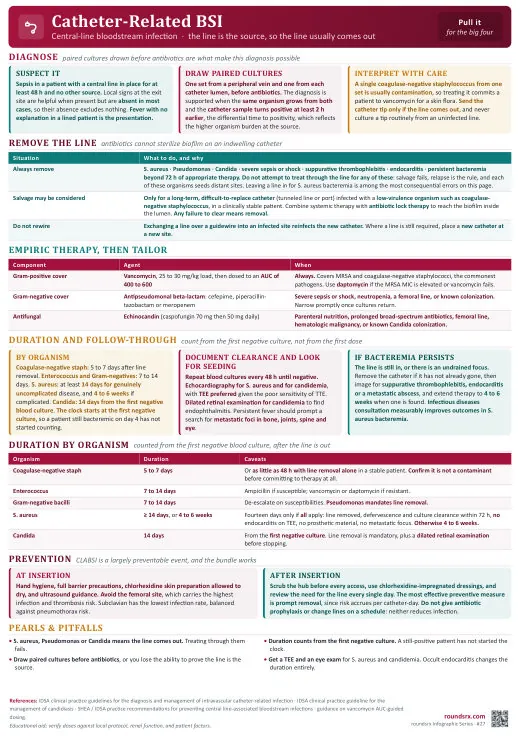
Text version
CLABSI & Line Infections, Quick Reference Card
Print this page (Ctrl/Cmd + P) for a condensed reference card.
CLABSI & LINE INFECTIONS, AT A GLANCE
📋 Diagnose: Paired cultures (central + peripheral). DTP ≥2h = line source. ≥2 sets for CoNS.
🔴 Remove line: S. aureus (ALWAYS), Candida (ALWAYS), Pseudomonas, tunnel/port infection, septic shock.
💊 Empiric: Vancomycin ± cefepime/pip-tazo. Add echinocandin if Candida risk.
🔬 S. aureus: Remove line + TEE + ID consult + repeat cultures. Min 4 wk (2 wk if uncomplicated).
🍄 Candida: Remove line ≤24h + echinocandin + ophtho consult. 14d from first negative culture.
🛡️ Prevent: Central line bundle: CHG, max barriers, subclavian preferred, daily line necessity review.
🔴 Remove line: S. aureus (ALWAYS), Candida (ALWAYS), Pseudomonas, tunnel/port infection, septic shock.
💊 Empiric: Vancomycin ± cefepime/pip-tazo. Add echinocandin if Candida risk.
🔬 S. aureus: Remove line + TEE + ID consult + repeat cultures. Min 4 wk (2 wk if uncomplicated).
🍄 Candida: Remove line ≤24h + echinocandin + ophtho consult. 14d from first negative culture.
🛡️ Prevent: Central line bundle: CHG, max barriers, subclavian preferred, daily line necessity review.
Related Topics
Cellulitis & Skin InfectionsDiabetic Foot InfectionFungal InfectionsHantavirus (HPS & HFRS)Herpes Simplex (HSV)Herpes Zoster (Shingles)