Code Status & Advance Directives
| Term | Definition |
|---|---|
| Full Code | All resuscitative measures including CPR, intubation, vasopressors, defibrillation |
| DNR (Do Not Resuscitate) | No chest compressions or defibrillation if pulseless. Does NOT limit other treatments. |
| DNI (Do Not Intubate) | No endotracheal intubation. May still receive BiPAP, medications, other interventions. |
| DNR/DNI | No CPR AND no intubation. All other treatments still available unless specified. |
| Comfort Measures Only (CMO) | Focus entirely on symptom relief. No disease-directed treatments. Hospice-level care. |
| POLST/MOLST | Portable medical order translating goals into specific treatment decisions (antibiotics, fluids, hospitalization, CPR) |
| Advance Directive | Legal document expressing wishes for future care when unable to decide (living will, healthcare proxy) |
| Step | What to Say |
|---|---|
| 1. Ask permission | "Would it be okay if we talked about what's most important to you regarding your medical care?" |
| 2. Assess understanding | "What is your understanding of your illness and where things are?" |
| 3. Explore values | "What's most important to you? What are you hoping for? What are you worried about?" |
| 4. Share prognosis | "I wish things were different, but I'm worried that..." (wish-worry framework) |
| 5. Make recommendation | "Based on what you've told me is important, I would recommend..." |
| 6. Document | Document code status, healthcare proxy, POLST. Communicate to all team members. |
- Current understanding of illness/prognosis
- Prior advance directives or POLST forms
- Healthcare proxy/POA identification
- Religious/spiritual considerations
- Family dynamics and decision-makers
- Prior experiences with hospitalization, ICU, mechanical ventilation
- What quality of life means to the patient
| Symptom | Medication | Dose |
|---|---|---|
| Pain | Morphine Sulfate | 2–4 mg IV q2h PRN or 5–10 mg PO q4h |
| Dyspnea | Morphine Sulfate | 2 mg IV q2h PRN (opioids treat air hunger) |
| Anxiety | Lorazepam (Ativan) | 0.5–1 mg IV/SL q4h PRN |
| Secretions | Glycopyrrolate (Robinul) | 0.2 mg IV q4h PRN or Scopolamine (Transderm Scōp) patch |
| Nausea | Ondansetron (Zofran) | 4 mg IV q6h PRN |
| Agitation/delirium | Haloperidol (Haldol) | 0.5–2 mg IV q4h PRN |
Patient: 74F with metastatic NSCLC admitted for pneumonia. No advance directive on file. Alert, oriented, ECOG 3. Family present.
Key findings: Progressive cancer despite 2nd-line therapy. Declining functional status over 3 months. No prior documented goals of care conversation.
Management:
- Initiate GOC conversation: "Given everything going on, I want to make sure we have a plan that matches your values"
- Explore understanding: "What has your oncologist told you about where things stand?"
- Clarify values: "If your heart were to stop, CPR has < 5% survival to discharge in metastatic cancer"
- Recommend: "Based on what you've told me, I'd recommend focusing on treatments that keep you comfortable"
- Document: DNR/DNI with clear rationale, update POLST, notify covering teams
Teaching point: Frame code status as a medical recommendation, not a menu choice. "Do you want us to do everything?" is a harmful question - patients cannot give informed consent without understanding outcomes.
Patient: 68M with severe ARDS from aspiration pneumonia, intubated day 12, FiO₂ 80%, vasopressors × 2. PMH: advanced cirrhosis (MELD 34). No advance directive. Wife and adult son disagree.
Key findings: Predicted mortality > 90% (MELD 34 + ARDS + vasopressors). Wife wants to continue. Son says "Dad would never want this."
Management:
- Identify legal surrogate (wife as spouse has legal priority in most states)
- Family meeting with entire care team - present medical reality clearly
- Use substituted judgment: "What would he say if he could see himself right now?"
- Allow time - offer a time-limited trial: "Let's reassess in 48 hours"
- If impasse persists → palliative care and ethics committee consultation
Teaching point: Time-limited trials are powerful tools. They give families permission to hope while creating a natural decision point. Set specific, measurable goals (e.g., "off vasopressors by Friday").
Patient: 82M with ESRD on HD, severe HFrEF (EF 15%), admitted with NSTEMI. Overnight: flash pulmonary edema → BiPAP → worsening. Full code. No family reachable.
Key findings: Impending respiratory arrest. Full code by default. Prior admission note documents patient saying "I don't want to be on machines" but no formal paperwork.
Management:
- Honor full code status - intubate if needed (no legal basis to withhold without valid documentation)
- Attempt emergent family contact via social work
- Document the prior stated wishes in the chart but note they are not legally binding
- Once stabilized: formal GOC conversation and advance directive completion
- Consider palliative care consult for longitudinal goals discussion
Teaching point: Verbal statements without documentation are not actionable in emergencies. Always complete formal paperwork (POLST/MOLST, advance directive) when patients express end-of-life preferences.
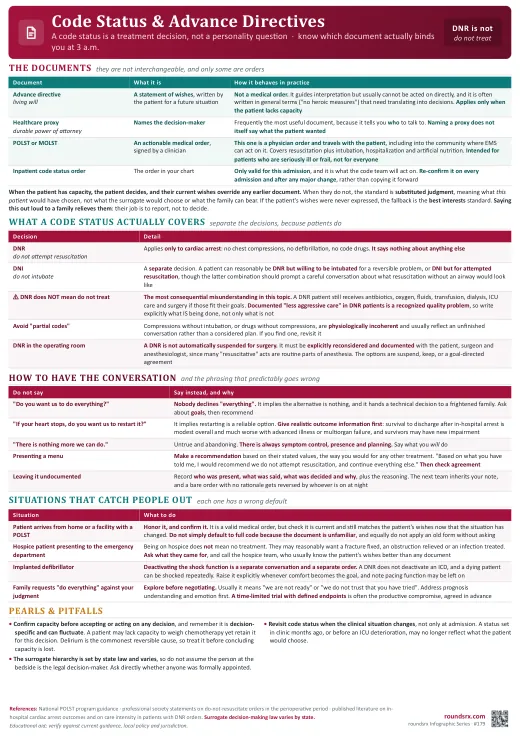
Text version
- Full code: all resuscitative measures, CPR, intubation, vasopressors, defibrillation.
- DNR: no compressions or defibrillation if pulseless. Nothing else is limited, so ICU care, antibiotics, and surgery all continue.
- DNI: no endotracheal intubation, but BiPAP and medications remain available, so a DNI patient can still be escalated.
- CMO: symptom relief only, no disease-directed treatment, hospice-level care.
- Advance directive: legal document anyone can complete for future care. It must be interpreted and translated into orders, so it is not directly actionable at the bedside.
- POLST/MOLST: physician-signed portable medical order for serious illness, actionable immediately, covering CPR, level of intervention, antibiotics, and artificial nutrition.
- Witnessed shockable VF/VT: ~30–40% survive to discharge, the best-case scenario patients picture from television.
- Overall in-hospital CPR: ~15% survive to discharge; ~25% achieve ROSC, so most who are resuscitated still never leave the hospital.
- Age > 80 with comorbidities: ~5% survive to discharge.
- Metastatic cancer: < 5% survive to discharge.
- On vasopressors at arrest, or sepsis-related arrest: < 2%.
- Give the actual numbers, not adjectives. Patients given quantitative outcome data choose DNR more often than those given qualitative descriptions, because you cannot consent to an outcome you cannot picture.
- Comfort care means treating symptoms aggressively while stopping disease-directed therapy. At appropriately titrated doses, opioids for dyspnea do not hasten death.
- Code status in the EMR with the rationale, so the next team understands why, not just what.
- Name the healthcare proxy or POA explicitly, because that person's decision carries legal authority when the patient cannot speak.
- Update the POLST, because it is the order that travels with the patient outside the hospital.
- Write a limited or conditional code verbatim ("DNR except in case of X"), because anything ambiguous defaults back to full code.
- Notify all covering teams, and if a patient states a wish verbally, complete formal paperwork; verbal statements are not actionable in an emergency.
- Asking "Do you want us to do everything?" Nobody says no, so the answer carries no information and cannot support informed consent. Explain what each intervention involves and ask which outcomes are acceptable.
- Treating DNR as "do not treat." DNR addresses cardiac arrest only.
- Doing CPR on a DNR patient because the arrest cause looks reversible. Treat the cause aggressively (calcium for hyperkalemia, treat anaphylaxis), but that is not CPR, and DNR still applies unless a limited code was specifically requested.
- Surgery: do the preoperative "required reconsideration" conversation to define which interventions are acceptable during and after the case, because most intraoperative arrests have reversible causes (anesthesia, bleeding, arrhythmia).
- Family conflict: identify the legally designated proxy first; if none, follow your state's surrogate hierarchy (spouse → adult children → parents → siblings), because only one voice can be the decision-maker.
- Reframe to substituted judgment: "What would the patient want?" is preferred whenever their values are known; fall back on the best-interest standard only when wishes are completely unknown.
- Prognostic uncertainty or a family that needs time: offer a time-limited trial (e.g., 48–72h) with specific measurable endpoints, because it lets families keep hoping while creating a natural decision point.
- Impasse after repeated meetings: palliative care, then ethics committee consultation.
- Emergency with no valid documentation: honor full code, there is no legal basis to withhold, then hold the formal conversation once stabilized.
- Ehlenbach, 2009 in-hospital CPR survival falls with age and comorbidity; patients over 80 have ~5% survival to discharge.
- Kaldjian, 2009 quantitative CPR outcome data shifts patients toward DNR more than qualitative description does.
- Wright, 2008 end-of-life discussions lead to less aggressive care, earlier hospice, and better quality of life.
- Temel, 2010 early palliative care in metastatic NSCLC improved quality of life and survival.
- Sykes, 2003 appropriately titrated opioids for symptom control do not hasten death, the basis of the principle of double effect.
- Quill, 2009 time-limited trials as the tool for prognostic uncertainty.