Pneumonia
| Type | Definition | Common Organisms | Empiric Antibiotics |
|---|---|---|---|
| CAP (Community-acquired) | Acquired outside hospital, or < 48h after admission | S. pneumoniae (#1), H. influenzae, Mycoplasma, Chlamydophila, Legionella, respiratory viruses | Outpatient (healthy): Amoxicillin 1g TID Outpatient (comorbid): Amox-clav + azithromycin Inpatient: Ceftriaxone IV + azithromycin IV ICU: Same ± vanc/linezolid if MRSA risk (linezolid if severe) |
| HAP* (Hospital-acquired) *HAP = Hospital-Acquired Pneumonia (≥48h after admission) | ≥ 48h after admission, not intubated at time of infection | MRSA, Pseudomonas, Klebsiella, Acinetobacter, Enterobacter | Pip-tazo 4.5g q6h or cefepime 2g q8h + vancomycin or linezolid (MRSA; linezolid if severe) Meropenem if ESBL/MDR risk Pip-tazo if anaerobic concern (aspiration + abscess/empyema). Cefepime if no anaerobes -especially with vanc (↓ AKI) ACORN, 2023 |
| VAP* (Ventilator-associated) *VAP = Ventilator-Associated Pneumonia (≥48h after intubation) | ≥ 48h after intubation | Same as HAP + higher Pseudomonas and MDR organisms | Pip-tazo or cefepime or meropenem + vanc or linezolid (MRSA; linezolid if severe) ± double Pseudomonas coverage if MDR risk Pip-tazo if anaerobic risk (aspiration, abscess). Cefepime + vanc preferred (lower nephrotoxicity). Need cefepime + anaerobes → add metronidazole |
| Aspiration pneumonia | Witnessed or high-risk aspiration event (AMS, dysphagia, GERD). Classically RLL or posterior segments of upper lobes (gravity-dependent). | Same as CAP -S. pneumoniae, H. influenzae, S. aureus, Enterobacteriaceae. Anaerobes are NOT the primary cause (old teaching). Anaerobes only significant if: lung abscess, empyema, necrotizing PNA, or poor dentition + indolent course. | Acute: Treat like CAP (ceftriaxone + azithro) If abscess/empyema/necrotizing: ADD anaerobic coverage -amp-sulbactam 3g q6h or pip-tazo or metronidazole Chemical pneumonitis = NO abx |
Old teaching: Hospitalization within 90 days, nursing home residence, hemodialysis, or home wound care = "Healthcare-Associated Pneumonia" → treat like HAP with broad-spectrum antibiotics.
Current teaching: HCAP led to massive over-treatment, most of these patients had CAP organisms, not MDR bugs. Increased C. diff and worse outcomes. Now: classify as CAP and assess individual MDR risk factors (prior MRSA culture, prior Pseudomonas culture, IV antibiotics within 90 days, structural lung disease) to decide if broader coverage is needed.
IDSA / ATS 2019 criteria STANDARD
Use to decide: ICU admission. 1 major OR ≥ 3 minor = severe CAP.
| Major criteria (any 1 = severe CAP) |
|---|
| Septic shock requiring vasopressors |
| Respiratory failure requiring mechanical ventilation |
| Minor criteria (need ≥ 3 = severe CAP) | Threshold |
|---|---|
| Respiratory rate | ≥ 30 |
| PaO2 / FiO2 | ≤ 250 |
| Multilobar infiltrates on imaging | present |
| Confusion / disorientation | present (new) |
| BUN (uremia) | ≥ 20 mg/dL |
| WBC (leukopenia from sepsis) | < 4,000 |
| Platelets (thrombocytopenia) | < 100,000 |
| Temperature (hypothermia) | < 36°C |
| Hypotension requiring aggressive fluid resuscitation | present |
- ICU admission and closer monitoring for shock and respiratory failure.
- Standard empiric regimen still: ceftriaxone + macrolide (or respiratory fluoroquinolone). Severity alone does not change the antibiotics.
- MRSA and Pseudomonas coverage are NOT added automatically. Add only if individual risk factors are present: prior respiratory isolation of that organism, hospitalization + IV antibiotics in the past 90 days, structural lung disease (bronchiectasis, severe COPD), or locally validated high prevalence. MRSA nasal PCR (~95% NPV) helps you stop empiric vanc/linezolid early.
- Earlier consideration of adjunctive hydrocortisone (CAPE COD 2023). See the CAPE COD criteria collapsible below for steroid eligibility.
CURB-65
Use to decide: outpatient vs inpatient vs ICU at the front door. Score 0-1 home, 2 admit, 3-5 consider ICU.
| Letter | Criterion |
|---|---|
| C | Confusion (new AMS) |
| U | Urea (BUN) > 19 mg/dL (or > 7 mmol/L) |
| R | Respiratory rate ≥ 30 |
| B | BP: SBP < 90 OR DBP ≤ 60 |
| 65 | Age ≥ 65 |
| Score | Disposition | 30-day mortality |
|---|---|---|
| 0-1 | Outpatient (consider home Rx) | < 3% |
| 2 | Inpatient ward | ~9% |
| 3-5 | ICU consideration | 15-40% |
PSI / Pneumonia Severity Index
Use to decide: granular severity (Class I-V). More variables and better discrimination than CURB-65 but harder to calculate at bedside. PSI > 130 = CAPE COD steroid threshold.
CAPE COD criteria
Use to decide: should I add hydrocortisone? Any one of: intubated, HFNC FiO2 ≥ 0.5 with P/F < 300, NIV with P/F < 300, or PSI > 130.
- Intubated / mechanical ventilation
- HFNC at FiO2 ≥ 0.5 with PaO2 / FiO2 < 300
- Non-invasive ventilation with PaO2 / FiO2 < 300
- PSI > 130
- Duration got shorter, not longer CHANGED -in the clinically stable patient, under 5 days with a 3-day minimum is now preferred for outpatients and non-severe inpatients. 2019 set the floor at 5 days. Severe CAP still gets ≥ 5 days, and that one is a strong recommendation.
- Steroids flipped in severe CAP CHANGED -now a conditional recommendation FOR systemic steroids in severe CAP, where 2019 suggested against them. In non-severe CAP the recommendation against is now strong (it was conditional).
- A detected respiratory virus can mean no antibiotics at all NEW 2025 -a healthy outpatient with no comorbidity and a positive viral PCR does not need antibiotics. Outpatients with comorbidities, and all hospitalized patients, still do.
- Lung ultrasound is an acceptable alternative to chest radiography NEW 2025 -where the expertise and a standardized protocol exist. 2019 did not address it.
| Setting | Regimen | Notes |
|---|---|---|
| CAP -Outpatient, no comorbidities | Amoxicillin (Amoxil) 1g TID 1ST LINE | Or doxycycline 100 mg BID. Or azithromycin 500 mg → 250 mg daily (only if local resistance < 25%). |
| CAP -Outpatient, with comorbidities | Amoxicillin-clavulanate 875 mg BID + azithromycin | Or respiratory fluoroquinolone (levofloxacin 750 mg daily or moxifloxacin 400 mg daily) -monotherapy. |
| CAP -Inpatient (non-ICU) | Ceftriaxone 1–2g IV daily + azithromycin 500 mg IV daily STANDARD | Or respiratory FQ monotherapy. Duration: under 5 days, minimum 3, once clinically stable CHANGED 2025 PTC (Dinh), 2021 -the 2025 ATS update prefers under 5 days here, where 2019 set the floor at 5. Stability first, then count. |
| CAP -ICU (severe) | Ceftriaxone (Rocephin) 2g IV + azithromycin (Zithromax) 500 mg IV | Add vancomycin or linezolid if MRSA risk factors (linezolid preferred if severe -superior lung penetration). Add piperacillin-tazobactam or cefepime if Pseudomonas risk. Always get blood cultures + sputum + Legionella/pneumococcal urine antigens. Duration: ≥ 5 days STRONG 2025 -severe CAP is explicitly excluded from the shorter-course recommendation, so do not apply the sub-5-day rule here. |
| HAP / VAP | Piperacillin-tazobactam (Zosyn) 4.5g IV q6h or cefepime 2g IV q8h or meropenem | Add vancomycin or linezolid for MRSA (linezolid if severe -superior lung penetration). Duration: 7 days ATS/IDSA HAP/VAP Guidelines, 2016. Shorter is better -reduces resistance. |
| Aspiration | Treat like CAP (ceftriaxone + azithro) | Anaerobes are NOT the primary cause -same organisms as CAP. Add anaerobic coverage (amp-sulbactam or pip-tazo) ONLY if: lung abscess, empyema, necrotizing PNA, or poor dentition + indolent course. Aspiration pneumonitis (chemical) = NO antibiotics. |
- Aspiration with abscess/empyema/necrotizing PNA -anaerobic coverage built in
- Intra-abdominal co-infection suspected
- Poor dentition + indolent course (anaerobes likely)
- Post-obstructive pneumonia (distal to tumor)
- Mixed aerobic-anaerobic infection
- HAP/VAP without anaerobic concern -standard nosocomial pneumonia
- Often paired with vancomycin when anaerobic cover is not needed. Note the AKI rationale did not survive the RCT ACORN, 2023
- Neutropenic fever (first-line IDSA, 2010)
- CKD/AKI patients on vancomycin -safer renal profile
- No suspected anaerobic infection
| Feature | Vancomycin | Linezolid (Zyvox) |
|---|---|---|
| Route | IV only (PO only for C. diff) | IV and PO (100% PO bioavailability) |
| MOA | Cell wall inhibitor -binds D-Ala-D-Ala, blocks peptidoglycan cross-linking. Bactericidal (slowly). | 50S ribosome inhibitor -blocks 70S initiation complex → stops protein synthesis. Bacteriostatic. Also a weak MAOi (→ serotonin syndrome risk). |
| VRE | ✗ No | ✓ Yes |
| Lung penetration | Poor (~25%) | Excellent (~100%) -key advantage in pneumonia |
| Renal dosing | Yes -trough/AUC monitoring required | No adjustment needed |
| Max duration | No hard limit | ≤ 14 days (thrombocytopenia risk) |
| Key toxicity | Nephrotoxicity, Red Man Syndrome, ototoxicity | Thrombocytopenia (> 14d), serotonin syndrome (MAOi), lactic acidosis, peripheral neuropathy (may be irreversible), optic neuritis (> 28d), myelosuppression |
- MRSA bacteremia / endocarditis
- Osteomyelitis (long-duration OK)
- Default empiric MRSA coverage
- Patient on SSRIs (serotonin risk with linezolid)
- MRSA pneumonia (superior lung penetration) ZEPHyR, 2012
- VRE infections
- CKD / AKI (no renal adjustment)
- No IV access / outpatient Tx (PO = IV)
Patient: 55M, cough with yellow sputum × 5 days, fever 38.9°C, RR 22, SpO₂ 94% on RA, CXR: RLL consolidation.
Severity -CURB-65: Confusion (0), BUN > 19 mg/dL (0), RR ≥ 30 (0), BP < 90 systolic (0), Age ≥ 65 (0) = Score 0 → outpatient treatment appropriate.
But: SpO₂ 94% borderline + looks unwell → admit for observation.
Inpatient non-ICU CAP:
- Ceftriaxone (Rocephin) 1g IV daily + azithromycin (Zithromax) 500mg IV/PO daily
- OR levofloxacin (Levaquin) 750mg PO/IV daily (respiratory fluoroquinolone monotherapy -reserve for PCN allergy or failure of beta-lactam). Ciprofloxacin is NOT a substitute here -it does not reliably cover S. pneumoniae.
When to add MRSA coverage (vanc or linezolid): Prior MRSA infection/colonization, cavitary infiltrate, empyema, recent influenza, or severe necrotizing pneumonia. Get nasal MRSA swab -negative PCR has ~95% NPV for MRSA pneumonia → can safely withhold MRSA coverage.
Duration: under 5 days, with a 3-day minimum, once the patient is clinically stable CHANGED 2025. Stability means afebrile, HR ≤ 100, RR ≤ 24, SBP ≥ 90, SpO₂ ≥ 90%, taking oral intake, and normal mental status. Severe CAP is the exception and gets ≥ 5 days (strong recommendation). No need for 7–14 days in anyone.
IV → PO switch: Once afebrile, tolerating PO, and clinically improving → switch to oral and discharge. Do not keep patients NPO or on IV abx waiting for "completion of course."
| Feature | Levofloxacin | Moxifloxacin |
|---|---|---|
| CAP dose | 750 mg IV/PO daily | 400 mg IV/PO daily |
| Pseudomonas | ✓ only at 750 mg, marginal even then -confirm susceptibility (ciprofloxacin is the more active antipseudomonal, but does NOT cover CAP) | ✗ none. The gap that matters most |
| Anaerobes | ✗ needs metronidazole added | ✓ incl. B. fragilis -stands alone |
| Renal dosing | Adjust below CrCl 50 -unadjusted accumulates (QT, tendon, CNS) | None at any renal function, including HD and CAPD |
| Urinary levels | ✓✓ ~87% unchanged -also covers a urinary source | ✗ ~20% unchanged. Not a UTI drug |
| QT | Class effect | Greatest of the class |
- Any Pseudomonas risk -bronchiectasis, structural lung disease, prior isolate. Use 750 mg
- Possible urinary source
- QT is a concern, or K/Mg deranged
- AKI, CKD or dialysis -no dose math, and it stays correct as creatinine moves
- Lung abscess or empyema -anaerobes without adding metronidazole
- No Pseudomonas risk
The guideline has now caught up with the trial. The 2025 ATS update makes systemic steroids in severe CAP a conditional recommendation FOR, reversing 2019, which suggested against them. In non-severe CAP the recommendation against is now strong (previously conditional), so the severity label is the entire decision: steroids help severe CAP and harm non-severe CAP.
| Scenario | Indication | Drug & Dose | Duration | Why |
|---|---|---|---|---|
| Severe CAP in ICU NEW 2023 | Any one of: intubated, HFNC FiO2 ≥ 0.5 with P/F < 300, NIV with P/F < 300, or PSI > 130 | Hydrocortisone 200 mg IV daily (50 mg q6h or 8 mg/hr continuous infusion) | 8 days if improving on day 4 (P/F > 200, breathing spontaneously, SOFA ≤ baseline). 14 days if not improving. Taper at end. | Dampens dysregulated lung inflammation that drives ARDS and shock in the sickest CAP patients. Older trials in non-severe CAP did not show mortality benefit because inflammation is not the rate-limiting step there. CAPE COD, 2023 |
| PJP / PCP pneumonia | PaO2 < 70 mmHg on room air OR A-a gradient ≥ 35 mmHg. Most often HIV (CD4 < 200), also chemotherapy, transplant, chronic steroid users. | Prednisone 40 mg PO BID days 1-5, then 40 mg daily days 6-10, then 20 mg daily days 11-21 | 21 days total (overlapping the full TMP-SMX course) | Killing PJP releases organism debris that worsens acute lung injury in the first few days of treatment. Pretreating with steroids blunts the inflammatory surge. Mortality benefit only below the PaO2/A-a thresholds; mild PJP does not benefit. Start with or before the first TMP-SMX dose. |
| COVID-19 pneumonia | Hospitalized COVID requiring supplemental O2 or higher (HFNC, NIV, intubated, or ECMO) | Dexamethasone 6 mg PO/IV daily | Up to 10 days (or until discharge, whichever is sooner) | Reserve for the inflammatory phase of COVID (~7-10 days into illness) when lungs fail. RECOVERY, 2020. Higher doses (12 mg) tested in COVID-STEROID 2 without significant additional benefit, more side effects. Stick to 6 mg. Do NOT give to COVID patients NOT requiring oxygen (RECOVERY showed potential harm in this subgroup). |
| Septic shock from pneumonia | Vasopressor-dependent septic shock | Hydrocortisone 200 mg/day IV (50 mg q6h or 8 mg/hr continuous infusion) | Until shock resolves and pressors weaning, typically 5-7 days then taper | Shorter shock duration, modest mortality benefit in some subgroups. ADRENAL, 2018 APROCCHSS, 2018. Surviving Sepsis 2026: conditional recommendation. Overlap with severe CAP: if a patient meets BOTH severe CAP criteria AND is in septic shock, the same hydrocortisone 200 mg/day satisfies both indications. |
- Non-severe CAP (ward-level, not meeting CAPE COD criteria). Older trials showed shorter time to clinical stability but no mortality benefit; risks (hyperglycemia, infection, GI bleed) outweigh benefit. The 2025 ATS update strengthened this to a strong recommendation against CHANGED 2025, so this is now one of the firmest statements in the guideline.
- Suspected or confirmed influenza pneumonia. Associated with higher mortality in observational data; skip unless another indication exists (asthma exacerbation, septic shock).
- Suspected fungal pneumonia, especially aspergillosis. Steroids worsen fungal disease.
- Active untreated TB. Will disseminate.
- Mild PJP (PaO2 > 70 AND A-a < 35 on room air). No mortality benefit, side effects without upside.
- COVID-19 NOT requiring supplemental O2. RECOVERY showed potential harm in this subgroup.
Patient: 72 y/o F with COPD and HTN, presents with 3 days of productive cough, fever 38.6°C, and dyspnea.
Key findings: RR 24, SpO₂ 91% on RA. CXR: RLL consolidation. WBC 16K, procalcitonin 2.8. CURB-65 = 2 (age + BUN 24). Blood cultures x2 drawn.
Management:
- Ceftriaxone 1g IV daily + azithromycin 500 mg IV daily (standard non-ICU inpatient regimen)
- Supplemental O₂ to maintain SpO₂ ≥ 92%
- Afebrile x48h + improving → transition to PO and discharge
- Total duration: 5 days PTC (Dinh), 2021, do not extend for persistent CXR abnormality
Teaching point: The old 7-14 day antibiotic course for CAP is outdated. ATS/IDSA 2019 recommends minimum 5 days, stopping once clinically stable x48h. Longer courses increase C. difficile risk and resistance without improving outcomes.
Patient: 58 y/o M with IVDU history, presents with high fever, productive cough with blood-tinged sputum, and hypoxia. Recent hospitalization 6 weeks ago.
Key findings: HR 118, BP 86/52, RR 32, SpO₂ 84% on 15L NRB. CXR: multilobar cavitary infiltrates. WBC 22K, lactate 4.8, procalcitonin 18.2. Intubated for respiratory failure.
Management:
- Meets ATS/IDSA major criterion for severe CAP (mechanical ventilation), ICU admission
- Ceftriaxone + azithromycin + vancomycin (cavitary lesions + recent hospitalization = MRSA risk)
- MRSA nasal swab sent, if negative (NPV > 95%), de-escalate vancomycin at 48h
- Blood cultures, sputum culture, Legionella and pneumococcal urine antigens
Teaching point: MRSA nasal swab PCR has > 95% negative predictive value, it is the best antibiotic stewardship tool for de-escalating vancomycin. Cavitary infiltrates, necrotizing pneumonia, and post-influenza pneumonia are classic MRSA scenarios.
Patient: 80 y/o M with advanced dementia and dysphagia, witnessed aspiration during feeding. Develops cough and fever 12h later.
Key findings: Temp 38.2°C, RR 22, SpO₂ 93% on 2L NC. CXR: RLL infiltrate (dependent segment). WBC 13K, procalcitonin 0.4.
Management:
- Distinguish aspiration pneumonitis (chemical, sterile) from aspiration pneumonia (bacterial infection)
- If symptoms develop > 24-48h after aspiration event with rising WBC/PCT → treat as bacterial aspiration PNA
- Antibiotics: ceftriaxone + azithromycin (same as CAP, anaerobes are NOT the primary cause)
- Add anaerobic coverage (amp-sulbactam or pip-tazo) ONLY if abscess, empyema, or necrotizing PNA
Teaching point: Chemical pneumonitis (within hours of aspiration, sterile inflammation) does NOT need antibiotics. Bacterial aspiration pneumonia is treated like CAP, the old teaching of routine anaerobic coverage with clindamycin is outdated unless there is abscess or necrotizing disease.
- History: Cough (productive vs dry), fever/chills, dyspnea, pleuritic chest pain, sick contacts, travel, immunosuppression, recent hospitalization/abx (within 90 days)
- Physical exam: Tachypnea, crackles/bronchial breath sounds, dullness to percussion, egophony, tactile fremitus
- Labs: CBC, BMP, procalcitonin (guides abx duration), lactate if sepsis concern, blood cultures ×2 (before abx in severe/ICU), sputum culture + Gram stain
- Imaging: CXR PA + lateral (infiltrate, consolidation, effusion). CT chest if CXR equivocal or complications suspected. Lung ultrasound is an acceptable alternative to the chest radiograph NEW 2025 where the expertise and a standardized protocol exist, which matters most when the patient cannot travel or you want an answer at the bedside. Routine follow-up imaging is not recommended if symptoms resolve within 5–7 days; infiltrates lag clinical cure by weeks
- Respiratory viral PCR: send whenever influenza or SARS-CoV-2 is circulating. A positive result starts an antiviral, and in a healthy outpatient with no comorbidities it now justifies withholding antibiotics entirely NEW 2025. Outpatients with comorbidities, and every hospitalized patient, still get antibiotics regardless of the viral result
- Urine antigens: Legionella (serogroup 1) + S. pneumoniae -order in ICU-level or severe CAP
- MRSA nasal swab: NPV > 95% -if negative, can safely de-escalate vanc/linezolid
- Procalcitonin: < 0.25 → bacterial unlikely. Serial levels guide antibiotic de-escalation (drop > 80% from peak → safe to stop). Never use it to withhold initial antibiotics in radiographically confirmed CAP; its role is to support stopping, not starting
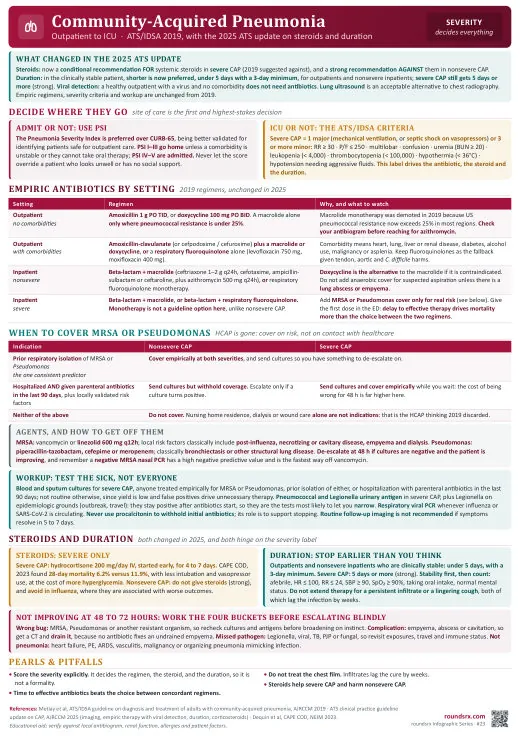
Text version
- Treating > 5 days without indication (short course is standard)
- FQ for uncomplicated outpatient CAP (reserve for comorbidities)
- Not getting follow-up CXR at 6-8 weeks in smokers
- Forgetting atypical coverage (azithromycin) for inpatient CAP