Heart Failure -Chronic Management
| Type | EF | Pathology | Key Feature |
|---|---|---|---|
| HFrEF (systolic) | ≤ 40% | Impaired contraction | GDMT* proven to reduce mortality. All four pillars apply. *GDMT = Guideline-Directed Medical Therapy |
| HFmrEF (mid-range) | 41–49% | Borderline -may behave like either | Emerging data supports GDMT (especially SGLT2i). Treat like HFrEF if symptomatic. |
| HFpEF (diastolic) | ≥ 50% | Impaired relaxation / filling | No mortality-reducing GDMT until SGLT2i. Manage volume, comorbidities, and now SGLT2i. |
| Class | Symptoms | Implication |
|---|---|---|
| I | No limitation. Ordinary activity does not cause symptoms. | Optimize GDMT. Continue current regimen. |
| II | Slight limitation. Comfortable at rest, symptoms with ordinary activity. | Ensure all four pillars are at target doses. |
| III | Marked limitation. Comfortable at rest, symptoms with less than ordinary activity. | Maximize GDMT. Consider ICD/CRT. Diuretic optimization. |
| IV | Unable to carry on any activity without symptoms. Symptoms at rest. | Advanced HF referral. Evaluate for LVAD / transplant. |
- BNP / NT-proBNP -higher levels = worse prognosis. Useful for tracking response to therapy.
- Hyponatremia (Na⁺ < 135) -independent predictor of mortality in HF
- Peak VO₂ -gold standard for transplant candidacy (≤ 14 mL/kg/min → list)
- NYHA class -class III/IV = ↑ mortality
- EF -lower EF = higher mortality, but HFpEF also carries significant morbidity
- Digitoxin -DIGIT-HF, 2025 showed digitoxin 0.07 mg daily reduced death + HF hospitalization by 18% in advanced HFrEF (NYHA III–IV) on GDMT. Consider as add-on after optimizing all four pillars.
▶ How to Escalate GDMT in HFrEF, Step by Step (tap to expand)
| Check | What | Why |
|---|---|---|
| Confirm HFrEF | Echo with EF ≤ 40% (or HFmrEF 41-49%, treat same way per 2022 guideline) | 4-pillar GDMT only proven to reduce mortality in HFrEF/HFmrEF. HFpEF gets different management (see HFrEF vs HFpEF section). |
| Stabilize hemodynamics | SBP ≥ 90, off pressors, no active cardiogenic shock | Starting ARNI or BB in shock will deepen the shock. Stabilize first, then layer GDMT. Loop diuretics for congestion don't wait. |
| Baseline labs | BMP (K+, Cr, eGFR), NT-proBNP or BNP, iron studies (ferritin, TSAT) | Hyperkalemia or AKI changes which pillars you can safely start. NT-proBNP trends gauge decongestion. Iron deficiency (ferritin < 100, or 100-299 with TSAT < 20%) needs IV iron (AFFIRM-AHF). |
| Pillar | Starting Dose | Why Low to Start |
|---|---|---|
| 1. ARNI (sacubitril/valsartan) | 49/51 mg BID if previously on ACEi/ARB and SBP ≥ 100; 24/26 mg BID if naive, elderly, or SBP 95-100 | 20% MACE reduction vs enalapril (PARADIGM-HF). Start low to limit hypotension and AKI; the BP drop is front-loaded. |
| 1 (alt). ACEi/ARB if ARNI not affordable | Lisinopril 2.5-5 mg, enalapril 2.5 mg BID, losartan 25 mg, valsartan 40 mg BID | Mortality benefit in CONSENSUS/SOLVD. Use as a placeholder until ARNI is accessible. Don't combine ARNI with ACEi. |
| 2. Beta-blocker | Carvedilol 3.125 mg BID, metoprolol succinate 12.5-25 mg daily, or bisoprolol 1.25 mg daily | Only these three BBs are evidence-based (MERIT-HF, COPERNICUS, CIBIS-II). Atenolol, propranolol, metoprolol tartrate are NOT acceptable substitutes. Negative inotropy at start makes congestion worse if patient is wet, so don't start during active decompensation. |
| 3. MRA | Spironolactone 12.5-25 mg daily, or eplerenone 25 mg daily | 30% mortality reduction (RALES, EMPHASIS-HF). Hold if K+ > 5.0 or eGFR < 30. Eplerenone if gynecomastia is a concern (less anti-androgen activity). |
| 4. SGLT2i | Dapagliflozin 10 mg or empagliflozin 10 mg daily (no titration) | 25-30% reduction in CV death + HF hospitalization (DAPA-HF, EMPEROR-Reduced), benefit regardless of diabetes status. Expect a 0.2 mg/dL Cr bump (hemodynamic, reverses; do not stop). Initiate down to eGFR 20. |
| Drug | Target Dose | How to Titrate |
|---|---|---|
| Sacubitril/valsartan | 97/103 mg BID | Double the dose q2-4 weeks if SBP and K+ tolerate. Recheck BMP at 1-2 weeks after each step. |
| Carvedilol | 25 mg BID (50 mg BID if > 85 kg) | Double q2 weeks. Hold uptitration if HR < 55 or SBP < 90. |
| Metoprolol succinate | 200 mg daily | Double q2 weeks (12.5 → 25 → 50 → 100 → 200). |
| Bisoprolol | 10 mg daily | Double q2 weeks (1.25 → 2.5 → 5 → 10). |
| Spironolactone | 25-50 mg daily | BMP at 3 days, 1 week, then monthly. Hold if K+ > 5.5. |
| Dapagliflozin / empagliflozin | 10 mg daily (no titration) | One-dose drug. Counsel on euglycemic DKA, GU mycotic infection, sick-day rules. |
- EF recovers > 35%: continue GDMT lifelong (do NOT stop; TRED-HF showed 40% relapse rate within 6 months of withdrawal). No ICD.
- EF stays ≤ 35%, NYHA II-III on optimized GDMT for ≥ 3 months: primary-prevention ICD (Class I).
- EF ≤ 35% + LBBB ≥ 150 ms + NYHA II-IV: CRT-D (strongest indication; Class I).
| Drug | When to Add | Why |
|---|---|---|
| Hydralazine + ISDN | Self-identified Black patients, NYHA III-IV on optimized GDMT | A-HeFT (2004): 43% mortality reduction in Black patients added to ACEi/BB. Class I in this population. |
| Ivabradine (Corlanor) | NSR with HR ≥ 70 despite max-tolerated BB, NYHA II-III, EF ≤ 35% | SHIFT (2010): 18% reduction in CV death/HF hospitalization. Funny-current (If) inhibitor in SA node; only works in NSR. Class IIa. |
| Vericiguat (Verquvo) | Recent worsening HF (hospitalization or IV diuretic) despite optimized GDMT | VICTORIA, 2020: 10% relative reduction in CV death/HF hospitalization (35.5% vs 38.5%) in high-risk worsening-HF patients. Soluble guanylate cyclase stimulator. Class IIb. |
| Digoxin | Persistent symptoms despite all above, or AF rate control overlay | DIG trial: no mortality benefit but reduces HF hospitalization. Narrow therapeutic window (target 0.5-0.9 ng/mL); higher levels increase mortality. |
| IV iron (ferric carboxymaltose) | Iron deficiency (ferritin < 100, or 100-299 with TSAT < 20%) | AFFIRM-AHF (2020): 26% reduction in HF hospitalization at 52 weeks. Treat even if Hb is normal -iron deficiency in HF is symptomatic without anemia. |
| Scenario | Do This | Why |
|---|---|---|
| Cardiogenic shock (SBP < 90, on pressors) | Hold all 4 pillars; continue loop diuretic at adjusted dose. Resume sequentially once off pressors and Cr stable. | Each pillar drops BP, blunts SNS, or worsens hemodynamics in shock. Restart in order: ACEi/ARB/ARNI → BB → MRA → SGLT2i. |
| AKI with Cr rise > 30% from baseline | Hold ACEi/ARB/ARNI and MRA; continue SGLT2i and BB (SGLT2i Cr bump is hemodynamic and reverses) | RAAS-blockade and MRA cause true GFR drop that doesn't reverse if pushed; SGLT2i bump is intraglomerular pressure normalization (renoprotective long-term). |
| Hyperkalemia (K+ > 5.5) | Don't stop the MRA reflexively -try patiromer or sodium zirconium cyclosilicate (SZC) first. DIAMOND (2022) showed K+ binders allow MRA continuation. | MRA mortality benefit is lost if discontinued. Binders preserve GDMT. Class IIa in the 2022 guideline. |
| SBP < 90 limiting titration | Prioritize BB and SGLT2i (less BP-dependent for mortality benefit); use lower-dose ARNI or hold ARNI; reduce non-GDMT BP-lowering agents (CCBs, alpha-blockers). | BB and SGLT2i mortality benefit holds at lower BPs. Don't abandon mortality drugs to chase a BP number. |
| HR < 55 or symptomatic bradycardia | Hold further BB uptitration; reassess for AV block; consider ivabradine if NSR and HR remains ≥ 70 at max-tolerated BB later | BB still has mortality benefit at submaximal doses (don't abandon it). Bradycardia at low BB dose may unmask underlying conduction disease. |
| Active decompensation (admitted, congested, on IV diuretic) | Don't initiate BB; continue if already on it (B-CONVINCED). OK to initiate ARNI/ACEi/MRA/SGLT2i if hemodynamically stable. | Negative inotropy of BB in a wet patient worsens cardiac output and congestion. Once euvolemic and stable, start BB before discharge. |
| HFpEF (EF ≥ 50%) | SGLT2i first (EMPEROR-Preserved, DELIVER), then consider MRA (TOPCAT signal in Americas), diuretic for congestion. Treat HTN, AF, OSA, obesity aggressively. | HFpEF has no ARNI/BB mortality benefit. SGLT2i is the only class with clean HFpEF outcome data. Class I (SGLT2i) in 2023 focused update. |
| HFmrEF (EF 41-49%) | Treat as HFrEF -all 4 pillars (Class IIa in 2022 guideline) | Pooled data and DELIVER subgroup show similar benefit to HFrEF. Don't undertreat just because EF is borderline. |
| Pillar | Drug (Brand) | Target Dose | Key Trial | Mortality Reduction | Watch Out |
|---|---|---|---|---|---|
| 1. ARNI* *= Angiotensin Receptor-Neprilysin Inhibitor (sacubitril-valsartan) 1ST LINE |
Sacubitril/valsartan (Entresto) Start 24/26 mg BID → target 97/103 mg BID |
97/103 mg BID | PARADIGM-HF, 2014 | 20% reduction in composite CV death + HF hospitalization vs enalapril (16% RRR for all-cause mortality) | Hold ACEi 36h before starting (angioedema risk). Hypotension. Do not use with ACEi. Avoid if SBP < 100. |
| 1. ACEi/ARB (if ARNI not tolerated) |
Enalapril (Vasotec) 10–20 mg BID Lisinopril (Zestril) 20–40 mg daily Losartan (Cozaar) 50–150 mg daily Valsartan (Diovan) 160 mg BID |
Max tolerated | CONSENSUS, 1987 SOLVD, 1991 |
~25–30% | Hyperkalemia, AKI, cough (ACEi). Monitor Cr + K⁺ at 1–2 weeks. Cr rise ≤ 30% acceptable. |
| 2. Beta-blocker 1ST LINE |
Carvedilol (Coreg) 3.125 → 25 mg BID Metoprolol succinate (Toprol-XL) 12.5 → 200 mg daily Bisoprolol 1.25 → 10 mg daily |
Max tolerated of one of the three | MERIT-HF, 1999 COPERNICUS, 2001 CIBIS-II, 1999 |
~35% | Only these three BBs are evidence-based for HFrEF. Atenolol, propranolol, etc. have no HF data. Start low, go slow. Do NOT start during decompensation. |
| 3. MRA* *= Mineralocorticoid Receptor Antagonist (spironolactone, eplerenone) 1ST LINE |
Spironolactone (Aldactone) 12.5–50 mg daily or Eplerenone (Inspra) 25–50 mg daily |
25–50 mg daily | RALES, 1999 EMPHASIS-HF, 2011 |
~30% | Hyperkalemia -monitor K⁺ at 3 days, 1 week, monthly. Avoid if K⁺ > 5.0 or eGFR < 30. Eplerenone = less gynecomastia than spironolactone. |
| 4. SGLT2 inhibitor 1ST LINE |
Dapagliflozin (Farxiga) 10 mg daily or Empagliflozin (Jardiance) 10 mg daily |
10 mg daily (no titration needed) | DAPA-HF, 2019 EMPEROR-Reduced, 2020 |
~25% reduction in CV death + HF hospitalization. Benefit independent of diabetes status. | Expect a ~0.2 Cr bump when starting (hemodynamic, not injury, reverses). Avoid if eGFR < 20 or T1DM (euglycemic DKA risk). Watch for GU mycotic infections. Hold peri-operatively or if NPO for > 24h. |
| Domain | HFrEF (EF ≤ 40%) | HFpEF (EF ≥ 50%) |
|---|---|---|
| Core pathology | Systolic dysfunction -weakened pump. Dilated LV, ↓ contractility. | Diastolic dysfunction -stiff ventricle. Normal LV size, impaired relaxation and filling. |
| ARNI / ACEi / ARB | MORTALITY BENEFIT ARNI preferred over ACEi/ARB. PARADIGM-HF, 2014: sacubitril/valsartan reduced CV death + HF hospitalization by 20% vs enalapril. | NO PROVEN BENEFIT PARAGON-HF, 2019: ARNI did not significantly reduce primary endpoint vs valsartan. Possible benefit in lower EF range (EF ≤ 57%). |
| Beta-blocker | MORTALITY BENEFIT Carvedilol, metoprolol succinate, or bisoprolol. COPERNICUS, 2001: carvedilol reduced mortality 35% in severe HFrEF. MERIT-HF, 1999: metoprolol succinate reduced mortality 34%. | NO PROVEN BENEFIT No mortality benefit in HFpEF trials. Use for rate control (Afib) or HTN -not as HF-specific therapy. |
| MRA | MORTALITY BENEFIT RALES, 1999: spironolactone reduced mortality 30% in severe HFrEF. EPHESUS, 2003: eplerenone in post-MI HFrEF. | POSSIBLE BENEFIT TOPCAT, 2014: overall negative, but Americas subgroup showed benefit. Consider if symptomatic despite diuretics. |
| SGLT2 inhibitor | MORTALITY BENEFIT DAPA-HF, 2019: dapagliflozin reduced worsening HF/CV death 26%. EMPEROR-Reduced, 2020: empagliflozin confirmed class effect. | HF HOSPITALIZATION BENEFIT EMPEROR-Preserved, 2021: empagliflozin reduced CV death + HF hospitalization 21%. DELIVER, 2022: dapagliflozin confirmed across EF spectrum. Only drug class with clear benefit in HFpEF. |
| Diuretics | Symptom relief. Loop diuretics for congestion. No mortality benefit but essential for decongestion. | Cornerstone of symptom management. Low-dose loop diuretics. Avoid over-diuresis -these patients are preload-dependent. |
| GLP-1 RA | No specific HFrEF indication. Use for comorbid T2DM/obesity. | EMERGING STEP-HFpEF, 2023: semaglutide improved symptoms, exercise capacity, and weight in obese HFpEF. Targets the obesity-HFpEF phenotype. |
| Comorbidity focus | ICD/CRT if EF ≤ 35% on optimal GDMT × 3 months. Cardiac rehab. Iron repletion if deficient. | Central to management. Aggressive HTN control, Afib rate control (restore atrial kick), weight loss, OSA treatment, glycemic control, exercise training. Ex-DHF, 2011: exercise training improved peak VO₂ and quality of life. |
| Devices | ICD if EF ≤ 35% + NYHA II–III on optimal GDMT ≥ 3 months (SCD-HeFT, 2005). CRT if EF ≤ 35% + LBBB + QRS ≥ 150ms. | No role for ICD or CRT. EF is preserved -sudden death risk is lower. |
- EF ≤ 35% despite ≥ 3 months of optimal GDMT
- NYHA class II–III
- Expected survival > 1 year
- Wait ≥ 40 days post-MI and ≥ 90 days post-revascularization before implant MADIT-II, 2002 SCD-HeFT, 2005
- EF ≤ 35% + LBBB with QRS ≥ 150 ms + NYHA II–IV on optimal GDMT → strongest indication (class I)
- LBBB with QRS 120–149 ms → class IIa
- Non-LBBB with QRS ≥ 150 ms → class IIa (weaker benefit)
- QRS < 120 ms → NO benefit from CRT
- NYHA III–IV despite maximal GDMT
- ≥ 2 HF hospitalizations in 12 months
- Rising BNP/NT-proBNP despite optimization
- Refractory volume overload requiring frequent IV diuretics
- Declining renal function (cardiorenal syndrome)
- Consideration for LVAD (bridge to transplant or destination therapy) or heart transplant
Patient: 55M with HTN and T2DM, presents with 3 weeks of progressive dyspnea on exertion, orthopnea (3-pillow), and bilateral leg swelling. No prior cardiac history.
Key findings: BP 142/88, HR 92, SpO2 95% on RA, JVD, bilateral crackles to mid-lung, 2+ pitting edema. BNP 1,840. Echo: EF 25%, global hypokinesis, no significant valvular disease. Troponin negative x2.
Management:
- IV furosemide 40 mg q12h for decongestion, daily weights, strict I/Os, Na < 2g/day
- Start all 4 pillars of GDMT simultaneously: sacubitril/valsartan 24/26 mg BID, carvedilol 3.125 mg BID, spironolactone 25 mg daily, empagliflozin 10 mg daily DAPA-HF, 2019
- Check BMP in 1 week (K+ and Cr on ARNI + MRA). Hold MRA if K+ > 5.0 or eGFR < 30
- Uptitrate ARNI and BB at 2-week intervals to target doses as tolerated
Teaching point: Current guidelines favor starting all 4 GDMT pillars early rather than sequential addition. SGLT2i can be started regardless of diabetes status. The STRONG-HF, 2022 trial showed rapid uptitration is safe and improves outcomes.
Patient: 68F with known HFrEF (EF 20%), on sacubitril/valsartan, carvedilol, spironolactone, and dapagliflozin. Presents with worsening dyspnea at rest x 2 days, unable to lie flat.
Key findings: BP 82/54, HR 110, SpO2 88% on 4L NC, cool extremities, mottled skin. Lactate 4.2. BNP 5,600. CXR: pulmonary edema. PA catheter: CI 1.6, PCWP 32, SVR 2,100 ("cold and wet" profile).
Management:
- Hold BB, ARNI, MRA in acute cardiogenic shock (restart once hemodynamically stable)
- IV milrinone (preferred if on chronic BB -- does not compete with beta receptors) or dobutamine for inotropy
- IV furosemide drip (double home dose) for decongestion once perfusion improves
- If refractory: consider mechanical circulatory support (Impella, IABP). Cardiology and CT surgery consult
Teaching point: In cardiogenic shock, hold all GDMT that lowers BP or HR. The "cold and wet" profile requires inotropes before diuresis. Use the Stevenson classification (warm/cold, wet/dry) to guide management.
Patient: 74F with obesity (BMI 38), HTN, T2DM, and Afib, presents with third HF admission in 6 months. Dyspnea on minimal exertion, 8 lb weight gain over 2 weeks despite taking furosemide 40 mg daily at home.
Key findings: BP 158/92, HR 84 (irregular), SpO2 93% on RA, elevated JVP, bibasilar crackles, 3+ edema. BNP 680. Echo: EF 62%, grade II diastolic dysfunction, moderate TR, RVSP 52. H2FPEF score: 8 (high probability of HFpEF).
Management:
- IV diuresis: furosemide 80 mg IV BID (double oral dose for IV). Target net negative 1-2 L/day
- Start empagliflozin 10 mg daily -- first drug class with proven benefit in HFpEF EMPEROR-Preserved, 2021
- Aggressive BP control (target < 130/80), rate control for Afib (target HR < 110), weight loss counseling
- Consider spironolactone 25 mg daily (reduces HF hospitalizations in HFpEF per TOPCAT, 2014 Americas subgroup)
Teaching point: SGLT2 inhibitors are the first drug class to show clear benefit across the entire EF spectrum. In HFpEF, focus on treating comorbidities (HTN, obesity, Afib, volume status) since no other drug has proven mortality benefit.
| Parameter | Frequency | Target / Action |
|---|---|---|
| Daily weights | Every morning, same scale, before breakfast | Weight gain > 2 lbs in 2 days or > 5 lbs in 1 week → call clinic / increase diuretic per action plan. Most important home monitoring tool. |
| BMP (K⁺, Cr, Na⁺) | 1–2 weeks after each GDMT initiation or dose change; then q3–6 months when stable | K⁺ 4.0–5.0 (RAAS inhibitors + MRA raise K⁺, diuretics lower it). Cr rise ≤ 30% acceptable on ACEi/ARB/ARNI. Na < 130 → fluid restrict. |
| Blood pressure | Each clinic visit; home monitoring encouraged | SBP ≥ 90 for ARNI/ACEi/ARB titration. Tolerate asymptomatic low SBP (90–100) if on optimal GDMT. Symptomatic hypotension → reduce diuretic first, then GDMT. |
| Heart rate | Each clinic visit | Resting HR 60–70 on maximally tolerated beta-blocker. HR ≥ 70 despite max BB → consider ivabradine (if sinus rhythm, EF ≤ 35%). |
| BNP / NT-proBNP | Baseline, then to track response to therapy | > 30% reduction from baseline = good prognostic sign. Do not chase a specific number -trend matters more than absolute value. If on sacubitril/valsartan (Entresto), trend NT-proBNP, not BNP -neprilysin inhibition falsely elevates BNP, while NT-proBNP is unaffected. Why ↗ |
| Echocardiogram (EF) | Repeat at 3–6 months after GDMT optimization | EF improvement → continue all GDMT (may reclassify HFrEF → HFimpEF). LBBB + EF ≤ 35% + QRS > 150 ms → CRT candidate. |
| Functional status (NYHA class) | Each visit | Dyspnea, exercise tolerance, orthopnea, PND. NYHA III–IV despite optimal GDMT → advanced HF referral (LVAD/transplant evaluation). |
| Iron studies | At diagnosis, then annually | Ferritin < 100 or ferritin 100–300 + TSAT < 20% → IV iron replacement. Improves functional capacity and reduces HF hospitalizations. |
- Echocardiogram -the single most important test. Establishes EF (HFrEF vs HFpEF vs HFmrEF), wall motion abnormalities, valvular disease, diastolic dysfunction, chamber sizes. Repeat at 3–6 months after GDMT optimization to reassess EF.
- BNP / NT-proBNP -elevated in HF (BNP > 100, NT-proBNP > 300). Useful for diagnosis, prognosis, and monitoring response to therapy. Trend over time -> 30% reduction with treatment is a good prognostic sign. On an ARNI (sacubitril/valsartan, Entresto), monitor with NT-proBNP -BNP is falsely raised by neprilysin inhibition, NT-proBNP is not a neprilysin substrate.
- BMP -baseline Cr, K⁺, Na⁺ before starting RAAS inhibitors and diuretics. Monitor after each dose change. Cr rise ≤ 30% acceptable on ACEi/ARB/ARNI. K⁺ must be < 5.0 for MRA initiation.
- CBC -anemia worsens HF symptoms and is common (anemia of chronic disease, hemodilution). Iron studies if anemic -IV iron if ferritin < 100 or ferritin 100–300 + TSAT < 20% AFFIRM-AHF, 2020
- TSH -hypo- and hyperthyroidism are reversible causes of HF. Check in all new diagnoses.
- Iron studies -ferritin and TSAT. Iron deficiency is common in HF and independently worsens exercise capacity and outcomes, even without anemia.
- ECG -LVH, prior MI, arrhythmia (AF common), conduction disease (LBBB -CRT candidate if QRS > 150 ms + EF ≤ 35%).
- Cardiac MRI -if echo is inadequate, or to characterize etiology (ischemic vs non-ischemic, infiltrative, myocarditis, hemochromatosis, amyloid).
| Pillar | Drug (Brand) | Starting → Target Dose | Key Monitoring |
|---|---|---|---|
| 1. ARNI | Sacubitril/valsartan (Entresto) | 24/26 mg BID → 97/103 mg BID | BP, Cr, K⁺ at 1–2 weeks. Hold ACEi 36h before starting. SBP ≥ 90. |
| 2. Beta-blocker | Carvedilol (Coreg) or metoprolol succinate (Toprol-XL) | Carvedilol 3.125 mg BID → 25 mg BID Metoprolol XL 12.5 mg → 200 mg daily | HR ≥ 60, SBP ≥ 90. Do NOT start during decompensation. Only these 3 BBs have evidence. |
| 3. MRA | Spironolactone (Aldactone) or eplerenone (Inspra) | Spironolactone 12.5 → 25–50 mg daily Eplerenone 25 → 50 mg daily | K⁺ < 5.0 and Cr < 2.5 before starting. Recheck at 1 week. Eplerenone if gynecomastia from spironolactone. |
| 4. SGLT2i | Dapagliflozin (Farxiga) or empagliflozin (Jardiance) | Dapagliflozin 10 mg daily Empagliflozin 10 mg daily | No titration needed. Works in diabetic AND non-diabetic HF. Watch for GU infections, euglycemic DKA (rare). |
- Diuretics -furosemide (Lasix) for volume management. Symptom relief only -no mortality benefit. Titrate to dry weight.
- Hydralazine/isosorbide dinitrate (BiDil) -add to GDMT in Black patients with NYHA III–IV (A-HeFT, 2004). Also for patients who cannot tolerate ACEi/ARB/ARNI.
- Ivabradine (Corlanor) -if HR ≥ 70 on maximally tolerated beta-blocker, sinus rhythm, EF ≤ 35% SHIFT, 2010.
- IV iron -ferric carboxymaltose (Injectafer) if ferritin < 100 or ferritin 100–300 + TSAT < 20%. Improves symptoms and reduces HF hospitalizations.
| Population | Iron deficiency definition | Why this threshold |
|---|---|---|
| General adult | Ferritin < 30 ng/mL OR TSAT < 20% with ferritin < 100 | Standard ID threshold; no inflammation correction needed. |
| Heart failure HIGHER FERRITIN CUTOFF | Absolute: ferritin < 100 ng/mL Functional: ferritin 100-299 ng/mL WITH TSAT < 20% | Chronic inflammation in HF elevates ferritin (acute-phase reactant). A "normal" ferritin (e.g., 80 ng/mL) in HF can mask iron-depleted stores. TSAT < 20% is more reliable -less affected by inflammation. |
Why TSAT > ferritin in HF specifically: ferritin is a storage marker AND an acute-phase reactant -it rises with inflammation. HF is a state of chronic systemic inflammation, so a "normal-looking" ferritin (e.g., 80-150 ng/mL) can mask depleted iron stores. TSAT reflects circulating iron available for cardiomyocyte and skeletal-muscle mitochondria right now, and is much less inflated by inflammation. That's why the HF iron-deficiency definition explicitly includes TSAT < 20% as a functional criterion -it catches the patient who looks fine on ferritin alone but is functionally iron-starved.
Pre-test pearls: hold oral iron for 24-48 h before draw (recent dose falsely elevates TSAT). TSAT has diurnal variation (higher in AM) -fasting AM draw is most reliable for borderline cases.
- HFrEF (EF ≤ 40%) AND iron-deficient (per HF criteria above) AND symptomatic (NYHA II-IV) -Class 2a per ACC/AHA 2022 and ESC 2023.
- HFmrEF (EF 41-49%) -reasonable based on extrapolation; trial data sparser.
- HFpEF (EF ≥ 50%) -individualize. Trials predominantly enrolled HFrEF; HFpEF iron data still emerging.
- Acute HF admission with iron deficiency -AFFIRM-AHF, 2020 supports IV iron BEFORE discharge to reduce HF rehospitalization.
| Drug | Dose | Notes |
|---|---|---|
| Ferric carboxymaltose (Injectafer) PREFERRED | Up to 1000 mg IV per dose, max 1500 mg per cycle. Repeat in 3-6 mo if depleted. | Most-studied IV iron in HF (FAIR-HF, CONFIRM-HF, AFFIRM-AHF, HEART-FID). Watch transient hypophosphatemia (especially with repeat dosing). |
| Ferric derisomaltose (Monoferric) SINGLE-INFUSION | Up to 1500 mg IV in one dose (over 20-30 min) | IRONMAN, 2022 showed clinical-event reduction. Convenient single infusion. Less hypophosphatemia than ferric carboxymaltose. |
| Iron sucrose (Venofer) OLDER | 200 mg IV per dose, multiple infusions needed | Older agent, requires more infusions (5-10 visits to repleting). Less convenient. Use only if newer agents unavailable. |
- Improves exercise capacity (6-minute walk distance, peak VO₂) -CONFIRM-HF, 2015
- Improves quality of life and NYHA class -FAIR-HF, 2009
- Reduces HF hospitalization -AFFIRM-AHF (acute HF discharge), IRONMAN (chronic HF)
- Mortality benefit -not robustly demonstrated; trials underpowered for individual mortality endpoint
- Mechanism: iron is essential for mitochondrial function in cardiomyocytes and skeletal muscle. Repletion improves cellular energetics independent of correcting anemia.
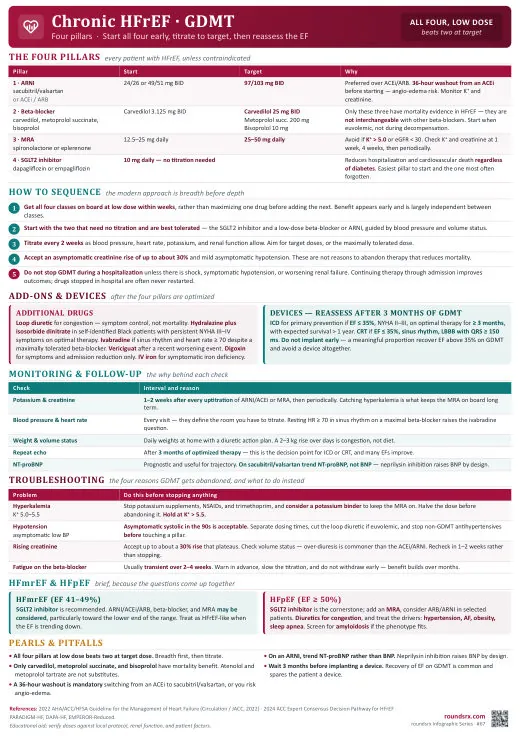
Text version
- Holding BB in acute HF (continue unless cardiogenic shock)
- Not starting all 4 GDMT pillars
- Chasing BNP number instead of clinical volume status
- Discharging without GDMT optimization + 7-day f/u