Contraception
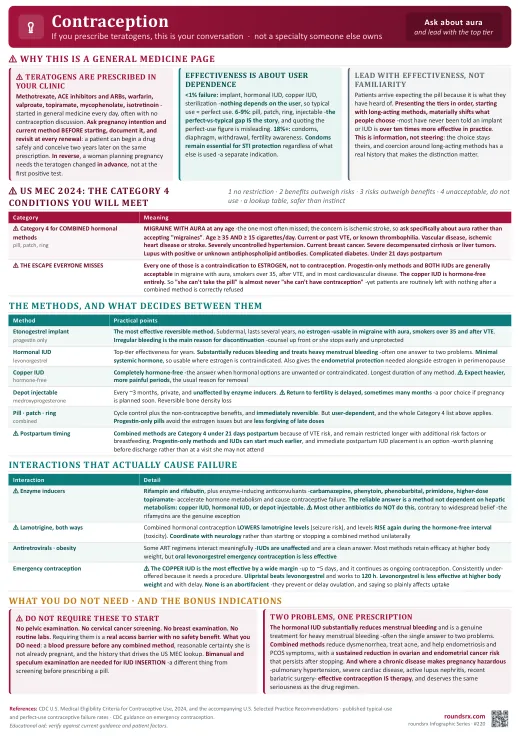
| Tier | Methods | Why |
|---|---|---|
| Most effective under 1% failure per year | Implant, hormonal IUD, copper IUD, sterilization | Nothing depends on the user. Once placed, effectiveness does not rely on remembering, timing or resupply -which is the entire reason this tier exists and why typical use and perfect use are nearly identical here. |
| Middle roughly 6-9% typical use | Combined pill, patch, ring, injectable | The gap between perfect and typical use is the whole story: these are highly effective when used exactly as directed and considerably less so in real life. Quoting the perfect-use figure to a patient is misleading. |
| Least effective 18% or more typical use | Condoms, diaphragm, withdrawal, fertility awareness, spermicide | Heavily user- and act-dependent. Condoms remain essential for sexually transmitted infection protection regardless of what else is used, which is a separate indication from pregnancy prevention. |
- The CDC US Medical Eligibility Criteria (US MEC, 2024) classify every method against every relevant condition on a four-point scale: 1 no restriction, 2 benefits generally outweigh risks, 3 risks generally outweigh benefits (use only if better options are unavailable and with close follow-up), and 4 unacceptable health risk -do not use.
- It is a lookup table, and using it is faster than reasoning from first principles. The value for a general internist is precisely in the chronic-disease rows, where instinct tends to be either needlessly restrictive or dangerously permissive.
- ⚠ A pelvic examination is not required to start hormonal contraception, nor is cervical cancer screening, nor breast examination, nor routine laboratory testing. Requiring them is a real access barrier with no safety benefit.
- What you do need: a blood pressure measurement before combined hormonal contraception, a reasonable certainty the patient is not already pregnant, and the medical history that drives the US MEC lookup.
- Bimanual and speculum examination are needed for IUD insertion itself, which is a different thing from screening before prescribing a pill.
| Interaction | Detail |
|---|---|
| ⚠ Enzyme inducers reduce contraceptive efficacy | Rifampin and rifabutin, and the enzyme-inducing anticonvulsants -carbamazepine, phenytoin, phenobarbital, primidone, topiramate at higher doses- accelerate hormone metabolism and can cause contraceptive failure. The reliable answer is a method that does not depend on hepatic metabolism: the copper IUD, the hormonal IUD, or injectable depot progestin. Note that most antibiotics do NOT do this, contrary to widespread belief -the rifamycins are the genuine exception. |
| ⚠ Lamotrigine, in both directions | Combined hormonal contraception lowers lamotrigine levels, risking seizures, and levels then rise again during the hormone-free interval, risking toxicity. Coordinate with neurology rather than starting or stopping a combined method unilaterally in someone on lamotrigine. |
| Antiretrovirals | Some regimens interact meaningfully. Intrauterine devices are unaffected and are a straightforward answer here. |
| Obesity | Efficacy of most methods is preserved, but oral levonorgestrel emergency contraception is less effective at higher body weight, which changes the emergency recommendation below. |
- ⚠ The copper IUD is the most effective option by a wide margin, effective up to about 5 days after intercourse, and it then continues as ongoing contraception. It is consistently under-offered because it requires a procedure.
- Ulipristal acetate is more effective than levonorgestrel and works up to 120 hours.
- Levonorgestrel is available without prescription and is best taken as soon as possible; it is less effective at higher body weight and less effective the longer the delay.
- Sooner is better for all of them, and none is an abortifacient -they prevent or delay ovulation, which is worth stating plainly because the misconception is common and affects uptake.
- The hormonal IUD substantially reduces menstrual bleeding and is a genuine treatment for heavy menstrual bleeding, which often makes it the single answer to two problems at once.
- Combined methods reduce dysmenorrhea, treat acne, and help the symptoms of endometriosis and polycystic ovary syndrome.
- Sustained reduction in ovarian and endometrial cancer risk with combined methods, persisting after discontinuation.
- Where a chronic disease makes pregnancy hazardous -pulmonary hypertension, severe cardiac disease, active lupus nephritis, recent bariatric surgery- effective contraception is itself a therapeutic intervention, and should be discussed with the same seriousness as the drug therapy.
"Ms. F is a 34-year-old woman with rheumatoid arthritis whom I am about to start on methotrexate, which is the reason contraception is part of today's visit rather than a separate conversation for someone else. She is currently using condoms alone, which is in the least effective tier at around 18% typical-use failure, and that is not adequate alongside a teratogen. On history she has migraine with aura, which is US MEC Category 4 for combined hormonal contraception because of the ischemic stroke risk, so the pill, patch and ring are all out. The important point is that this rules out estrogen rather than contraception: progestin-only methods and both intrauterine devices remain appropriate for her. Given she wants something reliable and reversible while on methotrexate, I have discussed the implant and both IUDs, leading with effectiveness rather than familiarity, and she is interested in the hormonal IUD, which will also help the heavy periods she mentioned. She is on no enzyme-inducing drugs, so metabolism is not a concern. I checked a blood pressure, confirmed she is not currently pregnant, and specifically did not require a pelvic exam or cervical screening to prescribe. I have documented the pregnancy-intention discussion and will revisit it at each methotrexate renewal, since she could conceive years into the same prescription."
- Starting a teratogen? Pregnancy intention and contraception discussed and documented, and revisited at renewal.
- Effectiveness presented in tiers, leading with long-acting methods, while leaving the choice with the patient.
- US MEC checked for the specific condition rather than reasoned from instinct.
- ⚠ Asked specifically about AURA, not just "migraines".
- Estrogen contraindicated? Offer progestin-only or an IUD rather than leaving her with nothing.
- Enzyme-inducing drugs reviewed, with an IUD or injectable offered where present.
- Blood pressure measured before a combined method -and no unnecessary pelvic exam, screening or labs required to start.
- Condoms discussed separately for sexually transmitted infection protection.
| Point | Detail |
|---|---|
| ⚠ Why it is YOUR job | Internists start methotrexate, ACE inhibitors and ARBs, warfarin, valproate, topiramate, mycophenolate, isotretinoin routinely. Contraception is part of that prescription -documented, and revisited at renewal, because a patient can conceive years into the same drug. |
| Effectiveness tiers | <1%: implant, hormonal IUD, copper IUD, sterilization -nothing depends on the user, so typical use ≈ perfect use. 6-9%: pill, patch, ring, injectable -the perfect-vs-typical gap is the whole story. 18%+: condoms, diaphragm, withdrawal, fertility awareness. |
| Counsel by effectiveness | Lead with the most effective tier, since most patients have never been told an implant or IUD is over ten times more effective in practice than a pill. Information, not steering -the choice stays theirs. |
| US MEC 2024 | Four categories: 1 no restriction · 2 benefits outweigh risks · 3 risks outweigh benefits · 4 unacceptable risk, do not use. A lookup table, faster and safer than instinct. |
| ⚠ Category 4 for COMBINED methods | Migraine WITH AURA at any age (ischemic stroke -ask specifically about aura). Age ≥ 35 AND ≥ 15 cigarettes/day. VTE or thrombophilia. Vascular disease, IHD or stroke. Severely uncontrolled hypertension. Current breast cancer. Severe decompensated cirrhosis or liver tumors. Lupus with antiphospholipid antibodies. Complicated diabetes. < 21 days postpartum. |
| ⚠ The escape everyone misses | Those contraindications are to ESTROGEN, not to contraception. Progestin-only methods and both IUDs are generally acceptable in migraine with aura, smokers over 35, after VTE and in most cardiovascular disease. The copper IUD is hormone-free entirely. "She can't take the pill" ≠ "she can't have contraception." |
| ⚠ Interactions | Rifampin/rifabutin and enzyme-inducing anticonvulsants (carbamazepine, phenytoin, phenobarbital, primidone, higher-dose topiramate) cause failure -use an IUD or injectable. Most other antibiotics do NOT, despite the belief. Lamotrigine: combined methods lower levels (seizures), which rise again in the hormone-free interval (toxicity) -coordinate with neurology. |
| Emergency contraception | Copper IUD is most effective (to ~5 days, then continues as contraception) and is under-offered. Ulipristal > levonorgestrel, to 120 h. Levonorgestrel is less effective at higher body weight. None is an abortifacient -say so, the misconception affects uptake. |
| Not required to start | No pelvic exam, no cervical screening, no breast exam, no routine labs. These are access barriers without safety benefit. Do check blood pressure before a combined method and reasonably exclude pregnancy. |
| Bonus indications | Hormonal IUD treats heavy menstrual bleeding (two problems, one device). Combined methods help dysmenorrhea, acne, endometriosis and PCOS, and reduce ovarian and endometrial cancer risk. Where pregnancy is hazardous, contraception IS therapy. |
- If you write for a teratogen, you own the contraception conversation. Not the specialist, not next visit.
- Ask about aura. It is the Category 4 most often missed, and the answer is estrogen-free, not contraception-free.
- Lead with the top tier. Most patients have never been told the difference, and it is the single change that most improves outcomes.