Acute Exacerbation of COPD (AECOPD)
This is the most common cause of COPD-related morbidity and mortality. Frequent exacerbators (≥ 2 per year) have accelerated lung function decline and reduced survival. ICU mortality ranges from 10–30%.
Trigger (infection, irritant) → airway inflammation → mucus plugging + bronchospasm → prolonged expiratory time → incomplete exhalation → air trapping → progressive hyperinflation → flattened diaphragm → reduced inspiratory capacity → respiratory muscle fatigue → hypercapnic respiratory failure.
Air stacking creates intrinsic PEEP (auto-PEEP), forcing patients to breathe against their own trapped air. This is why you see tripod positioning, pursed-lip breathing, and accessory muscle recruitment -they're desperately trying to empty their lungs before the next breath.
| # | Cause | Details | Precipitant, or the diagnosis itself? |
|---|---|---|---|
| 1 | Pneumonia / Pulmonary infection | Most common trigger. Viral ~50% (rhinovirus, influenza, RSV, parainfluenza). Bacterial ~30% (H. influenzae, S. pneumoniae, M. catarrhalis). | Both. An airway infection precipitates a true exacerbation, but an infiltrate on imaging means pneumonia rather than AECOPD |
| 2 | Pulmonary embolism | ~12% prevalence across hospitalized AECOPD overall; ~16% in unexplained AECOPD (Aleva meta-analysis 2017). Often missed. Always consider if no clear infectious trigger, pleuritic pain, unexplained tachycardia, or hypoxia out of proportion. | The diagnosis itself. A PE does not set off an exacerbation, it explains the breathlessness |
| 3 | Pneumothorax | Especially in emphysematous patients with bullae. CXR mandatory on all AECOPD admissions. | The diagnosis itself |
| 4 | Pleural effusion | Can worsen dyspnea and restrict lung expansion. Rule out on CXR. | The diagnosis itself |
| 5 | Poor compliance | Missed inhalers (LAMA/LABA/ICS non-adherence) -very common and modifiable. Always ask about medication use. | Precipitant |
| 6 | Pollution / environmental | PM2.5, ozone spikes, cold air, biomass fuel smoke, occupational dust. Leading cause of COPD in low-income countries (biomass > smoking). Both a cause of COPD development and a trigger for exacerbations. | Precipitant |
| # | P | Suspect it when | Why it matters |
|---|---|---|---|
| 1 | PE | No infectious prodrome, pleuritic pain, hypoxemia out of proportion to the wheeze, or poor response to bronchodilators | The highest-yield miss. Roughly 1 in 6 hospitalized patients with an unexplained exacerbation (pooled 16.1%), and 68% of those emboli were main, lobar or interlobar, so it is not subsegmental noise. Aleva, Chest 2017 |
| 2 | Pneumonia | Fever, focal consolidation, higher CRP | An infiltrate makes it pneumonia with COPD, not AECOPD: different antibiotic duration, different steroid logic, higher mortality |
| 3 | Pneumothorax | Sudden pain, unilateral signs, sudden deterioration on NIV | Bullous disease makes it disproportionately common and easy to miss on a portable film. Look before applying positive pressure, which can convert it to tension |
| 4 | Pump failure | Orthopnea, elevated JVP, edema, raised BNP | COPD and HFpEF overlap heavily in the same smoker. BNP is blunted by obesity and raised by cor pulmonale, so it helps but does not settle it. Diurese rather than escalate bronchodilators |
| 5 | Pulse | Irregular pulse, tachycardia that will not settle, chest pain or ischemic ECG change | ACS or a new arrhythmia (AF, atrial tachycardia, MAT). Demand ischemia and tachyarrhythmia both present as "I cannot breathe", and beta-agonists aggravate the arrhythmias |
| 6 | Plug / aspiration | Abrupt onset, lobar collapse, asymmetric air entry, or a choking or reduced-consciousness event | Mucus plugging, foreign body, aspiration or an upper airway process. The problem is the airway itself rather than the small airways, so bronchodilators will not fix it |
- Increased dyspnea -most sensitive symptom
- Increased sputum volume
- Increased sputum purulence -green/yellow suggests bacterial infection
- Accessory muscle use (sternocleidomastoid, scalenes), tripod positioning
- Pursed-lip breathing (creates back-pressure to prevent airway collapse)
- Prolonged expiratory phase, diffuse expiratory wheezing
- Tachypnea (RR > 24), tachycardia, diaphoresis
- Cyanosis, asterixis (CO₂ retention), altered mental status
- Severe dyspnea unresponsive to initial therapy (continued accessory muscle use, unable to speak in sentences)
- Altered mental status -confusion, somnolence, or coma
- Persistent hypoxemia: SpO₂ < 88% despite FiO₂ ≥ 0.4
- Severe or worsening respiratory acidosis: pH < 7.25 or PaCO₂ > 70 mmHg
- Acidosis not improving with NIV (recheck ABG at 1–2 hours)
- Hemodynamic instability requiring vasopressors
- NIV intolerance or failure
- ABG -mandatory in moderate-severe AECOPD. Assess pH, PaCO₂, PaO₂. Do NOT rely on SpO₂ alone.
- CXR -exclude pneumonia, pneumothorax, pulmonary edema, pleural effusion
- ECG -P pulmonale, right heart strain, arrhythmias (AF common in COPD)
- CBC -leukocytosis (infection), polycythemia (chronic hypoxia)
- BMP -metabolic alkalosis (chronic CO₂ retainer), hypokalemia (β₂ agonists)
- BNP / NT-proBNP -exclude heart failure as trigger or co-contributor
- Troponin if cardiac involvement suspected
| Pattern | pH | PaCO₂ | HCO₃ | Interpretation |
|---|---|---|---|---|
| Acute hypercapnia | < 7.35 | > 45 | Normal / mildly ↑ | Acute exacerbation -treat aggressively |
| Chronic compensated | 7.35–7.45 | > 45 | ↑↑ (≥ 30) | Stable CO₂ retainer -know their baseline |
| Acute-on-chronic | < 7.35 | > 45 (above baseline) | ↑↑ | Most common pattern -compensated chronically + acute decompensation |
| pH < 7.25 | < 7.25 | > 60 | ↑ | Severe -NIV now, low threshold for intubation |
- Sputum Gram stain + culture if purulent sputum and no recent culture data
- Respiratory viral panel (if influenza season -guides oseltamivir)
- Legionella urine antigen + Pneumococcal urine antigen if severe / ICU
- Procalcitonin -helps distinguish bacterial vs viral trigger PRORATA 2010
- Consider CTPA if PE not excluded (atypical presentation, no clear infectious trigger)
| Decision | AECOPD | Acute asthma |
|---|---|---|
| Albuterol frequency | q1–4 h scheduled, no q20 min loading | q20 min × 3 in first hour, front-loaded |
| Continuous nebs | Rarely, intermittent works; chronic patients don't tolerate continuous | Yes for severe (10–15 mg/hr) |
| Ipratropium duration | Continued throughout admission (often DuoNeb q4–6 h) | First 3 nebs only (ceiling effect, Rodrigo 2005) |
| O₂ target | 88–92% (controlled O₂, avoid hypercapnic respiratory failure) AVOID, 2010 | 93–95% |
| Steroids | Prednisone 40 mg × 5 d REDUCE, 2013 | Prednisone 40–60 mg × 5 d |
| Antibiotics | YES if Anthonisen ≥ 2 of 3 (↑ dyspnea, sputum volume, sputum purulence) | Usually NO |
| NIV | First-line for hypercapnic exacerbation (strong evidence, > 80% avoid intubation) | Bridge only, low threshold to intubate |
| IV magnesium | Not standard, weak evidence | 2 g IV for severe (3Mg) |
| Decompensation tempo | Days | Hours |
Why the upper limit matters:
- Haldane effect -Dominant mechanism (~70%). Oxygenated Hb offloads CO₂ into plasma → PaCO₂ rises independent of respiratory rate.
- V/Q mismatch -High FiO₂ abolishes hypoxic pulmonary vasoconstriction → blood flows to poorly-ventilated units → worsened dead space.
- Hypoxic drive suppression -Correcting hypoxia reduces peripheral chemoreceptor drive → hypoventilation (real but overemphasized).
Albuterol (Ventolin) 2.5–5 mg + ipratropium (Atrovent) 0.5 mg neb q1h × 1–2 if severe, then scheduled q4–6h (or DuoNeb [albuterol + ipratropium pre-mix] combination, same schedule). Do NOT use the asthma q20 min × 3 loading regimen, AECOPD doesn't need it and chronic patients tolerate intermittent dosing better.
Continue ipratropium throughout admission (unlike asthma where it's stopped after 3 doses).
MDI + spacer equally effective as nebulizer in mild-moderate exacerbations (and doesn't aerosolize virus). Turner, 1997
Continuous albuterol nebulizer only if severe bronchospasm not responding to intermittent dosing (less commonly needed in COPD than asthma).
Use IV methylprednisolone 60 mg daily if unable to take PO (NPO, vomiting) -equivalent to prednisone 40 mg PO, same 5-day course, no taper. Do NOT use 125 mg q6h (asthma-style dosing, not GOLD-aligned for AECOPD; lower-dose corticosteroids < 80 mg prednisone-equivalent are non-inferior).
No taper needed for 5-day course. Taper only if > 3 weeks of steroids.
Anthonisen Criteria (all 3 = definitely treat; 2/3 = probably treat; 1/3 = no benefit):
① Increased dyspnea ② Increased sputum volume ③ Increased sputum purulence
Empiric choice: Amoxicillin-clavulanate 875/125 mg PO BID OR doxycycline 100 mg BID × 5–7 days. Levofloxacin if Pseudomonas risk (structural lung disease, frequent hospitalization, recent abx).
Initial settings: IPAP 12–16 cmH₂O, EPAP 4–5 cmH₂O. Titrate IPAP for patient comfort + TV 6–8 mL/kg. Add supplemental O₂ to maintain SpO₂ 88–92%.
NIV Contraindications: Reduced consciousness, inability to protect airway, vomiting, facial trauma/burns, hemodynamic instability, copious secretions, pH < 7.15 with poor trajectory.
Initial vent: TV 6–8 mL/kg PBW, RR 10–12/min (lower than ARDS!), I:E 1:3 or 1:4, PEEP 5 cmH₂O.
Low RR = more time for exhalation = less air trapping.
If hemodynamic collapse after intubation → disconnect ETT → manual exhalation (auto-PEEP release).
Check plateau pressure + perform expiratory hold for intrinsic PEEP measurement.
| Parameter | Good Response (1–2h) | NIV Failure → Intubate |
|---|---|---|
| pH | Improving toward 7.35 | pH < 7.25 or worsening |
| PaCO₂ | Decreasing | Rising despite NIV |
| RR | Decreasing | Still > 30 after 1–2h |
| HR | Decreasing | Worsening tachycardia |
| Mentation | More alert, cooperative | Worsening confusion, agitation |
| Accessory muscles | Decreasing | Unchanged or increasing |
- Able to use inhalers correctly
- Needs bronchodilators no more frequent than q4h
- On room air or at baseline O₂ requirement
- Able to eat and sleep without significant dyspnea
- Clinically and hemodynamically stable for 12–24h
- Maintenance therapy optimized (LAMA + LABA ± ICS reviewed and prescribed)
- Smoking cessation counseling
- Pulmonary rehab referral
- Follow-up within 1–4 weeks
Patient: 68M with severe COPD (FEV1 35%), presents with worsening dyspnea × 3 days, productive cough with purulent sputum, RR 28, SpO₂ 86% on RA.
Immediate: O₂ via nasal cannula → target SpO₂ 88–92% (NOT 100% -risk of CO₂ retention in COPD). Start BiPAP if not improving (IPAP 12, EPAP 5).
Bronchodilators: Albuterol (ProAir) 2.5mg + ipratropium (Atrovent) 0.5mg nebs q20min × 3, then q4h.
Steroids: Prednisone (Deltasone) 40mg PO daily × 5 days (REDUCE trial -5 days = 14 days in outcomes).
Antibiotics: Azithromycin (Zithromax) 500mg PO daily × 3 days (indicated because purulent sputum -meets ≥ 2 of 3 Anthonisen criteria: ↑ dyspnea, ↑ sputum volume, ↑ sputum purulence).
ABG: pH 7.31, PaCO₂ 58, PaO₂ 62 → acute-on-chronic respiratory acidosis. BiPAP initiated. Repeat ABG in 1–2h.
Key: If BiPAP fails (worsening acidosis, inability to protect airway, AMS) → intubate. But BiPAP prevents intubation in ~75% of COPD exacerbations.
Patient: 74F with very severe COPD (FEV1 22%), brought in by EMS obtunded. RR 8, SpO₂ 78%, GCS 8. ABG: pH 7.12, PaCO₂ 95, PaO₂ 48.
This patient is too sick for BiPAP. Altered mental status + inability to protect airway = intubate.
Intubation strategy:
- Pre-oxygenate with BVM at low rate, avoid breath-stacking in COPD.
- RSI: Ketamine 1.5 mg/kg (bronchodilator properties, maintains hemodynamics) + rocuronium 1.2 mg/kg.
- Ventilator settings: Low RR (10–12), TV 6–8 mL/kg PBW, long expiratory time (I:E ratio 1:4 or 1:5) to prevent auto-PEEP/breath-stacking.
- Watch for auto-PEEP: If hypotension post-intubation → disconnect from vent for 10 seconds (releases trapped air). Most common cause of post-intubation hypotension in COPD.
Ongoing: Nebs via vent circuit. IV steroids (methylprednisolone 60 mg IV daily = prednisone 40 mg PO equivalent; transition to PO when able, 5-day total course, no taper). Antibiotics. Daily SBT when improving.
Key lesson: COPD + intubation = low rate, long expiratory time, watch for auto-PEEP. Post-intubation hypotension → disconnect and let air out before reaching for pressors.
Patient: 70M with moderate COPD, presents with dyspnea × 2 days, low-grade fever 38.2°C, HR 108, SpO₂ 89%. Treated as AECOPD with steroids, nebs, azithromycin. Not improving at 48h.
Re-evaluation:
- CXR: Right lower lobe infiltrate → pneumonia, not just AECOPD. Need broader antibiotics.
- D-dimer: 1,850 (elevated). Given immobility + tachycardia out of proportion → CTPA ordered → subsegmental PE found.
- Procalcitonin: 0.8 → supports bacterial infection. Confirms need for antibiotics.
Revised treatment:
- Upgrade antibiotics: Ceftriaxone 1g IV daily + azithromycin 500mg IV daily (CAP coverage).
- Anticoagulation for PE: Heparin drip → transition to apixaban once stable.
- Continue: Steroids, bronchodilators, O₂ targeting 88–92%.
Key lesson: When AECOPD doesn't improve in 48h → think beyond COPD. Get a CXR (pneumonia?), consider PE (especially if tachycardia out of proportion), and check procalcitonin. COPD patients often have overlapping diagnoses.
Patient: 62M with emphysema, sudden onset of severe dyspnea and pleuritic chest pain. SpO₂ 82%. Absent breath sounds on the right. Trachea midline.
CXR: Large right-sided pneumothorax (~40%). No mediastinal shift (simple pneumothorax, not tension, yet).
Why this matters in COPD:
- COPD patients have minimal pulmonary reserve, even a small PTX can be life-threatening.
- Bullous emphysema predisposes to spontaneous pneumothorax.
- BiPAP/CPAP is CONTRAINDICATED with pneumothorax, positive pressure worsens it → tension PTX.
Treatment:
- Chest tube (28-32Fr), large PTX in symptomatic COPD patient requires drainage, not observation.
- High-flow O₂ (if no CO₂ retention risk) accelerates pleural air reabsorption.
- Do NOT start BiPAP until tube is in place and lung is re-expanded.
- If recurrent → pleurodesis (chemical or surgical) or VATS referral.
- Treat underlying AECOPD concurrently (steroids, nebs, antibiotics if indicated).
Key lesson: Sudden worsening in COPD + absent breath sounds = get a CXR NOW. Rule out pneumothorax before slapping on BiPAP, positive pressure + PTX = tension physiology = cardiac arrest.
Patient: 66F with COPD, 4th hospitalization for AECOPD in the past year. Currently stable on room air, ready for discharge. This is a frequent exacerbator phenotype, high risk of readmission and mortality.
Before discharge, optimization checklist:
- Inhaler technique: Watch the patient use their inhalers. Up to 90% use them incorrectly. Teach, re-teach, and verify.
- Triple therapy: ICS/LABA/LAMA (e.g., Trelegy Ellipta), reduces exacerbations by ~25% vs dual therapy. Consider if eosinophils ≥ 300.
- Azithromycin prophylaxis: 250mg daily or 500mg 3×/week, reduces exacerbation frequency by ~27%. Check ECG (QTc) and hearing before starting. Avoid in NTM risk patients.
- Pulmonary rehab referral: Single most impactful intervention for reducing readmissions. Start within 4 weeks of discharge.
- Smoking cessation: If still smoking, varenicline (Chantix) + counseling. Only intervention that changes disease trajectory.
- Vaccinations: Influenza (annually), pneumococcal (PCV20), COVID, RSV (≥ 75, or 50-74 with risk conditions).
- Home O₂: If resting SpO₂ ≤ 88% or PaO₂ ≤ 55 on stable state, refer for home O₂ (improves mortality in hypoxemic COPD).
- Action plan: Written instructions for when to start prednisone burst + antibiotics at home vs call vs go to ED.
Key lesson: The real COPD management happens at discharge, not during the admission. Optimize inhalers, start prophylactic azithromycin, refer to pulm rehab, and give a written action plan. This prevents the next admission.
| Drug | Class | Dose (Acute) | Notes |
|---|---|---|---|
| Albuterol (Ventolin, ProAir) | SABA | 2.5–5 mg neb q1h × 1–2 if severe, then q4–6h scheduled. Continuous 10–15 mg/hr only for refractory bronchospasm. | First-line. Watch hypokalemia and β₂-driven lactic acidosis with frequent dosing. Do NOT use the asthma q20 min × 3 protocol. |
| Ipratropium (Atrovent) | SAMA | 0.5 mg neb q4–6h, continued throughout admission | Combine with albuterol, additive bronchodilation. Less tachycardia. Unlike asthma, ipratropium has sustained benefit in COPD (don't stop after 3 doses). |
| Albuterol + Ipratropium (DuoNeb) | SABA+SAMA | 2.5/0.5 mg neb q1h × 1–2 if severe, then q4–6h scheduled | Single-vial combination, preferred in acute setting for convenience. Same schedule as separate components. |
| Magnesium sulfate | Smooth muscle relaxant | 1.2–2g IV over 20 min | Consider in severe/refractory bronchospasm -evidence mainly from asthma but used in COPD |
| Drug | Dose | Duration | Evidence |
|---|---|---|---|
| Prednisolone (Orapred) | 40 mg PO daily | 5 days REDUCE, 2013 | Non-inferior to 14 days; reduces treatment failure and LOS |
| Methylprednisolone (Solu-Medrol) | 60 mg IV daily (equivalent to prednisone 40 mg PO) | 5 days, switch to PO when able. No taper. | Use only if NPO / unable to absorb PO. Avoid 125 mg q6h -asthma-style dosing, not GOLD-aligned for AECOPD. Lower-dose corticosteroids (< 80 mg prednisone-equivalent) non-inferior to higher doses. |
| Dexamethasone (Decadron) | 6 mg IV/PO daily (= prednisone 40 mg equivalent) | 5 days, no taper | Alternative; longer half-life, once-daily dosing. Avoid 8 mg -that is ~53 mg prednisone-equivalent, exceeds the GOLD-recommended 40 mg-equivalent target. |
| Drug | Dose | Indication | Notes |
|---|---|---|---|
| Amoxicillin-clavulanate | 875/125 mg PO BID × 5–7d | First-line moderate AECOPD with purulent sputum | Covers H. influenzae, S. pneumo, M. catarrhalis |
| Doxycycline (Vibramycin) | 100 mg PO BID × 5–7d | Alternative to amox-clav | Good atypical coverage; useful if penicillin allergy |
| Azithromycin (Zithromax) | 500 mg PO × 1, then 250 mg daily × 4d | Atypical coverage, macrolide option | Resistance rates rising; QTc monitoring |
| Levofloxacin (Levaquin) | 500–750 mg PO/IV daily × 5–7d | Pseudomonas risk, structural lung disease, frequent hospitalizations | QTc prolongation; Achilles tendon rupture risk; reserve for high-resistance risk |
| Piperacillin-tazobactam (Zosyn) | 3.375g q6h IV | ICU-level AECOPD with Pseudomonas risk | Bronchiectasis, structural lung disease, prior Pseudomonas isolation |
| Drug Class | Example | Notes |
|---|---|---|
| LAMA (Long-acting muscarinic antagonist) | Tiotropium (Spiriva) 18 mcg daily | Reduces exacerbation frequency. Most important maintenance drug. UPLIFT, 2008 |
| LABA (Long-acting β₂ agonist) | Salmeterol or Formoterol | Add to LAMA in moderate-severe disease |
| ICS + LABA | Budesonide/Formoterol | Add ICS if ≥ 2 exacerbations/year or eosinophils ≥ 300. IMPACT, 2018 -triple therapy reduces exacerbations |
| Roflumilast | 500 mcg PO daily | PDE4 inhibitor. Add in severe COPD (FEV₁ < 50%, chronic bronchitis, frequent exacerbations). GI side effects common. |
| Azithromycin prophylaxis | 250 mg 3×/week or 500 mg daily | Reduces exacerbation frequency in former/non-smokers. Albert 2011. Monitor QTc + hearing. |
Patient: 68M with GOLD 3 COPD (FEV1 35%), current smoker, presents with 3 days of worsening dyspnea, increased purulent sputum, and confusion. Uses tiotropium and PRN albuterol at home.
Key findings: RR 28, SpO2 82% on RA, HR 110, accessory muscle use, tripod position. ABG on 2L NC: pH 7.28, PaCO2 78, PaO2 55. CXR: hyperinflation, no infiltrate. Procalcitonin 0.08.
Management:
- Albuterol/ipratropium (DuoNeb) q20min x 3, then q4h. Target SpO2 88-92% Austin, 2010
- BiPAP: IPAP 12-14 / EPAP 5, titrate to comfort. Reassess ABG in 1-2h
- Prednisone 40 mg PO daily x 5 days (no taper needed) REDUCE, 2013
- Antibiotics: amoxicillin-clavulanate (Anthonisen Type 1 -- all 3 cardinal symptoms present)
Teaching point: NIV is the most important intervention in hypercapnic AECOPD (pH 7.25-7.35). The Haldane effect -- not suppression of hypoxic drive -- is the main reason over-oxygenation worsens CO2 retention.
Patient: 72F with severe COPD, intubated for respiratory failure after failing NIV (pH 7.18, obtunded). 20 minutes post-intubation, BP drops to 70/40, HR rising to 130.
Key findings: Vent settings: AC 16/500/FiO2 60%/PEEP 5. Peak airway pressure 45 cmH2O. Expiratory flow waveform does not return to zero (air trapping). Expiratory hold: intrinsic PEEP 14 cmH2O. Bilateral breath sounds present (not pneumothorax).
Management:
- Immediate: disconnect ETT from vent for 30-60 seconds (passive exhalation). BP recovers = confirms auto-PEEP
- Adjust vent: decrease RR to 10-12, prolong I:E to 1:4, reduce tidal volume, set extrinsic PEEP to ~80% of measured auto-PEEP
- Aggressive bronchodilation: continuous albuterol via in-line nebulizer + IV magnesium 2g
- Deep sedation + paralysis if severe air trapping persists (eliminate patient-ventilator dyssynchrony)
Teaching point: Hypotension after intubation in COPD = auto-PEEP until proven otherwise. Disconnecting from the vent is both diagnostic and therapeutic. Three causes of post-intubation hypotension: auto-PEEP, tension pneumothorax, and sedation-induced vasodilation.
Patient: 58F with moderate COPD (GOLD 2, FEV1 55%), presents with 4 days of increased dyspnea and change in sputum color. No accessory muscle use. Uses albuterol PRN only -- not on any maintenance inhaler.
Key findings: RR 20, SpO2 93% on RA, HR 88. Diffuse expiratory wheezing. ABG: pH 7.38, PaCO2 42. CXR: hyperinflation only. Procalcitonin 0.35.
Management:
- DuoNeb q4h, prednisone 40 mg PO daily x 5 days
- Doxycycline 100 mg BID x 5 days (Anthonisen Type 2 -- dyspnea + purulence)
- Observe 24h. If improving: discharge with prednisone, antibiotic, and albuterol MDI
- Critical discharge intervention: Start LABA/ICS maintenance inhaler. Refer for pulmonary rehab. Smoking cessation counseling and NRT
Teaching point: Every AECOPD admission is an opportunity to optimize maintenance therapy and address smoking cessation. Pulmonary rehabilitation is the single most effective non-pharmacologic intervention for reducing future exacerbations.
- SpO₂ 88–92% confirmed? Not on high-flow O₂?
- Latest ABG -pH and PaCO₂ trend?
- NIV hours per day? Mask tolerance?
- Bronchodilator frequency -still q4h? Ready to wean to q6h?
- Steroid day #? (5-day course)
- Antibiotic day #? (5–7 days). Sputum cultures back?
- Potassium -check daily with frequent nebs
- Glucose -steroid hyperglycemia?
- Ambulation -physio ordered?
- Discharge planning -inhalers correct technique, follow-up, smoking cessation
| Parameter | Frequency | Target / Action |
|---|---|---|
| SpO₂ | Continuous | 88–92% in CO₂ retainers. NOT 94–98%. |
| ABG | At 30–60 min after O₂/NIV start, then q4–6h if on NIV | pH improving, PaCO₂ stable or falling |
| RR, accessory muscle use | q1–2h | RR decreasing; less accessory muscle use = good response |
| Mental status | q1–2h on NIV | Worsening confusion → intubate |
| Potassium | q4–6h if frequent nebs | Hypokalemia with frequent albuterol + steroids; replace aggressively |
| Glucose | q6h if on steroids | Steroid hyperglycemia -use insulin sliding scale |
| ECG | On admission + PRN | New AF common in AECOPD; rate control with diltiazem or digoxin (avoid BB) |
| CXR | On admission, repeat if worsening | Exclude new pneumonia, pneumothorax, effusion |
- Check ABG 1–2h after starting NIV -if no improvement → escalate
- Mask fit -leaks significantly reduce effectiveness
- Patient tolerance -sedation is NOT used with NIV (risks aspiration)
- Titrate IPAP for TV 6–8 mL/kg and patient comfort
- SpO₂ 88–92% while on NIV
- Reassess every 2–4h -early identification of NIV failure critical
| Parameter | Setting | Rationale |
|---|---|---|
| Mode | AC/VC | Volume control preferred for predictable TV delivery |
| Tidal volume | 6–8 mL/kg PBW | Lower than ARDS -compliance better but still protect lungs |
| Rate | 10–12 /min (low!) | Low RR = more time to exhale = less auto-PEEP |
| I:E ratio | 1:3 to 1:4 | Prolonged expiratory time to reduce air trapping |
| PEEP | 3–5 cmH₂O (low) | Counter auto-PEEP partially; high PEEP worsens hyperinflation |
| FiO₂ | Titrate to SpO₂ 88–92% | Same target as non-intubated |
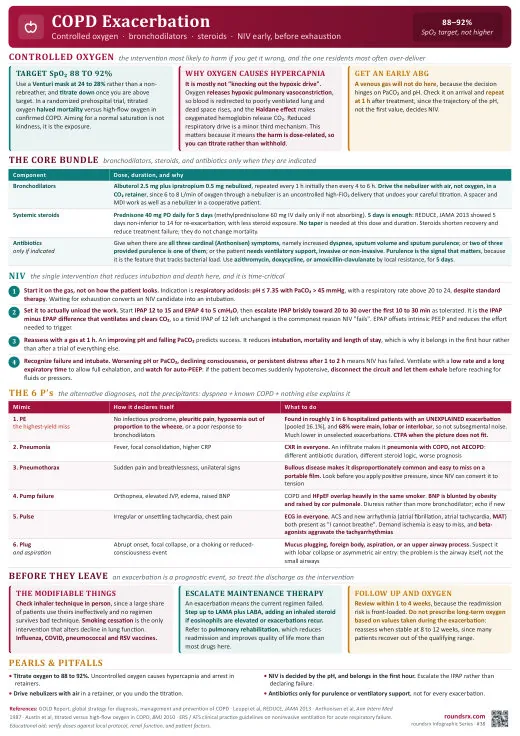
Text version
② Increased sputum volume
③ Increased sputum purulence
2–3 present → give antibiotics Anthonisen 1987
1 present → no antibiotic benefit
- SpO₂ 88–92% target
- ABG at 1–2h after NIV start
- K⁺ daily (albuterol + steroids)
- Glucose q6h (steroids)
- ECG -new AF common
- High-flow O₂ → CO₂ retention
- Steroids > 5 days (not needed)
- Antibiotics for viral AECOPD
- Missing PE, the highest-yield alternative diagnosis
- High PEEP in auto-PEEP patient
- High RR on vent → air trapping
- pH improving toward 7.35
- PaCO₂ stable or falling
- RR decreasing
- More alert and cooperative
- Accessory muscle use decreasing
- Brochard 1995: NIV reduces intubation + mortality
- REDUCE 2013: 5d steroids = 14d
- Anthonisen 1987: Antibiotic criteria
- Austin 2010: Titrated O₂ reduces mortality 58%
- UPLIFT 2008: Tiotropium reduces exacerbations