COPD -Chronic Management
Irreversible airflow obstruction (FEV₁/FVC < 0.70 post-bronchodilator). GOLD staging drives therapy. Inhaler selection matters -know the stepwise approach. For acute exacerbations requiring ICU management, see AECOPD (ICU).
↪
Also see: AECOPD (Acute Exacerbation, ICU) for inpatient management: NIV pathway, antibiotic selection, steroid burst, vent settings.
🔍 Overview
What changed in GOLD 2026 COPD Report (released January 2026): (1) Biologics codified for severe eosinophilic COPD -mepolizumab, benralizumab (anti-IL-5/IL-5R), and dupilumab (anti-IL-4Rα) for patients with frequent exacerbations and blood eosinophils ≥ 300 cells/μL despite optimized inhaler triple therapy. (2) ABE classification (introduced 2023) refined further -A (low symptom + low exacerbation), B (high symptom + low exacerbation), E (any exacerbations regardless of symptom). Old ABCD framework retired. (3) Triple therapy (LABA/LAMA/ICS) reserved for Group E with eos ≥ 300 OR persistent exacerbations on LABA/LAMA. ICS-without-LABA is not appropriate. Step-down to LABA/LAMA encouraged when eos low and stable. (4) Spirometry severity (GOLD 1-4) retained for FEV₁ % predicted; symptoms (CAT, mMRC) and exacerbation history drive treatment, not GOLD stage alone. (5) Smoking cessation -varenicline preferred, cytisinicline now available, combination NRT (patch + short-acting) emphasized. (6) Pulmonary rehab within 4 weeks post-exacerbation strongly emphasized -reduces 1-year mortality and rehospitalization.
Diagnosis
- Spirometry: post-bronchodilator FEV₁/FVC < 0.70 confirms airflow obstruction
- Symptoms: chronic dyspnea, cough, sputum production (≥ 3 months/year × 2 years = chronic bronchitis definition)
- Risk factors: smoking (> 10 pack-years), alpha-1 antitrypsin deficiency (test in early-onset or non-smoker COPD), biomass fuel exposure
GOLD Severity (by FEV₁)
| GOLD Stage | FEV₁ (% predicted) | Severity |
|---|---|---|
| GOLD 1 | ≥ 80% | Mild |
| GOLD 2 | 50–79% | Moderate |
| GOLD 3 | 30–49% | Severe |
| GOLD 4 | < 30% | Very severe |
GOLD Stage vs GOLD ABE -they answer two different questions. A common point of confusion. GOLD Stage 1-4 (FEV₁ % predicted) tells you how bad the airflow obstruction is -drives prognosis, LVRS / lung transplant eligibility, disability evaluations. GOLD ABE (symptoms + exacerbation history) tells you what treatment the patient needs -drives inhaler choice, biologic eligibility, post-exacerbation rehab triggers. Treatment is NOT driven by FEV₁ anymore. A patient with GOLD 1 (mild FEV₁) but frequent exacerbations is Group E and gets aggressive therapy; a patient with GOLD 4 but no exacerbations and low symptoms could be Group A on a bronchodilator alone. Rule of thumb: GOLD Stage → prognosis. GOLD ABE → inhaler.
GOLD ABE Groups (2023, refined in 2026)
The 2023 GOLD report simplified the old ABCD into ABE; the 2026 report refined the framework further (biologics codified for severe eosinophilic Group E, triple therapy step-down rules, ICS-without-LABA explicitly inappropriate). Assessment is based on symptoms + exacerbation history.
| Group | Symptoms (mMRC / CAT) | Exacerbations | Initial Therapy |
|---|---|---|---|
| A | Low (mMRC 0–1, CAT < 10) | 0–1 (not leading to hospitalization) | Bronchodilator (SABA PRN or LAMA or LABA) |
| B | High (mMRC ≥ 2, CAT ≥ 10) | 0–1 (not leading to hospitalization) | LABA + LAMA combination |
| E (Exacerbator) | Any | ≥ 2 moderate or ≥ 1 hospitalization | LABA + LAMA. Consider LABA + LAMA + ICS if eos ≥ 300. |
💊 Stepwise Therapy
▶ How to Escalate COPD Therapy, Step by Step (tap to expand)
GOLD 2023-2026 framework: initial therapy is driven by the ABE group (symptoms + exacerbation history), NOT the spirometry stage (GOLD 1-4 still informs prognosis but no longer chooses the drug). The 2023 update collapsed the old C/D groups into a single E (exacerbator). Two things every COPD patient gets regardless of step: smoking cessation (the only intervention that slows FEV₁ decline and reduces mortality) and the full vaccine bundle (flu, PCV20, COVID, Tdap, RSV ≥ 75 or 50-74 with risk conditions, Shingrix ≥ 50).
Step 1: Confirm diagnosis and grade severity
| Check | What | Why |
|---|---|---|
| Confirm COPD | Post-bronchodilator FEV₁/FVC < 0.70 on spirometry | Symptoms alone misdiagnose. Pre-bronchodilator obstruction may reverse and represent asthma. Without spirometry, you'll over-treat reversible disease and under-treat fixed obstruction. |
| Grade airflow limitation | GOLD 1 (FEV₁ ≥ 80%), GOLD 2 (50-79%), GOLD 3 (30-49%), GOLD 4 (< 30%) | Informs prognosis and qualifies for some interventions (lung volume reduction, transplant), but does not drive initial drug choice. |
| Check eosinophils | Baseline CBC with diff | Eos < 100: avoid ICS (no benefit, pneumonia risk). Eos 100-299: ICS uncertain, use judgment. Eos ≥ 300: ICS is helpful, especially in exacerbators (key threshold). |
| Assess alpha-1 antitrypsin | Once in every COPD patient, especially < 45 yr, lower lobe disease, family history, or never-smoker | AAT deficiency is treatable with augmentation therapy. Missing it is missing a specific therapy. GOLD recommends one-time testing in every COPD diagnosis. |
Step 2: Assign the ABE group
| Group | Symptoms | Exacerbations in past year | Initial Maintenance |
|---|---|---|---|
| A | Low (mMRC 0-1 or CAT < 10) | 0-1 moderate, no hospitalization | A bronchodilator (LAMA preferred, but any of SABA-PRN-only, LAMA, or LABA acceptable) |
| B | High (mMRC ≥ 2 or CAT ≥ 10) | 0-1 moderate, no hospitalization | LABA + LAMA (2023 update upgraded from single bronchodilator to combined; better FEV₁ and symptoms) |
| E | Any | ≥ 2 moderate, OR ≥ 1 hospitalization | LABA + LAMA; add ICS if eos ≥ 300 (initial triple therapy) |
Symptom tools: mMRC scores dyspnea 0-4 (0 = only with strenuous exercise; 4 = too breathless to leave the house). CAT scores impact across 8 domains 0-40. Use either, not both. The point of the symptom score is to detect a B patient hiding among A patients, frequent silent under-treatment when only spirometry is checked.
Step 3: Follow up at 4-12 weeks → Review, Assess, Adjust
The GOLD cycle:
- Review: symptoms (mMRC/CAT), exacerbations since last visit, inhaler technique (observed return-demonstration, ~70% of patients use them wrong), adherence.
- Assess: if persistent dyspnea or exacerbations, why? Wrong device? Wrong drug? Missed comorbidity (HF, OSA, bronchiectasis)? Continued smoking?
- Adjust: escalate, switch device, address comorbidity. Don't escalate without first verifying technique and adherence (the #1 reason for apparent treatment failure).
Step 4: Step up if persistent symptoms or exacerbations
| Current Regimen | Problem | Step Up |
|---|---|---|
| LAMA or LABA monotherapy | Persistent dyspnea | LABA + LAMA (combined inhaler preferred for adherence) |
| LABA + LAMA | Persistent exacerbations, eos ≥ 300 | Add ICS → ICS + LABA + LAMA triple (Trelegy, Breztri). IMPACT (2018) and ETHOS (2020) showed triple reduces exacerbations vs dual and ETHOS showed mortality benefit. |
| LABA + LAMA | Persistent exacerbations, eos < 100 | Add roflumilast (PDE4 inhibitor) for chronic bronchitis phenotype with FEV₁ < 50%, or azithromycin 250 mg daily or 500 mg 3×/wk for ex-smokers. ICS unlikely to help here. |
| Triple therapy | Persistent exacerbations, eos ≥ 300 | Add biologic (see Step 5) |
| Triple therapy | Persistent exacerbations, eos < 100, chronic bronchitis | Add roflumilast 500 mcg daily (REACT/RE2SPOND: ~17% exacerbation reduction). GI side effects rate-limit. |
| Triple therapy | Persistent exacerbations, frequent infections | Azithromycin 250 mg daily or 500 mg M/W/F. Check QTc and audiogram first (QT prolongation, ototoxicity). Most benefit in ex-smokers. |
Step 5: Biologic add-on for severe eosinophilic COPD (GOLD 2026)
Eligibility: severe eosinophilic COPD with frequent exacerbations (≥ 2 mod or ≥ 1 hospitalization in past year) AND blood eosinophils ≥ 300 cells/μL despite optimized triple therapy. GOLD 2026 codified this pathway after BOREAS (2023) and NOTUS (2024).
- Dupilumab (Dupixent) 300 mg SC q2 wk - IL-4Rα; preferred if elevated FeNO or atopy overlap.
- Mepolizumab (Nucala) 100 mg SC q4 wk - IL-5; MATINEE/METREX (2024) ~21% exacerbation reduction.
- Benralizumab (Fasenra) 30 mg SC q8 wk - IL-5Rα; q8 wk dosing advantage.
Step 6: Non-pharm interventions, layered at every step
| Intervention | When | Why |
|---|---|---|
| Smoking cessation | Every visit, every active smoker | The only intervention that slows FEV₁ decline and reduces mortality. Combine pharmacotherapy (varenicline or NRT) with counseling. |
| Pulmonary rehab | Symptomatic patients (mMRC ≥ 2), and ALL within 4 weeks of an exacerbation hospitalization | Reduces hospital readmission ~30%, improves exercise tolerance, dyspnea, QOL. Single highest-yield non-pharm intervention after smoking cessation. |
| Long-term oxygen therapy | Resting PaO₂ ≤ 55 or SpO₂ ≤ 88%, OR PaO₂ 56-59 with cor pulmonale, polycythemia (Hct > 55%), or peripheral edema. ≥ 15 hr/day. | NOTT (1980): > 15 hr/day O₂ reduced mortality. Not for isolated nocturnal or exercise desaturation (LOTT 2016 showed no benefit there). |
| Home NIV (BiPAP) | Stable severe hypercapnic COPD (PaCO₂ ≥ 52) with nocturnal hypoventilation or recent post-exacerbation hospitalization | HOT-HMV (2017): home NIV reduced readmission/death 17% in post-exacerbation hypercapnic patients. |
| Lung volume reduction (surgical or endoscopic valves) | Severe upper-lobe-predominant emphysema with hyperinflation and low exercise tolerance despite GDMT | NETT (2003): surgery improved exercise capacity and survival in upper-lobe-predominant, low-exercise-capacity subset. Endoscopic valves (Zephyr) approved 2018 for selected patients. |
| Lung transplant | Refractory severe COPD, FEV₁ < 25%, hypercapnia, pulmonary HTN, BODE 7-10 | End-stage when all other options exhausted. Refer early to a transplant center. |
| Vaccines | All patients | Influenza annually, PCV20 (or PCV15 + PPSV23), COVID-19, Tdap (then Td q10y), RSV ≥ 75 or 50-74 with risk conditions (chronic lung disease qualifies), Shingrix ≥ 50. Reduces exacerbations and pneumonia. |
Shortcuts that override the ladder
| Scenario | Do This | Why |
|---|---|---|
| ASTHMA-COPD overlap (history of asthma, atopy, eos high, reversible component on spirometry) | ICS-containing regimen from the start (ICS+LABA, escalate to triple as needed) | ICS-naive treatment is dangerous in asthma. Treat as asthma overlap when in doubt; don't withhold ICS waiting for exacerbation history. |
| Frequent pneumonia on ICS | Step down to LABA + LAMA (drop the ICS), especially if eos < 100 | TORCH and FLAME: ICS modestly raises pneumonia risk. If eos doesn't support ICS and patient gets pneumonia repeatedly, withdraw it. SUNSET (2018) showed safe ICS withdrawal in non-eos patients. |
| Persistent symptoms on optimized triple, eos < 100 | Re-evaluate diagnosis: HF (BNP, echo), bronchiectasis (CT chest), pulmonary HTN, OSA, deconditioning, anxiety | Comorbidity drives "treatment-resistant COPD" more often than under-treatment. Don't stack more drugs onto the wrong diagnosis. |
| Patient using SABA > 2×/week | Step up maintenance therapy | SABA overuse is a marker of poorly controlled disease, mirrors the asthma SABA-overuse signal (AUSTRI, etc.). |
| Acute exacerbation (worsening dyspnea, sputum volume/purulence) | Add oral steroid burst (prednisone 40 mg × 5 days, REDUCE 2013), antibiotic if increased purulence or hospitalized, increase short-acting bronchodilators. See COPD Exacerbation. | Acute management is separate from chronic escalation. After resolution, reassess group and consider step up. |
| Hypercapnic respiratory failure (pH < 7.35) | BiPAP first, intubate only if NIV fails or contraindicated | Brochard 1995: NIV reduces intubation 65%. Hypoxic drive concerns are overblown, target SpO₂ 88-92% to avoid hyperoxic CO₂ retention without underventilating. |
| Alpha-1 antitrypsin deficiency | Standard COPD therapy PLUS IV augmentation therapy (Prolastin, Zemaira) if ZZ phenotype with COPD | Disease-modifying for AAT, slows FEV₁ decline. Refer to specialty center. |
| End-of-life / palliative phase | Add low-dose opioids for dyspnea, anxiolytics for air hunger, palliative care referral | Morphine 1-2 mg PO q4h PRN provides dyspnea relief without respiratory depression at low dose. Pulm rehab + GDMT only goes so far in end-stage disease. |
Inhaler Therapy
| Drug Class | Examples | When | Key Notes |
|---|---|---|---|
| SABA PRN RESCUE | Albuterol (ProAir/Ventolin) 2 puffs q4–6h PRN | All patients -rescue inhaler | Quick onset (5–15 min). If using > 2×/week → step up maintenance therapy. |
| LAMA 1ST LINE MAINTENANCE | Tiotropium (Spiriva) 18 mcg daily Umeclidinium (Incruse) 62.5 mcg daily | Group A (monotherapy) or as part of combination | Preferred first-line maintenance in COPD (unlike asthma where ICS is first). Reduces exacerbations. Once-daily dosing. |
| LABA 1ST LINE MAINTENANCE | Salmeterol (Serevent) 50 mcg BID Formoterol 12 mcg BID Indacaterol (Arcapta) 75 mcg daily | Monotherapy or combination | Long-acting bronchodilator. Never use LABA alone in asthma (but OK in COPD). |
| LABA + LAMA GROUP B/E | Umeclidinium/vilanterol (Anoro Ellipta) Tiotropium/olodaterol (Stiolto) | Group B (symptomatic), Group E (exacerbator) | Dual bronchodilation = backbone of COPD therapy. Better than either alone for FEV₁, symptoms, and exacerbation reduction. |
| ICS (add-on) SELECTIVE USE | Fluticasone, budesonide (always in combination with LABA ± LAMA) | Only if eosinophils ≥ 300 or frequent exacerbations despite LABA+LAMA | ICS is NOT first-line in COPD (unlike asthma). Increases pneumonia risk TORCH, 2007. Use blood eosinophils to guide: ≥ 300 → add ICS. < 100 → avoid ICS. |
| Triple: ICS + LABA + LAMA ESCALATION | Fluticasone/umeclidinium/vilanterol (Trelegy Ellipta) | Group E with eos ≥ 300 or persistent exacerbations on dual | IMPACT, 2018: triple reduced exacerbations by 15% vs LAMA+LABA and 25% vs ICS+LABA. ETHOS, 2020: also showed mortality reduction. Best evidence for triple in high-eos exacerbators. |
| Biologics NEW 2026 | Mepolizumab (Nucala) 100 mg SC q4 wk Benralizumab (Fasenra) 30 mg SC q8 wk Dupilumab (Dupixent) 300 mg SC q2 wk | Severe eosinophilic COPD with frequent exacerbations AND blood eos ≥ 300 cells/μL despite optimized triple therapy | GOLD 2026 codified biologic add-on for severe eos COPD. Mepolizumab and benralizumab target IL-5 / IL-5R; dupilumab targets IL-4Rα (used in eos COPD with elevated FeNO or atopy overlap). BOREAS, 2023 · NOTUS, 2024 · MATINEE, 2024. Expensive ($30-40k/yr) -prior auth required. |
Vaccinations -All COPD Patients
- Influenza -annually
- Pneumococcal -PCV20 (Prevnar 20) or PCV15 + PPSV23
- COVID-19 -per current guidelines
- Tdap -if not previously received, then Td booster q10y
- RSV -routine at ≥ 75, or 50-74 with risk conditions such as chronic lung disease
- Zoster (Shingrix) -if ≥ 50
📋 On Rounds
Why is ICS not first-line in COPD the way it is in asthma?
COPD inflammation is primarily neutrophilic (driven by CD8+ T cells, neutrophils, macrophages) and relatively steroid-resistant. Asthma inflammation is eosinophilic (Th2-driven, mast cells, eosinophils) and highly steroid-responsive. ICS in COPD adds modest exacerbation reduction but significantly increases pneumonia risk TORCH, 2007.
When do you prescribe home oxygen in COPD?
Only for severe resting hypoxemia: PaO₂ ≤ 55 mmHg or SpO₂ ≤ 88% at rest on room air (or PaO₂ 56–59 with evidence of cor pulmonale or polycythemia). Must be measured when clinically stable, at rest, on room air. NOTT, 1980 showed mortality benefit for continuous O₂ (> 15 h/day).
What changed from GOLD ABCD to ABE?
The 2023 GOLD update merged groups C and D into a single group E (Exacerbator). Previously, C = low symptoms + frequent exacerbations, D = high symptoms + frequent exacerbations -but they had the same initial treatment (LABA+LAMA ± ICS), so the distinction was clinically unnecessary. Now: A = low symptoms/low exacerbations, B = high symptoms/low exacerbations, E = any symptoms with ≥ 2 moderate or ≥ 1 hospitalized exacerbation.
When do you prescribe long-term oxygen therapy (LTOT) in COPD and what's the evidence?
Indications for LTOT (≥ 15h/day): (1) Resting PaO₂ ≤ 55 mmHg or SpO₂ ≤ 88%, (2) PaO₂ 56-59 with evidence of cor pulmonale, polycythemia (Hct > 55%), or RHF. Evidence: NOTT, 1980 and MRC, 1981 showed LTOT ≥ 15h/day reduces mortality in COPD with severe resting hypoxemia. Continuous O₂ (> 18h/day) was better than nocturnal-only.
Case 1: GOLD Group E Frequent Exacerbator
67M with COPD, 3 exacerbations in the past year (Group E), FEV₁ 45% (GOLD 3), blood eosinophils 320 cells/μL, currently on Tiotropium (Spiriva) monotherapy. Presents for optimization. Step up to triple therapy: Fluticasone furoate/Umeclidinium/Vilanterol (Trelegy Ellipta), eosinophils ≥ 300 supports ICS addition per GOLD 2023. Add Roflumilast (Daliresp) 500 mcg daily given FEV₁ < 50% + chronic bronchitis (reduces exacerbations by 15–20%). Refer to pulmonary rehab. Continue Albuterol PRN rescue. Reassess eosinophils and PFTs in 3 months.
Case 2: Stable COPD with Dyspnea, Undertreated
72F with known COPD, GOLD Group B (FEV₁ 55%, mMRC 2, CAT score 14), using only Albuterol (ProAir) PRN. No hospitalizations. Dyspnea limits daily activities. Initiate LABA/LAMA combination: Umeclidinium/Vilanterol (Anoro Ellipta) once daily, dual bronchodilation is the backbone for Group B with high symptom burden. Assess and correct inhaler technique at every visit (70–80% use inhalers incorrectly). Check SpO₂ at rest; if ≤ 88%, initiate supplemental O₂ ≥ 15h/day. Reinforce smoking cessation and ensure vaccinations (PCV20, influenza, RSV, COVID-19) are current.
Case 3: COPD-Asthma Overlap (ACO)
58M, 30 pack-year smoking history, childhood asthma diagnosis, now with fixed airflow obstruction on PFTs but partial reversibility (post-BD FEV₁ improves > 12% and 200 mL). Blood eosinophils 450 cells/μL. ICS-containing regimen is mandatory, never LABA monotherapy in ACO (asthmatic component → LABA alone increases mortality per SMART trial). Start triple therapy: Budesonide/Glycopyrrolate/Formoterol (Breztri Aerosphere). If eosinophilic disease remains uncontrolled despite maximum inhaled therapy, consider add-on biologic: Dupilumab (Dupixent) targets IL-4/IL-13 and has FDA approval for uncontrolled COPD with eosinophilic phenotype.
📣 Sample Presentation
One-Liner
"Mr. Williams is a 66-year-old with COPD (GOLD stage II, FEV₁ 62%, Group E -2 exacerbations last year), currently on tiotropium only. Here for medication optimization."
Key Points to Cover on Rounds
COPD GOLD II, Group E (≥2 exacerbations/year). Current: LAMA only (tiotropium). Undertreated. Recommended per GOLD 2024: escalate to triple therapy (LAMA + LABA + ICS) given eosinophils 320 (>300 supports ICS). Prescription: fluticasone furoate/umeclidinium/vilanterol (Trelegy) 100/62.5/25 one puff daily. Rescue: albuterol PRN. Azithromycin 250 mg MWF for exacerbation prevention (eosinophils >100 + frequent exacerbations). Vaccinations: pneumococcal (PCV20), flu, COVID, RSV -all updated. Pulmonary rehab: referred. Smoking: quit 3 years ago -reinforced. LDCT screening: current. Plan: PFTs in 3 months, reassess.
⚡ Summary
Summary
Confirm the Diagnosis Spirometrically
Post-bronchodilator FEV1/FVC below 0.70 is required. A clinical diagnosis without spirometry is wrong roughly a third of the time, in both directions, and it commits patients to inhalers they may not need or misses asthma that would respond differently. GOLD 1 to 4 grades severity by FEV1.
Assign the ABE Group, Because It Sets the Therapy
Group A: few symptoms, no exacerbations. Group B: more symptoms, no exacerbations. Group E: any exacerbation history, 2 or more moderate or 1 requiring admission. The 2023 revision merged the old C and D into E, recognizing that exacerbation history dominates the treatment decision regardless of symptom burden.
Match the Inhaler to the Group
Group A: a bronchodilator. Group B: LABA plus LAMA combination, which beats either alone. Group E: LABA plus LAMA, adding an inhaled steroid when the blood eosinophil count is 300 cells/microlitre or more. The eosinophil count, not the symptom score, is what predicts inhaled steroid benefit.
Inhaled Steroids Are Not for Everyone
They increase pneumonia risk and, with eosinophils below 100, provide little benefit. Withdraw them in a patient with low eosinophils and no exacerbations. This is the opposite of asthma practice and it is where COPD prescribing most often drifts.
Check Inhaler Technique at Every Visit
A large proportion of patients use their device incorrectly, so what looks like treatment failure is frequently delivery failure. Check technique before escalating therapy, and match the device to the patient's inspiratory flow and dexterity rather than to habit.
The Non-Pharmacologic Interventions Are the Ones That Change Mortality
Smoking cessation is the only intervention proven to slow the decline in FEV1. Long-term oxygen therapy improves survival in resting hypoxemia, PaO2 55 mmHg or below, or 59 or below with cor pulmonale or polycythemia. Pulmonary rehabilitation improves symptoms, exercise capacity and quality of life more than any inhaler, and it is chronically under-referred.
Vaccinate Everyone
Influenza annually, pneumococcal, COVID-19, RSV in older adults, and Tdap. Vaccination reduces exacerbations, which is what drives lung function decline, hospitalization and death in this disease.
Know What to Add in Severe Disease
Roflumilast for chronic bronchitis with an FEV1 below 50% and frequent exacerbations. Azithromycin for frequent exacerbations, checking QTc and hearing. Dupilumab as a biologic add-on for severe eosinophilic COPD (GOLD 2026). Consider lung volume reduction or transplant referral in the right anatomy, screen for alpha-1 antitrypsin deficiency at least once, and introduce advance care planning early, since COPD trajectories are hard to predict.
📄 One Pager
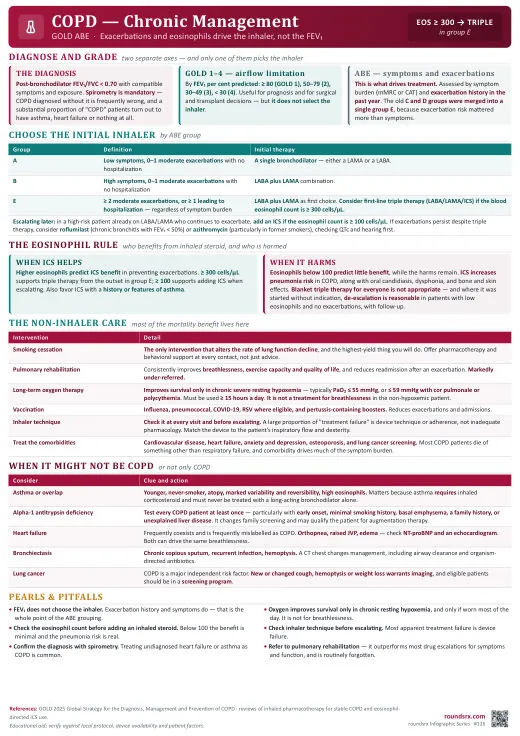
Text version
Pulmonology · One Pager
COPD
GOLD staging by FEV₁ + symptoms + exacerbations. Triple therapy (ICS/LABA/LAMA) for Group E. LTOT if SpO₂ ≤ 88%. Pulmonary rehab reduces hospitalizations. Vaccinations for all.
Classification
Spirometry: GOLD I-IV by FEV₁ %. Group A: few symptoms, 0-1 exacerbations. Group B: more symptoms, 0-1 exacerbations. Group E: ≥ 2 exacerbations/year or ≥ 1 hospitalization.
Acute Exacerbation
Prednisone 40 mg × 5 days + antibiotics (azithromycin or doxycycline if purulent sputum) + bronchodilators + O₂ target 88-92% (avoid O₂-induced hypercapnia). BiPAP for hypercapnic respiratory failure.
Chronic Management
Group A: SABA PRN. Group B: LABA or LAMA. Group E: LAMA + LABA + ICS (triple, if eos ≥ 300). Azithromycin 250 MWF (exacerbation prevention). LTOT if SpO₂ ≤ 88% [NOTT, MRC]. Pulmonary rehab. Vaccinations.
Key Drugs
Trelegy ElliptaICS/LAMA/LABA (triple)
Tiotropium18 mcg daily (LAMA)
Prednisone40 mg × 5d (exacerbation)
Azithromycin250 mg MWF (prevention)
Pitfalls
- O₂ target > 92% in COPD (risk of hypercapnia -target 88-92%)
- ICS without LABA (ICS monotherapy not recommended in COPD)
- Missing OSA overlap (common, worsens outcomes)
- Not referring for pulmonary rehab (most effective non-pharmacologic intervention)
Related Topics
AsthmaHemoptysisInterstitial Lung DiseaseObstructive Sleep ApneaPFT InterpretationPleural Effusion