Corticosteroids
Complete guide to systemic corticosteroids, glucocorticoid vs mineralocorticoid potency, equivalent dosing, duration of action, and when to choose which steroid. A high-yield reference that crosses every rotation.
🔍 Overview
Glucocorticoid vs Mineralocorticoid Activity
- Glucocorticoid activity, anti-inflammatory, immunosuppressive, metabolic (gluconeogenesis, protein catabolism, fat redistribution). This is the effect you want for most indications (asthma, autoimmune disease, cerebral edema, etc.).
- Mineralocorticoid activity, sodium retention, potassium excretion, volume expansion. Desired in adrenal insufficiency (replaces aldosterone), but an unwanted side effect in most other settings (causes edema, hypertension, hypokalemia).
- Key principle: All corticosteroids have BOTH activities in varying ratios. Choosing the right steroid means matching the glucocorticoid:mineralocorticoid profile to the clinical scenario.
Duration of Action Categories
| Category | Biologic Half-Life | Examples | Clinical Implication |
|---|---|---|---|
| Short-acting | 8–12 hours | Hydrocortisone (Solu-Cortef), Cortisone | Most physiologic. Mimics endogenous cortisol. Best for replacement therapy. Must dose BID-TID. |
| Intermediate-acting | 12–36 hours | Prednisone, Prednisolone, Methylprednisolone (Solu-Medrol), Triamcinolone | Workhorse steroids. Daily or BID dosing. Most common for anti-inflammatory use. |
| Long-acting | 36–72 hours | Dexamethasone (Decadron), Betamethasone | Most potent per mg. No mineralocorticoid activity. Daily dosing. Greatest HPA axis suppression. |
📊 Equivalency Table
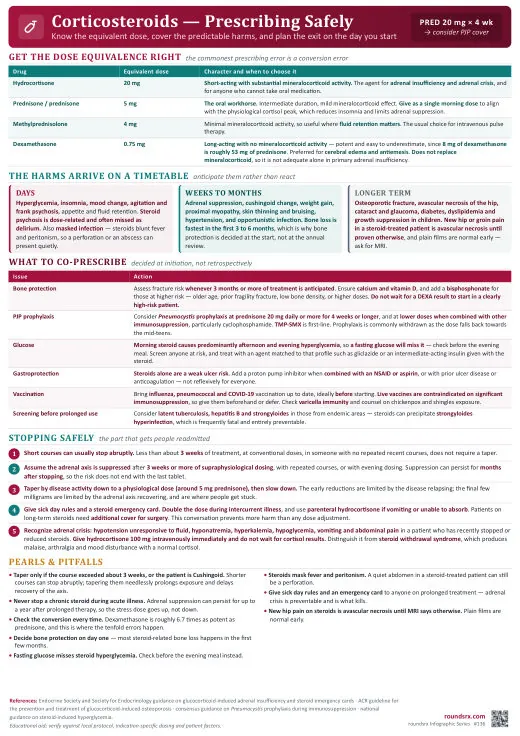
Steroid Equivalency & Potency Comparison
How to read this table: All doses shown are equivalent to 20 mg hydrocortisone (the body's daily physiologic cortisol output). A higher glucocorticoid potency number means you need LESS drug for the same anti-inflammatory effect.
| Steroid | Equivalent Dose | Glucocorticoid Potency vs Hydrocortisone (1×) | Mineralocorticoid Potency vs Hydrocortisone (1×) | Biologic Half-Life | Duration |
|---|---|---|---|---|---|
| Hydrocortisone (Solu-Cortef) Most physiologic, identical to endogenous cortisol |
20 mg | 1× | 1× | 8–12 h | Short |
| Cortisone Prodrug → converted to hydrocortisone in liver |
25 mg | 0.8× | 0.8× | 8–12 h | Short |
| Prednisone Most commonly prescribed oral steroid |
5 mg | 4× | 0.6× | 12–36 h | Intermediate |
| Prednisolone Active form of prednisone, use in liver failure |
5 mg | 4× | 0.6× | 12–36 h | Intermediate |
| Methylprednisolone (Solu-Medrol) IV steroid of choice, less mineralocorticoid than prednisone |
4 mg | 5× | 0.5× | 12–36 h | Intermediate |
| Triamcinolone (Kenalog) Common for intra-articular injections |
4 mg | 5× | 0× | 12–36 h | Intermediate |
| Dexamethasone (Decadron) Most potent, zero mineralocorticoid activity |
0.75 mg | 25–30× | 0× | 36–72 h | Long |
| Betamethasone (Celestone) Used for fetal lung maturity in preterm labor |
0.75 mg | 25–30× | 0× | 36–72 h | Long |
| Fludrocortisone (Florinef) Mineralocorticoid replacement, NOT used for anti-inflammatory effect |
N/A | 10× | 125× | 18–36 h | Intermediate |
Fludrocortisone is used purely for mineralocorticoid replacement in primary adrenal insufficiency (0.05–0.2 mg daily). Despite having glucocorticoid potency, it is NEVER used as an anti-inflammatory agent because the mineralocorticoid side effects (Na⁺ retention, K⁺ wasting, HTN) would be unacceptable at those doses.
🏥 Clinical Use
When to Use Which Steroid
| Clinical Scenario | Steroid of Choice | Why This One |
|---|---|---|
| Adrenal crisis / insufficiency replacement Most common steroid question on rounds |
Hydrocortisone 100 mg IV bolus → 50 mg q8h | Most physiologic. Provides BOTH glucocorticoid AND mineralocorticoid coverage. Mimics endogenous cortisol. Endocrine Society, 2016 |
| Relative adrenal insufficiency (CIRCI) Critical illness-related corticosteroid insufficiency |
Hydrocortisone 50 mg IV q6h × 7 days then taper | Adrenals cannot mount an adequate cortisol response to physiologic stress. Suspect in vasopressor-dependent shock not responding to fluids and pressors. Random cortisol <10 in critical illness is suggestive. SSC, 2021/2026: start steroids for septic shock with ongoing vasopressor requirement. APROCCHSS, 2018 |
| Adrenal insufficiency, need cosyntropin stim test | Dexamethasone 4 mg IV q12h | Does NOT cross-react with cortisol assay → lets you treat the patient AND still get a valid cosyntropin stimulation test result. Switch to hydrocortisone once diagnosis confirmed. |
| Cerebral edema / increased ICP | Dexamethasone 10 mg IV load → 4 mg q6h | Most potent anti-inflammatory. Zero mineralocorticoid activity = no sodium/water retention that would worsen cerebral edema. Galicich & French, 1961 |
| Bacterial meningitis (adjunctive) | Dexamethasone 0.15 mg/kg q6h × 4 days | Reduces inflammation and hearing loss. Must give BEFORE or WITH first antibiotic dose. de Gans, 2002 |
| COPD exacerbation | Methylprednisolone 125 mg IV (inpatient) OR Prednisone 40 mg PO daily × 5 days | IV methylprednisolone for acute ED/inpatient management, then transition to PO prednisone 40 mg daily to complete a 5-day course. REDUCE, 2013 GOLD, 2024 |
| Asthma exacerbation | Prednisone 40–60 mg PO daily × 5–7 days OR Dexamethasone 16 mg PO × 2 days | Dex option emerging as single-dose/2-day alternative in ED. Prednisone is traditional standard. Rehrer, 2016 |
| Autoimmune flare (SLE, vasculitis, etc.) | Methylprednisolone 1g IV daily × 3 days ("pulse"), then Prednisone taper | IV pulse for rapid immunosuppression. Methylprednisolone preferred IV, less mineralocorticoid than hydrocortisone at high doses. EULAR, 2020 |
| Spinal cord compression | Dexamethasone 10 mg IV load → 4 mg q6h | Same rationale as cerebral edema, maximal anti-inflammatory, no fluid retention. |
| Croup | Dexamethasone 0.6 mg/kg PO/IM × 1 dose | Long half-life = single dose sufficient. Well-studied in pediatrics. Bjornson, Cochrane 2013 |
| Thyroid storm | Hydrocortisone 100 mg IV q8h | Blocks peripheral T4→T3 conversion. Treats relative adrenal insufficiency from hypermetabolic state. Mineralocorticoid activity is acceptable here. ATA, 2016 |
| Septic shock (refractory) | Hydrocortisone 50 mg IV q6h × 7 days | Low-dose stress steroids for vasopressor-refractory shock. SSC, 2021/2026 ADRENAL, 2018 APROCCHSS, 2018 |
| Fetal lung maturity (preterm labor) | Betamethasone 12 mg IM × 2 doses 24h apart | Crosses placenta effectively. No mineralocorticoid activity. Standard of care 24–34 weeks gestation. Liggins & Howie, 1972 |
| Chronic replacement (primary AI) | Hydrocortisone 15–20 mg AM + 5–10 mg PM + Fludrocortisone 0.05–0.2 mg daily | Hydrocortisone for glucocorticoid + some mineralocorticoid. Fludrocortisone added because primary AI loses both cortisol AND aldosterone. Endocrine Society, 2016 |
| Chronic replacement (secondary AI) | Hydrocortisone 15–20 mg AM + 5–10 mg PM | No fludrocortisone needed, aldosterone production is preserved (renin-angiotensin axis intact). |
| Liver failure patient needing steroids | Prednisolone or Methylprednisolone | Prednisone is a prodrug that requires hepatic conversion to prednisolone. In liver failure, use the active form directly. |
Key Clinical Pearls
Prednisone vs Prednisolone: Prednisone is a prodrug, the liver converts it to active prednisolone. In severe liver disease or hepatic failure, use prednisolone (or methylprednisolone IV) directly since the conversion may be impaired.
Dexamethasone + cosyntropin stim test: When you suspect adrenal insufficiency but want to treat BEFORE confirming, use dexamethasone instead of hydrocortisone. Dex does NOT cross-react with the cortisol assay used in the cosyntropin stimulation test, so you can treat and test simultaneously.
Mineralocorticoid effects at high doses: Even steroids with "low" mineralocorticoid potency (like prednisone) can cause significant Na⁺ retention, edema, and HTN when used at high doses (≥40 mg/day). This is why methylprednisolone or dexamethasone are preferred for high-dose IV pulse therapy, minimal mineralocorticoid effect.
⚠️ Side Effects
Adverse Effects by System
| System | Effect | Mechanism / Notes |
|---|---|---|
| Metabolic Most common overall | Hyperglycemia, insulin resistance | Gluconeogenesis + peripheral insulin resistance. Check BG q6h on all inpatients started on steroids. May need sliding scale or basal insulin adjustment. RABBIT 2, 2011 |
| Musculoskeletal | Osteoporosis, avascular necrosis, myopathy | Bone: inhibits osteoblasts + Ca²⁺ absorption. Start calcium + vitamin D + consider bisphosphonate if ≥3 months of prednisone ≥7.5 mg/day. AVN: hip most common. ACR, 2022 |
| Infectious | Immunosuppression, opportunistic infections | PJP prophylaxis (TMP-SMX) if prednisone ≥20 mg/day for ≥1 month. Reactivation risk: TB, strongyloides, HBV. IDSA/ATS Guidelines |
| GI | Peptic ulcer (with NSAIDs), GI bleed | Steroids alone = low ulcer risk. Steroids + NSAIDs together = significantly increased risk → add PPI. |
| Psychiatric | Insomnia, agitation, psychosis, mania | Dose-dependent. Most common with prednisone ≥40 mg/day. Give AM dosing to minimize insomnia. Steroid psychosis more common than appreciated. |
| Endocrine | HPA axis suppression, adrenal atrophy | Risk if ≥20 mg prednisone equivalent daily for ≥3 weeks. Cannot abruptly stop, must taper. Cushingoid features with chronic use. |
| Cardiovascular | HTN, fluid retention, hypokalemia | Mineralocorticoid effect. Worse with hydrocortisone/cortisone/fludrocortisone. Monitor K⁺ and BP. |
| Ophthalmologic | Cataracts (posterior subcapsular), glaucoma | Risk increases with dose and duration. Screen with ophthalmology if chronic use anticipated. |
| Dermatologic | Skin thinning, easy bruising, poor wound healing, striae | Inhibits collagen synthesis. Counsel patients on increased skin fragility. |
Three things to do for EVERY patient started on steroids: (1) Check blood glucose q6h and cover with insulin. (2) Start GI prophylaxis if also on NSAIDs or anticoagulants. (3) Plan the taper from day one, do not start steroids without an exit strategy.
📉 Tapering
When to Taper vs Abrupt Stop
- Can stop abruptly: Short course (≤2 weeks) at any dose, OR low dose (≤10 mg prednisone) for any duration, OR alternate-day regimen.
- Must taper: ≥20 mg prednisone equivalent daily for ≥3 weeks. Also taper if ANY duration on supraphysiologic doses AND the patient has Cushingoid features or symptoms of HPA suppression.
- General rule: The longer the patient was on steroids, the slower the taper. There is no single correct taper, individualize based on the disease being treated and the patient's symptoms.
Sample Taper Strategies
| Starting Dose | Taper Approach | Notes |
|---|---|---|
| Prednisone ≥40 mg/day | Decrease by 10 mg every 1–2 weeks until 20 mg, then by 5 mg every 1–2 weeks until 10 mg, then by 2.5 mg every 1–2 weeks | Slower taper below 10 mg, this is where HPA axis recovery happens |
| Prednisone 20–40 mg/day | Decrease by 5 mg every 1–2 weeks until 10 mg, then by 2.5 mg every 1–2 weeks | Watch for disease flare and adrenal insufficiency symptoms during taper |
| Stress-dose hydrocortisone | 100 mg q8h → 50 mg q8h → 25 mg q8h → physiologic replacement (15–20 mg AM, 5–10 mg PM) | Taper over 3–5 days once acute illness resolving |
Signs of too-fast taper: fatigue, malaise, arthralgias, myalgias, nausea, orthostatic hypotension. These may represent adrenal insufficiency OR disease flare, check an AM cortisol to differentiate. If cortisol low → slow the taper. If cortisol normal → likely disease flare → increase dose back up.
🩺 Rounds
Pimp Questions
Why do you use dexamethasone instead of hydrocortisone when you still need to confirm adrenal insufficiency with a cosyntropin stim test?
Hydrocortisone IS cortisol, it cross-reacts with the cortisol immunoassay and will falsely elevate the measured cortisol level, invalidating the stim test results. Dexamethasone is a synthetic steroid that does NOT cross-react with the cortisol assay, so you can treat the patient and still get an accurate stim test.
Why is methylprednisolone preferred over hydrocortisone for IV pulse therapy in autoimmune disease?
At high pulse doses (500–1000 mg), hydrocortisone's mineralocorticoid activity would cause massive sodium and water retention, hypertension, and hypokalemia. Methylprednisolone has minimal mineralocorticoid activity, so you get the immunosuppression without the volume overload.
A patient with cirrhosis needs steroids for an autoimmune hepatitis flare. Why should you use prednisolone instead of prednisone?
Prednisone is a prodrug that requires hepatic conversion to its active form, prednisolone. In a patient with severe liver disease, this conversion may be impaired, leading to a subtherapeutic response. Prednisolone is already the active form and bypasses this step.
Why does primary adrenal insufficiency require fludrocortisone but secondary does not?
In primary AI, the adrenal gland itself is destroyed → you lose BOTH cortisol (glucocorticoid) AND aldosterone (mineralocorticoid). Fludrocortisone replaces the missing aldosterone. In secondary AI, the problem is pituitary ACTH deficiency → cortisol drops, but aldosterone production is still intact because it is regulated by the renin-angiotensin system, NOT ACTH.
What is the physiologic daily cortisol output, and which steroid dose is equivalent?
The body produces ~15–25 mg of cortisol daily (average ~20 mg). This equals hydrocortisone 20 mg, prednisone 5 mg, methylprednisolone 4 mg, or dexamethasone 0.75 mg. Anything above this is "supraphysiologic" and carries risk of HPA axis suppression with chronic use.
Why is dexamethasone the steroid of choice for cerebral edema and not hydrocortisone?
Dexamethasone has ZERO mineralocorticoid activity, no sodium or water retention. Hydrocortisone would worsen cerebral edema through its mineralocorticoid effect. Dex is also the most potent glucocorticoid per mg (25–30× hydrocortisone), giving maximum anti-inflammatory effect with minimum volume.