Cushing's Syndrome
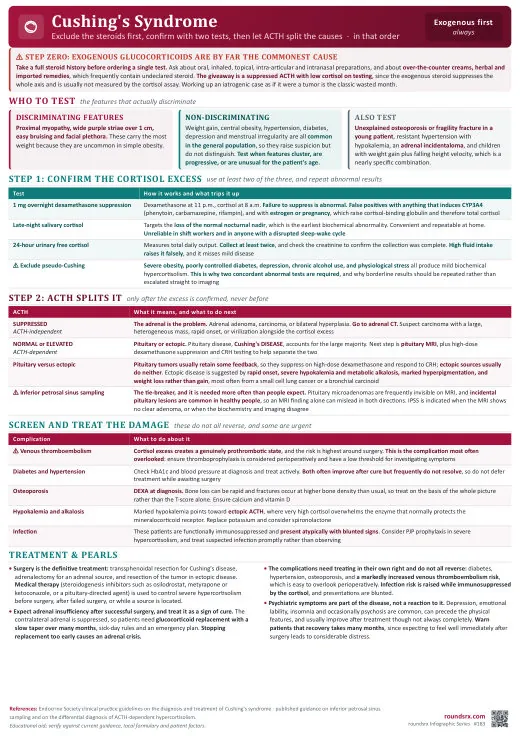
Cushing's syndrome = clinical manifestations of chronic cortisol excess. Exogenous (iatrogenic steroids) is by far the most common cause overall. Among endogenous causes: Cushing's disease (ACTH-secreting pituitary adenoma, ~70%), ectopic ACTH (small cell lung cancer, carcinoid, ~15%), adrenal adenoma/carcinoma (~15%). Classic features: central obesity, moon facies, dorsal fat pad (buffalo hump), violaceous striae (> 1 cm wide), proximal muscle weakness, easy bruising, hyperglycemia, HTN, osteoporosis, hirsutism, menstrual irregularity, depression/psychosis. Key teaching point: the workup is a 3-step process -(1) confirm hypercortisolism, (2) determine ACTH dependence, (3) localize the source.
- Step 1 -Confirm hypercortisolism (need 2 of 3 tests positive):
- 24-hour urine free cortisol (× 2) -elevated > 3× ULN is virtually diagnostic. Mild elevations can be false positive (pseudo-Cushing: alcoholism, depression, obesity).
- Late-night salivary cortisol (× 2) -loss of diurnal cortisol rhythm. Cortisol should nadir at 11 PM. Elevated = abnormal. Convenient outpatient test.
- 1 mg overnight dexamethasone suppression test (DST) -give dex 1 mg PO at 11 PM → check 8 AM cortisol. Normal: cortisol < 1.8 mcg/dL (suppressed). Cushing's: cortisol fails to suppress (> 1.8). Nieman, 2008
- Step 2 -ACTH level (determine dependence):
- ACTH elevated (> 20 pg/mL) → ACTH-dependent: pituitary (Cushing's disease) vs ectopic ACTH
- ACTH suppressed (< 5 pg/mL) → ACTH-independent: adrenal source (adenoma, carcinoma, bilateral hyperplasia)
- Step 3 -Localize:
- ACTH-dependent: MRI pituitary (60% show adenoma). If MRI negative or equivocal → inferior petrosal sinus sampling (IPSS) with CRH stimulation (gold standard to confirm pituitary vs ectopic).
- ACTH-independent: CT adrenals (adenoma vs carcinoma vs bilateral hyperplasia)
- Ectopic ACTH: CT chest/abdomen (small cell, carcinoid, thymic tumors). Octreotide scan. PET/CT.
| Drug | Dose | Route | Notes |
|---|---|---|---|
| Ketoconazole | 200-400 mg BID-TID | PO | Steroidogenesis inhibitor. Most commonly used medical therapy. Monitor LFTs (hepatotoxicity). QTc prolongation. Drug interactions (CYP3A4). |
| Metyrapone | 250-750 mg TID-QID | PO | 11β-hydroxylase inhibitor. Blocks cortisol synthesis. Can cause hyperandrogenism (hirsutism, acne). Monitor cortisol + ACTH. |
| Osilodrostat | 2-7 mg BID | PO | 11β-hydroxylase inhibitor. Newer. LINC-3, 2022. QTc monitoring. Adrenal insufficiency risk. |
| Mifepristone | 300-1200 mg daily | PO | GR antagonist. FDA-approved for Cushing's-associated hyperglycemia. Cannot monitor cortisol (blocked receptor). Monitor clinically. SEISMIC, 2012 |
| Pasireotide | 0.6-0.9 mg SQ BID | SQ | Somatostatin analog for Cushing's disease. Hyperglycemia is major side effect (up to 70%). |
| Mitotane | 2-6 g/day (titrate) | PO | Adrenolytic -for adrenal carcinoma. Causes AI (needs replacement). Monitor levels (target 14-20 mcg/mL). Teratogenic. |
Patient: 36F with 25 lb central weight gain, new T2DM, HTN, wide purple striae, easy bruising, and proximal weakness × 10 months. Moon facies, dorsocervical fat pad. No exogenous steroids.
Key findings: 24h UFC 420 mcg (4× ULN), late-night salivary cortisol elevated, 1 mg DST cortisol 14.2 (failed suppression). ACTH 72 pg/mL (elevated → ACTH-dependent). MRI pituitary: 7 mm adenoma.
Management:
- Confirm ACTH-dependent Cushing's: high-dose DST (8 mg) → > 50% suppression supports pituitary source
- Referral for transsphenoidal surgery (TSS), first-line, cure rate 70-90% for microadenomas
- Pre-op: insulin for hyperglycemia, VTE prophylaxis (Cushing's is hypercoagulable), PCP prophylaxis with TMP-SMX
- Post-op: expect adrenal insufficiency (start hydrocortisone 15-20 mg/day, taper over months)
- If TSS fails or recurrence: repeat surgery, radiation, bilateral adrenalectomy, or medical therapy (ketoconazole, osilodrostat)
Teaching point: After successful TSS, cortisol should be undetectable (< 2 mcg/dL), this confirms cure. Patients will need glucocorticoid replacement for 6-18 months until the suppressed HPA axis recovers.
Patient: 58M smoker with rapid-onset HTN, hypokalemia (K⁺ 2.4), hyperglycemia (glucose 380), and proximal weakness over 6 weeks. Hyperpigmented. No classic Cushingoid body habitus (too rapid for fat redistribution).
Key findings: ACTH 280 pg/mL (markedly elevated), UFC > 1000 mcg. High-dose DST: no suppression. CT chest: 3 cm RLL mass with hilar lymphadenopathy. Consistent with ectopic ACTH from SCLC.
Management:
- Aggressive K⁺ replacement + spironolactone (mineralocorticoid excess from cortisol overwhelming 11β-HSD2)
- Ketoconazole 200 mg TID or metyrapone to rapidly lower cortisol (medical adrenalectomy)
- Oncology: staging and treatment of SCLC (chemo ± radiation)
- If refractory hypercortisolism: bilateral adrenalectomy (definitive but causes permanent AI)
- VTE prophylaxis, extreme hypercortisolism is profoundly prothrombotic
Teaching point: Ectopic ACTH presents differently from pituitary Cushing's: rapid onset, severe hypokalemia, very high ACTH (> 200), and hyperpigmentation. The patient often looks sick, not Cushingoid, because fat redistribution takes months.
Patient: 65F with RA on prednisone 20 mg daily × 2 years. Moon facies, central obesity, osteoporosis (T-score -3.2), T2DM, recurrent oral candidiasis. Rheumatologist requests steroid taper advice.
Key findings: Iatrogenic Cushing syndrome, the #1 cause of Cushing's overall. Chronic exogenous steroids have suppressed the HPA axis. Abrupt discontinuation → adrenal crisis.
Management:
- Slow taper: reduce by 2.5 mg q2-4 weeks until physiologic dose (5 mg prednisone ≈ 20 mg hydrocortisone)
- Below physiologic dose: switch to hydrocortisone 10-15 mg/day and taper by 2.5 mg q2-4 weeks
- ACTH stimulation test before final discontinuation, if cortisol > 18 mcg/dL, axis has recovered
- DMARD optimization for RA (methotrexate, biologics) to enable steroid discontinuation
- Address complications: DEXA + bisphosphonate for osteoporosis, diabetes management, PCP prophylaxis if > 20 mg/day
Teaching point: Exogenous steroids at any dose for > 3 weeks can suppress the HPA axis. Always taper, never stop abruptly. Patients on chronic steroids need stress-dose steroids for surgery or acute illness until axis recovery is confirmed.
Ms. Rivera is a 38-year-old woman with new-onset diabetes, HTN, 30 lb weight gain (central), wide purple striae on abdomen, and proximal weakness × 8 months. No exogenous steroid use. Labs: 24h UFC 380 mcg (3× ULN), late-night salivary cortisol 0.85 mcg/dL (elevated), 1 mg DST cortisol 12.4 (failed suppression). ACTH 68 pg/mL (elevated). MRI pituitary: 8 mm left-sided adenoma.
- 24h urine free cortisol -to monitor treatment response. Target: normalization.
- AM cortisol + ACTH -post-TSS: check day 1-3. Undetectable cortisol (< 2) = successful surgery. Patient needs hydrocortisone replacement.
- Morning cortisol off replacement -periodically to assess HPA axis recovery (may take 6-18 months post-surgery). Cosyntropin stim test when cortisol approaches normal.
- LFTs q2-4 weeks on ketoconazole
- ECG (QTc) on ketoconazole, osilodrostat
- Blood glucose -Cushing's causes insulin resistance. May need insulin during active disease. Hyperglycemia also a major side effect of pasireotide.
- DEXA scan -osteoporosis screening (cortisol excess → bone loss)
- MRI pituitary annually × 5 years post-TSS (recurrence monitoring)