Cyclosporiasis (Cyclospora cayetanensis)
Source and recall: The traceback points to shredded iceberg lettuce (Taylor Farms de Mexico) served at Taco Bell locations in Indiana, Kentucky, Michigan, Ohio, and West Virginia. On July 17, 2026, Taylor Farms de Mexico recalled all iceberg lettuce sourced from central Mexico.
Why this matters clinically: Suspect cyclosporiasis in any patient with prolonged (more than 1 week) or relapsing watery diarrhea, especially with a fresh-produce exposure. Standard stool ova-and-parasites (O&P) does not detect Cyclospora, so the diagnosis is missed unless you order it specifically. Sources: CDC HAN (HAN00531, 2026); CDC Cyclosporiasis Outbreak Investigation (July 2026); Infection Control Today, 2026.
- Fecal-oral, via contaminated food or water, not directly person-to-person. Freshly passed oocysts are not immediately infectious: they need days to weeks in the environment to sporulate (mature). This is why direct person-to-person spread does not occur, and why hospital contact precautions beyond standard hygiene are not required.
- Classic vehicles are fresh produce that is eaten raw and can hold onto oocysts: leafy greens (iceberg/romaine lettuce), fresh herbs (cilantro, basil), raspberries, blackberries, snow peas, and mesclun. The 2026 US outbreak is lettuce-linked.
- Seasonality: US cases cluster in spring and summer (May through August), which is why an outbreak in July fits the expected pattern.
- Washing does not reliably remove it. Oocysts adhere tightly to produce surfaces and are resistant to routine chlorine and sanitizer washes, so ordinary rinsing cannot be relied on to make contaminated produce safe (see Prevention).
- Watery, non-bloody diarrhea is the hallmark, often frequent and profuse.
- Relapsing / remitting course is highly characteristic: patients improve, then relapse. Untreated illness commonly lasts several weeks and can persist a month or more, which is why it is a leading cause of prolonged traveler's and foodborne diarrhea.
- Profound anorexia, fatigue, and weight loss are disproportionate to a "simple" gastroenteritis and are a useful clue.
- Other features: abdominal cramping, bloating, marked flatulence, nausea, low-grade fever, and myalgias.
- Immunocompromised (advanced HIV, transplant): more severe, voluminous, and protracted diarrhea; biliary tract involvement (acalculous cholecystitis) can occur.
- Watery diarrhea lasting more than ~1 week, or a relapsing diarrheal course, in an otherwise immunocompetent patient. Prolonged duration is the key trigger, since most bacterial and viral gastroenteritis resolves in days.
- Fresh-produce or contaminated-water exposure, restaurant/outbreak link, or travel to an endemic region (Latin America, South/Southeast Asia).
- Diarrhea plus disproportionate fatigue, anorexia, and weight loss.
| Test | What it shows / why it works | Notes |
|---|---|---|
| Molecular multiplex GI PCR panel | Most sensitive and fastest. Several FDA-cleared gastrointestinal pathogen panels include Cyclospora cayetanensis. Detects parasite DNA directly. | PREFERRED where available Increasingly the first-line test; does not depend on catching oocysts on a slide. |
| Modified acid-fast stain (modified Ziehl-Neelsen / Kinyoun) | Oocysts are 8 to 10 μm (about twice the size of Cryptosporidium, ~4 to 6 μm). They are variably acid-fast: in the same field, oocysts range from unstained to light pink to deep red. | Requires the lab to be told to look; not part of a routine O&P. |
| UV autofluorescence microscopy | Oocysts autofluoresce blue-green under ultraviolet epifluorescence against a dark background. Rapid and sensitive screening method. | Sensitive but not specific; confirm with stain or molecular test. |
| Stool wet mount / O&P | Standard parasite exam. Insensitive for Cyclospora and easily missed. | DOES NOT rule it out A negative routine O&P does not exclude cyclosporiasis. |
- CBC: eosinophilia is not typical (unlike many helminths), so a normal eosinophil count does not argue against it.
- BMP: assess for dehydration and electrolyte loss from prolonged diarrhea.
- Consider co-testing for other stool pathogens; Cyclospora can co-occur with other foodborne organisms in an outbreak setting.
- Antiparasitic therapy: TMP-SMX (trimethoprim-sulfamethoxazole) is the treatment of choice. It is the only reliably effective agent. Untreated illness is prolonged and relapsing, so treating shortens the course and prevents relapse rather than just easing symptoms.
- Rehydration and supportive care: oral rehydration for most; IV fluids if volume-depleted from profuse or prolonged diarrhea. Replace electrolytes as needed.
- Immunocompromised patients need more: higher doses, longer duration, and often long-term secondary suppression (see Medications), because relapse is common once therapy stops.
- Public health reporting: cyclosporiasis is a nationally notifiable condition. Report confirmed and suspected cases to your state or local health department, especially during the current outbreak, so traceback and recalls can proceed.
- Do not rely on a routine O&P to exclude it before treating a compatible prolonged/relapsing diarrhea, order the specific test.
- Do not expect antibacterial "traveler's diarrhea" regimens to cover it. Azithromycin and standard fluoroquinolone empiric dosing are not reliable Cyclospora therapy; the parasite needs TMP-SMX.
- Do not stop antiparasitic therapy early in the immunocompromised, relapse is the rule without an adequate course and suppression.
| Agent | Dose & Duration | Role / Why |
|---|---|---|
| TMP-SMX (Bactrim/Septra) DS 1ST LINE | 1 double-strength tablet (TMP 160 mg / SMX 800 mg) PO twice daily × 7 to 10 days (immunocompetent adults and children over 2 months). Pediatric: TMP 5 mg/kg / SMX 25 mg/kg PO BID. | The only reliably effective agent. 7 to 10 days covers the full course and prevents the characteristic relapse; shorter courses risk recurrence. |
| TMP-SMX (immunocompromised) | Higher dose / longer course during acute illness, then secondary suppression: 1 DS tablet PO 3 times weekly while immunosuppressed (e.g., advanced HIV until immune reconstitution). | Immunosuppressed patients relapse without prolonged therapy and maintenance suppression, mirroring the approach used for other coccidian parasites in HIV. |
| Nitazoxanide (Alinia) SULFA ALLERGY | 500 mg PO twice daily × 7 days (adult). | Considered for true sulfa allergy, but evidence is limited and efficacy is inconsistent. No alternative matches TMP-SMX. |
| Ciprofloxacin SULFA ALLERGY | 500 mg PO twice daily × 7 days (adult). | Second-line for sulfa-allergic patients. Less effective than TMP-SMX with slower symptom resolution; use when nitazoxanide is unavailable or fails. |
- Washing produce reduces but does not eliminate risk. Cyclospora oocysts stick tightly to produce and resist routine chlorine/sanitizer washing, so rinsing cannot be relied on to make contaminated produce safe. During an active outbreak, avoiding the implicated product is the only reliable measure.
- During the 2026 outbreak: follow CDC/FDA advisories, avoid recalled iceberg lettuce (Taylor Farms de Mexico, central-Mexico sourced), and heed restaurant-specific warnings.
- Cooking kills the parasite; the risk is from raw/fresh produce. When in doubt in a high-risk period, cooked produce is safe.
- Travelers to endemic regions should follow safe food and water practices (avoid raw produce and untreated water) during spring/summer months when transmission peaks.
- Report cases. Cyclosporiasis is nationally notifiable; prompt reporting lets public health link cases, identify the food vehicle, and trigger recalls that stop the outbreak.
- No person-to-person precautions beyond standard hygiene are needed in the hospital, because freshly shed oocysts are not infectious until they sporulate in the environment. Standard hand hygiene is sufficient.
- No vaccine exists; prevention is entirely food/water safety and outbreak avoidance.
Patient: 44F, healthy, presents with 10 days of frequent watery, non-bloody diarrhea that briefly improved then relapsed. Marked fatigue, anorexia, and 5-lb weight loss. Ate at a fast-food restaurant with shredded lettuce ~1 week before onset.
Key findings: Afebrile to low-grade fever, mild orthostasis, no eosinophilia. Initial routine stool O&P negative. Local outbreak of cyclosporiasis reported.
Management:
- Ordered Cyclospora-specific testing (molecular GI panel) rather than trusting the negative O&P
- Molecular panel positive for Cyclospora cayetanensis
- TMP-SMX DS 1 tab PO BID × 7 to 10 days + oral rehydration
- Reported to the local health department (outbreak traceback)
Teaching point: Prolonged/relapsing watery diarrhea + fresh-produce exposure + negative routine O&P is the classic trap. Order the specific test and treat with TMP-SMX.
Patient: 52M with documented sulfonamide allergy (prior urticaria), 2 weeks of relapsing watery diarrhea, weight loss, confirmed Cyclospora on molecular panel.
Management:
- Cannot use first-line TMP-SMX given allergy history
- Started nitazoxanide 500 mg PO BID × 7 days; counseled that response may be incomplete
- Ciprofloxacin 500 mg PO BID × 7 days held as backup if no improvement
- Close follow-up arranged given the lack of a highly effective non-sulfa option
Teaching point: There is no equal substitute for TMP-SMX. Nitazoxanide or ciprofloxacin are fallbacks, and the patient needs follow-up because response is less reliable.
Patient: 39M with advanced HIV (CD4 40), profuse, voluminous, protracted watery diarrhea for over 3 weeks, dehydration, RUQ discomfort.
Key findings: Cyclospora confirmed; ultrasound suggests acalculous cholecystitis (biliary involvement can occur in advanced immunosuppression).
Management:
- Higher-dose, longer-course TMP-SMX for acute illness
- Secondary suppression (1 DS tablet PO 3×/week) until immune reconstitution on ART
- Aggressive rehydration and electrolyte repletion
- Start/optimize antiretroviral therapy, immune recovery is the durable fix
Teaching point: In advanced immunosuppression, cyclosporiasis is severe and relapsing. Treat longer and maintain suppression until CD4 recovers.
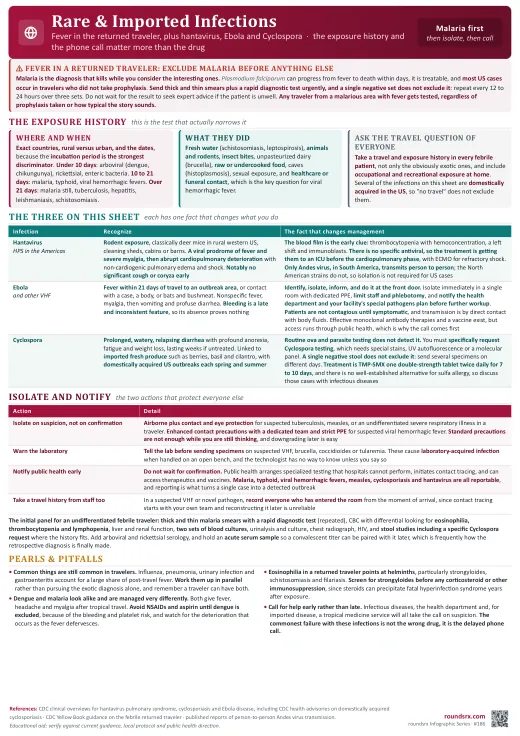
Text version
- Watery, non-bloody, prolonged (more than 1 week) or relapsing diarrhea + fatigue, anorexia, weight loss
- Incubation median ~7 days; fresh-produce/water or outbreak/travel exposure
- Order Cyclospora-specific testing: molecular GI PCR panel (preferred), modified acid-fast stain, or UV autofluorescence
- Oocysts 8 to 10 μm, variably acid-fast, autofluoresce blue-green
- Intermittent shedding, collect 2 to 3 specimens on different days; one negative does not exclude
- Eosinophilia is NOT expected, a normal count does not argue against it
- TMP-SMX DS (160/800 mg) 1 tab PO BID × 7 to 10 days, immunocompetent adults/children over 2 months (only reliably effective agent; prevents relapse)
- Rehydrate (oral, or IV if volume-depleted); replace electrolytes
- Sulfa allergy: nitazoxanide 500 mg BID × 7d OR ciprofloxacin 500 mg BID × 7d, both less reliable, no highly effective substitute
- Immunocompromised: higher-dose, longer course + suppression (1 DS tab 3×/week) until immune recovery
- Report to public health (nationally notifiable)