Altered Mental Status & Delirium
| Feature | Delirium | Dementia |
|---|---|---|
| Onset | Acute (hours–days) | Chronic (months–years) |
| Course | Fluctuating (waxes and wanes) | Progressive, stable day-to-day |
| Attention | Impaired (cardinal feature) | Preserved until late stages |
| Consciousness | Altered (hyperalert or obtunded) | Clear until late stages |
| Reversibility | Reversible (treat the cause) | Irreversible (but delirium can be superimposed on dementia) |
- 1. Acute onset with fluctuating course (was fine yesterday, confused today, better this afternoon, worse tonight)
- 2. Inattention (can't recite months backward, can't spell WORLD backward, easily distracted) -most important feature
- 3. Disorganized thinking (incoherent speech, illogical flow of ideas)
- 4. Altered level of consciousness (anything other than alert -lethargic, stuporous, hyperalert, agitated)
| Letter | Cause | Workup |
|---|---|---|
| A | Alcohol (withdrawal or intoxication), acidosis | BAL, urine tox, ABG, CIWA |
| E | Electrolytes (Na⁺, Ca²⁺, glucose, Mg), endocrine (thyroid, adrenal) | BMP, Ca, Mg, PO₄, TSH, cortisol, glucose |
| I | Infection (UTI, pneumonia, meningitis, sepsis) | CBC, UA, CXR, blood cultures, LP if indicated |
| O | Oxygen (hypoxia, hypercarbia, CO poisoning) | ABG, SpO₂, CO level if suspected |
| U | Uremia, hepatic encephalopathy | BUN/Cr, ammonia, LFTs |
| T | Trauma, temperature (hypo/hyperthermia) | Head CT, core temp |
| I | Iatrogenic (medications -#1 modifiable cause) | Med review: benzos, opioids, anticholinergics, steroids, polypharmacy |
| P | Psychiatric (diagnosis of exclusion), post-ictal | Rule out organic causes first. EEG if concern for non-convulsive status |
| S | Stroke, seizure, space-occupying lesion | CT head, MRI, EEG |
- Reorient frequently -clock, calendar, whiteboard with date/nurse/doctor name, familiar objects from home
- Sleep hygiene -lights off at night, minimize nighttime vitals/meds/interruptions, cluster care, earplugs, eye mask
- Early mobilization -out of bed, PT/OT, minimize restraints (restraints worsen delirium)
- Sensory aids -glasses, hearing aids (at bedside, not in a drawer)
- Remove lines/catheters ASAP -Foley, central lines, telemetry if not needed
- Medication review -stop/minimize anticholinergics (diphenhydramine, hydroxyzine, oxybutynin), benzos, opioids. Use the Beers List.
- Treat pain -undertreated pain causes delirium too. Use scheduled acetaminophen, avoid PRN opioids only.
- Avoid physical restraints -they worsen agitation and prolong delirium
| Drug | Dose | When | Notes |
|---|---|---|---|
| Haloperidol (Haldol) | 0.5–2 mg IV/IM/PO q4–6h PRN | Agitated delirium threatening safety (pulling lines, aggression) | No evidence it shortens delirium duration. Use lowest effective dose, shortest duration. Monitor QTc (hold if QTc > 500). Avoid in Parkinson's (worsens motor symptoms). |
| Quetiapine (Seroquel) | 25–50 mg PO at bedtime | Sundowning, nocturnal agitation, ICU delirium | Lower EPS risk than haloperidol. Sedating. Preferred in Parkinson's and Lewy body dementia (less D2 blockade). Start 12.5–25 mg in elderly. |
| Dexmedetomidine | 0.2–1.5 mcg/kg/hr IV | ICU delirium (intubated patients) | MENDS, 2007: dex reduced delirium duration vs midazolam in ICU. SEDCOM, 2009: less delirium (54% vs 76.6%) and shorter extubation time vs midazolam. DahLIA, 2016: dex resolved agitated delirium faster and reduced ventilator time. No respiratory depression. Preferred ICU sedative for delirium. |
| Exception | Agent / Dose | Why Benzos Are Correct Here |
|---|---|---|
| Alcohol withdrawal delirium (DTs) Most common benzo indication in elderly delirium | Lorazepam 1–2 mg IV q1–2h symptom-triggered (CIWA), or diazepam 5–10 mg IV loading. Prefer lorazepam in liver disease. | Benzos replace the GABA tone that alcohol was providing. Underdosing kills (seizures, aspiration). Haloperidol lowers seizure threshold and does NOT treat withdrawal. |
| Benzodiazepine withdrawal | Restart a long-acting benzo (diazepam or chlordiazepoxide) at equipotent dose, then taper by 10–25% every 1–2 weeks. | Abrupt discontinuation of chronic benzos causes a withdrawal delirium that mirrors DTs. Requires slow taper, not abstinence. |
| Catatonia (often mistaken for hypoactive delirium) Mutism, staring, waxy flexibility, posturing | Lorazepam 1–2 mg IV/IM challenge (both diagnostic and therapeutic). If response, continue 1–2 mg q4–6h scheduled. | Catatonia responds rapidly to lorazepam. Antipsychotics can worsen or trigger malignant catatonia, so get the diagnosis right first. Always consider catatonia in a quiet, unresponsive elderly patient. |
| Seizure or non-convulsive status epilepticus (NCSE) | Lorazepam 2–4 mg IV, then load anti-seizure med (levetiracetam, fosphenytoin). | Persistent post-ictal confusion or fluctuating delirium with no clear cause should trigger EEG. Benzos stop the seizure, ASM prevents recurrence. |
| Neuroleptic malignant syndrome (NMS) or serotonin syndrome | Lorazepam 1–2 mg IV q4–6h as adjunct to supportive care. | Benzos reduce rigidity and agitation. Primary treatment is stopping the offending agent and cooling; benzos buy time and reduce muscle breakdown. |
| Agent | Elderly Dose | When to Choose | Cautions |
|---|---|---|---|
| Haloperidol (Haldol) FIRST LINE | 0.25–0.5 mg PO/IV/IM q4–6h PRN. Max ~3 mg/24h in frail elderly. | Hyperactive agitation threatening safety (pulling lines, aggression). Non-Parkinsonian patient. | Check QTc before dosing, hold if > 500. EPS, akathisia. Contraindicated in Parkinson's and Lewy body dementia (precipitates motor crisis). |
| Quetiapine (Seroquel) DLB / PARKINSON'S | 12.5–25 mg PO at bedtime, can give 12.5 mg q12h PRN. Start low, titrate slowly. | Parkinson's disease, Lewy body dementia, sundowning, nocturnal agitation. Less D2 blockade so fewer motor side effects. | Sedating (can cause daytime somnolence). Orthostatic hypotension in elderly. Still carries the FDA black box warning. |
| Risperidone (Risperdal) | 0.25–0.5 mg PO BID PRN. | Alternative to haloperidol when oral route available. | EPS at higher doses. Orthostatic hypotension. Not preferred in Parkinson's / DLB. |
| Olanzapine (Zyprexa) | 2.5–5 mg PO or IM q8–12h PRN. | Refractory agitation, when oral route fails and IM needed. | Sedation, weight gain, anticholinergic effects at higher doses, orthostatic hypotension. |
| Dexmedetomidine ICU ONLY | 0.2–1.5 mcg/kg/hr IV infusion. | ICU delirium, especially ventilated patients or when extubation is imminent. MENDS, 2007, SEDCOM, 2009, DahLIA, 2016. | Requires continuous monitoring. Bradycardia, hypotension. Not for floor patients. |
| Mimic | How to catch it in 60 sec | Why this is the first move |
|---|---|---|
| Hypoxia | SpO₂, RR, accessory muscle use | A hypoxic patient sedated with haldol stops fighting AND stops breathing. SpO₂ before any sedative, no exceptions. |
| Hypoglycemia | Fingerstick | Looks identical to delirium. Missed → seizure, anoxic injury, death. D50 1 amp IV solves it in 90 seconds. |
| Alcohol or BZD withdrawal | Tremor, HR, BP, diaphoresis, last-drink history, CIWA score | Haloperidol does NOT treat withdrawal AND lowers seizure threshold. Wrong drug here = grand mal seizure on the floor. |
| Urinary retention or fecal impaction | Bladder scan, suprapubic exam, rectal | A 1-liter bladder is a top cause of "sudden delirium" in older men. Straight-cath fixes it without a single milligram. |
| Uncontrolled pain | Grimacing, guarding, surgical site, fracture, ischemic limb. PAINAD scale if non-verbal. | Under-treated pain is the most common reversible trigger of post-op agitation. Antipsychotic without analgesic just snows a hurting patient. |
| Hypercapnia | COPD/OSA history, recent opioids, somnolence preceding agitation. VBG/ABG if suspected. | CO₂ narcosis presents as agitation BEFORE somnolence. Sedating accelerates the crash to intubation. |
| Acute intracranial event | Focal exam, recent fall, anticoagulation, asymmetric pupils, new headache | Anticoagulated patient with new agitation = non-contrast head CT before sedation. A sedated stroke patient masks the deficit. |
| NMS or serotonin syndrome | Rigidity, hyperreflexia (SS) or lead-pipe rigidity (NMS), fever, recent antipsychotic or serotonergic agent | BOTH contraindicate haldol. Stop offender, cool, supportive care; benzodiazepines are correct here, antipsychotics are not. See NMS vs Serotonin Syndrome. |
- One staff member talks, others step back. Multiple voices escalate. Get to eye level, hands visible, slow speech. Why: a delirious frontal cortex is overwhelmed by stimulus; reducing inputs is the fastest de-escalation lever.
- Reorient briefly, then validate. "Mr. K, you're at the hospital, it's Tuesday morning, your daughter is on her way. I can see you're frustrated." Why: validation before redirection. Telling a delirious patient "calm down" is data they can't process; "I can see you're upset" is.
- Glasses on, hearing aids in, dentures in. Why: you cannot de-escalate someone who can't see or hear you. Sensory deprivation manufactures agitation; every encounter without aids generates more confusion.
- Lights up, curtains open, TV off, monitor alarms silenced if safe. Why: ambient stimulus drives the hyperactive subtype. Daytime light also re-anchors circadian rhythm, which is a downstream delirium fix.
- Untether what you can. Foley out if not needed, telemetry off if not indicated, IV moved to less prominent arm. Why: tethers are the #1 thing patients pull at, AND Foleys cause CAUTI which causes more delirium = vicious loop.
- Family at bedside, even at 2 AM. Phone-speaker if family can't come in. Why: a familiar voice often resolves what no drug will. Family also remember the patient's baseline and can tell you what's actually different.
- Toileting offer + warm drink + snack. Why: "is there something you need?" fixes a surprising fraction of "agitated" patients. The complaint is often something basic the resident skipped past.
- 1:1 sitter as soon as available. Why: always preferred over restraints. Restraints INCREASE agitation, injury, pressure ulcers, aspiration risk, and prolong delirium. A sitter de-escalates; a restraint escalates.
- Dose: 0.25–0.5 mg PO/IV/IM in older adults (≥ 65 or frail). 1–2 mg in younger non-frail adults. May repeat q30 min PRN. If you're past ~3 mg/24h on the wards, stop and reassess, the diagnosis is wrong or the patient needs a higher level of care.
- Onset: IV ~5–10 min, IM ~15–30 min, PO ~30–60 min. Pick the route to match how fast you need control AND how cooperative the patient is.
- Why first-line: decades of ward use, IV/IM/PO all available, no active metabolites, minimal hypotension, minimal anticholinergic load.
- Pre-dose checks: EKG (QTc < 500), K, Mg. Repeat EKG after cumulative dose ≥ 2 mg or any other QT-prolonger on board. Why: haloperidol prolongs QT and torsades is the dose-related lethal complication.
- Avoid in: Parkinson's disease, Lewy body dementia, prior NMS, QTc > 500, alcohol or BZD withdrawal as the primary cause.
| Scenario | Drug | Dose | Why this one |
|---|---|---|---|
| Parkinson's disease or Lewy body dementia | Quetiapine (Seroquel) | 12.5–25 mg PO; can repeat q12h | Least D2 blockade of the antipsychotics → least extrapyramidal effect. Haldol can precipitate parkinsonian crisis or NMS in these patients. |
| QTc 470–500 or other QT concern | Olanzapine (Zyprexa) | 2.5–5 mg PO/IM (PO disintegrating available) | IM available when refusing PO, less QT effect than haldol at low doses. Anticholinergic at higher doses, so keep it low in elderly. |
| Need oral, haldol contraindicated for non-Parkinson's reason | Risperidone (Risperdal) | 0.25–0.5 mg PO BID PRN | Solid PO option when IV access is fine and you need a lower-EPS-risk-than-haldol agent. Avoid in Parkinson's and DLB. |
| Drug | Dose | Onset | When to choose / cautions |
|---|---|---|---|
| Droperidol (Inapsine) FAST IV |
2.5 mg IV/IM, may repeat q15-30 min. Cap ~10 mg/24h on the wards. (5 mg in younger non-frail adults; 1.25 mg in the very elderly.) | IV 3-10 min IM 15-30 min |
Butyrophenone (same class as haldol) with faster IV onset and more sedation per milligram. Carries an FDA black box (2001) for QT prolongation and torsades based on older 25+ mg surgical-anesthesia and antiemetic doses; at modern 2.5-5 mg agitation doses with baseline EKG screening, recent ED literature (Calver 2015, Perkins 2015) shows safety profile comparable to haldol, and many EDs now use droperidol as the preferred parenteral antipsychotic for severe agitation. Pre-dose checks identical to haldol: EKG (QTc < 500), K, Mg. Same contraindications as haldol (Parkinson's, DLB, prior NMS). |
| Olanzapine (Zyprexa) IM SEDATION |
5-10 mg IM (Zydis ODT also available for cooperative PO refuser). Max 30 mg/24h. Cap at 10 mg single dose in older adults. | 15-45 min IM | More sedating than haldol or droperidol, useful when the dominant problem is the patient cannot rest. Do NOT combine with IM/IV lorazepam within 1 hour, FDA black box for cardiorespiratory depression and death (especially in elderly). Anticholinergic load at higher doses, hence the elderly cap. |
| Ziprasidone (Geodon) IM NON-PARKINSON ATYPICAL |
10-20 mg IM, may repeat q4h. Max 40 mg/24h. | 15-30 min IM | Useful when haldol is contraindicated for non-QT reasons (Parkinson's, prior NMS) and the patient is refusing PO. Less sedating than olanzapine, less anticholinergic. Caveat: ziprasidone has the highest QT-prolonging effect of the atypical antipsychotics, so it does NOT rescue you when QTc is the contraindication, the alternative for QT-prolonged patients is non-pharmacologic management plus level-of-care escalation. |
| Level-of-care escalation CALL FOR HELP |
Rapid response → anesthesia → step-down or ICU transfer | Immediate | If 2-3 antipsychotics across 60-90 min have failed, stop and call. The diagnosis is probably wrong (re-run the mimic sweep, consider NMS, serotonin syndrome, status epilepticus, ICH, sepsis), or the patient needs continuous dexmedetomidine 0.2-1.5 mcg/kg/hr in a monitored setting, the only reliably escalatory pharmacologic option beyond bolus antipsychotics, and not appropriate for a regular medical floor. DahLIA, 2016: dex resolves agitated delirium faster than placebo in ventilated patients. |
- Indication: imminent harm AND less-restrictive options have failed or are unsafe. Document both halves explicitly. Why: a chart that just says "patient agitated, restraints applied" doesn't meet CMS standards and is medico-legally exposed.
- Order requirements: physician order, time-limited (CMS: 4 hours adults, 2 hours ages 9–17, 1 hour under 9), specific behaviors documented, less-restrictive alternatives tried documented. Renewal requires face-to-face evaluation.
- Monitoring: circulation, skin integrity, range of motion, toileting, hydration q15 min initially. Why: restraint-related injuries (pressure, brachial plexus, asphyxia from prone restraint) are "never events" and the q15 min check is what catches them.
- Mitts before 4-points. Mittens prevent line-pulling without immobilizing limbs. 4-point restraint is rarely necessary on a medical ward outside acute psychiatric emergencies.
- Remove ASAP. Reassess at every nursing check, not just at order renewal. Why: every additional hour increases delirium duration, pressure injury, and aspiration risk.
- Reassess in 30 minutes for response and side effects: dystonia, akathisia, hypotension, oversedation, EPS. Why: akathisia is commonly mistaken for "still agitated" → wrong response is to give more antipsychotic, which makes it worse.
- Repeat EKG if cumulative haloperidol ≥ 2 mg or any other QT-prolonger on board.
- Daily reassessment of need. Write a stop date on the antipsychotic order. Why: most ward antipsychotics started for delirium get discharged on the patient, leading to outpatient falls, CV events, and the FDA-warned mortality bump.
- Document trigger identified (or "no clear trigger after sweep"), what was tried, what worked, what dose. Why: the next overnight team needs the playbook so they don't restart from zero at 3 AM.
- SpO₂, fingerstick, full vitals while you walk in.
- Bladder scan if not done in last 6h. Rectal if no BM in 3 days.
- CIWA + last-drink history if any tremor, tachycardia, HTN, or diaphoresis.
- Pain assessment (verbal scale, or PAINAD if non-verbal).
- Sensory aids on, lights up, sitter requested, family called.
- If still agitated AND a danger to self or staff: Haldol 0.5 mg IV (or 0.25 mg if frail/very elderly). Re-evaluate in 30 min. Do not redose more frequently than q30 min without re-eval.
- If haldol inadequate at 30 min: repeat once if cumulative < 3 mg AND EKG OK, OR switch agents, droperidol 2.5 mg IV (faster onset), olanzapine 5-10 mg IM (more sedation), ziprasidone 10-20 mg IM (when haldol contraindicated for Parkinson's). See escalation table above.
- If 2-3 agents across 60-90 min have failed: stop, re-run mimic sweep, reconsider diagnosis (NMS, serotonin syndrome, status epilepticus, ICH, sepsis), and call rapid response, the patient needs ICU/step-down for dexmedetomidine, not more haldol.
- If withdrawal: Lorazepam 1–2 mg IV + thiamine 100 mg IV (thiamine BEFORE glucose if EtOH).
- Document trigger and response before you leave the room.
- The most dangerous moment in ward agitation is the order for sedation written before the SpO₂ is checked. Hypoxia and hypoglycemia look identical to delirium and they kill faster.
- Every Foley pulled is one less reason to be agitated tomorrow. Untether early and often.
- A 1:1 sitter is medicine. Restraints are a complication waiting to happen.
- Haloperidol calms behavior; it does not treat delirium. The fix is the trigger, not the prescription.
- Akathisia from haldol looks like "still agitated." Giving more makes it worse. Always consider EPS before redosing.
- If you write for an antipsychotic, write the stop date in the same order. Every. Single. Time.
Patient: 78M with mild dementia (baseline MMSE 22), POD 2 from hip fracture repair, found pulling at IV lines, yelling at staff, trying to climb out of bed at 2 AM. Received morphine PCA and diphenhydramine for sleep.
Key findings: HR 108, BP 162/94, Temp 37.2°C. Agitated, disoriented to place and time, unable to spell "WORLD" backwards. CAM positive. UA: positive for UTI. Medications: morphine, diphenhydramine (both high-risk).
Management:
- Remove precipitants: Stop morphine PCA (switch to scheduled acetaminophen + low-dose oxycodone PRN). Stop diphenhydramine (strong anticholinergic)
- Treat UTI with appropriate antibiotics
- Non-pharmacologic measures: reorient frequently, mobilize early, sleep hygiene, glasses/hearing aids at bedside
- For acute safety: haloperidol 0.5-1 mg IV/IM once. Check QTc first. Avoid in Parkinson or Lewy body dementia
Teaching point: Always remove offending medications (anticholinergics, benzodiazepines, opioids) before reaching for antipsychotics. The MIND Trial, 2018 showed antipsychotics do NOT treat delirium.
Patient: 82F with CHF and CKD, admitted for pneumonia 4 days ago. Nursing notes: "sleeping most of day, not eating." Intern documents "oriented x3" based on brief interaction.
Key findings: Drowsy, slow to respond. Unable to list months backwards (inattention). Does not know she is in the hospital. CAM positive. RASS -2. Medications: lorazepam 0.5 mg HS, metoclopramide.
Management:
- Stop lorazepam (benzodiazepines are a major delirium precipitant in elderly)
- Stop metoclopramide (dopamine antagonist, can worsen delirium)
- Check metabolic causes: BMP (hyponatremia, hypercalcemia, uremia), TSH, B12, blood cultures
- Mobilize aggressively, ensure adequate nutrition, implement HELP protocol Inouye HELP, 1999
Teaching point: Hypoactive delirium is far more common (70% of cases) but frequently missed because patients are quiet. It carries worse prognosis than hyperactive delirium. Screen every elderly patient daily with CAM.
Patient: 65M intubated for 4 days with ARDS from pneumonia. Nurse reports intermittent agitation and lethargy. RASS fluctuating between -1 and +2.
Key findings: CAM-ICU positive. Currently on propofol drip and fentanyl for sedation. No spontaneous breathing trial attempted today. Foley catheter and bilateral soft restraints in place.
Management:
- Switch from propofol/benzodiazepine sedation to dexmedetomidine (associated with less delirium) SEDCOM, 2009
- Implement ABCDEF bundle: A ssess pain · B oth SAT + SBT daily · C hoice of light sedation · D elirium screening BID · E arly mobility · F amily engagement
- Target lightest sedation possible (RASS 0 to -1). Daily sedation vacation + spontaneous breathing trial
- Remove Foley (independent risk factor for delirium). Remove restraints if safe
Teaching point: The ABCDEF bundle reduces ICU delirium, ventilator days, and mortality. Every day of delirium in the ICU independently increases mortality by 10%. Dexmedetomidine is preferred over benzodiazepines for sedation.
- CAM on the ward or CAM-ICU in intensive care. Positive requires acute onset with a fluctuating course and inattention, plus either disorganized thinking or an altered level of consciousness.
- 4AT is a fast alternative needing no training, and it scores arousal, so it catches the hypoactive patient.
- Establish the baseline from family or the care home before calling it delirium. Delirium superimposed on dementia is common and is still delirium.
- Review the medication chart first. Anticholinergics, benzodiazepines, opioids, steroids, and any drug started in the last 72 hours. This is the highest-yield single step and the most modifiable.
- Infection: urinalysis and culture, chest radiograph, and a careful skin and line examination. Do not treat asymptomatic bacteriuria as the cause; it is a common false trail.
- Metabolic: CBC, electrolytes with calcium and magnesium, glucose, renal and liver function, TSH, and B12 where the picture fits.
- Hypoxia and hypercapnia: pulse oximetry and an arterial or venous blood gas if respiratory disease is plausible.
- Retention and constipation: a bladder scan and an abdominal examination. Both are common, easily missed, and immediately reversible.
- Withdrawal: alcohol and benzodiazepines. Take a substance history from family if the patient cannot give one.
- Reorientation: clock, calendar, familiar objects, consistent caregivers, windows for day/night cycle
- Sleep hygiene: minimize nighttime vitals/interruptions, reduce noise, lights off at night, cluster care
- Mobility: early ambulation, PT/OT, avoid bed rest. Remove tethers (telemetry, Foley, restraints) when possible
- Sensory aids: hearing aids, glasses at bedside -sensory deprivation worsens delirium
- Avoid restraints: increase agitation, worsen delirium, increase fall risk. Use 1:1 sitter instead.
- Review medications: STOP deliriogenic drugs (anticholinergics, benzodiazepines, opioids, diphenhydramine, muscle relaxants)
| Drug | Dose | Route | Notes |
|---|---|---|---|
| Haloperidol (Haldol) | 0.5-1 mg, repeat q30-60 min PRN | IV/IM | Low-dose antipsychotic for acute agitation. Avoid if QTc >500 ms. Check ECG before and after. Not FDA-approved for delirium but widely used. |
| Quetiapine (Seroquel) | 12.5-50 mg PO BID-TID | PO | More sedating, useful for nighttime agitation. Lower EPS risk than haloperidol. Monitor QTc. |
| Dexmedetomidine (Precedex) | 0.2-1.5 mcg/kg/hr IV | IV | Alpha-2 agonist. ICU setting for intubated patients. Maintains arousability. Reduces delirium duration vs benzodiazepines. Risk: bradycardia, hypotension. |
| Benzodiazepines AVOID | - | - | WORSEN delirium in most cases. Exception: alcohol withdrawal delirium and benzodiazepine withdrawal -benzodiazepines are treatment of choice for these specific etiologies. |
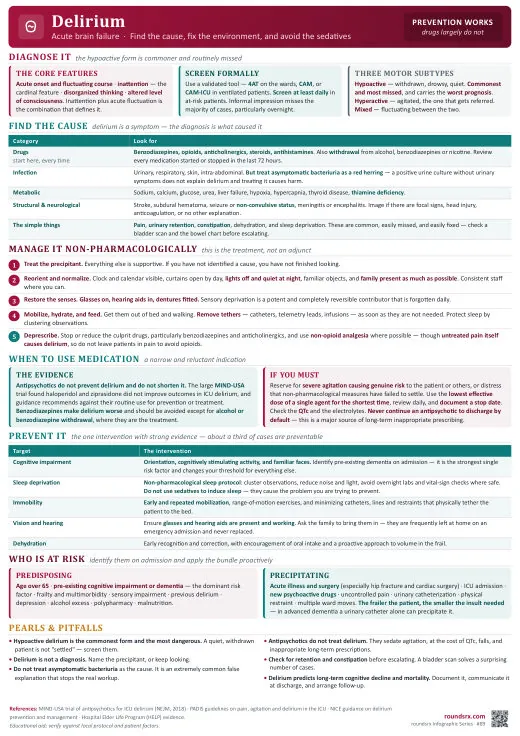
Text version
🧪 Workup: AEIOU TIPS, focused labs + imaging → see Workup tab
⚡ Treat: Non-pharm first (HELP protocol), find and fix the trigger → see Management tab
⚠️ Acute agitation: 5-min mimic sweep (SpO₂, glucose, withdrawal, retention, pain) BEFORE any sedative; verbal de-escalation + 1:1 sitter; haldol 0.25–0.5 mg only if safety threatened → see Acute Agitation tab
💊 Drugs: Haldol first-line, quetiapine for Parkinson's or DLB, NO benzos except for withdrawal, seizure, catatonia, NMS, or SS → see Medications tab
📣 Present: One-liner + key points → see Rounds tab