Dementia & Cognitive Impairment
The diagnosis is clinical: cognitive decline from baseline that impairs independence, with delirium and depression excluded first. Getting the subtype right changes management immediately, because antipsychotics can be lethal in Lewy body disease and cholinesterase inhibitors are useless in frontotemporal disease. The highest-value work is rarely the drug, it is caregiver support, deprescribing, and planning while the patient can still participate.
🔍 Overview
Definitions That Decide the Plan
- Dementia (major neurocognitive disorder): acquired decline in one or more cognitive domains that impairs independence in daily activities. The functional impairment is the dividing line, not the test score.
- Mild cognitive impairment (MCI): measurable decline with independence preserved. Roughly 10-15% per year progress to dementia, but a meaningful proportion remain stable or revert, which is why MCI is monitored rather than treated as early dementia.
- Subjective cognitive decline: the patient notices, testing is normal. Worth documenting and re-checking rather than dismissing or over-investigating.
The Three Things to Exclude Before Anything Else
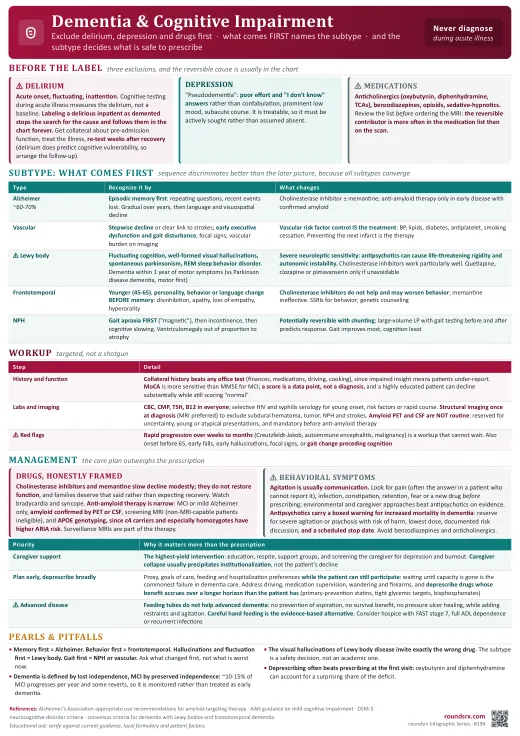
- Delirium -acute onset, fluctuating course, inattention. The single most consequential mistake on the wards is labeling a delirious inpatient as demented, which stops the search for the cause and follows the patient in the chart forever. Cognitive testing during an acute illness does not diagnose dementia.
- Depression -"pseudodementia." Poor effort and "I don't know" answers rather than confabulation, prominent low mood, and a subacute course. It is treatable, so it must be actively looked for rather than assumed absent.
- Medications -anticholinergics (oxybutynin, diphenhydramine, TCAs), benzodiazepines, opioids, sedative-hypnotics. Review the list before ordering the MRI: the reversible cause is more often in the medication list than on the scan.
Red Flags for a Non-Alzheimer Cause
- Rapid progression over weeks to months -think Creutzfeldt-Jakob, autoimmune encephalitis, malignancy, or a toxic-metabolic cause. This is a workup that cannot wait.
- Onset before 65 -raises frontotemporal dementia, genetic causes, HIV, syphilis, alcohol-related brain injury.
- Early falls or parkinsonism, early hallucinations, early incontinence, or focal neurologic signs -each points away from typical Alzheimer disease and toward a specific alternative.
- Gait disturbance preceding cognitive change -normal pressure hydrocephalus or vascular disease, both of which change management.
🧪 Workup
History and Cognitive Testing
- Get a collateral history -patients with impaired insight under-report, and the informant's account of function (finances, medications, driving, cooking) is more diagnostic than any office test.
- MoCA is more sensitive for MCI and executive dysfunction than the MMSE; Mini-Cog is a fast screen when time is short. Adjust for education, and remember a score is a data point, not a diagnosis -a highly educated patient can decline substantially while still scoring "normal."
- Screen function directly: instrumental ADLs first (finances, medications, transport, shopping) since they fail before basic ADLs.
- Ask about safety now: driving, firearms, wandering, cooking, and whether medications are being taken correctly.
Laboratory (targeted, not a shotgun)
- Every patient: CBC, CMP, TSH, B12. These are the cheap, treatable, guideline-endorsed ones -hypothyroidism and B12 deficiency are the classic reversible contributors.
- Selective: HIV and syphilis serology (young onset, risk factors, or rapid course), folate, calcium, ammonia if hepatic disease, drug and alcohol history, sleep apnea screening (frequently missed and genuinely treatable).
- The honest caveat: fully reversible dementia is uncommon, but the treatable contributors are common enough and cheap enough to look for that skipping them is indefensible.
Imaging and Biomarkers
- Structural imaging (MRI preferred, CT acceptable) once at diagnosis -to exclude the surgical and vascular things: subdural hematoma, tumor, normal pressure hydrocephalus, strokes, and to assess hippocampal and lobar atrophy patterns.
- Amyloid PET or CSF biomarkers (p-tau, Aβ42, or the p-tau/Aβ42 ratio) -not routine. Reserved for diagnostic uncertainty, young onset, atypical presentations, and mandatory before anti-amyloid therapy, because that treatment requires proven amyloid pathology.
- Blood-based biomarkers are emerging and increasingly used as a triage step, but confirmatory testing and specialist input still govern treatment decisions.
- FDG-PET or DaTscan in selected cases to separate frontotemporal from Alzheimer disease, or to support Lewy body disease.
🧠 Subtypes
Getting the Subtype Right Changes Management
| Type | Recognize it by | What changes |
|---|---|---|
| Alzheimer disease ~60-70%, the default | Insidious episodic memory loss first (recent events, repeating questions), then language and visuospatial decline. Gradual over years. | Cholinesterase inhibitor ± memantine; anti-amyloid therapy only in early disease with confirmed amyloid. |
| Vascular dementia | Stepwise decline or clear temporal link to strokes, early executive dysfunction and gait disturbance, focal signs, vascular burden on imaging. | Aggressive vascular risk factor control is the treatment -BP, lipids, diabetes, antiplatelet where indicated, smoking cessation. Prevention of the next infarct is the therapy. |
| Lewy body dementia ANTIPSYCHOTIC DANGER | Fluctuating cognition, well-formed visual hallucinations, spontaneous parkinsonism, REM sleep behavior disorder. Dementia within 1 year of motor symptoms (vs Parkinson disease dementia, where motor precedes by years). | Severe neuroleptic sensitivity: antipsychotics can cause life-threatening rigidity and autonomic instability. Cholinesterase inhibitors work particularly well here. Quetiapine or clozapine only if unavoidable; pimavanserin is an option. |
| Frontotemporal dementia | Younger onset (45-65), personality and behavior change or language decline BEFORE memory: disinhibition, apathy, loss of empathy, compulsions, hyperorality. | Cholinesterase inhibitors do not help and may worsen behavior; memantine is not effective. SSRIs for behavioral symptoms. Genetic counseling, since a substantial minority is familial. |
| Normal pressure hydrocephalus | Gait apraxia first ("magnetic" gait), then urinary incontinence, then cognitive slowing -the gait leads. Ventriculomegaly out of proportion to atrophy. | Potentially reversible with shunting; large-volume LP with gait testing before and after predicts response. The gait improves most, cognition least. |
The mnemonic that actually helps: memory first = Alzheimer; behavior/personality first = frontotemporal; hallucinations and fluctuation first = Lewy body; gait first = NPH or vascular. What comes first is more discriminating than what is present later, because all of them eventually look similar.
🚨 Management
Symptomatic Drugs (modest, and honest about it)
- Cholinesterase inhibitors (donepezil, rivastigmine, galantamine) -for Alzheimer, Lewy body, and Parkinson disease dementia. Benefit is modest and symptomatic, not disease-modifying: expect stabilization or slower decline, not improvement, and say so to families rather than letting them expect recovery. Cholinergic side effects (nausea, diarrhea, bradycardia, vivid dreams, syncope) are the usual reason for stopping; ask about falls and check the pulse.
- Memantine (NMDA antagonist) -moderate to severe Alzheimer disease, alone or added to a cholinesterase inhibitor. Better tolerated; renally dosed.
- Do not use cholinesterase inhibitors in frontotemporal dementia -no benefit and they can worsen behavioral symptoms.
- Deprescribe when the burden exceeds the benefit -in advanced disease, with poor tolerance, or when goals shift to comfort. Continuing a drug because it was started is not a reason.
Anti-Amyloid Therapy (narrow eligibility, real monitoring burden)
- Who qualifies: MCI or mild dementia due to Alzheimer disease only, with amyloid confirmed by PET or CSF -these agents are not for moderate or severe disease and not for dementia of unproven cause.
- Baseline requirements: a screening MRI (patients who cannot have MRI are not eligible), and APOE genotyping, because APOE ε4 carriers, especially homozygotes, carry substantially higher ARIA risk and that changes the consent conversation.
- ARIA (amyloid-related imaging abnormalities) -edema (ARIA-E) and microhemorrhage/siderosis (ARIA-H) are the defining toxicity, usually asymptomatic but occasionally serious. Surveillance MRI before specified infusions (for lecanemab, before the 5th, 7th, and 14th) is part of the therapy, not optional.
- Anticoagulation is a serious caution given the hemorrhage risk, and requires specialist judgment.
- Set expectations honestly: the benefit is a slowing of decline, not reversal or cure, and it is statistically real but clinically modest -in CLARITY-AD, 2023 lecanemab slowed decline by 27%, which is roughly half a point on an 18-point scale, while TRAILBLAZER-ALZ 2, 2023 reported ARIA-E in roughly a quarter of donanemab-treated patients. It comes with infusion visits, repeated MRIs, and real risk. Patients and families deserve that framing before starting.
Behavioral Symptoms: Non-Drug First, Always
- Look for the trigger before reaching for a drug: pain (very often the answer in a patient who cannot report it), infection, constipation, urinary retention, hunger, fear, overstimulation, a new medication. Agitation is usually communication.
- Environmental and caregiver approaches first: routine, orientation cues, simplified tasks, adequate lighting, music, and caregiver training in redirection rather than confrontation. These have better evidence than antipsychotics for most symptoms.
- ⚠ Antipsychotics carry a boxed warning for increased mortality in elderly patients with dementia. Reserve them for severe agitation or psychosis with risk of harm, after non-drug measures fail. Use the lowest dose for the shortest time, document the indication and the discussion of risk, and schedule a stop date.
- In Lewy body dementia, antipsychotics can be life-threatening -treat this as a hard contraindication unless a specialist directs otherwise.
- Avoid benzodiazepines (falls, worse confusion, paradoxical agitation) and anticholinergics of every kind.
The Care Plan That Matters More Than the Prescription
- Caregiver support is the highest-yield intervention -education, respite, support groups, and screening the caregiver for depression and burnout. Caregiver collapse is what most often precipitates institutionalization, not the patient's decline.
- Advance care planning early, while the patient can participate: health care proxy, goals of care, feeding and hospitalization preferences. Waiting until capacity is gone is the commonest failure in dementia care.
- Safety: driving assessment (and reporting where required), medication supervision, home hazards, wandering precautions, firearm access.
- Deprescribe broadly: anticholinergics, sedatives, and drugs whose benefit accrues over a longer horizon than the patient has -statins for primary prevention, tight glycemic targets, and bisphosphonates all deserve reconsideration.
- Feeding tubes do not help advanced dementia -they do not prevent aspiration, improve survival, or heal pressure ulcers. Careful hand feeding is the evidence-based alternative, and families need that said clearly and kindly.
- Hospice for advanced disease: consider with FAST stage 7, dependence in all ADLs, recurrent infections, or poor nutritional status.
🏥 Rounds
Pimp Questions
❓ Why is giving haloperidol to a patient with Lewy body dementia potentially fatal?
Severe neuroleptic sensitivity. These patients already have degeneration of nigrostriatal dopaminergic neurons, so D2 blockade can precipitate life-threatening rigidity, autonomic instability, and an NMS-like syndrome, with reactions in a substantial minority of exposures. The clinical trap is that visual hallucinations are a core feature of the disease, so the presentation invites exactly the wrong drug. If an antipsychotic is unavoidable, use quetiapine or clozapine (least D2 blockade), or pimavanserin.
❓ An 82-year-old admitted with pneumonia is confused and scores 18 on the MoCA. Can you diagnose dementia?
No. Acute illness plus confusion is delirium until proven otherwise, and cognitive testing during delirium measures the delirium, not a baseline. Diagnosing dementia here stops the hunt for the cause and follows the patient in the chart permanently. Get a collateral history about pre-admission function, treat the acute illness, and re-test after recovery (weeks, not days). Delirium does predict underlying cognitive vulnerability, so arrange follow-up testing rather than dropping it.
❓ What distinguishes Lewy body dementia from Parkinson disease dementia?
Timing, by the one-year rule. If dementia begins within 1 year of parkinsonism (or precedes it), it is dementia with Lewy bodies; if motor symptoms precede cognitive decline by more than a year, it is Parkinson disease dementia. The underlying synuclein pathology is the same and management largely overlaps (cholinesterase inhibitors help both, antipsychotics endanger both), which is why the distinction is more useful for prognosis and classification than for treatment.
❓ A family asks about a feeding tube for their mother with advanced dementia who is no longer eating. What is the evidence-based answer?
Feeding tubes do not help in advanced dementia: they do not prevent aspiration (they may increase it via reflux), do not improve survival, do not heal or prevent pressure ulcers, and do not improve comfort -while adding restraint use, agitation, and tube complications. Careful hand feeding is the recommended alternative, and stopping eating is often part of the dying process rather than a problem to solve. Frame it as continuing to feed the person by hand for as long as they will accept it, rather than as withdrawing care.
❓ Which dementia subtype should NOT get a cholinesterase inhibitor, and why?
Frontotemporal dementia. The cholinergic deficit that these drugs address is characteristic of Alzheimer and Lewy body disease, but is not the primary pathology in FTD, so there is no benefit and behavioral symptoms including disinhibition can worsen. Memantine is likewise ineffective. Management is SSRIs for behavioral symptoms, non-drug behavioral strategies, caregiver support, and genetic counseling given the familial proportion.
Sample Presentation
Mrs. Halvorsen is a 76-year-old woman brought by her daughter for 18 months of progressive forgetfulness: repeating questions, missed bill payments, and one episode of getting lost driving a familiar route. Collateral confirms she has stopped cooking. No hallucinations, no falls, no stepwise change. MoCA 19/30 with poor delayed recall. She takes oxybutynin for urge incontinence and diphenhydramine most nights for sleep. TSH, B12, CBC and CMP normal. MRI shows hippocampal atrophy without significant vascular burden or hydrocephalus.
Key Points: (1) Memory-first, gradual, with hippocampal atrophy and no red flags fits Alzheimer disease -but the first prescription here is a deprescription: oxybutynin and diphenhydramine are both potent anticholinergics and are actively worsening her cognition. Remove them and reassess before attributing everything to the disease. (2) Screen for depression, and consider a cholinesterase inhibitor with an honest conversation that it slows decline rather than restoring function. (3) Because she is early and functional, this is the moment for advance care planning, a proxy, driving assessment, and caregiver support -while she can still participate. If the family asks about anti-amyloid therapy, eligibility requires confirmed amyloid on PET or CSF, an MRI-capable patient, and APOE testing, with ARIA surveillance built in.
Clinic Checklist
- Delirium and depression excluded before the label is applied; collateral history obtained.
- Medication list scrubbed of anticholinergics, benzodiazepines and sedatives -the reversible cause is more often here than on the scan.
- CBC, CMP, TSH, B12 done; structural imaging once at diagnosis.
- Subtype considered explicitly (what came first: memory, behavior, hallucinations, or gait) because it changes which drugs are safe.
- Safety addressed: driving, firearms, wandering, medication supervision, home hazards.
- Advance care planning started while capacity remains, with a documented proxy.
- Caregiver asked about directly -burden, mood, respite, support group referral.
- Antipsychotic, if any, has an indication, a documented risk discussion, and a stop date.
📋 Summary
Summary
Function Defines It, Not the Score
Dementia is cognitive decline that impairs independence; MCI is decline with independence preserved. A MoCA is a data point, and a highly educated patient can decline substantially while still scoring "normal." The collateral history about finances, medications, driving and cooking is more diagnostic than any office test.
Exclude Three Things First
Delirium, depression, and medications. Labeling a delirious inpatient as demented stops the search for the cause and follows them forever, so never diagnose dementia during acute illness -re-test after recovery. Depression is treatable and must be sought. Anticholinergics, benzodiazepines and sedatives are the commonest reversible contributor, and they are in the chart, not on the scan.
What Comes First Names the Subtype
Memory first = Alzheimer. Behavior or personality first = frontotemporal. Hallucinations and fluctuation first = Lewy body. Gait first = NPH or vascular. Sequence discriminates better than the later picture, because all subtypes converge as they advance. Stepwise decline with focal signs points to vascular disease, where risk factor control is the treatment.
The Subtype Changes What Is Safe
Antipsychotics can be life-threatening in Lewy body dementia (severe neuroleptic sensitivity causing rigidity and autonomic instability), and the visual hallucinations that are a core feature invite exactly the wrong drug. Cholinesterase inhibitors do not help frontotemporal dementia and can worsen behavior. Getting the subtype right is a safety decision, not an academic one.
Workup Is Targeted, Not a Shotgun
CBC, CMP, TSH and B12 in everyone; structural imaging once to exclude subdural, tumor, NPH and strokes. Amyloid PET and CSF biomarkers are not routine -reserved for uncertainty, young onset, atypical presentations, and mandatory before anti-amyloid therapy. Fully reversible dementia is uncommon, but the treatable contributors are cheap enough that skipping them is indefensible.
Symptomatic Drugs, Honestly Framed
Cholinesterase inhibitors and memantine slow decline modestly; they do not restore function, and families deserve that framing rather than expecting recovery. Watch bradycardia, syncope and GI effects. Deprescribe when burden exceeds benefit -in advanced disease or shifting goals, "it was already started" is not an indication.
Anti-Amyloid Therapy Is Narrow and Demanding
Only MCI or mild Alzheimer dementia with amyloid confirmed by PET or CSF, plus a screening MRI (non-MRI-capable patients are ineligible) and APOE genotyping, because ε4 carriers and especially homozygotes have substantially higher ARIA risk. Surveillance MRIs are part of the therapy. The benefit is slowed decline, not reversal, and anticoagulation is a serious caution.
The Care Plan Outweighs the Prescription
Agitation is usually communication -look for pain, infection, constipation, retention or fear before prescribing, since antipsychotics carry a boxed mortality warning and need an indication, a risk discussion and a stop date. Caregiver support is the highest-yield intervention, caregiver collapse being what usually precipitates institutionalization. Plan advance care while the patient can still participate, and know that feeding tubes do not help advanced dementia while careful hand feeding does.