Deprescribing & Polypharmacy
- Deprescribing is the planned, supervised reduction or withdrawal of a medication that is no longer benefiting the patient or may be causing harm. It is an active intervention with its own indications, technique and follow-up, not a failure to prescribe.
- Polypharmacy is usually defined around five or more regular medications, but the number is a risk marker rather than a diagnosis. A patient on eight appropriate drugs for eight genuine indications is better served than one on three, of which two are harming them. Count the drugs to prompt the review, then judge each one individually.
- The harms scale with the count: adverse drug events, interactions, falls, delirium, hospitalization, and the practical burden of cost and adherence.
- Under-prescribing is equally common and equally harmful. This is why the standard tool comes in two halves: STOPP flags potentially inappropriate medications, and START flags indicated treatments that have been omitted.
- Common omissions in exactly these patients: anticoagulation in atrial fibrillation withheld over fall risk that is usually overstated, statins where genuinely indicated, osteoporosis treatment after a fragility fracture, and ACE inhibitors or ARBs in proteinuric kidney disease.
- A good medication review changes the list in both directions, and a review that only ever subtracts is as incomplete as one that only adds.
- The AGS Beers Criteria (2023 update) list medications potentially inappropriate in older adults: over three dozen drugs or classes to avoid in most older people, plus more than forty to use with caution or avoid in specific conditions. They are a prompt for thought, not a prohibition -a Beers-listed drug can still be the right answer with an explicit rationale.
- STOPP/START (version 3, 2023) is the complementary European tool, organized by system, and is particularly useful precisely because it forces the under-prescribing question alongside the over-prescribing one.
- Anticholinergic burden is cumulative and is the single most under-recognized target. No individual drug looks dramatic, but a bladder antimuscarinic plus an antihistamine plus a tricyclic plus a sedating antiemetic together produce confusion, falls, constipation, urinary retention, dry mouth and blurred vision. Total the burden across the whole list rather than judging each drug alone.
| Class | Why it is a target, and the catch |
|---|---|
| ⚠ Benzodiazepines and Z-drugs | Falls, fractures, cognitive impairment, dependence, and a dangerous interaction with opioids. Often started for a transient problem years ago and never reviewed. Must be tapered, never stopped abruptly. See Chronic Insomnia for the CBT-I alternative that makes stopping realistic. |
| ⚠ Anticholinergics | First-generation antihistamines, bladder antimuscarinics, tricyclics, some antiemetics and muscle relaxants. Frequently over the counter, so patients do not report them as medications -ask specifically. |
| ⚠ Antipsychotics for behavioral symptoms of dementia | Carry a boxed warning for increased mortality in older adults with dementia-related psychosis. Reserve for genuine danger after non-drug approaches, use the lowest dose, and set a review date at the time of prescribing, because these are the drugs most likely to be continued indefinitely by default. |
| Proton pump inhibitors | Often started for a defined indication such as stress ulcer prophylaxis or a short course, then continued for years without one. Review whether the original indication still applies. |
| NSAIDs | Gastrointestinal bleeding, kidney injury, heart failure decompensation and hypertension. Particularly hazardous with concurrent anticoagulation, renal impairment or RAAS blockade. |
| Sulfonylureas and tight glycemic targets | Hypoglycemia causes falls, confusion and admissions, and the benefit of tight control takes years. Relax the target and simplify the regimen in frailty or limited life expectancy -an A1c that would be inadequate at 55 may be entirely appropriate at 88. |
| Antihypertensives | Not to be reflexively stopped, but reassess targets with frailty, orthostatic hypotension or falls, and check lying and standing blood pressure rather than assuming the seated reading tells the story. |
| Opioids and gabapentinoids | Sedation, falls, cognitive effects and dependence, with the risk compounding when combined. Both require tapering. |
- Hospital admission is the single best moment -the full list is in front of you, the patient is being reviewed anyway, and an adverse drug effect may be the reason they are there.
- ⚠ But hospital is also where lists grow. Drugs started for a transient inpatient problem -a proton pump inhibitor, an antipsychotic for one night of delirium, a laxative, a hypnotic- are frequently carried onto the discharge summary and then continued for years. Anything started in hospital needs an explicit stop date or a stated plan in the discharge letter.
- Other natural triggers: a fall, new confusion, a transition of care, a new diagnosis of limited life expectancy, or the patient simply saying they take too many tablets.
- Get a genuinely accurate list first, including over-the-counter products, supplements, topicals, inhalers and eye drops. Ask patients to bring everything in, because the reconciled list and the drugs actually being taken are frequently different documents.
- For each drug ask four questions: what is it for, is that indication still valid, is it working, and do the harms now outweigh the benefit at this stage of life.
- Prioritize. Start with the drug causing active harm, or the one the patient most wants to stop, and change one thing at a time so that any consequence is attributable.
- Agree the plan with the patient, including what to watch for and when you will review it.
- Frame it as active care, not withdrawal of care. "This medication was right when it was started, and I think it may now be doing more harm than good" lands very differently from "you don't need this."
- Name the specific harm you are trying to prevent -the fall, the confusion, the bleed. A general worry about too many tablets is unpersuasive; a concrete risk is not.
- Offer a trial rather than a verdict. "Let us stop it for a month and see how you feel, and we can restart it if you are worse" preserves the patient's control and is usually accepted where a permanent stop is refused.
- Say explicitly that you are not giving up on them. Patients and families frequently hear deprescribing that way, particularly when it follows a conversation about prognosis.
- Follow up and document the reasoning, or the next clinician will simply restart the drug. Record why it was stopped, not merely that it was.
"Mr. B is an 84-year-old man admitted after a fall, on eleven regular medications. Reviewing the list, I think the fall is at least partly iatrogenic. He is on zopiclone started during an admission three years ago for transient insomnia and never reviewed, plus oxybutynin, plus an antihistamine he buys himself and did not initially mention because he does not consider it a medication -so his cumulative anticholinergic burden is substantial, and that combination plausibly explains both the fall and his mild confusion. I also noticed he takes amlodipine and furosemide, and there is no documented heart failure; his ankle edema appeared after the amlodipine was started, so I think this is a prescribing cascade and the diuretic is treating a drug side effect rather than a disease. His lying and standing blood pressures show a 22 mmHg drop. His A1c is 6.4% on glipizide, which at his age and frailty is tighter than it needs to be and carries real hypoglycemia risk. My plan is to change one thing at a time: taper the zopiclone with a warning about rebound, stop the oxybutynin and the antihistamine, reduce the amlodipine and reassess whether furosemide is needed at all, and simplify his diabetes regimen. On the START side he is not on anything for bone protection despite a fragility fracture, so that needs adding. I will document why each was stopped, or the next clinician will restart them."
- Is an adverse drug effect the reason for this admission? Ask it explicitly on every older patient.
- Complete list obtained including over-the-counter products, supplements and topicals.
- Anticholinergic burden totaled across the list, not judged drug by drug.
- Any new symptom checked against the drug list before a new drug is added.
- Lying and standing blood pressure measured in anyone on antihypertensives who has fallen.
- ⚠ Everything started this admission has a stop date or an explicit plan in the discharge summary.
- Reasons documented for each drug stopped, and follow-up arranged to review the effect.
| Point | Detail |
|---|---|
| Framing | Deprescribing is a planned, supervised intervention with its own technique and follow-up -not a failure to prescribe. Polypharmacy (commonly ≥ 5 drugs) is a risk marker, not a diagnosis: count to prompt the review, then judge each drug individually. |
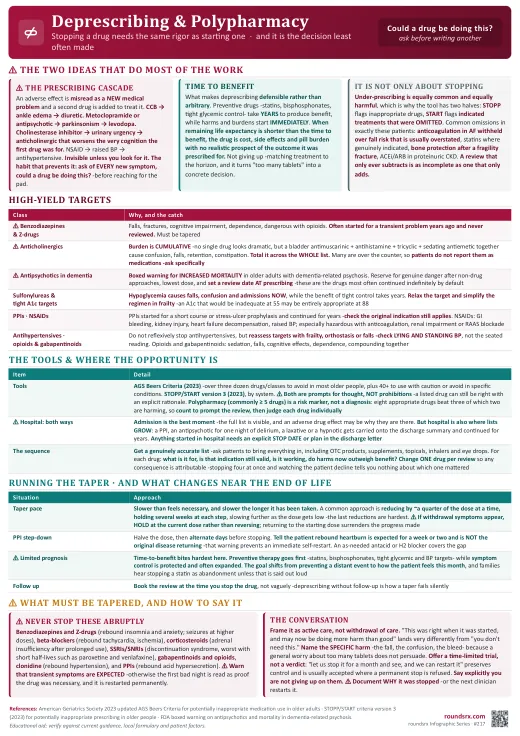
| ⚠ Prescribing cascade | An adverse effect misread as a new disease and treated with another drug. CCB → edema → diuretic. Metoclopramide or antipsychotic → parkinsonism → levodopa. Cholinesterase inhibitor → urgency → anticholinergic that worsens cognition. The habit that prevents it: ask of every new symptom, could a drug be doing this? |
| ⚠ Time to benefit | Preventive drugs (statins, bisphosphonates, tight glycemic control) take years to help while harms start immediately. If life expectancy is shorter than time to benefit, the drug is burden without prospect of gain. This makes the conversation concrete rather than vague. |
| Both directions | STOPP flags inappropriate drugs; START flags omitted indicated ones. Common omissions: anticoagulation in AF withheld over overstated fall risk, statins, bone protection after fragility fracture, ACEi/ARB in proteinuric CKD. |
| Tools | AGS Beers Criteria (2023) and STOPP/START v3 (2023). Prompts for thought, not prohibitions -a listed drug can still be right with an explicit rationale. |
| ⚠ Anticholinergic burden | Cumulative -no single drug looks dramatic, but several together cause confusion, falls, retention, constipation. Total it across the whole list, and ask about over-the-counter antihistamines, which patients do not report as medications. |
| High-yield targets | Benzodiazepines and Z-drugs, anticholinergics, antipsychotics in dementia (boxed warning for increased mortality), long-term PPIs, NSAIDs, sulfonylureas and tight A1c targets in frailty, opioids and gabapentinoids. |
| ⚠ Must be tapered | Benzodiazepines and Z-drugs, beta-blockers, corticosteroids, SSRIs and SNRIs, gabapentinoids and opioids, clonidine, and PPIs (rebound acid). Warn that transient symptoms are expected, or the first bad night restarts the drug permanently. |
| The opportunity | Admission (the list is visible and a drug may be why they are there) and discharge. ⚠ Anything started in hospital needs a stop date in the discharge letter, or it continues for years. |
| How to say it | "This was right when it was started, and may now be doing more harm than good" beats "you don't need this." Name the specific harm, offer a time-limited trial with the option to restart, and document WHY -or the next clinician restarts it. |
- Ask of every new symptom whether a drug is causing it, before writing another prescription. That single habit prevents most cascades.
- Match the drug to the horizon. Time to benefit is what turns "too many tablets" into a defensible decision.
- Taper what needs tapering, and say the rebound is coming. Otherwise the withdrawal effect gets read as proof the drug was needed.